 2016, Vol.27


Polydopamine (PDA) is a nature-inspired polymer and can be in situ formed on almost any type of substrate surfaces by using a dopamine solution in Tris buffer at pH 8.5 via polymerization [1, 2, 3]. PDA coating has attracted growing attention over the past decade due to its fascinating features such as strikingly high adhesion strength on substrate surface and its ability to further adhere or bind othermaterials of interest onto its surface [4]. Recently,PDA coating has also found its use in the surface pretreatment of a fused-silica capillary column in capillary electrophoresis (CE) [5, 6]. It may also have potential in capillary gas chromatography (GC). However,as a result of a recent survey,no related publications are available up to now. PDA coating basically consists of dihydroxyindole and indoledione units [3] and may exhibit a stronger binding ability to a GC stationary phase with H-bonding and dipole-dipole nature. From this perspective,cucurbit[n]urils (CBs) [7] can be an ideal choice for the integration with PDA coating.
This work reports the column fabrication of CB7 stationary phase on PDA precoating (denoted as PDA-CB7 column) and its GC separation performance. CB7 is of symmetric and rigid structure with a hydrophobic cavity and two identical polar portals lacedwith multiple carbonyl groups and shows good separation performance as GC stationary phase [8]. Meanwhile,one CB7 capillary column prepared with a conventional coating method without PDA coating (denoted as CB7 column) and one commercial column (DB-35MS) were also used for comparison. Interestingly,we found that integration of PDA coating with CB stationary phase did make a difference from the conventional coating method and the presence of PDA coating also partially contributed to GC separations.
2. Experimental 2.1. Chemicals and instrumentsAll the analytes were of analytical grade. CB7 was synthesized following the method we previously reported [8]. Untreated fusedsilica capillary tubing (0.25 mm i.d.) was purchased from Yongnian Ruifeng Chromatogram Apparatus Company (Hebei,China). All gas chromatographic separations were performed on an Agilent GC 7890A gas chromatograph with a flame ionization detector (FID) under the followingGCconditions: nitrogen of highpurity (99.999%) as carrier gas at a flowrate of 1 mL/min,injection port at 250 ℃ and FID at 300 ℃. Temperature programs for the separations of different samples are individually provided in their figure captions.
2.2. Capillary column fabricationPDA-CB7 column was fabricated as follows. A capillary column (10 m × 0.25 mm,i.d.) was filled with a dopamine solution (1.2 μg/mL dopamine in 10 μmol/L Tris-HCl buffer,pH 8.5) and stayed for 24 h at room temperature. After this,the solution in the capillary was flushed out and washed with water for 5 min and dried under nitrogen. The obtained PDA coating showed orderly crumpled morphology (Fig. S1 in Supporting information). Then,the column with PDA was further statically coated with the suspension of CB7 stationary phase in dichloromethane (0.25%,w/v) at room temperature. Briefly,after the column was filled with the suspension,one end of the capillary was sealed and the other was connected to a vacuum system to gradually remove the solvent. The coated capillary columns were then conditioned from 40 to 180 ℃ at the rate of 1 ℃/min and held at the high-end temperature for 7 h under a constant flow of nitrogen at 1 mL/min. CB7 column without PDA was prepared by the method described in the reference [8].
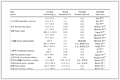
3. Results and discussion 3.1. McReynolds constants and column efficiencyColumn efficiency of PDA-CB7 column was determined by isothermal determination of n-dodecane at 120 ℃ and evaluated by the theoretical plate number per meter. As a result,PDA-CB7 column exhibited a column efficiency of 2823 plates/m. McReynolds constants were determined at 120 ℃ by using five probe compounds,namely benzene (X'),1-butanol (Y'),2-pentanone (Z'),1-nitropropane (U') and pyridine (S'). Table 1 lists the obtained McReynolds constants for PDA-CB7 column as well as CB7 column. As shown,PDA-CB7 column showed average polarity of 122,slightly higher than that of CB7 column,suggesting their weakly polar nature. Relatively,PDA-CB7 column had higher Y',U' and S' values than CB7 column,suggesting its slightly stronger H-bonding and dipole-dipole interactions with H-bonding analytes than CB7 column possibly due to the presence of PDA coating.
|
Table 1 McReynolds constants of PDA-CB7,CB7 and DB-35MS capillary columns. |

Separation performance of PDA-CB7 column was investigated by separations of analytes of different variety,including n-alkanes,halogenated benzenes and the Grob test mixture. Fig. 1 shows the separations of n-alkanes (a) and halogenated benzenes (b) on PDACB7 column,showing its good separation performance for common analytes. To examine its performance for critical analytes,the Grob mixture,the most challenging mixture in GC,was separated,while a CB7 column without PDA and a commercial DB-35MS column were used for comparison (Fig. 2).

|
Download:
|
| Fig. 1.Separations of n-alkanes (a) and halogenated benzenes (b) on PDA-CB7 column. Peaks for (a): (1) nonane,(2) decane,(3) undecane,(4) dodecane,. (5) tridecane,(6) tetradecane,(7) pentadecane,(8) hexadecane; for (b): (1) chlorobenzene,(2) bromobenzene,(3) 1,4-dichlorobenzene,(4) 1,2-dichlorobenzene,(5)1,2,4-trichlorobenzene. Temperature programs: (a) 40 ℃ (1 min) to 130 ℃ at 10 ℃/min and (b) 40 ℃ (1 min) to 90 ℃ at 10 ℃/min. | |


|
Download:
|
| Fig. 2.Separations of the Grob mixture on PDA-CB7,CB7 and DB-35MS capillary columns. Peaks: (1) 2,3-butanediol,(2) n-decane,(3) n-undecane,(4) nonanal,(5) 1-octano | |

As evidenced in Fig. 2,PDA-CB7 and CB7 columns shared the same elution order for the analytes but differed from the commercial column for some of them. Noticeably,PDA-CB7 column exhibited good resolution for most of them,especially for the peak pairs of n-undecane/1-nonanal/1-octanol (peaks 3/4/ 5,a3/4 = 1.03,a4/5 = 1.06) and dicyclohexylamine/methyl undecanoate (peaks 10/11,a9/10 = 1.01),which completely coeluted on CB7 column. This finding suggested the partial contribution of PDA coating to the separation. The analytes of n-undecane,1-nonanal and 1-octanol share a quite close boiling point but have different polarity. PDA-CB7 column exhibited higher selectivity for these analytes probably due to its additional interactions with these analytes via H-bonding and dipole-dipole interactions. These additional interactions may be minor but did make a difference when working together with CB7 stationary phase in achieving improved separations of the indicated analytes. In contrast to the commercial column,PDA-CB7 column switched the elution order of two peak pairs,namely 1-nonanal/1-octanol (peaks 4/5) and 2,6- dimethylaniline/2-ethylhexanoic acid (peaks 7/8). The later elution of 1-octanol and 2-ethylhexanoic acid on PDA-CB7 column indicated their stronger H-bonding and dipole-dipole interactions with PDA-CB7 coating,which may also lead to their tailing peaks. Additionally,PDA-CB7 column showed wider peaks due to its lower column efficiency which might be attributed to the adsorption nature of PDA-CB7 column for the separations. The above findings demonstrate that PDA precoating is feasible in GC column fabrication and also helpful for improving the resolving ability of the as-fabricated column for critical analytes such as aldehydes and amines.
3.3. Separation repeatability and thermal stabilityFurthermore,separation repeatability of PDA-CB7 column was also examined by separation of a mixture of 11 analytes and evaluated by relative standard deviations (RSD %) in retention times of the analytes. The obtained RSD values are listed in Table S1,showing 0.01-0.05% for intra-day (n = 6),0.06-0.69% for inter-day (n = 6) and 2.7-6.4% for between-column(n = 3),respectively. These results demonstrated the good repeatability of PDA-CB7 column for GC separations. In addition,the columnalso exhibited good thermal stability up to 270 ℃.
4. ConclusionThis work introduced PDA coating into GC column fabrication and presented the first example of employing PDA coating as an efficient GC column pretreatmentmethod. This work demonstrates that PDA coating not only served for the pretreatment but alsomade a partial contribution to GC separations. Integration of PDA coating with CB7 achieved enhanced resolving ability in contrast to neat CB7 column,suggesting the possible synergic interactions PDA coating with CB7 stationary phase. This work shows that PDA coating for GC column pretreatment is facile and efficient and has advantages over the conventional method in separation performance.
AcknowledgmentsThis work was supported by the National Natural Science Foundation of China (No. 21075010) and the 111 Project B07012 in China.
Appendix A. Supplementary dataSupplementary data associated with this article can be found,in the online version,at http://dx.doi.org/10.1016/j.cclet.2015.05.054.
| [1] | M.J. Sever, J.T. Weisser, J. Monahan, S. Srinivasan, J.J. Wilker, Metal-mediated crosslinking in the generation of a marine-mussel adhesive, Angew. Chem. Int. Ed. 43(2004) 447-450. |
| [2] | H. Lee, S.M. Dellatore, W.M. Miller, P.B. Messersmith, Mussel-inspired surface chemistry for multifunctional coatings, Science 318(2007) 426-430. |
| [3] | J. Liebscher, R. Mrówczyński, H.A. Scheidt, et al., Structure of polydopamine:a never-ending story? Langmuir 29(2013) 10539-10548. |
| [4] | S.M. Kang, N.S. Hwang, J. Yeom, S.Y. Park, P.B. Messersmith, I.S. Choi, R. Langer, D.G. Anderson, H. Lee, One-step multipurpose surface functionalization by adhesive catecholamine, Adv. Funct. Mater. 22(2012) 2949-2955. |
| [5] | X.B. Yin, D.Y. Liu, Polydopamine-based permanent coating capillary electrochromatography for auxin determination, J. Chromatogr. A 1212(2008) 130-136. |
| [6] | R.J. Zeng, Z.F. Luo, D. Zhou, F.H. Cao, Y.M. Wang, A novel PEG coating immobilized onto capillary through polydopamine coating for separation of proteins in CE, Electrophoresis 31(2010) 3334-3341. |
| [7] | J. Lagona, P. Mukhopadhyay, S. Chakrabarti, L. Isaacs, The cucurbit[n]uril family, Angew. Chem. Int. Ed. 44(2005) 4844-4870. |
| [8] | P. Zhang, S.J. Qin, M.L. Qi, R.N. Fu, Cucurbit[n]urils as a new class of stationary phases for gas chromatographic separations, J. Chromatogr. A 1334(2014) 139-148. |