 2015, Vol.26


Ionic liquids (ILs),resulting from the combination of organic cations and inorganic or organic anions,can be defined as organic salts that are liquid at or near room temperature. In order to meet the specific needs,the structure and types of ILs cations or anions should be modified. They possess noN-volatile,extended liquidstate temperature range,strong dissolving ability and easily tunable properties. These unique physicochemical properties contributed to the creation of new applications [1, 2]. With the expansion of the application scope of ILs,the method of detection and separation of ILs become very important [3]. Currently,the methods for the determination of ionic liquid cations mainly included reversed phase liquid chromatography (RPLC) [4],ionpair chromatography (IPC) [5, 6],ion chromatography (IC) [7] and hydrophilic interaction chromatography (HILIC) [8, 9],etc. HILIC [10] is one of emerging areas in chromatography research in recent years. It is a chromatographic technique used to improve the poor retention behaviors of polar substances in RPLC. The determination of pyrrolidinium ionic liquid cations has been scarcely reported,and some experiments have been conducted using RPLC and IC [11, 12]. The RPLC method was not recommended for analysis of pyrrolidinium cations whose alkyl side chains was shorter than 4 carbon atoms,since its retention and selectivity were poor,thus adding ion pair reagent was needed. IC with a conductivity detector used the specialized ion chromatography instruments. As a general application in laboratory,UV detector has been widely paired with liquid chromatography to detect compounds with UV group absorbance. For compounds with no UV absorbance groups,indirect ultraviolet (IUV) detection has been a suitable method [13]. The method was achieved by adding materials having UV absorption groups as background reagents to the mobile phase. Recently,research and applications of the HILIC-UV detection have been reported [8, 9],but the research and applications of the relevant HILIC-IUV detection have not been reported.
The goal of this work was to develop a method to analyze pyrrolidinium ionic liquid cations that have side chains with carbon atoms fewer than 4 by HILIC with IUV detection. Results showed that the retention of strongly polar substances was improved compared to the RPLC method. The separation and IUVdetection of pyrrolidinium cations were achieved on a hydrophilic column using imidazolium ILs and organic solvents as the mobile phase,and the method was simple and practical.
2. ExperimentalThe ILs (99% purity) were N-methyl-N-ethyl pyrrolidinium bromide ([MEPy][Br]),N-methyl-N-propyl pyrrolidinium bromide ([MPPy][Br]),N-methyl-N-butyl pyrrolidinium bromide ([MBPy][Br]),1-ethyl-3-methyl imidazolium tetrafluoroborate ([EMIm][BF4]),1-propyl-3-methyl imidazolium tetrafluoroborate ([PMIm][BF4]),1-butyl-3-methyl imidazolium tetrafluoroborate ([BMIm][BF4]),1-amyl-3-methyl imidazolium tetrafluoroborate ([AMIm][BF4]),1-ethyl-3-methyl imidazolium trifluoroacetate ([EMIm][CF3COO]),1-ethyl-3-methyl imidazolium p-toluenesulfonate ([EMIm][C7H7SO3]) and 1-ethyl-3-methyl imidazolium methanesulfonate ([EMIm][CH3SO3]) purchased from Shanghai Chengjie Chemical Ltd. (Shanghai,China). 4-Aminophenol hydrochloride,sulfosalicylic acid,nicotinamide and phthalic acid (analytical grade) were supplied by J&K Chemical Ltd. (Beijing,China). Methanol and acetonitrile (HPLC grade) were obtained from Dikma Technologies (Shanghai,China). Acetic acid and sodium hydroxide (analytical grade) were obtained from Shanghai reagent factory (Shanghai,China).
Standard solutions of ionic liquid cations at a concentration of 1 g/L were prepared in acetonitrile and deionized water (50/50,v/v),and then diluted to the concentration required for the experiment. They were then filtered through a 0.22 μm membrane.
A Millipore Milli-Q water purification system (Millipore,Bedford,MA,USA) was used to purify distilled water,and the deionized water produced at 18.2 MΩ cm was prepared for eluents and sample solutions. A model PHSF-3F pH meter (Shanghai Precision and Scientific Instrument,Shanghai,China) was used for pH measurement. Before use,mobile phases were filtered through a 0.22 μm filter,and then degassed for 15 min with a Model DOAP504-BN pump (IDEX,USA). All experiments were carried out on an Agilent 1200 HPLC system (Agilent,USA),which consisted of a quaternary pump (Model Quat pump-G1311A),a detector (Model DAD-G1315D),an autosample injector (Model ALSG1329A),a column oven (Model TCC-G1316A) and a degasser system (Model Degasser-G1322A). The chromatographic system control,data acquisition and data analysis were performed using the Agilent Rev.B.04.01 workstation (Agilent,USA).
All separations were performed on a 4.6 mm i.d. × 250 mm TSK-GEL Amide-80 HR column (TOSOH,Japan). The optimal mobile phase consisted of 0.8 mmol/L 1-ethyl-3-methyl imidazolium tetrafluoroborate aqueous solution/acetonitrile (40/60,v/v). The flow rate was set at 1.0 mL/min. The column temperature was 30 ℃. The injection volume was 20 μL. IUV (210 nm) was employed.
3. Results and discussionPyrrolidinium cations have no UV absorption groups in their molecular structures,thus the addition of background UV absorbing reagents to the mobile phase is needed for the IUV detection method. The detection of pyrrolidinium cations was investigated using 4-Aminophenol hydrochloride,sulfosalicylic acid,nicotinamide and phthalic acid as background UV absorbing reagents at their respective maximum wavelength. The mobile phase used was a background UV absorbing reagent aqueous solution/acetonitrile (40/60,v/v). As a result,when sulfosalicylic acid,nicotinamide and phthalic acid were used as the mobile phase,there were no chromatographic peaks of pyrrolidinium cations appeared; when 4-Aminophenol hydrochloride was used as the mobile phase,although the peaks had appeared,the peak shape was poor and the separation of cations was not satisfactory. The imidazolium ionic liquid cations has a strong UV absorption. Using imidazolium ILs as the background UV absorbing reagents,with a 0.5 mmol/L 1-ethyl-3-methyl imidazolium tetrafluoroborate aqueous solution/acetonitrile (40/60,v/v) as the mobile phase,and under the maximum UV absorption wavelength of 210 nm,three pyrrolidinium cations were measured. From the chromatograms,it can clearly be seen that chromatographic peaks of the cations appeared. Based on this result,we used imidazolium ILs as the background UV absorbing reagent.
In order to investigate the effects of different imidazolium ILs with various alkyl groups on the determination of three pyrrolidinium cations,four imidazolium ILs [EMIm][BF4],[PMIm][BF4],[BMIm][BF4] and [AMIm][BF4] were examined as mobile phase components. The mobile phase used was imidazolium ionic liquid aqueous solution/acetonitrile (40/60,v/v). As shown in Fig. 1,in contrast to the RPLC,the HILIC had an elution order of which the less polar substances were eluted first and the more polar substances were eluted later. Alpert [10] confirmed that the reason was water in mobile phase adsorbed at the surface of the stationary phase,thus a dynamic ‘‘water-rich layer’’ is formed in which the polar substances were better retained,the retention of solutes was achieved by its partition between the water-rich layer and the organic phase. It was found that with the increase of the lengths of the alkyl substituent of imidazolium cation from ethyl to amyl led to shortened retention time of the cations. The longer alkyl chain length on the imidazole ring is,the less polar is the cation. Long alkyl chains attached on imidazolium cation weakened the polarity of the mobile phase,thus the analytes can be better retained in the stationary phase. When [BMIm][BF4] and [AMIm][BF4] were used as a mobile phase component,separately,the analytes’ retention time was longer than the cases where [PMIm][BF4] or [EMIm][BF4] were used as a mobile phase,and the response of the analytes was low. Considering the factors of retention time and peak shape,[EMIm][BF4] was selected as the mobile phase component.

|
Download:
|
| Fig. 1.Chromatograms obtained with mobile phases containing different imidazolium ILs. Chromatographic conditions: mobile phase, 0.5 mmol/L imidazolium ILs aqueous solution/acetonitrile (40/60, v/v); column, TSK-GEL Amide-80 HR (4.6 mm i.d. × 250 mm, 5 mm). Imidazolium ILs: a, [EMIm][BF4]; b, [PMIm][BF4]; c, [BMIm][BF4]; d, [AMIm][BF4]. Peaks (mg/L): 1, [MBPy]+ (50); 2, [MPPy]+ (50); 3, [MEPy]+ (50). | |
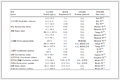
The effect of [EMIm][BF4] concentration on the determination of pyrrolidinium cations was investigated using [EMIm][BF4] aqueous solution/acetonitrile (40/60,v/v) as the mobile phase. The concentrations of [EMIm][BF4] were investigated at 0.3,0.5,0.8,1.0 and 1.2 mmol/L and the results are shown in Table 1. The results showed that the retention times of pyrrolidinium cationswere shortened and the detection limits were increased with increased concentration of [EMIm][BF4]. Retention time was shortened because with the increased concentration of [EMIm][BF4],there will be enhanced molecular dipole interactions between the solutes and the mobile phase,resulting an enhanced elution ability,thus the solutes retention was weakened. The greater values of the detection limit were caused by [EMIm][BF4] as a background UV absorption reagent. The higher the concentration is,the stronger is the background absorbance,which led to greater noise and greater values of detection limit. Therefore,considering the factors of the retention time and the detection limit,the suitable concentration of [EMIm][BF4] chosen was 0.8 mmol/L.
|
Table 1 The relationship between the concentration of [EMIm][BF4] and retention time and LOD. |

The effects of imidazolium ionic liquid anions ([CF3COO]-,[BF4]-,[C7H7SO3]-,[CH3SO3]-) on the determination of pyrrolidinium cations were further investigated using 0.8 mmol/L 1- ethyl-3-methyl imidazolium ILs ([EMIm][CF3COO],[EMIm][BF4],[EMIm][C7H7SO3],[EMIm][CH3SO3])/acetonitrile (40/60,v/v) as the mobile phase. The results showed that [EMIm][C7H7SO3] had greater interference on the determination than other 1-ethyl-3- methyl imidazolium ILs. The reason was that [C7H7SO3]- had UV absorption,creating stronger baseline noise,and smaller analytes’ chromatographic peaks. When [EMIm][CH3SO3] was used as a mobile phase component,the chromatographic baseline noise was unstable and the peak shape of the analytes was poor. [EMIm][CF3COO] had a greater noise level (0.2204 mAU) compared to [EMIm][BF4] (0.0879 mAU). The anion of [BF4]- compared to [CH3SO3]-,[CF3COO]- had less effect on the detection of pyrrolidinium cations. Therefore,[EMIm][BF4] was chosen as an optimum mobile phase additive.
The effects of organic solvents such as methanol and acetonitrile on the determination of three pyrrolidinium cations were investigated using 0.8 mmol/L [EMIm][BF4] aqueous solution/ methanol and 0.8 mmol/L [EMIm][BF4] aqueous solution/acetonitrile (30/70,v/v) as the mobile phase,respectively. The result showed that using methanol as an organic solvent,there were no peaks of three pyrrolidinium cations appeared. Because methanol as a polar protic solvent can form hydrogen bonds with the stationary phase and formed competitive adsorption with analytes in the HILIC,destructed the formation of water-rich layer,then enhanced hydrophobicity of the stationary phase surface,resulting in decreased analytes’ retention [14]. Recently,Li et al. [15] also reported that methanol has poor retention in the HILIC. Thus,this study confirmed acetonitrile as the optimal organic component of the mobile phase.
The effects of acetonitrile concentration in mobile phase on determination of pyrrolidinium cations were investigated; the volume fractions of acetonitrile were 50%,55%,60%,65% and 70% with 0.8 mmol/L [EMIm][BF4] aqueous solution as the mobile phase. The results showed that the retention times of three pyrrolidinium cations were increased with increased acetonitrile volume fractions. The reason was that water was a very strong elution solvent in HILIC,as the amount of acetonitrile increased,water content decreased in the mobile phase,the solute was more difficult to be eluted,so the retention enhanced [10]. When the content of acetonitrile was 50%,the resolution was poor. Therefore,the acetonitrile volume fraction of 60% was suitable,and in which the peak shape was the best.
The effects of the mobile phase pH value (adjusted with acetic acid or NaOH) for 4.0,4.5,5.0 (unadjusted pH of mobile phase),5.5 and 6.0 on determination of three pyrrolidinium cations were investigated using 0.8 mmol/L [EMIm][BF4] aqueous solution mixed with 60% acetonitrile as the mobile phase. The result indicated that with the increase of the mobile phase pH value,the retention time gradually extended. The possible reason was that the pH value of the mobile phase will affect the degree of protonation of the solutes,thereby affecting solute retention. When the pH value was gradually increased,the degree of ionization of the solute increased,thus the hydrophilicity of solutes was enhanced and the retention was strengthened,which conform to the regularity of HILIC [14]. When the pH value was adjusted at 5.0 the baseline noise was minimum. The effects of detection wavelength changed from 200 nm to 230 nm on the determination of three pyrrolidinium cations were investigated using 0.8 mmol/L [EMIm][BF4] aqueous solution/acetonitrile (40/ 60,v/v) as the mobile phase. It was found that using the detection wavelength at 210 nm,the baseline noise was more stable and the detection limit of cations was low. Therefore,the suitable detection wavelength was 210 nm.
The effects of column temperature on the retention time of three pyrrolidinium cations were investigated with column temperatures set to 20,25,30,35 and 40 ℃. The mobile phase was 0.8 mmol/L [EMIm][BF4] aqueous solution/acetonitrile (40/60,v/v). The result showed that the changes of column temperature have little effect on the determination of three pyrrolidinium cations. Therefore,30 ℃ was selected as an appropriate temperature because it was closer to room temperature.
There is a carbon number rule between carbon atoms and homologue retention factor: lg k = a·nC + b [16] (k is the retention factor, nC is the homologue carbon atoms number). Under the optimum chromatographic conditions,the carbon number rule curve of cations ([MEPy]+,[MPPy]+,[MBPy]+) was lg k = -0.0919nC + 1.3116,r = 0.9988. The equation showed that lg k and nC has a good linear relationship,indicating that under these conditions,retention factor of pyrrolidinium cations conformed with the number of carbons. As seen from the formula,as the carbon atoms in homologues increases,the retention factor decreases,and it was opposite to the retention rule of RPLC. It was verified the elution order in HILIC was that less polar substances would be eluted earlier than the more polar substances. This mechanism in which the polar substances have better retention,could solve the retention problem of weakly retained substances in the RPLC.
According to the above discussion,the suitable chromatographic conditions for the determination of three pyrrolidinium cations are described as the follows. The analysis was performed using a TSK-GEL Amide-80 HR column with an IUV detection wavelength of 210 nm,0.8 mmol/L [EMIm][BF4] aqueous solution/acetonitrile (40/60,v/v) as the mobile phase,a flow rate of 1.0 mL/min and thecolumn temperature controlled at 30 ℃. Under these conditions,the chromatogram of three pyrrolidinium cations is shown in Fig. 2.

|
Download:
|
| Fig. 2.Chromatogram of a standard mixture solution of pyrrolidinium cations. Chromatographic conditions: column, TSK-GEL Amide-80 HR (4.6 mm i.d. × 250 mm, 5 μm); mobile phase, 0.8 mmol/L [EMIm][BF4] aqueous solution/ acetonitrile (40/60, v/v). Peaks (mg/L): 1, [MBPy]+ (50); 2, [MPPy]+ (50); 3, [MEPy]+ (50). | |
Under optimum chromatographic conditions,the standards solutions of three pyrrolidinium cations were determined. Linear regression equations were obtained from the relationship between the peak area (integral value) and ionic concentration (mg/L). Detection limits were calculated with a tripled signal-to-noise ratio (S/N = 3),and noise of the baseline was 0.0879 mAU. Relative standard deviations of retention time and peak area (RSDt/RSDs) were obtained by five repeated measurements of a standard mixture solution of [MEPy]+ (50 mg/L),[MPPy]+ (50 mg/L) and [MBPy]+ (50 mg/L) under the chromatographic conditions. The data are listed in Table 2. The results showed that the reproducibility and linearity of the method can meet the requirements of quantitative analysis.
|
|
Table 2 Linear regression equation, limits of detection (LOD) and relative standard deviation of retention time and peak area (RSDt/RSDs). |

This method was applied to the determination of pyrrolidinium ILs synthesized by the chemistry lab,namely N-methyl-N-ethyl pyrrolidinium bromide ([MEPy][Br]),N-methyl-N-propyl pyrrolidinium bromide ([MPPy][Br]),N-methyl-N-butyl pyrrolidinium bromide ([MBPy][Br]). The analysis weights of [MEPy][Br],[MPPy][Br] and [MBPy][Br] were 0.1700 g,0.1623 g and 0.1562 g,respectively,diluted to 100 mL as stock solutions. Then,1.0 mL [MEPy][Br],1.0 mL [MPPy][Br] and 1.0 mL [MBPy][Br] were taken from the stock solutions,respectively,and were diluted to 50 mL. After filtering through a 0.22 mm membrane filter,these sample solutions were used for the determination of pyrrolidinium cations under the selected conditions. Recoveries were tested by the standard addition method. Analytical results and recoveries of pyrrolidinium cations in the ionic liquid samples are listed in Table 3,chromatogram is shown in Fig. 3. The data in Table 3 are average values (n = 5),and the RSDs are less than 0.6%. Data from Table 3 show that the method were accurate and reproducible,and met the requirements of quantitative analysis of pyrrolidinium cations.
|
|
Table 3 Analytical results and recoveries of pyrrolidiunium cations found in ionic liquid samples. |


|
Download:
|
| Fig. 3.Chromatograms of ionic liquid samples synthesized and added standard. a, sample without addition; b, addition of 5 mg/L; c, addition of 40 mg/L; d, addition of 80 mg/L. Chromatographic conditions as in Fig. 2. Peaks: 1, [MBPy]+; 2, [MPPy]+; 3, [MEPy]+. | |

In this work,a novel approach was developed using imidazolium ILs as the background UV absorption reagents in HILIC-IUV detection for the determination of pyrrolidinium cations,which have no UV absorption. The retention behavior of pyrrolidinium cations on HILIC column had typical HILIC characteristics,and the retention of pyrrolidinium cations conformed with the number of carbons. The detection limits of [MEPy]+,[MPPy]+ and [MBPy]+ were 0.59,0.53 and 0.46 mg/L,respectively. This method has been successfully applied in determining of pyrrolidinium ILs synthesized in chemistry laboratory,which proved this relatively simple and practical method meet the requirements of quantitative analysis.
AcknowledgmentThis work was supported by the Natural Science Foundation of Heilongjiang Province (No. B201307).
| [1] | Z.S. Gao, S. Sun, W. Li, et al., An efficient ionic liquid supported divergent assembly of 3,6-branched glucosamine-containing pentasaccharide, Chin. Chem. Lett. 25 (2014) 1525-1530. |
| [2] | Y.J. Ma, M. Li, H. Yu, R.S. Li, Fast analysis of thiocyanate by ion-pair chromatography with direct conductivity detection on a monolithic column, Chin. Chem. Lett. 24 (2013) 1067-1069. |
| [3] | T.D. Ho, C. Zhang, L.W. Hantao, J.L. Anderson, Ionic liquids in analytical chemistry: fundamentals, advances, and perspectives, Anal. Chem. 86 (2014) 262-285. |
| [4] | M.J. Ruiz-Angel, A. Berthod, Reversed-phase liquid chromatography analysis of alkyl-imidazolium ionic liquids: II. Effects of different added salts and stationary phase influence, J. Chromatogr. A 1189 (2008) 476-482. |
| [5] | H. Yu, Y.M. Sun, C.M. Zou, Imidazolium ionic liquid as the background ultraviolet absorption reagent for determination of morpholinium cations by high performance liquid chromatography-indirect ultraviolet detection, Chin. Chem. Lett. 25 (2014) 1371-1374. |
| [6] | C.M. Zou, H. Yu, M.Y. Wang, Determination of tetraethyl ammonium by ion-pair chromatography with indirect ultraviolet detection using 4-aminophenol hydrochloride as background ultraviolet absorbing reagent, Chin. Chem. Lett. 25 (2014) 201-204. |
| [7] | Q. Chen, H. Yu, J.F. Wang, Determination of pyridinium ionic liquid cations by ion chromatography with direct conductivity detection, J. Liq. Chromatogr. Relat. Technol. 35 (2012) 1184-1193. |
| [8] | G. Le Rouzo, C. Lamouroux, C. Bresson, et al., Hydrophilic interaction liquid chromatography for separation and quantification of selected room-temperature ionic liquids, J. Chromatogr. A 1164 (2007) 139-144. |
| [9] | C. Lamouroux, G. Foglia, G. Le Rouzo, How to separate ionic liquids: use of hydrophilic interaction liquid chromatography and mixed mode phases, J. Chromatogr. A 1218 (2011) 3022-3028. |
| [10] | A.J. Alpert, Hydrophilic-interaction chromatography for the separation of peptides, nucleic acids and other polar compounds, J. Chromatogr. 499 (1990) 177-196. |
| [11] | Y. An, H. Yu, C.M. Zou, Rapid determination of pyrrolidinium ionic liquid cations by monolithic column-ion-pair chromatography with indirect ultraviolet detection, Chin. J. Anal. Chem. 41 (2013) 1057-1062. |
| [12] | R.Q. Zhang, H. Yu, X.J. Sun, Separation and determination of pyrrolidinium ionic liquid cations by ion chromatography with direct conductivity detection, Chin. Chem. Lett. 24 (2013) 503-505. |
| [13] | S.L. Da, Indirect photometric high-performance liquid chromatography, Chin. J. Anal. Chem. 17 (1989) 372-381. |
| [14] | X.J. Dai, Y. He, Y.M. Wei, B.L. Gong, A novel hydrophilic polystyrene-based beads for hydrophilic interaction chromatography by surface-initiated atom transfer radical polymerization, Chin. Chem. Lett. 22 (2011) 245-248. |
| [15] | R.P. Li, Q. Yuan, Y.P. Huang, Hydrophilic interaction chromatography on silica column: retention mechanism and its influential factors, Chin. J. Chromatogr. 32 (2014) 675-681. |
| [16] | M.L. Zhang, X.J. Liang, S.X. Jiang, H.D. Qiu, Preparation and applications of surfaceconfined ionic-liquid stationary phases for liquid chromatography, Trends Anal. Chem. 53 (2014) 60-72. |