 2015, Vol.26


b The Academy of Fundamental and Interdisciplinary Science, Harbin Institute of Technology, Harbin 150080, China
With the number automobiles increasing rapidly in the world, organic sulfur compounds present in diesel fuel oils lead to more emission of SOX by combustion, which not only heavily pollutes the atmosphere, but also irreversibly poisons the noble-metal catalysts in automobile exhaust systems [1, 2, 3]. Therefore, the sulfur content specifications in fuels are becoming more and more stringent worldwide. In the petroleum refining industry, catalytic hydrodesulfurization (HDS) is the conventional and commonly used method to reduce sulfur in fuels. However, it is difficult to remove organic sulfur compounds exhibiting steric hindrance at the sulfur atom, such as dibenzothiophene (DBT) and its derivatives, especially 4,6-dimethyldibenzothiophene (4,6-DMDBT) [4]. Severe HDS conditions are required to remove these compounds, such as temperatures about 643 K, pressures in the range of 50-100 bar and a liquid hourly space velocity (LHSV) below 1.5 h-1, which inevitably leads to high capital expenditure [5]. Thus, alternative methods that operate at moderate conditions without requiring H2, such as oxidative desulfurization [6, 7, 8, 9], biodessulfurization [10], extractive desulfurization [11, 12, 13] and adsorptive desulfurization [14] have been investigated. Among these technologies, extractive desulfurization has been studied extensively because of its facile and simple operation. A number of organic solvents, such as polyalkyleneglycol and polyalkyleneglycol ether, were tested as extractants for the removal of sulfurcontaining compounds from fuel oils, but their performances were never satisfactory. Recently, ionic liquids (ILs) have been employed in the extractive desulfurization of fuel oils because of their unique properties, such as the immiscibility with fuel oils, high affinity to sulfur-containing compounds, nonvolatility, and high thermal stability [15, 16, 17, 18], However, the efficiencies of various kinds of ionic liquids used as extractants on sulfur removal were rather low [19, 20]. Based on published papers [21, 22], metal-based ionic liquids drew our attention and interest due to their obvious advantages. Zhang et al. [23] found AlCl3-based ionic liquids were effective for the removal of S-containing compounds, however, the application of AlCl3-based ionic liquids was limited to the absorption of certain aromatic compounds, such as DBT. Huang et al. [24], found that a CuCl-based ionic liquid exhibited remarkable desulfurization ability in the desulfurization of gasoline; however, the extraction was carried out at relative high temperature 80 ℃. Nan Hee Ko et al. [25] found FeIII-containing ionic liquids were effective extractants for the desulfurization of a model (simulated) oil consisting of dibenzothiophene (DBT) dissolved in n-octane at room temperature.
In this work, we synthesized several different metal-based ionic liquids (ILs) with 1-butyl-3-methyl imidazole (BMIM) as cation, which were used as extractants for the desulfurization of DBT in simulated oil. Additionally, the reaction conditions were optimized and the extraction effectiveness of the optimal IL in the extractive desulfurization of different sulfur compounds and actual diesel oil were investigated.
2. Experimental 2.1. MaterialsDibenzothiophene (99%), n-octane (analytical pure grade), benzothiophene (97%), ferric chloride (analytical pure grade) and n-methylimidazole (99%) were purchased from Aladdin, China, and were used without any further treatment, actual diesel oil (12,400 μg/mL S) was purchased from Shijiazhuang refinery.
2.2. AnalysisA magnetic stirrer (DF-II, Ronghua Instrument Manufacturing Co., Ltd.) under the reactor flask was used to vigorously stir the solution. Concentrations of sulfur compounds were determined by gas chromatography (GC-7900, Shanghai Tianmei Scientific Instruments Co., Ltd.) equipped with Flame Photometric Detector. The prepared ILs were characterized by Fourier transform infrared spectrophotometry (FT-IR) (IRPrestige-21, Shimazu, Japan) and electrospray ionization mass spectrometry (ESI-MS) (MS-2010EV, Shimazu, Japan).
2.3. Preparation of ionic liquids[BMIM]Br/FeCl3, [BMIM]Cl/FeCl3, [BMIM]OH/FeCl3, [BMIM] HSO4/FeCl3, [BMIM]BF4/FeCl3, [BMIM]HSO4/CuCl2, [BMIM]HSO4/ CoCl2, [BMIM]HSO4/ZnCl2, [BMIM]HSO4/MoCl2, [BMIM]HSO4/ MnCl2, [BMIM]HSO4/FeCl3 were prepared by the procedures described in published literature [26, 27, 28]. The first step is to synthesize the intermediate ([BMIM]Cl), which could be converted to the ILs with different anions, and then followed by the addition of an equal-molar quantity of the corresponding metal salt in a round-bottom flask maintained for 5 h at room temperature (300 K). The residual reactant and water were removed by a rotary evaporator. The ILs were dried in vacuum to yield the products as colorless liquids. In the case of [BMIM]HSO4/FeCl3 for example, Scheme 1 shows the synthesis route of [BMIM]HSO4/ FeCl3. The structures of the prepared ILs were identified by FT-IR and ESI-MS.

|
Download:
|
| Scheme 1.The synthesis route of [BMIM]HSO4/FeCl3 IL. | |
Simulated oil (1000 μg/mL S) was prepared by dissolving DBT in n-octane. The extractive desulfurization of model oil was conducted in a 50 mL flask. In a typical run, certain volumes of ionic liquid and model oil were added to the flask and the mixture stirred for a certain period of time at a room temperature (300 K). The clarified oil sample was withdrawn periodically and analyzed for sulfur content by gas chromatography with flame photometric detector.
3. Results and discussion 3.1. Characterization of the ILsThe FT-IR spectra of [BMIM]HSO4/FeCl3, [BMIM]HSO4/0.5FeCl3, [BMIM]HSO4/ZnCl2 and [BMIM]HSO4 ILs are shown in Fig. 1. It is commonly acknowledged that the characteristic absorption peaks of [BMIM]HSO4 appear at 3148 cm-1, 2961 cm-1, 1573 cm-1, 1170 cm-1, 847 cm-1. The peak could be assigned to the hydrogen bonding between N-H of imidazole with Cl in FeCl3 [29]. In addition, as demonstrated in Fig. 1, an increase in the amount of FeCl3, increased the strength of the hydrogen bond because of the existence of the larger FeCl4- anion [25].

|
Download:
|
| Fig. 1.FT-IR spectra of ionic liquids. | |
The ESI-MS spectrum of [BMIM]HSO4/FeCl3, as a typically representative extractant, was conducted to detect the anions of the IL. From the ESI-MS spectrum of [BMIM]HSO4/FeCl3, intensive peaks can be observed at m/z = 96.9, 160.84 and 197.8, which correspond to HSO4-, FeCl3 and FeCl4-, respectively. Thus, the anions of the [BMIM]HSO4/FeCl3 IL could be demonstrated conclusively.
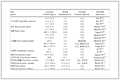
3.2. Effect of anions in ILs on the extractive desulfurization of DBTAs seen in Table 1, the nature of the anion in ILs, indeed, had an influence on the extraction activity for DBT when the molar ratio of the metal salt and imidazolium cation are the same. As is well known, the lone pair of electrons on the S atom results in DBT displaying Lewis base properties, while metal-based ILs are Lewis acids. The extractive desulfurization was actually accomplished by the acid-base complexation reaction. Metal-based ILs are the complexes formed by the anions of ILs and metal salts. The complexing powers of various ILs with FeCl3 are different, which leads to different Lewis acidity. The [BMIM]HSO4/FeCl3 IL exhibited a remarkable ability for sulfur removal, indicating that the complexing power of HSO4- with FeCl3 was the strongest of all.
|
Table 1 Effect of anions in ILs on the extractive desulfurization of model oil. |

The extractive abilities of ILs with different metal ions in the desulfurizationofmodel oilwere investigated. The results are shown in Table 2. The desulfurization ratio of Fe-based IL could reach 100% under the same conditions. The addition of themetal salts improved the desulfurization ratios significantly according to Table 2. So the p-complexation between lone pair electrons on organic sulfur compounds and the unoccupied orbital on transitionmetal ions was higher than the p-p interaction between the unsaturated bonds of the S-compound andthe imidazoliumring of IL [6]. It canalsobe seen that the S atom of DBT has a lone pair electrons characteristic of a Lewisbase, and the IL [BMIM]HSO4/FeCl3 acts as a Lewis acid because of the unoccupied orbital of Fe3+. The complexation was formed between Lewis acid and the Lewis base.
|
|
Table 2 Effects of metal ions on the extraction desulfurization of model oil. |

Based on the results found in Table 1 and Table 2, both anion and metal ion types had effects on the extractive desulfurization of DBT, however, the effect of the metal ion was more significant. The desulfurization ratio of DBT by [BMIM]HSO4/FeCl3 was higher than the other ILs. The optimization of reaction conditions for the extraction process was determined in follow-up experiments with [BMIM]HSO4/FeCl3 used as extractant.
3.4. Effect of n(IL)/n(metal) on the extractive desulfurization of DBTAs listed in Table 3, it is clear that the desulfurization ratio increased with the increasing molequantities of FeCl3.However, the desulfurization ratio dropped rapidly when the mole ratio of [BMIM]HSO4 and FeCl3 exceeded 1:1. As the amount of FeCl3 increased, the number of complexes formed by the anion and FeCl3 increased, strengthening the acidity of the IL and enhancing the extractive desulfurization ratio higher. When the amount of FeCl3 continued to increase, there were insufficient anions complexed with FeCl3.Whatisworse, the viscosity of Fe-basedIL also increased, resulting in the worsened (decreased) mobility, the declined mass transfer rate and the depressed degree of desulfurization. Thus, the optimum proportion of n([BMIM]HSO4)/n(FeCl3) was 1:1.
|
|
Table 3 Effects of n(ILs)/n(metal) on the extractive desulfurization of DBT. |

As is shown in Fig. 2, the sulfur removal ratio increased with VIL/Voil increasing. The extractive desulfurization ratio rose from 37.2% to 96.3% quickly with the VIL/Voil increasing from 1:5 to 4:5. While the VIL/Voil was increasing further, the desulfurization ratio was basically flat. The reason was that the amount of IL was insufficient to complex with DBT of the model oil under the condition of VIL/Voil≤4:5; but with the increase of VIL/Voil, the IL had more opportunities to contact with DBT, thus the sulfur removal ratio increased. Moreover, the sulfur removal ratio of DBT increased slowly to 98.9% and 100%, when the VIL/Voil increased further from 4.5:5 to 1:1. The results indicate that VIL/Voil of 1:1 is optimal, and the utilization of excessive IL is not economical.

|
Download:
|
| Fig. 2.Effect of VIL/Voil on the sulfur removal of DBT. Conditions: t = 1 h; T = 300 K; [BMIM]HSO4/FeCl3. | |
As shown in Fig. 3, [BMIM]HSO4/FeCl3 had a strong extraction ability for DBT since the extractive desulfurization ratio of DBT could reach 95% in 1 min. The extractive desulfurization was shorter than most of the other ILs, such as with the BF4--based ionic liquids [30], where the desulfurization ratio could achieve only 40% in 60 min, and with the pyridium-based ionic liquid, where the desulfurization ratio could reach 45.5% in 30-40 min [18]. The extractive desulfurization by [BMIM]HSO4/FeCl3 IL was almost complete in 5 min, which demonstrated that [BMIM]HSO4/ FeCl3 IL has a great advantage on the extractive time and desulfurization ratio (Fig. 3).

|
Download:
|
| Fig. 3.Effect of extractive time on the sulfur removal of DBT. Conditions: T = 300 K; VIL/Voil = 1:1. | |
At the end of each run, the IL phase (lower-layer) was withdrawn and DBT in the [BMIM]HSO4/FeCl3 IL was re-extracted from the IL by an equal volume of carbon tetrachloride based on the similarity-intermiscibility theory. Then, [BMIM]HSO4/FeCl3 IL was reused for six times with fresh model oil. The results are shown in Table 4 indicating the desulfurization ratio decreased from 100% to 92.1%, which may be due to losses of regenerated ionic liquid.
|
|
Table 4 The extractive desulfurization of DBT by regeneration [BMIM]HSO4/FeCl3. |

The extractive desulfurization of different sulfur-containing compounds was studied by [BMIM]HSO4/FeCl3 IL. As shown in Table 5, the extractive desulfurization ratios of dibenzothiophene (DBT), 2-methyl thiophene (2-MTH), benzothiophene (BT) and thiophene (TH) with [BMIM]HSO4/FeCl3 IL all exceeded 90%, indicating that [BMIM]HSO4/FeCl3 IL had a high extraction ability for various sulfides. From the results, we can also conclude that the higher the aromaticity of sulfide substrate, the higher of the extractive desulfurization ratio.
|
|
Table 5 The extractive desulfurization of different sulfur compounds by [BMIM]HSO4/FeCl3. |


In view of the general suitability for different sulfur-containing compounds, extractive performance of [BMIM]HSO4/FeCl3 in the desulfurization of actual diesel was tested further. As shown in Fig. 4, the initial sulfur content of diesel oil was 12,400 ppm, and the sulfur content dropped to 120 ppm after extraction, indicating that most of the sulfide in actual diesel oil was removed and the extent of sulfur removal could reach 99% after a single extraction. Fig. 5 shows three samples of diesel oil. No. 1 is actual diesel oil with a high sulfur content; No. 2 is diesel sample No. 1 after extractive desulfurization with [BMIM]HSO4/FeCl3 and No. 3 is 0# diesel fuel commercially available from a gas station. From Fig. 5, we can see that the color of diesel sample No. 2 obviously became lighter after processing compared with the diesel No. 1; while diesel No. 2 was very similar or even the same with diesel No. 3 based on appearance and sulfur content.

|
Download:
|
| Fig. 4.GC-FPD chromatogram of actual oil before and after extraction. Conditions: t = 5 min, T = 300 K, VIL/Voil = 1:1. | |


|
Download:
|
| Fig. 5.Photos of three samples of actual diesel oil. | |

A series of metal-based ILs were initially prepared for the extractive desulfurization of DBT in model oil and actual diesel oil. Species of both anions of the IL and the metal ions had an influence on the degree of desulfurization. The [BMIM]HSO4/FeCl3 showed a surprising high extractive ability for DBT and diesel. The results showed that the removal ratio of DBT was up to 100% with the Fe-based IL as extractant under the optimal conditions (300 K, VIL/Voil = 1:1, 5 min, n(IL)/n(metal) = 1:1 as molar ratio). Furthermore, [BMIM]HSO4/FeCl3 could be recovered and reused for six times, and its extractive activity exhibited no obvious decrease. The sulfur removal ratios of dibenzothiophene (DBT), 2-methyl thiophene (2-MTH), benzothiophene (BT) and thiophene (TH) by [BMIM]HSO4/FeCl3 all exceeded 90%, indicating that [BMIM] HSO4/FeCl3 had general suitability for various sulfur analogs, and that 99.1% of the sulfur compounds in the actual diesel oil could be removed by extraction with [BMIM]HSO4/FeCl3. Thus, this metalbased ionic liquid is a promising extraction agent in extractive desulfurization.
AcknowledgmentsThis work was financially supported by the National Natural Science Foundation of China (No. 21106032) and Hebei University of Science and Technology doctor funding (No. 000172).
| [1] | D.S. Zhao, J.L. Wang, E.P. Zhou, Oxidative desulfurization of diesel fuel using a Brønsted acid room temperature ionic liquid in the presence of H2O2, Green Chem. 9(2007) 1219-1222. |
| [2] | H.M. Li, W.S. Zhu, Y. Wang, et al., Deep oxidative desulfurization of fuels in redox ionic liquids based on iron chloride, Green Chem. 11(2009) 810-815. |
| [3] | D.S. Zhao, Y.N. Wang, E.H. Duan, J. Zhang, Oxidation desulfurization of fuel using pyridinium-based ionic liquids as phase-transfer catalysts, Fuel Process. Technol. 91(2010) 1803-1806. |
| [4] | H.Y. Lü, J.B. Gao, Z.X. Jiang, et al., Ultra-deep desulfurization of diesel by selective oxidation with [C18H37N(CH3)3]4[H2NaPW10O36] catalyst assembled in emulsion droplets, J. Catal. 239(2006) 369-375. |
| [5] | L.N. He, H.M. Li, W.S. Zhu, et al., Deep oxidative desulfurization of fuels using peroxophosphomolybdate catalysts in ionic liquids, Ind. Eng. Chem. Res. 47(2008) 6890-6895. |
| [6] | F.T. Li, R.H. Liu, J.H. Wen, et al., Desulfurization of dibenzothiophene by chemical oxidation and solvent extraction with Me3NCH2C6H5Cl·2ZnCl2 ionic liquid, Green Chem. 11(2009) 883-888. |
| [7] | S. Dhir, R. Uppaluri, M.K. Purkait, Oxidative desulfurization:kinetic modeling, J. Hazard. Mater. 161(2009) 1360-1368. |
| [8] | J. Zhang, A.J. Wang, X. Li, X.H. Ma, Oxidative desulfurization of dibenzothiophene and diesel over [Bmim]3PMo12O40, J. Catal. 279(2011) 269-275. |
| [9] | A.E.S. Choi, S. Roces, N. Dugos, et al., Optimization of ultrasound-assisted oxidative desulfurization of model sulfur compounds using commercial ferrate (VI), J. Taiwan Inst. Chem. Eng. 45(2014) 2935-2942. |
| [10] | K. Kirimura, T. Furuya, Y. Nishii, et al., Biodesulfurization of dibenzothiophene and its derivatives through the selective cleavage of carbon-sulfur bonds by a moderately thermophilic bacterim Bacillus subtilis WU-S2B, J. Biosci. Bioeng. 91(2001) 262-266. |
| [11] | L.Z. Zhai, Q. Zhong, C. He, J. Wang, Hydroxyl ammonium ionic liquids synthesized by water-bath microwave:synthesis and desulfurization, J. Hazard. Mater. 161(2009) 1360-1368. |
| [12] | C. Asumana, G.R. Yu, X. Li, et al., Extractive desulfurization of fuel oils with lowviscosity dicyanamide-based ionic liquids, Green Chem. 12(2010) 2030-2037. |
| [13] | W.N.A.W. Mokhtar, W.A.W.A. Bakar, R. Ali, A.A.A. Kadir, Deep desulfurization of model diesel by extraction with N,N-dimethylformamide:optimization by Box-Behnken design, J. Taiwan Inst. Chem. Eng. 45(2014) 1542-1548. |
| [14] | A. Srivastav, V.C. Srivastava, Adsorptive desulfurization by activated alumina, J. Hazard. Mater. 170(2009) 1133-1140. |
| [15] | J.L. Wang, D.S. Zhao, K.X. Li, Oxidative desulfurization of dibenzothiophene using ozone and hydrogen peroxide in ionic liquid, Energy Fuels 24(2010) 2527-2529. |
| [16] | A. Bösmann, L. Datsevich, A. Jess, et al., Deep desulfurization of diesel fuel by extraction with ionic liquids, Chem. Commun. (2001) 2494-2495. |
| [17] | Y. Nie, C.X. Li, A.J. Sun,H.Meng, Z.H.Wang, Extractive desulfurization of gasoline using imidazolium-based phosphoric ionic liquids, Energy Fuels 20(2006) 2083-2087. |
| [18] | J.L. Wang, D.S. Zhao, E.P. Zhou, Z. Dong, Desulfurization of gasoline by extraction with N-alkyl-pyridinium-based ionic liquids, J. Fuel Chem. Technol. 35(2007) 293-296. |
| [19] | S.Q. Zhang, Z.C. Zhang, Novel properties of ionic liquids in selective sulfur removal from fuels at room temperature, Green Chem. 4(2002) 376-379. |
| [20] | B.-M. Su, S.G. Zhang, Z.C. Zhang, Structural elucidation of thiophene interaction with ionic liquids by multinuclear NMR spectroscopy, J. Phys. Chem. B 108(2004) 19510-19517. |
| [21] | I.J.B. Lin, C.S. Vasam, Metal-containing ionic liquids and ionic liquid crystals based on imidazolium moiety, J. Organomet. Chem. 690(2005) 3498-3512. |
| [22] | C.M. Zhong, T. Sasaki, A. Jimbo-Kobayashi, et al., Syntheses, structures, and properties of a series of metal ion-containing dialkylimidazolium ionic liquids, Bull. Chem. Soc. Jpn. 80(2007) 2365-2374. |
| [23] | S.G. Zhang, Q.L. Zhang, Z.C. Zhang, Extractive desulfurization and denitrogenation of fuels using ionic liquids, Ind. Eng. Chem. Res. 43(2004) 614-622. |
| [24] | C.P. Huang, B.H. Chen, J. Zhang, Z.C. Liu, Y.X. Li, Desulfurization of gasoline by extraction with new ionic liquids, Energy Fuels 18(2004) 1862-1864. |
| [25] | N.H. Ko, J.S. Lee, E.S. Huh, et al., Extractive desulfurization using Fe-containing ionic liquids, Energy Fuels 22(2008) 1687-1690. |
| [26] | G. Neeraj, L.K. Goverdhan, S. Jasvinder, Enhancing nucleophilicity in ionic liquid [bmim]HSO4:a recyclable media and catalyst for the halogenation of alcohols, J. Mol. Catal. A:Chem. 302(2009) 11-14. |
| [27] | D. Kogelnig, A. Stojanovic, F. Jirsa, et al., Transport and separation of iron (III) from nickel (II) with the ionic liquid trihexyl (tetradecyl) phosphonium chloride, Sep. Purif. Technol. 72(2010) 56-60. |
| [28] | Y.Q. Jiang, W.S. Zhu, H.M. Li, et al., Oxidative desulfurization of fuels catalyzed by Fenton-Like ionic liquids at room temperature, ChemSusChem 4(2011) 399-403. |
| [29] | F.T. Li, Y. Liu, Z.M. Sun, et al., Deep extractive desulfurization of gasoline with XEt3NHCl3FeCl3 ionic liquids, Energy Fuels 24(2010) 4285-4289. |
| [30] | L. Alonso, A. Arce, M. Francisco, O. Rodríguez, A. Soto, Gasoline desulfurization using extraction with [C8mim][BF4] ionic liquid, AIChE J. 53(2007) 3108-3115. |