 2015, Vol.26


Condensed heterocyclic compounds with pyrimidine ring are of interest since they include valuable pharmacological substances [1, 2]. Triazolopyrimidines as a main class of hybrid heterocycles of pyrimidine fused with triazole, are very important compounds as they occur in a large number of natural products [3, 4]. Also, they have attracted special attention because of its exciting biological properties such as antitumor [5], antibacterial [6], cytotoxicity [7], and therapeutic potentiality activity [8]. In addition, fused triazole systems with a partially hydrogenated pyrimidine ring can be very useful synthetic pharmaceutical agents in medicinal chemistry because they are dihydro hetero analogs of active natural products such as adenine and guanine [9].
On the other hand, barbituric acid has been shown a broad range of pharmaceutical activities, including antimicrobial, antifungal, antiviral, antitumor, anticonvulsive, sedative, and antihypertensive agents [10, 11]. This pyrimidine like compound has been used as a reactant to form a large class of barbiturate drugs which are used as hypnotics, sedatives, anticonvulsants, anesthetics and as central nervous system depressants. Owing to their ready availability and various heterocyclization possibilities, barbituric acid is effective starting material for the synthesis of different fused heterocycles which have diverse biological activity and coverage of a broad synthetic diversity [12, 13].
The need for developing new eco-friendly methods which includes spectacular decrease in reaction time, clean product formation, improved selectivity and yields and easier work up is currently a focus of attention in organic synthesis. The use of microwave irradiation for the synthesis of new compounds has proved to be efficient, safe and environmentally benign techniques due to its ability to fuse directly starting materials and high thermal conductivity leading to a rapid increase in the temperature of the reaction. As we know, delay in temperature rising enhance the probability of generating side products [14, 15].
Following of our interest in synthesis of new heterocycles [16, 17, 18, 19], and to overcome the limited scope and problems associated with the using conventional heating with our reported protocol [20], we report herein a green method for the preparation of 9-aryl-5, 9-dihydropyrimido[4, 5-d][1,2,4]triazolo[1, 5-a]pyrimidine-6, 8(4H, 7H)-diones via a microwave-assisted one-pot three component reactions.
2. ExperimentalGeneral procedure for the synthesis of 9-aryl-5, 9-dihydropyrimido[4, 5-d][1,2,4]triazolo[1, 5-a]pyrimidine-6, 8(4H, 7H)-dione 4: A mixture of barbituric acid derivatives (1 mmol), arylaldehyde (1 mmol) and 3-amino-1H-1, 2, 4-triazoles (1 mmol) was irradiated at 300Win a domesticMWoven for 10-15 min. The progress was followed by TLC. After completion of the reaction, the obtained powder was recrystallized from EtOH to afford the pure product.
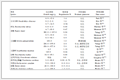
3. Results and discussionInitially, we started our study taking barbituric acid, benzaldehyde and 3-amino-1H-1, 2, 4-triazole as the model substrates under catalyst- and solvent-free conditions (Scheme 1). However, no desired product was obtained at room-temperature even after 24 h. When the reaction was carried out under microwave irradiation, the desired product was obtained in 98% using an unmodified domestic MW oven at 300W after 5 min at roomtemperature. By increasing the temperature the yield decreased. This may be due to the decomposition of the product at higher temperature. Moreover, the effect of microwave power on the yields was also monitored from 250Wto 350 W. It can be seen that 300Wachieved the best yield. Therefore, 300Wwas chosen as the optimum microwave power. Finally, reaction conditions were optimized using barbituric acid (1 mmol), benzaldehydes (1 mmol) and 3-amino-1H-1, 2, 4-triazole (1 mmol) at roomtemperature under microwave irradiation for 5-10 min. A wide range of structurally varied aldehydes were subjected under optimized reaction conditions to provide the corresponding products 4 as summarized in Table 1. It should be mentioned that our efforts on the synthesis of compound 4 using both barbituric acid and N, N-dimethyl barbituric acid were successful while in previously reported procedure, desired products were not obtained with barbituric acid. So, the presented method provides a better scope.

|
Download:
|
| Scheme 1.MW-assisted regioselective synthesis of 9-aryl-5,9-dihydropyrimido[4,5-d][1,2,4]triazolo[1,5-a]pyrimidine-6,8(4H,7H)-diones. | |
|
Table 1 Microwave-assisted catalyst-free synthesis of 4a–v. |


The data obtained from elemental analysis, 1H NMR and 13C NMR spectra confirmed the proposed products. For example, the 1H NMR spectrum of 4a exhibited a singlet for benzylic proton at d 5.70, signals of aromatic protons at δ 7.56-8.35, and three signals at δ 8.45, 10.86, and 11.19 for NH groups. The proton decoupled 13C NMR spectrum showed 11 distinct resonances that confirmed the proposed structure. The IR spectrum displayed characteristic carbonyl (1700, 1685 cm-1) and NH (broad 3280, 3180 cm-1) stretching vibrations.
From a synthetic point of view, 9-aryl-5, 9-dihydropyrimido[4, 5-d][1,2,4]triazolo[1, 5-a]pyrimidine-6, 8(4H, 7H)-diones 4 can be easily synthesized via a catalyst-free microwave-assisted reaction of barbituric acid derivatives 1, aromatic aldehydes 2 and 3-amino-1H-1, 2, 4-triazoles 3 under solvent-free conditions. The formation of regioisomers 4 and 5 is very possible in general reactions, but in this reaction, even no trace of the alternative product 5 was found. As a suitable evidence for regioselectivity of the reactions, the 1H NMR spectra of the obtained products exhibited the signal of benzylic proton as a singlet peak, while for compound 5, it appears as doublet.
The suggested mechanism for the synthesis of product 4 is shown in Scheme 2. Initially, arylidene barbituric acid 6 is formed from the Knoevenagel condensation of barbituric acid and aldehyde. Then, 3-amino-1H-1, 2, 4-triazole attacks to 6 to form intermediate 7. In the next step, 7 is converted to 8 via an intramolecular cyclization, followed by the dehydration to yield corresponding product.

|
Download:
|
| Scheme 2.Proposed mechanism for the synthesis of compound 4. | |

In summary, a green catalyst- and solvent-free regioselective synthesis of novel and known 9-aryl-5, 9-dihydropyrimido[4, 5-d][1,2,4]triazolo[1, 5-a]pyrimidine-6, 8(4H, 7H)-diones have been developed via a microwave-assisted reaction of 3-amino-1H-1, 2, 4-triazoles, aromatic aldehydes and barbituric acids. The synthesized compounds as potentially beneficial heterocyclic compounds with possible biological activity can be applied in various fields such as medicinal and agricultural areas. Due to the synthesis of products using microwave irradiation under solventand catalyst-free conditions, these reactions have been established based on green chemistry principles.
| [1] | V.M. Chernyshev, A.N. Sokolov, V.A. Taranushich, Improved synthesis of 2-amino-1, 2,4-triazolo[1,5-a]pyrimidines, Russ. J. Appl. Chem. 79(2006) 1134-1137. |
| [2] | V.V. Lipson, T.M. Karnozhitskaya, S.V. Shishkina, O.V. Shishkin, A.V. Turovc, Reactions of 3-amino-12,4-triazoles with cinnamic aldehydes, Russ. Chem. Bull. 58(2009) 1441-1444. |
| [3] | I.G. Ovchinnikova, M.S. Valova, E.G. Matochkina, et al., Unusual heterocyclization of chalcone podands with 3-amino-1, 2,4-triazole, Russ. Chem. Bull. 60(2011) 965-974. |
| [4] | S.M. Desenko, Dihydroazolopyrimidines with a nodal nitrogen atom:synthesis, reactions, tatutomerism, Chem. Heterocycl. Compd. 31(1995) 125-136. |
| [5] | J.A.R. Navarro, J.M. Salas, M.A. Romero, et al., Cis-[PtCl2(4,7-H-5-methyl-7-oxo[1, 2,4] triazolo[1,5-a]pyrimidine)2]:a sterically restrictive new cisplatin analogue. Reaction kinetics with model nucleobases, DNA interaction studies, antitumor activity, and structure-activity relationships, J. Med. Chem. 41(1998) 332-338. |
| [6] | V.L. Rusinov, A.V. Myasnikov, T.L. Pilicheva, Improved synthesis of 2-amino-1,2,4-triazolo[1,5-a]pyrimidines, Russ. J. Appl. Chem. 79(2006) 1134-1137. |
| [7] | S. Salameh, M. Abul-Haj, M. Quiró s, J.M. Salas, 2,4-Triazolo[4,3-a]pyrimidines:a new kind of ligands. Structure of the silver (I) dimer with the 7-oxo derivative, Inorg. Chim. Acta 358(2005) 824-827. |
| [8] | G. Ruisi, L. Canfora, G. Bruno, et al., Triorganotin (IV) derivatives of 7-amino-2-(methylthio)[1,2, 4] triazolo[1,5-a]pyrimidine-6-carboxylic acid. Synthesis, spectroscopic characterization, in vitro antimicrobial activity and X-ray crystallography, J. Organomet. Chem. 695(2010) 546-551. |
| [9] | V.V. Lipson, S.N. Desenko, V.V. Borodina, M.G. Shirobokova, V.A. Musatov, Synthesis of partially hydrogenated 1,2,4-triazoloquinazolines by condensation of 3,5-diamino-1,2,4-triazole with aromatic aldehydes and dimedone, Russ. J. Org. Chem. 41(2005) 114-119. |
| [10] | S.V. Laxmi, Y.T. Reddy, B. Suresh Kuarm, et al., Synthesis and evaluation of chromenyl barbiturates and thiobarbiturates as potential antitubercular agents, Bioorg. Med. Chem. Lett. 21(2011) 4329-4331. |
| [11] | V.V. Dabholkar, D.R. Tripathi, Synthesis of Biginelli products of thiobarbituric acids and their antimicrobial activity, J. Serb. Chem. Soc. 75(2010) 1033-1040. |
| [12] | A.A. Vieira, N.M. Gomes, M.E. Matheus, P.D. Fernandes, J.D. Figueroa-Villar, Synthesis and in vivo evaluation of 5-chloro-5-benzobarbiturates as new central nervous system depressants, J. Braz. Chem. Soc. 22(2011) 364-371. |
| [13] | V.I. Balas, I.I. Verginadis, G.D. Geromichalos, et al., Synthesis, structural characterization and biological studies of the triphenyltin (IV) complex with 2-thiobarbituric acid, Eur. J. Med. Chem. 46(2011) 2835-2844. |
| [14] | S.R. Devineni, S. Doddaga, R. Donka, N.R. Chamarti, CeCl3·7H2O-SiO2:catalyst promoted microwave assisted neat synthesis, antifungal and antioxidant activities of α-diaminophosphonates, Chin. Chem. Lett. 24(2013) 759-763. |
| [15] | Y.H. Ma, G. Wu, N. Jiang, et al., Microwave-assisted, facile, rapid and solvent-free one pot two-component synthesis of some special acylals, Chin. Chem. Lett. 26(2015) 81-84. |
| [16] | M. Farahi, B. Karami, M. Azari, Tungstate sulfuric acid as an efficient catalyst for the synthesis of benzoxazoles and benzothiazoles under solvent-free conditions, C.R. Chimie 16(2013) 1029-1034. |
| [17] | M. Farahi, B. Karami, S. Alipour, L.T. Moghadam, Silica tungstic acid as an efficient and reusable catalyst for the one-pot synthesis of 2-amino-4H-chromene derivatives, Acta Chim. Slov. 61(2014) 94-99. |
| [18] | B. Karami, S. Khodabakhshi, S. Akrami, M. Farahi, Regiospecific strategies for the synthesis of novel dihydropyrimidinones and pyrimidopyridazines catalyzed by molybdate sulfuric acid, Tetrahedron Lett. 55(2014) 3581-3584. |
| [19] | M. Farahi, B. Karami, I. Sedighimehr, H. Mohamadi Tanuraghaj, An environmentally friendly synthesis of 1,4-dihydropyrano[2,3-c]pyrazole derivatives catalyzed by tungstate sulfuric acid, Chin. Chem. Lett. 25(2014) 1580-1582. |
| [20] | B. Karami, M. Farahi, Z. Banaki, A new protocol for catalyst-free regioselective synthesis of 5,9-dihydropyrimido[5,4-e] [1,2,4] triazolo[1,5-a]pyrimidine-6,8(4H,7H)-diones, Synlett 26(2015) 741-744. |