


Water hyacinth,which is considered to be the world’s most troublesome foreign invasion species,has caused serious environ- mental problems and economic burdens in China [1]. In the absence of its natural enemies,the reproductive potential of this scourge is enormous. The rapid growth and reproduction of water hyacinth out-competes other plant species and forms dense floatingmats,whichmay completely cover canals,rivers,and lakes [2]. In addition to direct harmful effects,such as impeding transport of irrigation and drainage of water,hindering navigation, contaminating fishing and aquaculture,and interfering with hydroelectric schemes,it also brings about some indirect negative effects,including the development of vectors or parasites [3]. Millions of dollars are spent on the control of the massive outbreak of the water hyacinth ever year in China [4].
Different management methods including manual salvage, herbicides and bio-controls,have been used to combat the exotic aquatic weeds. However,it is difficult to provide an effective control fundamentally by these traditional approaches [5, 6, 7]. Moreover,the water hyacinth’s free-floating behavior makes it a very effective colonizer of newly invaded fresh water bodies. Although herbicides such as 2,4-dichlorophenoxy acetic acid (2,4- D),glyphosates,and paraquat have long been used in controlling water hyacinth and effectively reduced weed infestation,they also bring noticeable environmental pollution because herbicidesmust be applied throughout the entire body of water [8]. Self-spreading pesticides have been used in rice fields because of the advantages of high efficiency,safety,economy and labor reduction [9]. How- ever,these pesticides were prepared by physical methods,and the active compounds easily precipitated from the water. Focusing on the control of water hyacinth according to its unique floating characteristics,we explored novel self-spreading highly active compounds derived from phenoxy carboxylic acids,which can float on thewater surface and exhibit excellent herbicidal activities against water hyacinth at low surface concentration. Our original design strategy is outlined in Fig. 1.

|
Download:
|
| Fig. 1.The original design strategy for the control of water hyacinth. | |
Phenoxy carboxylic acids including 2,4-D possessed good herbicidal activities against water hyacinth in the previous studies [10, 11]. However,their drawbacks include intrinsic disadvantages like high density,water-insolubility and sedimentation. Ethylene glycols show hydrophilic nature and are does not ionize after being dissolved in water,and it can self-spread quickly and form surface films at the air-water interface [12]. In this study,in order to endow phenoxy carboxylic acids with the abilities of self-spreading and floating on the water surface,we synthesized phenoxy carboxylic acid derivatives being linked with different length ethylene glycols by l2 catalyzed one-step reaction (Scheme 1). The hydrophilic nature of ethylene glycols [13, 14, 15] and hydrophobic phenoxy carboxylic acids in the structure of synthesized compounds (3a-3p)givethe products excellent self-spreading and floating performance accord- ing to the theory of surfactants [16, 17]. Further experiments revealed that the floating derivatives kept high herbicidal activities for the water hyacinth at very low surface concentrations.

|
Download:
|
| Scheme.1. Synthesis of self-dispreading compounds 3a-3p. | |
All commercial reagents and solvents used for the reactions were commercially available and were used without further purification. Phenoxy carboxylic acids were purchased from TCI, and other chemicals used in the synthesis were of analytical grade. The infrared spectra were recorded on a Perkin-Elmer 1730 FT-IR spectrometer using KBr disks as stated. NMR spectrawere obtained on a Bruker AVANCE 400 (400 MHz) spectrometer using tetra- methylsilane as the internal standard and CDCl3 as the solvent. The spectral data were in full agreement with its structure. HRMS was carried out on a high-resolution mass spectrometer (LCMS- IT-TOF). Reactions were monitored by thin layer chromatography (TLC) with silica plates.
Water hyacinth plantswere collected fromthe Ganjiang river in Ganzhou and housed in water tanks (d = 50 cm; h = 50 cm) filled with river water for 3 days before the tests.
General procedure for synthesis of 3a-3p: The procedure for synthesis of compounds 3a-3p is outlined in Scheme 1. A mixture of phenoxy carboxylic acid 1 (2 mmol),ethylene glycol (10 mmol), l2 (0.025 g,0.1 mmol) in toluene (10 mL) was heated under reflux for 2-3 h. When the reaction was completed (TLC),the mixture was washed with 10% Na2S2O3 (10 mL × 3) and H2O (10 mL × 2). The organic layer was dried over anhydrous Na2SO4. The crude product was purified by column chromatography to afford the desired products 3a-3p (characterization data for compounds 3a-3p,see Supporting information).
Self-spreading activities of 3a-3p: Polystyrene foam grains with a diameter of 4 mm were used as a buoyage,which were placed at the center of the water tank,and floated on the water surface. 20 μL of the self-spreading products were dropped at the distance of 0.5 cm from the buoyage,and then the floating distances of the buoyage were observed,and the spreading speeds were also measured.
Herbicidal activities of 3a-3p: Certain quantities of the derivatives were dropped on the water surface until they formed the surface concentration of 0.5 g/m2 . Each water tank contained five weed individuals. The test time was 3 weeks. The herbicidal activities of the derivatives were investigated by fresh weight loss rate,new root inhibition rate and leaf wilting rate. 1a-1d were used as control groups.
3. Results and discussionCompounds 3a-3pwere synthesized using l2 as catalyst by one- step reaction (Scheme 1). The starting materials,phenoxy carboxylic acids and ethylene glycols,are commercially available. The reaction was performed under mild conditions and afforded good to excellent isolated yields. The process provided a facile and effective approach to prepare the ester compounds.
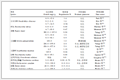
The spreading speeds of the 3a-3p were 4-10 cm/s and the areas were 125-380 cm2 ,respectively (Table 1). The spreading speeds showed an accelerating trend with the increasing chain length of ethylene glycol group linked on phenoxy carboxylic acid. The excellent self-spreading abilities provided the practical application for the water hyacinth control.
|
Table 1 The self-spreading abilities of 3a-3p. |

The herbicidal activities of the novel derivatives against water hyacinth plants were examined with comparison to the control groups. As shown in Table 2,the compounds showed good to excellent herbicidal activities against the root and leaf of the plants. The control groups (1a-1d) exhibited poor herbicidal activities because of their poor dissolution abilities. The com- pounds with an electron-withdrawing group at the 4-position of the benzene rings (3i-3p) possessed better herbicidal activities than 3a-3h. Among these compounds,3m showed 88.7% fresh weight loss rate,99.0% new root inhibition rate and 100% leaf wilting rate. Increasing the chain length of the derivatives led to a decline in herbicidal activities. Compared with traditional herbi-cides which must be dispersed throughout the entire body of water,the designed and synthesized self-spreading compounds in our work only floated on the water surface according to the free- floating habit of water hyacinth. The above advantages endowed the self-spreading and floating derivatives with excellent herbi- cidal activities at very low surface concentrations.
|
|
Table 2 The herbicidal activities of the novel derivatives against water hyacinth plants. |


In summary,a series of novel self-spreading phenoxy carboxylic acid derivatives were designed and synthesized by l2 catalyzed one-step reaction. The derivatives can self-spread and float on the water surface. The bioassay activities results indicated that some target compounds,3i-3p,had excellent herbicidal activities against water hyacinth. These results were worthy for further study in the control of the other harmful aquatic organisms floating on the water surface.
AcknowledgmentsThis work was supported by the Advanced Research Team Project of Jiangxi Province (No. 20133BCB24011),Key Technology R&D Program of Jiangxi Province (No. 20141BBG70070) and Science Foundation of Jiangxi Provincial Department of Education (No. Gjj4669).
Appendix A. Supplementary dataSupplementary data associatedwith this article can be found,in the online version,at http://dx.doi.org/10.1016/j.cclet.2015.04. 008.
| [1] | J.J. Chun, Y. Ding, Q.J. Zhuang, Invasion and control of water hyacinth (Eichhorniacrassipes) in China, J. Zhejiang Univ. Sci. B 7 (2006) 623-626. |
| [2] | A.M. Mailu, Preliminary assessment of the social, economic and environmental impacts of water hyacinth in lake Victoria basin and status of control, in: M.H. Julien, M.P. Hill, T.D. Center, J. Ding (Eds.), Biological and Integrated Control of Water Hyacinth, Eichhornia crassipes, ACIAR Proceedings, 102, 2001, pp. 130-139. |
| [3] | E. van Wyk, B.W. van Wilgen, The cost of water hyacinth control in South Africa: a case study of three options, Afr. J. Aquat. Sci. 27 (2002) 141-149. |
| [4] | J.B. Lu, J.G. Wu, Z.H. Fu, L. Zhu, Water hyacinth in China: a sustainability sciencebased management framework, Environ. Manage. 40 (2007) 823-830. |
| [5] | T.D. Center, F.A. Dray Jr., G.P. Jubinsky, M.J. Grodowitz, Biological control of water hyacinth under conditions of maintenance management: can herbicides and insects be integrated? Environ. Manage. 23 (1999) 241-256. |
| [6] | R. Charudattan, Integrated control of water hyacinth (Eichhornia crassipes) with a pathogen, insects, and herbicides, Weed Sci. 34 (1986) 26-30. |
| [7] | L. Gao, B. Li, A potential native natural enemy of invasive aquatic weed-water hyacinth, Biol. Invasions 8 (2006) 1689-1692. |
| [8] | F.F. Bebawi, B.F. Mohamed, Effects of 2,4-D on mature and juvenile plants of water hyacinth (Eichornia crassipes (Mart.) Solms), Hydrobiologia 110 (1984) 91-93. |
| [9] | B. Zhou, The progress of pesticide formulations and application techniques in Japanese, Pesticides 38 (1999) 40-42. |
| [10] | W.T. Penfound, V. Minyard, Relation of light intensity to effect of 2,4-dichlorophenoxyacetic acid on water hyacinth and kidney bean plants, Bot. Gaz. 109 (1947) 231-234. |
| [11] | A.H. Pieterse, F.A. Roorda, L. Verhagen, Ten-fold enhancement of 2,4-D effect on water hyacinth by addition of gibberellic acid, Experientia 36 (1980) 650-651. |
| [12] | B.A. Noskov, S.Y. Lin, G. Loglio, R.G. Rubio, R.Miller, Dilational viscoelasticity of PEO-PPO-PEO triblock copolymer films at the air-water interface in the range of high surface pressure, Langumuir 22 (2006) 2647-2652. |
| [13] | D.J. Fu, Y. Jin, M.Q. Xie, Y.J. Ye, D.D. Qin, K.Y. Lou, Y.Z. Chen, F. Gao, Preparation and characterization of mPEG grafted chitosan micelles as 5-fluorouracil carriers for effective anti-tumor activity, Chin. Chem. Lett. 25 (2014) 1435-1440. |
| [14] | C.L. Liu, G. Wu, S.C. Chen, J. You, Y.Z. Wang, Crystallization induced micellization of poly(p-dioxanone)-block-polyethylene glycol diblock copolymer functionalized with pyrene moiety, Chin. Chem. Lett. 25 (2014) 1311-1317. |
| [15] | X.Y. Zhou, Y.R. Jiang, C.C. Li, X.Y. Xie, Synthesis of poly(ethylene glycol)-functionalized hydroxyapatite organic colloid intended for nanocomposites, Chin. Chem. Lett. 24 (2013) 647-650. |
| [16] | T. Ogawa, K. Hirao, S. Osawa, Spreading behavior of the oil-film area of fuel oil on the surface of the water, SEKIYU GAKK 43 (2000) 207-212. |
| [17] | D.W. Camp, J.C. Berg, The spreading of oil on water in the surface-tension regime, J. Fluid Mech. 184 (1987) 4445-4462. |