


b National Development Center for High Technology Green Material, Beijing 100081, China
For the research of lithium-ion secondary battery,lithium transition metal phosphates such as LiMPO4 (M= Fe,Co,Ni,Mn), Li3M2(PO4)3 (M= Fe,V) and LiVPO4F have been extensively studied [1, 2, 3, 4, 5].NASICONcathodematerial Li3V2(PO4)3 is a promising cathode material that can guarantee both dynamic and thermal stability,but the relatively lowelectronic and ionic conductivity restrict itswider applications [6, 7]. To solve the problem,cation doping is one of an effective strategy. Despite the fact that several metallic ion-doped Li3MxV2-x(PO4)3/C (M= Cr3+,Mn2+,Mg2+,Al3+,Na+,etc.)[8, 9, 10, 11, 12]have been studied,the electrochemical performance of the nominal Li3MxV2-x(PO4)3/C has not reached a satisfactory level. In this paper, Nd3+is selected to dope into Li3V2(PO4)3,and Li3NdxV2-x(PO4)3, which has good electrochemical performance in high discharge rate and long cycle,is synthesized.
2. ExperimentalThe Li3NdxV2-x(PO4)3 (x = 0.00,0.02,0.05,0.08 or 0.1) composites were prepared by the rheological phase reaction method,which produced more homogeneous particles than the conventional solid-state reactions. Stoichiometric amount of Li2CO3 (A.R.),V2O5 (A.R.),(NH4)2HPO4 (A.R.),Nd2O3,C6H12O6 were employed as the starting materials. The carbon source,C6H12O6 was added in the process as a reducing reagent at the minimum dose level according to the reaction equations. First,stoichiometric amount of Li2CO3,V2O5,(NH4)2HPO4 and C6H12O6 were fullymixed by grinding in a mortar for half an hour. An amount of deionized water was added in themixture to give a rheological body. Second, the mixture was transferred into a sealed polytetrafluoroethylene container and then maintained at 80 °C for 12 h. Finally,the mixture was heated at 60 °C for 4 h until it was dried,and the solid was grinded to produce a lavender precursor. The precursor was initially calcined at 350 °C for 3 h and then treated at 750 °C for 6 h under flowing argon to yield the Li3V2(PO4)3 composite materials. Doped sampleswere prepared by the same process for comparison.
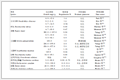
3. Results and discussionFig. 1 shows the XRD patterns of the Li3NdxV2-x(PO4)3 (x = 0.00, 0.02,0.05,0.08 or 0.1) composites. The cell parameters that are carried out using the software Jade are presented in Table 1. The Nd3+ -doped samples show a monoclinic Li3V2(PO4)3 phase,similar to the pristine sample. According to a comparative analysis of all the samples,there is little impurity detected within the resolution of XRD patterns. Lattice parameters of a,b and c vary and the cell volume of Li3NdxV2-x(PO4)3 decreases with the increasing of Nd3+ -doped content. The peak type is clear and sharp with a small deviation in position,which indicates that crystal growth is in good condition and the doping of Nd3+ has a certain influence on the formation of crystals.

|
Download:
|
| Fig. 1.XRD patterns of Li3NdxV2-x(PO4)3 (x = 0.00,0.02,0.05,0.08 or 0.1) samples. | |
|
Table 1 Lattice parameters of Li3NdxV2-x(PO4)3 (x = 0.00,0.02,0.05,0.08 or 0.1) samples. |


After Nd3+ doping,there is a small amount of impurity peaks that may be attributed to the form of NdPO4. The positions of almost characteristic peaks have shifted,because Nd3+ ions have penetrated into the lattice structure. Meanwhile,the decrease of lattice parameters may also be due to the doping of Nd3+ . The diameter of Nd3+ ion ismuch larger than that of V5+ ion.When Nd3+ substitutes the location of V5+ ,it may squeeze the crystal lattice and lead to a collapse of the lattice,so that cell parameters reduce slightly with the doping of Nd3+ . More Nd3+ ions may act as scaffolds,which are helpful for the increasing of cell volume.
The initial charge/discharge curves of Li3NdxV2-x(PO4)3 (x = 0.00,0.02,0.05,0.08 or 0.1) samples at a 0.2 C rate in potential range of 3.0-4.3 V are shown in Fig. 2. It can be seen that the LVP sample kept the highest charge capacity and reached 128.3 mAh/g,which is closed to the theoretical capacity of 132 mAh/g. But the discharge capacity of LVP is only 108.8 mAh/g with an efficiency of 84.8%. The discharge capacities of Li3NdxV2-x(PO4)3 depended significantly on the Nd3+ amount. Li3Nd0.08V1.92(PO4)3 shows better performance than others, which has a charge/discharge capacity of 123.4 mAh/g and 115.8 mAh/g,respectively,and a corresponding coulombic efficiency of 93.8%. These results confirm that properly Nd3+ - doped Li3NdxV2-x(PO4)3 exhibited better electrical performance than that of LVP. This can be explained by the increase of free electrons in lattice by the small amount of Nd3+ . Moreover, excessive Nd3+ doping would block the tunnels of Li + ions and reduce the charge/discharge capacities.

|
Download:
|
| Fig. 2. The initial charge-discharge profiles of Li3NdxV2-x(PO4)3 (x = 0.00,0.02,0.05, 0.08 or 0.1) samples at 0.2 C in potential range of 3.0-4.3 V. | |

Fig. 3 shows the rate capability of Li3NdxV2-x(PO4)3 (x = 0.00, 0.02,0.05,0.08 or 0.1) at various controlled rates. The cell was first cycles at 0.2 C,and the rate was increased in stages to 2 C in the voltage range of 3.0-4.3 V. The discharge capacity of Li3Nd0.08V1.92(PO4)3 delivers 111.3 mAh/g at 0.2 C and does not change after 10 cycles. The sample also displays a good performance of reversibility at 0.5 C and 1 C. After 50 weekly cycles,the discharge capacity still retains 90.0 mAh/g (80.86% of capacity retention) by increasing the rate from 0.2 C to 2 C. It shows that the Nd3+ -doped samples have excellent rate discharge performance. In comparison,the Nd3+ -free sample unfolds a specific capacity of 106.4 mAh/g at 0.2 C and achieves a 43.8 mAh/ g discharge capacity after increasing the rate to 2 C,which only has a capacity retention of 41.16%. Therefore,the introduction of Nd3+ is also beneficial for the rate capability.

|
Download:
|
| Fig. 3. The rate performance of the Li3NdxV2-x(PO4)3 (x = 0.00,0.02,0.05,0.08 or 0.1) samples between 3.0 and 4.3 V. | |

The 51st cycle galvanostatic charge-discharge curves of Li3NdxV2-x(PO4)3 (x = 0.00,0.02,0.05,0.08 or 0.1) at 0.2 C are presented in Fig. 4. It can be seen that the voltage platformofNd3+ - free LVP becomes short and tilt,and the platformvalue decrease to an average of 3.4 V (Platform B1). Obviously,the Nd3+ -doped samples have better floors. Li3Nd0.08V1.92(PO4)3,which has the best discharge capacity,possesses a stable double discharge platformof 3.60 V/3.53 V separately (Platform A1/A2). The changes of voltage platform value may be caused by a smaller potential polarization, which can improve the Li+ migration number and the electronic conductivity.

|
Download:
|
| Fig. 4. Galvanostatic charge-discharge curves of Li3NdxV2-x(PO4)3 (x = 0.00,0.02, 0.05,0.08 or 0.1) samples with the rate of 2 C in 51st cycle. | |

The cycle performance of Li3NdxV2-x(PO4)3 (x = 0.00,0.02,0.05, 0.08 or 0.1) at 0.2 C is given in Fig. 5. For the pristine one,the specific discharge capacity is 85.1 mAh/g and the capacity retention is 80.8% after 80 cycles. In contrast,Li3Nd0.05V1.95(PO4)3 obtains the best specific discharge capacity,which holds at 100.4 mAh/g with a capacity retention of 92.4%. It may be understood that the Li + migration activity is improved by doping a proper amount of Nd3+ ,which is beneficial to the stability of the lattice structure and results in a good cycle performance.

|
Download:
|
| Fig. 5. The cyclic behavior of Li3NdxV2-x(PO4)3 (x = 0.00,0.02,0.05,0.08 or 0.1) samples at 0.2 C between 3.0 and 4.3 V. | |

The CV curves are recorded for the Li3V2(PO4)3 and Li3Nd0.08V1.98(PO4)3 systems at the scanning rate of 0.1 mV/s in a voltage range of 3.0-4.4 V. As shown in Fig. 6,both curves exhibit a similar profile. There are three oxidation peaks of Li3V2(PO4)3 at around 3.65,3.73 and 4.13 V (peaks C1,C2,C3),couplingwith three reduction peaks at 3.55,3.62,and 3.88 V (peaks D1,D2,D3), respectively. However,the oxidation of Li3Nd0.08V1.92(PO4)3 peaks shift to 3.63,3.71,and 4.13 V,while the reduction peaks shift up to 3.56,3.62,and 3.92 V,respectively. The similar shape of CV curves show that the Nd3+ doping does not change the structure of Li3V2(PO4)3 during the electrochemical and phase transition processes. The anodic peaks are more apparent and intense in Li3Nd0.08V1.92(PO4)3 system,and the potential differences between the anodic and cathodic peaks become smaller. It should be noted that the lithium extraction and insertion processes for Li3Nd0.08V1.92(PO4)3 are much more ordered than the pristine one. In addition,it also reflects that the potential polarization of Li3Nd0.08V1.92(PO4)3 is decreased compared with the un-doped one,which is good for the improvement of the electrode reaction reversibility.

|
Download:
|
| Fig. 6. CV curves of pristine Li3V2(PO4)3 and Nd-doped Li3Nd0.08V1.92(PO4)3 between 3.0 and 4.4 V. | |

In summary,Nd3+ -doped Li3NdxV2-x(PO4)3 (x = 0.00,0.02,0.05, 0.08 or 0.1) has been successfully prepared via the rheological phase reaction. XRD patterns show that all the samples have the similar monoclinic crystal structure. The changes of peak positions and lattice parameters prove the existence of Nd3+ in the Li3NdxV2-x(PO4)3 lattice. A proper doping amount of Nd3+ can enhance the electrochemistry properties of the samples,including high rate capacity and cyclic stability. Li3Nd0.08V1.92(PO4)3 has a charge/discharge capacity of 123.4mAh/g and 115.8mAh/g,re- spectively,and a corresponding coulombic efficiency of 93.8%. After 50 weekly cycles,its discharge capacity still retains 90.0mAh/g (80.86% of capacity retention) by increasing the rate from 0.2 C to 2 C. The CV curse confirms the increased electrode’s reversibility by Nd3+ doping. Thus,a proper amount of Nd3+ dopingmay strengthen the electronic conductivity and the Li + diffusion in Li3NdxV2-x(PO4)3, which is favorable to improve the electrochemical performance of that material.
AcknowledgmentsThis work was supported by the National Key Programfor Basic Research of China (No. 2009CB220100),National High-tech 863 Key Program (No. 2011AA11A235),and Basic Research Fund of Beijing Institute of Technology (No. 3100012211111).
| [1] | K. Kesavan, C.M. Mathew, S. Rajendran, Lithium ion conduction and ion-polymer interaction in poly(vinyl pyrrolidone) based electrolytes blended with different plasticizers, Chin. Chem. Lett. 25 (2014) 1428-1434. |
| [2] | X. Wang, Y.J. Yang, Y. Ma, J.N. Yao, Controlled synthesis of multi-shelled transition metal oxide hollow structures through one-pot solution route, Chin. Chem. Lett. 24 (2013) 1-6. |
| [3] | C. Delacourt, L. Laffont, R. Bouchet, et al., Toward understanding of electrical limitations (electronic, ionic) in LiMPO4 (M = Fe, Mn) electrode materials, J. Electrochem. Soc. 152 (2005) A913-A921. |
| [4] | S.F. Yang, P.Y. Zavalij, M.S. Whittingham, Hydrothermal synthesis of lithium iron phosphate cathodes, Electrochem. Commun. 3 (2001) 505-508. |
| [5] | J. Barker, M.Y. Saidi, J.L. Swoyer, Electrochemical insertion properties of the novel lithium vanadium fluorophosphate, LiVPO4F, J. Electrochem. Soc. 150 (2003) A1394-A1398. |
| [6] | H. Huang, S.C. Yin, T. Kerr, N. Taylor, L.F. Nazar, Nanostructured composites: a high capacity, fast rate Li3V2(PO4)3/carbon cathode for rechargeable lithium batteries, Adv. Mater. 14 (2002) 1525-1528. |
| [7] | S. Patoux, C. Wurm, M. Morcrette, G. Rousse, C. Masquelier, A comparative structural and electrochemical study of monoclinic Li3Fe2(PO4)3 and Li3V2(PO4)3, J. Power Sources 119-121 (2003) 278-284. |
| [8] | Y.H. Chen, Y.M. Zhao, X.N. An, et al., Preparation and electrochemical performance studies on Cr-doped Li3V2(PO4)3 as cathode materials for lithium-ion batteries, Electrochim. Acta 54 (2009) 5844-5850. |
| [9] | S. Zhang, Q. Wu, C. Deng, et al., Synthesis and characterization of Ti-Mn and Ti-Fe codoped Li3V2(PO4)3 as cathode material for lithium ion batteries, J. Power Sources 218 (2012) 56-64. |
| [10] | C. Deng, S. Zhang, S.Y. Yang, et al., Effects of Ti and Mg codoping on the electrochemical performance of Li3V2(PO4)3 cathode material for lithium ion batteries, J. Phys. Chem. C 115 (2011) 15048-15056. |
| [11] | Q.Q. Chen, X.C. Qiao, Y.B. Wang, et al., Electrochemical performance of Li3-x-NaxV2(PO4)3/C composite cathode materials for lithium ion batteries, J. Power Sources 201 (2012) 267-273. |
| [12] | J. Barker, R.K.B. Gover, P. Burns, A. Bryan, The effect of Al substitution on the electrochemical insertion properties of the lithium vanadium phosphate, Li3V2(PO4)3, J. Electrochem. Soc. 154 (2007) A307-A313. |