


Advances in column technologies have contributed to the development of high-performance liquid chromatography (HPLC) as a modern analytical technique [1]. Reversed-phase liquid chromatography (RPLC) is the most widely used chromatographic separation technology owing to its higher column efficiency and separation ability [2],and is always performed with octadecylated silica (ODS) columns. However,RPLC is not quite suitable to analyze the polar molecules because of the stationary phase with very strong hydrophobicity. On the other hand,since the separation with RPLC only depends on the difference of the hydrophobic interaction between solute and stationary phase,it is lack of selectivity to the solute. Thus,new stationary phases are still emerging and have been studied in recent years [3, 4]. Chemical modification of silica packing materials is still a popular method that is used to achieve novel solute selectivity in HPLC [5].
Recently,ionic liquids (ILs) immobilized on silica as novel HPLC stationary phases have attracted considerable attention for their differential behavior and low free-silanol activity due to their useful and desirable physicochemical properties,such as low melting point,low volatility,and high dissolvability [6, 7, 8]. Indeed, around more than 20 species of surface-confined ionic liquids stationary phases have been developed in the recent years [9]. Several ILs are bonded to silica such as imidazole [10, 11] and pyridine [12, 13]. Their chromatographic behavior has been studied,and despite the presence of a positive charge on the stationary phase,they showed considerable promise for the separation of neutral solutes (not only basic analytes),when operated in RPLC mode. This promotes the study on the potential for truly multimodal stationary phases.
However,at present the application of IL-modified HPLC stationary phase is only limited to separate and analyze the small solutes [14, 15, 16, 17]. So far,it has not been reported to be applied to protein separation. The main reasons are that when performed in RPLC mode,the pH value is less than 3 with adding 0.1% trifluoroacetic acid (TFA) as ion-pairing reagent in the mobile phase,so the proteins are charged positively resulting not to be retained on the same charged stationary phase by electrostatic repulsion. On the other hand,with the ILs cation group attached on the silica surface,it can display a strong anion-exchange mechanism [10]. However,when performed in ion exchange chromatography (IEC) mode,the proteins cannot be eluted due to the strong hydrophobicity of the stationary phase.
In this paper,N-methylimidazolium IL-modified silica-based stationary phase (SilprMim) was prepared and investigated as a novel multi-interaction stationary phase charged positively for protein separation. Compared with commonly used commercial ODS column,the novel stationary phase can be performed in RPLC/ IEC mode,and shows the selectivity and good resolution to acidic proteins.
2. Experimental 2.1. Preparation of N-methylimidazolium IL-modified silica-based stationary phaseThe N-methylimidazolium IL-modified silica-based HPLC sta- tionary phase (SilprMim) was prepared as the same as that was described previously [10] and the procedurewas shown in Scheme 1.

|
Download:
|
| Scheme.1.The synthetic procedures of N-methylimidazolium IL-modified stationary phases. | |
SilprMim was synthesized by a two-step reaction. Firstly,5 g
silica (5 μm particle size; 300 pore size; 180 m2
/g surface area,
purchased from Lanzhou Institute of Chemical Physics,Chinese
Academy of Sciences,China)was immersed in hydrochloric acid for
24 h and then washed with deionized water and dried under
vacuum at 120 °C for 8 h. Then,the activated silica (5 g) was
suspended in 100 mL of dry toluene and then an excess of 3-
chloropropyltrimethoxysilane (5.0 mL) was added,followed by
0.2 mL of triethylamine (added as a catalyst). The suspension was mechanically stirred and refluxed at 120 °C for 36 h. After
refluxing,the reaction was stopped. The modified silica was
cooled to room temperature and washed with toluene,methanol,
and water in turn finally with methanol (100 mL). The chlor-
opropyl silica (SilprCl) was obtained and dried under vacuum at
65 °C for 12 h.
pore size; 180 m2
/g surface area,
purchased from Lanzhou Institute of Chemical Physics,Chinese
Academy of Sciences,China)was immersed in hydrochloric acid for
24 h and then washed with deionized water and dried under
vacuum at 120 °C for 8 h. Then,the activated silica (5 g) was
suspended in 100 mL of dry toluene and then an excess of 3-
chloropropyltrimethoxysilane (5.0 mL) was added,followed by
0.2 mL of triethylamine (added as a catalyst). The suspension was mechanically stirred and refluxed at 120 °C for 36 h. After
refluxing,the reaction was stopped. The modified silica was
cooled to room temperature and washed with toluene,methanol,
and water in turn finally with methanol (100 mL). The chlor-
opropyl silica (SilprCl) was obtained and dried under vacuum at
65 °C for 12 h.
Secondly,the chloropropyl groups on SilprCl reacted with N- methylimidazolium. Briefly,3.0 g SilprCl was placed in a reaction flask containing 60 mL of acetonitrile. Then,a large excess of N- methylimidazolium (3.0 mL) was added into the mixture. The reactionmixture was stirred under nitrogen at 80 °C for 24 h. Then the reaction was stopped and the modified silica was washed with methanol,water and methanol in turn. The silica chemically bonded with N-methylimidazolium,SilprMim was dried under vacuum at 50 °C for 4 h.
2.2. Chromatographic conditionsIn RPLC mode,the column was equilibrated in mobile phase 1A (H2O + 0.1% TFA),and the proteins were eluted at a flow rate of 1.0 mL/min with a 30 min linear gradient of 0-100% mobile phase 1B (CH3CN + 0.1% TFA). The detection wavelength was 280 nm.
In RPLC/IECmode,the columnwas equilibrated inmobile phase 2A (H2O + 10 mmol/L KH2PO4,pH 7.0),and the proteins were eluted at a flow rate of 1.0 mL/min with a 30 min linear gradient of 0-100% mobile phase 2B (50% H2O + 50% CH3CN + 1.0 mol/L NaClO4 + 10 mmol/L KH2PO4,pH 7.0). The detection wavelength was 280 nm.
3. Results and discussion 3.1. Protein separation using SilprMim in RPLC modeAs described previously [10],SilprMim was prepared and characterized by Fourier Transform Infrared Spectroscopy (FT-IR) and elemental analysis. The results were exactly consistent with the literature,which confirmed that N-methylimidazolium was immobilized to silica gel successfully.
Firstly,the novel stationary phase was used to separate protein standards in RPLC mode. Unfortunately,all of the tested protein standards (including acidic and basic) cannot be retained on this stationary phase at all. Themain reason could be thatwhen adding 0.1% TFA as the ion-pairing reagent in the mobile phase,the pH value of the mobile phase is less than 3,all of the tested proteins are charged positively. As a result,the positively charged proteins were eluted out directly by electrostatic repulsion based on N- methylimidazolium cation group attached on the surface of the stationary phase.
Moreover,the effects of the pH values of the mobile phase on the protein separation were investigated in detail. Using the mobile phase 1A containing 10 mmol/L phosphate buffer saline (PBS) at neutral pH,all of the basic proteins tested,such as myoglobin (pl 7.0),RNase B (pl 8.8),RNase A (pl 9.4),a-chymotrypsin A (pl 9.5),cytochrome C (pl 10.6) and lysozyme (pl 11.0) can still not be retained on this stationary phase by electrostatic repulsion. On the contrary,all of the acidic proteins tested,such as human serumalbumin (HSA,pl 4.64),BSA (pl 4.98), α-acid glycoprotein (pl 3.5),ovalbumin (pl 4.7),trypsin inhibitor (pl 4.55),insulin (pl 4.5),α-lactoglobulin (5.8),β-lactoglobulin (pl 5.2),conalbumin A (pl 6.3) and α-amylase (pl 6.0) were charged negatively. Due to the strong electrostatic and hydrophobic interactions with SilprMim,these acidic proteins were adsorbed on the surface of SilprMim too tightly to be eluted in RPLC mode.
3.2. Protein separation using SilprMim in RPLC/IEC modeIn order to elute the acidic proteins from SilprMim,the electrostatic and hydrophobic interactions between the acidic proteins and SilprMim must be inhibited or reduced. So we explored a strategy to add salt in themobile phase B to increase the ionic strength. Sodium perchlorate (NaClO4) is a kind of inorganic salt and soluble in bothwater and acetonitrile [18]. Thus,1.0 mol/L NaClO4 as additives was added in the mobile phase 2B and the performance was similar to anion exchange chromatography (AEC). With the increase of the ionic strength and the concentrα- tion of organic eluent,the electrostatic and hydrophobic interac- tions between the acidic proteins and the stationary phase can be inhibited or reduced leading to the acidic proteins being eluted from SilprMim.
A mixture of acidic proteins was separated by SilprMim with a 30 min linear gradient elution in RPLC/IEC mode (shown in Fig. 1). Because BSA and α-acid glycoprotein could be separated partly and the peaks of α-amylase and ovalbumin were overlapped with each other completely,only eight kinds of acidic proteins,including HSA,α-acid glycoprotein,ovalbumin,trypsin inhibitor,insulin,α- lactoglobulin,β-lactoglobulin and conalbumin A,were shown in Fig. 1. From Fig. 1,it can be seen that the eight kinds of acidic proteins can be separated completely with SilprMim. The result indicates that the novel stationary phase with N-methylimidazo- lium cation group not only displays selectivity to the acidic proteins,but also the higher column efficiency and better resolution can be achieved in RPLC/IEC mode.

|
Download:
|
| Fig. 1. The chromatogram of eight kinds of acidic proteins separated with SilprMim in RPLC/IEC mode. Chromatographic condition: the length of the column: 50 mm×4.6 mm I.D.; mobile phase in RPLC/IEC mode: solution 2A, H2O + 10 mmol/L KH2PO4,pH 7.0; solution 2B,50% H2O + 50% CH3CN + 1.0 mol/L NaClO4 + 10 mmol/L KH2PO4,pH 7.0; the flow rate: 1.0 mL/min,linear gradient elution: 30 min,0-100% B; detector: 280 nm; peaks: (1) HSA,(2) α-acid glycoprotein,(3) ovalbumin,(4) trypsin inhibitor,(5) insulin,(6) α-lactoglobulin, (7) β-lactoglobulin,and (8) conalbumin A. | |
Based on the difference of the hydrophobicity between the proteins and C18 stationary phase,the proteins can be separated by ODS column. A mixture containing acidic and basic proteins was separated with a conventional ODS column in RPLC mode and was shown in Fig. 2. It can be seen that both acidic and basic proteins can be retained on it. Therefore,compared with the novel stationary phase above,ODS column cannot show selectivity to the acidic proteins.

|
Download:
|
| Fig. 2. The chromatogram of six kinds of proteins separated with ODS column. Chromatographic condition: mobile phase in RPLC mode: solution 1A,H2O + 0.1% TFA; solution 1B,CH3CN + 0.1% TFA; the flow rate: 1.0 mL/min,linear gradient elution: 30 min,0-100% B; detector: 280 nm; peaks: (1) RNase A,(2) insulin,(3) cytochrome c,(4) lysozyme,(5) myoglobin,and (6) ovalbumin. | |
Six kinds of acidic proteins were separated with ODS column and shown in Fig. 3.However,they cannot be separated completely by ODS column. Compared Fig. 1with Fig. 3,it can be observed that not only the elution order of these acidic proteins is different,but also the resolution of the latter is worse than the former. The reason is that protein separation with RPLC is mainly based on the difference of the hydrophobic interaction between proteins and ODS column,butwhen protein is separatedwith SilprMimin RPLC/ IECmode,multiplemodes of interactions,such as hydrophobic and electrostatic interactions between protein and the stationary phase can contribute to the protein separation. Therefore,the selectivity and resolution of SilprMim to the acidic proteins can be enhanced.

|
Download:
|
| Fig. 3. The chromatogramof six kinds of acidic proteins separatedwith ODS column. Chromatographic condition: mobile phase in RPLC mode: solution 1A,H2O + 0.1% TFA; solution 1B,CH3CN + 0.1% TFA; the flow rate: 1.0 mL/min,linear gradient elution: 30 min,0-100% B; detector: 280 nm; peaks: (1) HSA,(2) insulin,(3) α- lactoglobulin,(4) conalbumin A,(5) β-lactoglobulin,and (6) ovalbumin. | |
To investigate the effect of ligand structure of the stationary phases on protein separation,besides N-methylimidazolium, several other ionic liquids,such as 4-methylthiazole (Fig. 4A), pyrazine (Fig. 4B) and pyridine (Fig. 4C) were also immobilized on the silica gel to formnewligands,respectively. The chromatograms of the protein standards separated by the three kinds of ILs- modified stationary phases in RPLC/IECmodewere shown in Fig. 4. To compare with N-methylimidazolium as ligand (Fig. 1),it can be seen that with the cation group attached on the silica surface,the acidic proteins can also be retained on the other three ILs-modified stationary phase with the same elution order as Fig. 1. However, conalbumin A cannot be eluted from the three stationary phases and β-lactoglobulin cannot be eluted from pyrazine and pyridine modified stationary phases,respectively (Fig. 4B and C). In addition,the basic proteins,such as lysozyme and cytochrome c can be retained on them. Because both acidic and basic proteins can be retained on the other three ILs-modified stationary phases (Fig. 4),unlike N-methylimidazolium modified as ligand (Fig. 1), they cannot show selectivity for the acidic proteins.

|
Download:
|
| Fig. 4. The chromatograms of protein mixture separated with three kinds of ionic liquid stationary phase in RPLC/IEC mode. Ligand structure: (A) 4-methylthiazole,(B) pyrazine,and (C) pyridine. Chromatographic conditions are the same as those indicated in Fig. 1. Peaks: (1) HSA,(2) ovalbumin (3) trypsin inhibitor,(4) insulin,(5) α- lactoglobulin,(6) β-lactoglobulin,(7) lysozyme,and (8) cytochrome c. | |
The values of pKb and the hydrophobic fragment constant (log P) of four kinds of ligands were listed in Table 1,respectively. Based on the Lewis acid-base theory,with the decrease of pKb,the anion exchange capacity of the ligand with the cation group becomes stronger,and with the increase of log P,the hydropho- bicity of the ligand also becomes larger. In fact,these two forces are opposite with ionic liquid as ligand. To compare with N- methylimidazolium as ligand,the electrostatic interaction be- tween the acidic protein and the pyridine-modified stationary phase becomes weaker,but the hydrophobic interaction between them becomes so stronger that β-lactoglobulin and conalbumin A cannot be eluted from pyridine-modified stationary phase. Meanwhile,the basic proteins,such as lysozyme and cytochrome c can also be retained on it. The similar results were also obtained in Fig. 4A and B due to the weaker electrostatic repulsion and stronger hydrophobic interaction between the basic protein and 4- methylthiazole or pyrazine ionic liquid as ligand.
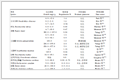
|
Table 1 pKb and log P of N-methylimidazolium,4-methylthiazole,pyrazine and pyridine ionic liquids as ligands. |


As discussed above,it is obvious that the retention mechanism of protein on SilprMim is very different from that performed with RPLC or AEC. It is known that the conventional ODS or other alkylated organic stationary phases can recognize the hydropho- bicity of solutes in HPLC. This indicates that these stationary phasesmay be able to separate two proteinmolecules which differ only in the extent of hydrophobic interactions between the proteins and the packing materials. Thus,the more the hydropho- bicity of proteins,the stronger they are retained on the ODS column. However,compared Fig. 1 with Fig. 3,the elution order of the eight kinds of acidic proteins from SilprMim is much different from ODS column. For example,the hydrophobicity of ovalbumin is the strongest among the acidic proteins (Fig. 3),but it is eluted before the other five kinds of acidic proteins in Fig. 1.
Furthermore,the elution order of these acidic proteins from SilprMim is not the same as that from AEC column according to their pl nature. In AEC,the elution order of proteins is consistent with their pl nature. The lower the pl value,the longer the protein is retained on AEC column. Thus,the elution order of the eight kinds of acidic proteins in AEC should be conalbumin A (pl 6.3), α-lactoglobulin (pl 5.8),β-lactoglobulin (pl 5.2),ovalbumin (pl 4.7),HSA (pl 4.64),trypsin inhibitor (pl 4.55),insulin (pl 4.5) and α-acid glycoprotein (pl 3.5). However,from Fig. 1,it can be seen that HSA (pl 4.64) was the first one to be eluted out from SilprMim,while conalbumin A with the largest pl value became the last one. Moreover,although the pl value of α-acid glycoprotein (pl 3.5) is the lowest,due to its heavy glycosylα- tion,the polarity of the protein molecule becomes so stronger that it is the second one to be eluted out. Therefore,compared with ODS column,based on N-methylimidazolium cation group attached on the silica surface,SilprMim is an anion exchanger, but it has multi-modal retention properties,which involves multiple modes of interactions,such as p-p,hydrophobic, electrostatic and anion-exchange interactions. The protein retention can be controlled mainly by the electrostatic and hydrophobic interactions between the proteins and the station- ary phase. Therefore,with such characteristics of multi- interaction mechanism and multi-modal separation,not only the selectivity to the acidic proteins can be enhanced,but also a better resolution can be achieved.
3.6. The protein separation of egg white with SilprMimEgg white was treated as described previously [19],40 μL of egg white sample was loaded and separated with SilprMim (shown in Fig. 5). The fractions denoted with Arabic numerals were collected and analyzed by SDS-PAGE (Fig. 5). The result indicates that the basic protein lysozyme cannot be retained and eluted out directly with solvent (peak 1),and two kinds of acidic proteins,ovalbumin (peak 2) and ovotransferrin (peak 3),can be separated completely.It confirms further that SilprMim has good selectivity and resolution to the acidic proteins.

|
Download:
|
| Fig. 5.Fig. 5. The chromatogramof egg white separated with SilprMimin RPLC/IECmode (A) and analysis by SDS-PAGE (B). (A) Sample size,40 μL,the chromatographic conditions are the same as those in Fig. 1. (B) Lane S,egg white sample; Lane O,ovalbumin standard; Lane T,ovotransferrin standard; Lane L,lysozyme standard; Lanes 1-3,peaks 1-3. | |

In summary,SilprMim was prepared and investigated as a novel multi-interaction stationary phase charged positively for protein separation. Compared with the conventional ODS column,the novel stationary phase,based on N-methylimidα- zolium cation group attached on the silica surface,displays the strong anion exchange property leading to the selectivity to acidic proteins,and can be performed in RPLC/IEC mode. Because of the mixed-mode retention mechanism,the good selectivity and resolution to acidic proteins can be achieved and enhanced. It indicates that SilprMim has a promising application in the separation and analyses of acidic proteins from the complex samples in proteomics.
AcknowledgmentsThis work is supported by the National 863 Program (No. 2006AA02Z227),Natural Science Foundation of Shaanxi Province (No. 2011JZ002),the Foundation of Key Laboratory in Shaanxi Province (Nos. 2010JS103,11JS097,14JS098),Shaanxi Provincial Science and Technology Co-ordinating innovation projects (No. 2013SZS18-K01).
| [1] | O. Núñez, K. Nakanishi, N. Tanaka, Preparation of monolithic silica columns for high-performance liquid chromatography, J. Chromatogr. A 1191 (2008) 231-252. |
| [2] | H.D. Qiu, X.J. Liang, M. Sun, S.X. Jiang, Development of silica-based stationary phases for high-performance liquid chromatography, Anal. Bioanal. Chem. 399 (2011) 3307-3322. |
| [3] | J.J. Kirkland, J.J. DeStefano, The art and science of forming packed analytical highperformance liquid chromatography columns, J. Chromatogr. A 1126 (2006) 50-57. |
| [4] | J.J. Kirkland, Development of some stationary phases for reversed-phase HPLC, J. Chromatogr. A 1060 (2004) 9-21. |
| [5] | Y.Y. Li, S.Y. Cheng, P.C. Dai, X.M. Liang, Y.X. Ke, Large-pore monodispersed mesoporous silica spheres: synthesis and application in HPLC, Chem. Commun. 9 (2009) 1085-1087. |
| [6] | T.L. Greaves, C.J. Drummond, Protic ionic liquids: properties and applications, Chem. Rev. 108 (2008) 206-237. |
| [7] | X.H. Xiao, S.J. Liu, X. Liu, S.X. Jiang, Application of ionic liquid in analytical chemistry, Chin. J. Anal. Chem. 4 (2005) 569-574. |
| [8] | Q.H. Cai, Y.W. Hou, S.Y. Shi, B. Lu, Y.K. Shan, A novel ionic liquid based on small size cation, Chin. Chem. Lett. 20 (2009) 62-65. |
| [9] | V. Pino, A.M. Afonso, Surface-bonded ionic liquid stationary phases in high-performance liquid chromatography -a review, Anal. Chim. Acta 714 (2012) 20-37. |
| [10] | H.D. Qiu, S.X. Jiang, X. Liu, N-Methylimidazolium anion-exchange stationary phase for high-performance liquid chromatography, J. Chromatogr. A 1103 (2006) 265-270. |
| [11] | H.D. Qiu, S.X. Jiang, X. Liu, L. Zhao, Novel imidazolium stationary phase for highperformance liquid chromatography, J. Chromatogr. A 1116 (2006) 46-50. |
| [12] | T. Takeuchi, T. Kawasaki, L.W. Lim, Separation of inorganic anions on a pyridine stationary phase in ion chromatography, Anal. Sci. 26 (2010) 511-514. |
| [13] | L.M.L.A. Auler, C.R. Silva, K.E. Collins, C.H. Collins, New stationary phase for anionexchange chromatography, J. Chromatogr. A 1073 (2005) 147-153. |
| [14] | S.J. Liu, F. Zhou, X.H. Xiao, et al., Surface confined ionic liquid -a new stationary phase for the separation of ephedrines in high-performance liquid chromatography, Chin. Chem. Lett. 15 (2004) 1060-1062. |
| [15] | H.D. Qiu, A.K. Mallik, M. Takafuji, H. Ihara, A facile and specific approach to new liquid chromatography adsorbents obtained by ionic self-assembly, Chem. Eur. J. 17 (2011) 7288-7297. |
| [16] | H.D. Qiu, S.X. Jiang, M. Takafuji, H. Ihara, Polyanionic and polyzwitterionic azobenzene ionic liquid-functionalized silica materials and their chromatographic applications, Chem. Commun. 49 (2013) 2454-2456. |
| [17] | Y.Q. Sun, A.M. Stalcup, Mobile phase effects on retention on a new butylimidazolium-based high-performance liquid chromatographic stationary phase, J. Chromatogr. A 1126 (2006) 276-282. |
| [18] | A.J. Alpert, Electrostatic repulsion hydrophilic interaction chromatography for isocratic separation of charged solutes and selective isolation of phosphopeptides, Anal. Chem. 80 (2008) 62-76. |
| [19] | K.L. Zhao, L. Yang, X.J. Wang, et al., Preparation of a novel dual-function strong cation exchange/hydrophobic interaction chromatography stationary phase for protein separation, Talanta 98 (2012) 86-94. |