


b Department of Chemistry, Northeastern University, Shenyang 110819, China
1,2-Disubstituted benzimidazoles have been recognized as valuable scaffolds in the development of novel pharmaceutical agents and functional materials [1]. In modern drug discovery,a myriad of benzimidazole-based compounds have been synthesized and displayed a variety of pharmacological effects,such as anti-infective,anti-inflammatory,anti-tumor,and anti-diabetic activities [2].
In our previous research on the synthesis of AKT inhibitor IV (ChemBridge 5233705),the unique 2-aminovinyl benzimidazole core structure posed a huge challenge to the existing synthetic methods for benzimidazoles [3]. The conventional condensation of 1,2-phenylenediamines with anN-arylated 3-aminoacrolein (1) in refluxing ethanol followed byin situoxidation only afforded the products in low yields (<20%) [1, 4]. Our attempt to promote the reaction by adding oxidants (e.g.,potassium peroxymonosulfate [5],I2 [6],MnO2 [7],and 2,3-dichloro-5,6-dicyanop-benzoquinone (DDQ) [8]),acidic catalysts (e.g.,BF3·Et2O[9] and polyphosphoric acid (PPA) [10]),or reducing agents (e.g., SnCl2[11]) according to precedent reports failed to generate the desired product. Interestingly,in our search for potential metal catalyst [12],we found that ZrOCl2·8H2O and ZrCl4 exhibited a dramatic catalytic effect on the reactions of 1,2-phenylenediamines with1and improved the yields to 50%-70% [3]. However, the understanding of this metal-catalyzed condensation/cyclization reaction is still very limited and the extension of this approach toN,N-dialkylated 3-aminoacroleins has never been explored. We report herein a microwave-assisted method for the synthesis of a diversity of 2-aminovinyl benzimidazoles with bis(cyclopentadienyl)zirconium(IV) dichloride (Cp2ZrCl2)asa more effective catalyst. 2. Experimental
1,2-Phenylenediamines (7-12) were prepared according to the reported procedures [3]. All NMR spectra were obtained with a 400 MHz instrument with chemical shifts reported in parts per million (ppm,δ) and referenced to CDCl3or DMSO-d6. IR spectra were recorded on a FT-IR spectrometer. High-resolution mass spectra were obtained with a TOFQ mass spectrometer and reported as m/z.Microwave reactions were performed on an Anton Paar Monowave 300 instrument with 30 mL reaction vials. The characterization data of known compounds (1-3,5,and 13-18) and 1HNMR and 13C NMR spectra of new compounds (4,6,and19- 25) were included in the Supporting information. 2.1. General procedure for the synthesis of 3-aminoacroleins (1-6)
To a solution of amine (10 mmol) and propargyl alcohol (20 mmol) in toluene (20 mL) was slowly added activated MnO2 (200 mmol) at 0℃. The reaction was stirred for 2 h and then warmed up to 22℃. After 24 h,MnO2was filtered off and washed with ethyl acetate (10 mL). The combined filtrate was concentrated in vacuo. Flash column chromatography on silica gel afforded the product.
s-N-Cyclohexyl-N-ethylaminoacrolein (4): Yellow solid; mp 58-60℃; 1HNMR (400 MHz,CDCl3):δ0.94-1.26 (m,6H),1.26- 1.40 (m,2H),1.50-1.61 (m,1H),1.74 (d,4H,J= 10.6 Hz),2.90-3.19 (m,3H),5.06 (dd,1H,J1= 8.7 Hz,J2= 12.5 Hz),6.98 (d,1H, J= 12.8 Hz),8.92 (d,1H,J= 8.6 Hz); 13C NMR (100 MHz,CDCl3): δ12.3,25.0,25.5,32.3,42.1,65.1,100.9,156.7,189.1; IR (neat, cm-1 ):vmax2927,2848,1595,1442,1350,1161,893,795; HRMS (ESI+): m/z calcd. for C11H19NO [M+H]+ : 182.1467; found: 182.1458.
(E)-3-(4-Methylpiperazin-1-yl)acrylaldehyde (6): Yellow oil; 1H NMR (400 MHz,CDCl3):δ1.88-1.99 (m,3H),2.00-2.21 (m,4H), 2.74-3.28 (m,4H),4.76-4.89 (m,1H),6.64-6.78 (m,1H),8.65-8.75 (m,1H); 13C NMR (100 MHz,CDCl3):δ44.4,45.3,53.5,100.4,158.4, 188.6; IR (neat,cm-1 ): vmax2944,1597,1435,1317,1173,767; HRMS (ESI+):m/zcalcd. for C8H14N2O [M+H]+ : 155.1106; found: 155.1112. 2.2. General procedure for the synthesis of 2-aminovinyl benzimidazoles (13-25)
To a solution of 1,2-phenylenediamine (0.1 mmol) and 3-aminoacrolein (0.12-0.15 mmol) in ethanol (15 mL) was added Cp2ZrCl2(0.05 mmol). The solution was subjected to microwave heating at 80℃ for 3-5 min. Then,MnO2(0.5 mmol) was added, and the reaction was stirred for 5 min. MnO2was filtered off and washed with ethanol (5 mL). The combined filtrate was concentrated in vacuo. Flash column chromatography on silica gel afforded the product.
[(E)-2-(5-Benzothiazole-2-yl-1-phenyl-1H-benzoimidazole-2-yl)ethenyl]isopropylphenylamine (19): Yellow solid; mp 172- 174℃; 1HNMR (400 MHz,CDCl3):δ1.24 (d,6H,J= 6.7 Hz),3. 84-3. 98 (m,1H),4.84 (d,1H,J= 13.3 Hz),7.08 (d,1H,J= 8.4 Hz), 7.13 (d,2H,J= 7.8 Hz),7.21 (dd,1H,J1=J2=7.2 Hz),7.27-7.52 (m, 9H),7.86 (d,1H,J= 7.9 Hz),7.93 (d,1H,J= 8.4 Hz),8.00-8.10 (m, 2H),8.27 (s,1H); 13C NMR (100 MHz,CDCl3):δ21.8,54.7,84.2, 109.3,117.0,120.5,121.5,122.9,124.6,126.1,126.9,127.3,128.0, 128.1,128.5,129.3,129.7,135.1,135.9,138.7,142.5,144.1,145.0, 154.5,156.6,169.6; IR (neat,cm-1 ):vmax3651,1619,1586,1502, 1460,1412,1071,869,754; HRMS (ESI+):m/zcalcd. for C31H26N4S [M+H]+ : 487.1878; found: 487.1869.
[(E)-2-(5-Benzothiazole-2-yl-1-phenyl-1H-benzoimidazole-2-yl)ethenyl]methylbenzylamine(20): Yellow solid; mp 72-74℃; 1H NMR (400 MHz,CDCl3):δ2.72 (s,3H),4.36 (s,2H),4.84 (d,1H, J= 13.0 Hz),7.08 (d,1H,J= 8.4 Hz),7.20 (d,2H,J= 7.2 Hz),7.27- 7.36 (m,4H),7.38-7.51 (m,4H),7.52-7. 63 (m,2H),7.87 (d,1H, J= 7.9 Hz),7.94 (d,1H,J= 8.2 Hz),8.05 (d,2H,J= 10.6 Hz),8.27 (s, 1H); 13C NMR (100 MHz,CDCl3):δ36.7,59.5,81.7,109.3,116.9, 120.5,121.5,122.9,124.7,126.1,127.5,127.6,127.8,128.2,128.7, 128.8,129.9,135.2,136.1,136.9,139.9,144.1,147.7,154.5,156.7, 169.7; IR (neat,cm-1 ): 3674,1626,1595,1497,1466,1276,1052, 895,755; HRMS (ESI+): m/z calcd. for C34H24N4S [M+H]+ : 473.1722; found: 473.1716.
[(E)-2-(5-Benzothiazole-2-yl-1-phenyl-1H-benzoimidazole-2-yl)ethenyl]ethylcyclohexylamine(21): Yellow solid; mp 132-134℃; 1HNMR (400 MHz,CDCl3):δ0.98-1.16 (m,3H),1.18-1.36 (m,3H), 1.37-1.52 (m,2H),1.58-1.70 (m,1H),1.82 (d,4H,J= 10.8 Hz), 3.03-3.31 (m,3H),4.74 (d,1H,J= 13.1 Hz),7.05 (d,1H,J= 8.3 Hz), 7.31 (dd,1H,J1=J2= 7.6 Hz),7.39-7.50 (m,4H),7.56 (dd,2H, J1=J2=7.6 Hz),7.84 (d,1H,J= 3.4 Hz),7.87 (s,1H),7.90 (d,1H, J= 8.4 Hz),8.03 (d,1H,J= 8.2 Hz),8.23 (s,1H); 13C NMR (100 MHz, CDCl3):δ13.3,25.4,26.0,32.4,41.2,64.1,79.8,109.0,116.5,120.1, 121.5,122.8,124.6,126.0,127.6,128.0,128.5,129.8,135.1,136.3, 138.9,144.3,144.7,154.5,157.6,169.8; IR (neat,cm-1 ): 3674, 1622,1497,1460,1395,1275,1218,1067,809,754; HRMS (ESI+): m/zcalcd. for C30H30N4S [M+H]+ : 479.2191; found: 479.2184.
4-[(E)-2-(5-Benzothiazol-2-yl-1-phenyl-1H-benzoimidazol-2-yl)ethenyl]morpholine(22): Yellow solid; mp 172-174℃ (decomp.); 1HNMR (400 MHz,CDCl3):δ 3.12-3.24 (m,4H),3.71 (t,4H, J= 4.6 Hz),4.95 (d,1H,J= 13.3 Hz),7.10 (d,1H,J= 8.4 Hz),7.34 (dd, 1H,J1=J2=7.7 Hz),7.39-7.49 (m,3H),7.52 (dd,1H,J1=J2=7.2 Hz), 7.60 (dd,2H,J1=J2=7.2 Hz),7.73 (d,1H,J= 13.3 Hz),7.88 (d,1H, J= 7.9 Hz),7.95 (d,1H,J= 8.3 Hz),8.05 (d,1H,J= 8.0 Hz),8.26 (s,1H); 13C NMR (100 MHz,CDCl3):δ48.6,66.3,83.3,109.5,117.2,120.9, 121.6,123.0,124.8,126.2,127.7,128.5,128.9,130.1,135.3,136.0, 138.9,144.0,147.0,154.6,156.1,169.5; IR (neat,cm-1 ): 3674,1624, 1498,1443,1392,1081,890,759; HRMS (ESI+):m/z calcd. for C26H22N4OS [M+H]+ : 439.1514; found: 439.1506.
4-Methyl-[(E)-2-(5-benzothiazol-2-yl-1-phenyl-1H-benzoimidazol-2-yl)ethenyl]piperazine (23): Yellow solid; mp 180-182℃ (decomp.); 1HNMR (400 MHz,CDCl3):δ2.29 (s,3H),2.40 (t,4H, J= 4.7 Hz),3.19 (t,4H,J= 4.6 Hz),4.89 (d,1H,J= 13.2 Hz),7.07 (d, 1H,J= 8.4 Hz),7.33 (dd,1H,J1=J2=7.7 Hz),7.37-7.47 (m,3H), 7.50 (dd,1H,J1=J2=7.2 Hz),7.58 (dd,2H,J1=J2=7.4 Hz),7.74 (d, 1H,J= 13.2 Hz),7.87 (d,1H,J= 7.9 Hz),7.93 (d,1H,J= 8.4 Hz),8.03 (d,1H,J= 8.1 Hz),8.24 (s,1H); 13C NMR (100 MHz,CDCl3):δ46.3, 48.3,54.4,82.3,109.4,117.0,120.6,121.5,122.9,124.7,126.1, 127.6,128.2,128.8,130.0,135.2,136.0,138.8,144.0,146.8,154.5, 156.5,169.6; IR (neat,cm-1 ): 3680,1623,1495,1408,1380,1240, 1056,899,751; HRMS (ESI+):m/zcalcd. for C27H25N5S [M+H]+ : 452.1831; found: 452.1841.
4-[(E)-2-Phenyl-1H-benzoimidazole-2-yl)ethenyl]morpholine (24): Yellow solid; mp 64-66℃; 1HNMR (400 MHz,CDCl3):δ3.11 (t,4H,J= 4.8 Hz),3.68 (t,4H,J= 4.8 Hz),4.97 (d,1H,J=13.4Hz), 7.00-7.09 (m,2H),7.19 (dd,1H,J1=J2=7.6 Hz),7.39 (d,2H, J= 7.2 Hz),7.48 (dd,1H,J1=J2=7.3 Hz),7.56 (dd,2H, J1=J2=7.2 Hz),7.63 (d,1H,J= 7.6 Hz),7.66 (d,1H,J= 13.2 Hz); 13C NMR (100 MHz,CDCl3):δ48.5,66.3,84.0,109.2,117.5,121.0, 122.4,127.7,128.5,129.8,136.4,136.6,143.6,146.3,154.3; IR (neat, cm-1 ): 3406,1624,1585,1459,1381,1254,1027,956,767; HRMS (ESI+):m/zcalcd. for C19H19N3S[M+H]+ : 306.1528; found: 306.1519.
{(E)-2-[5-Benzothiazole-2-yl-1-(4-methoxyphenyl)-1H-benzoimidazole-2-yl]ethenyl}methylbenzylamine (25): Yellow solid; mp 76- 78℃; 1HNMR (400 MHz,CDCl3):δ2.71 (s,3H),3.88 (s,3H),4.36 (s, 2H),4.80 (d,1H,J= 13.0 Hz),7.04 (d,3H,J= 8.3 Hz),7.20 (d,2H, J= 7.6 Hz),7.27-7.36 (m,6H),7.45 (dd,1H,J1=J2=7.3 Hz),7.87 (d, 1H,J= 7.9 Hz),7.94 (d,1H,J= 8.3 Hz),8.02 (d,1H,J= 8.0 Hz),8.04- 8.06 (m,1H),8.25 (s,1H); 13C NMR (100 MHz,CDCl3):δ29.8,36.6, 55.7,59.5,81.8,109.2,115.1,116.8,120.4,121.5,122.9,124.6, 126.1,127.5,127.8,128.0,128.6,128.8,135.2,136.9,139.3,144.1, 147.5,154.5,157.1,159.6,169.8; IR (neat,cm-1 ): 3046,1631, 1514,1467,1278,1027,839,760; HRMS (ESI+):m/z calcd. for C31H26N4OS [M+H]+ : 503.1827; found: 503.1819. 3. Results and discussion
To explore the scope of the reaction,a series ofN-arylated and N,N-dialkylated 3-aminoacroleins 1-6 were synthesizedvia a modified procedure described in Scheme 1 [13]. Treatment of 1.0 equiv. of propargyl alcohol with 0.5 equiv. of amino compounds in the presence of 10 equiv. of activated MnO2afforded1-6in 53%- 75% yields. Compared to the δH values of the aldehyde protons of benzaldehyde (10.02),n-hexyl aldehyde (9.66),and cinnamaldehyde (9.74),the δH value of 3-(N-phenyl-N-methyl)aminoacrolein (1) was much smaller (9.27),indicating that the electropositivity of the carbonyl group was remarkably lowered due to the conjugation of electron-donating aniline moiety. This result explained why the conventional condensation methods for regular aldehyde substrates were not applicable on 1. The aldehyde proton peaks of N,N-dialkyl 3-aminoacroleins 3-6 moved toward higher magnetic field (8.92-8.74),suggesting thatN,N-dialkylated 3-aminoacroleins might be less reactive toward nucleophiles because of the higher electron-donating capability of the dialkylamino moiety.

|
Download:
|
| Scheme 1.A general method for the synthesis ofN-arylated andN,N-dialkylated 3-aminoacroleins 1-6. | |
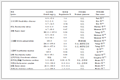
Compared to thermal heating,microwave irradiation has showed positive effects on both reaction time and yield in precedent synthesis of benzimidazoles [7, 14]. In our research, we explored the possibility to improve the synthetic efficacy of 2-aminovinyl benzimidazoles under microwave conditions. In the preliminary experiments,the ethanol solution of 1(1.2 equiv.) and 4-benzothiazol-2-yl-N1 -phenylbenzene-1,2-diamine (7,1.0 equiv.) with different Lewis acids (0.5 equiv.) was irradiated with microwave at 80℃ for 3 min. To the reaction solution was then added activated MnO2(5.0 equiv.) to generate the 2-aminovinyl benzimidazole13. The experimental results listed in Table 1 (entries 1-16) showed that most tested Lewis acids resulted in no reaction or only gave 13in poor yields. In contrast,all of the zirconium(IV) salts exhibited comparable catalytic effect on the formation of 13. Compared to the previously reported ZrCl4and ZrOCl2·8H2O,Cp2ZrCl2-catalyzed reaction afforded 13 in even higher yield (78%). The solvent effect on this reaction was also investigated. The data in Table 1 (entries 16-22) showed that the catalytic effect of Cp2ZrCl2was specific in ethanol and not simply related the dielectric constants and polarity of the solvents, suggesting that Zr(IV) salts might go through a solvolysis process and ethanol was possibly involved in reactive metal complex that promoted the condensation of1and7. It was also confirmed that a minimum of 0.5 equiv. of Cp2ZrCl2was required for complete consumption of7.
|
Table 1 Effects of Lewis acid and solvent on the synthesis of 2-aminovinyl benzimidazole 13. |


As shown in Scheme 2,the reactions of a variety of 1,2-phenylenediamines7-12andN-arylated 3-aminoacroleins 1and 2. with Cp2ZrCl2as the catalyst under microwave conditions followed by MnO2 oxidation yielded the corresponding 2-aminovinyl benzimidazoles 14-19in 70%-76% yields. In contrast,when N,Ndialkylated 3-aminoacroleins3-6 were applied,a higher equivalent of 3-aminoacroleins (1.5 equiv.) and longer microwave irradiation time (5 min) were required to afford 20-25 in good yields (68%-76%). These results were in agreement with our speculation thatN,N-dialkylated 3-aminoacroleins were less reactive than their N-arylated counterparts. Moreover,control experiments based on thermal heating were also performed. The reaction of 7 and N-arylated 3-aminoacrolein1in refluxing ethanol needed 30 min for the first step,whereas that of 7 andN,N-dialkylated 3-aminoacrolein 5 required 2 h. Compared to thermal heating,microwave irradiation also improved the yields of 13 (72% for thermal heating and 78% for MW) and 22(60% for thermal heating and 70% for MW).

|
Download:
|
| Scheme 2.Microwave-assisted synthesis of 2-aminovinyl benzimidazoles 14-25 with Cp2ZrCl2as the catalyst. | |

TLC monitoring of the first step reaction of1and7showed that the major product spot was an orange-colored polar band,which was unstable to isolate. After MnO2oxidation,it was completely converted to the less polar spot of 13. Due to the fact that benzimidazoline intermediate is typically less polar than the corresponding benzimidazole,we proposed that the condensation of1 and 7 favored the formation of imine instead of the cyclized benzimidazoline intermediate in the presence of Cp2ZrCl2. Only after oxidant was added to transform the benzimidazoline intermediate to 13,the cyclization reaction was driven to completion. 4. Conclusion
In summary,we developed a general method for the synthesis of a variety of 2-aminovinyl benzimidazole compounds. Our experimental results showed that Cp2ZrCl2 exhibited the best catalytic effect on the condensation of 1,2-phenylenediamine and 3-aminoacrolein substrates under microwave conditions. This novel synthetic method provides facile and efficient access to diverse 2-aminovinyl benzimidazoles and will facilitate the investigation of their applications in pharmaceutical and material sciences.
AcknowledgmentsWe thank the National Natural Science Foundation of China (Nos. 21262014 to Q. Sun and 21003018 to H.-B. Sun),Key Project of Chinese Ministry of Education (No. 212092),and Research Funds (Nos. ky2012zy08 and 2013QNBJRC001) from JXSTNU for financial support.
Appendix A. Supplementary dataSupplementary data associated with this article can be found,in the online version,at http://dx.doi.org/10.1016/j.cclet.2014.11.014.
| [1] | (a) P.N. Preston, Synthesis, reactions, and spectroscopic properties of benzimidazoles, Chem. Rev. 74 (1974) 279-314; (b) L.C.R. Carvalho, E. Fernandes, M.M.B. Marques, Developments towards regioselective synthesis of 1,2-disubstituted benzimidazoles, Chem. Eur. J. 17 (2011) 12544-12555. |
| [2] | M. Alamgir, D.S.C. Black, N. Kumar, Synthesis, reactivity and biological activity of benzimidazoles, Top. Heterocycl. Chem. 21 (2007) 87-118. |
| [3] | Q. Sun, R.Z. Wu, S.T. Cai, et al., Synthesis and biological evaluation of analogues of AKT (protein kinase B) inhibitor-IV, J. Med. Chem. 54 (2011) 1126-1139. |
| [4] | J.M. Smith, V. Krchnak, A solid phase traceless synthesis of benzimidazoles with three combinatorial steps, Tetrahedron Lett. 40 (1999) 7633-7636. |
| [5] | P.L. Beaulieu, B. Hache, E. von Moos, A practical oxone-mediated, high-throughput, solution-phase synthesis of benzimidazoles from 1,2-phenylenediamines and aldehydes and its application to preparative scale synthesis, Synthesis (2003) 1683-1692. |
| [6] | P. Gogoi, D. Konwar, An efficient and one-pot synthesis of imidazolines and benzimidazoles via anaerobic oxidation of carbon-nitrogen bonds in water, Tetrahedron Lett. 47 (2006) 79-82. |
| [7] | S.Y. Kim, K.H. Park, Y.K. Chung, Manganese(IV) dioxide-catalyzed synthesis of quinoxalines under microwave irradiation, Chem. Commun. (2005) 1321-1323. |
| [8] | J.P. Mayer, G.S. Lewis, C. McGee, et al., Solid-phase synthesis of benzimidazoles, Tetrahedron Lett. 39 (1998) 6655-6658. |
| [9] | R.R. Nagawade, D.B. Shinde, BF3 OEt2 promoted solvent-free synthesis of benzimidazole derivatives, Chin. Chem. Lett. 17 (2006) 453-456. |
| [10] | M.B. Wallace, J. Feng, Z.Y. Zhang, et al., Structure-based design and synthesis of benzimidazole derivatives as dipeptidyl peptidase IV inhibitors, Bioorg. Med. Chem. Lett. 18 (2008) 2361-2362. |
| [11] | L.P. Duan, Q. Li, N.B. Wu, et al., Synthesis of 2,5-disubstitued benzimidazole using SnCl2-catalyzed reduction system at room temperature, Chin. Chem. Lett. 25 (2014) 155-158. |
| [12] | (a) Z.H. Zhang, L. Yin, Y.M. Wang, An expeditious synthesis of benzimidazole derivatives catalyzed by Lewis acids, Catal. Commun. 8 (2007) 1126-1131; (b) R.R. Nagawade, D.B. Shinde, Zirconyl(IV) chloride-promoted synthesis of benzimidazole derivatives, Russ. J. Org. Chem. 42 (2006) 453-454. |
| [13] | K. Deo, S. Kanwar, A. Pandey, et al., Process for the preparation of N-methyl anilino acrolein, WO 2005090256, Chem. Abstr. 145 (2006) 292712. |
| [14] | (a) G. Navarrete-Vázquez, H. Moreno-Diaz, F. Aguirre-Crespo, et al., Design, microwave-assisted synthesis, and spasmolytic activity of 2-(alkyloxyaryl)-1Hbenzimidazole derivatives as constrained stilbene bioisosteres, Bioorg. Med. Chem. Lett. 16 (2006) 4169-4173; (b) R.G. Jacob, L.G. Dutra, C.S. Radatz, et al., Synthesis of 1,2-disubstituted benzimidazoles using SiO2/ZnCl2, Tetrahedron Lett. 50 (2009) 1495-1497." |