


For the prospect of applications as molecular sensors,switches, and data storage devices,a large number of temperature-triggered solid-to-solid phase transition materials (SSPTMs) have been found and studied [1, 2, 3, 4, 5, 6, 7, 8, 9, 10, 11, 12, 13, 14, 15, 16, 17]. Among of them,phase transition materials of molecular-ionic crystals are of great importance and they are also hotspots that chemists are researching. To design such materials,one of the most efficient strategies is to introduce moieties that can easily undergo the order-disorder transitions. Cases for organic cations including pyridinium and imidazolium are flexible cations. While cases for inorganic anions are mainly the tetrahedral ones such as ClO4- ,BF4- and TO4- . The common features of these anions are that they all have small volumes and high symmetries. When changing the temperature,the moieties may undergo an order-disorder transformation,thus leading to phase transitions,as depicted in imidazolium perchlorate [18]. In contrast,octahedral anions like hexafluorophosphate,which can also reorient,have been rarely explored comparing with the tetrahedral ones.
For the above-mentioned reasons,numerous imidazolium and pyridinium have been explored and their tetrafluoroborate and perchlorate compounds have been found to exhibit ferroelectric properties [19, 20, 21]. Moreover,we found that pyridazine cation can also undergo the order-disorder transition triggered by the temperature. However,the pyridazine compounds have not been studied as thorough as imidazolium and pyridinium. According to the literatures,Czapla et al.have reported the structural phase transitions of first order in pyridazine fluoroborate and perchlorate [22, 23]. Interestingly,the phase transitions of these two compounds are coupled with the crystal symmetry changing from the monoclinic P21/nto trigonalR3mon heating. The driving force of the phase transitions can be attributed to the dynamics of the constituent cationic and anionic units. In addition,the existence of intermolecular hydrogen bonds plays an important role in the stabilization of the structures.
In order to check whether hexafluorophosphate compounds have different mechanism of phase transition from the perchlorate and tetrafluoroborate salts,we have successfully synthesized the pyridazine hexafluorophosphate and study its physical properties by X-ray diffraction,dielectric measurement and differential scanning calorimetry (DSC). It turns out that pyridazine hexafluorophosphate undergoes a solid-solid phase transition around 140 K,accompanying by the order-disorder changing of the hexafluorophosphate anion. During the phase transition progress, the pyridazine moiety shows no observable disorder. As far as we know,this is the first low temperature phase transition for pyridazine compounds,and probably will be beneficial for the research of molecular-ionic crystals. 2. Experimental 2.1. Materials and measurements
All reagents and solvents were commercially available and used as received without further purification. Elemental analyses for carbon,hydrogen and nitrogen were performed on a Vario EL III elemental analyzer. The X-ray powder diffraction data was obtained by a Rigaku X-ray powder diffractometer D/MAX 2000/ PC. Dielectric measurements were performed on pure crystalline powder of title compound using automatic impedance TongHui 2828 Analyzer.
Single-crystal X-ray diffraction measurements: Single-crystal data were collected at 93 K and 293 K on a Rigaku SCXmini CCD diffractometer equipped with graphite-monochromated MoKa radiation. The structures were solved using direct methods and successive Fourier difference syntheses (SHELXS-97) [24],and refined using the full-matrix least-squares method on F2 with anisotropic thermal parameters (SHELXL-97) [25]. Differential scanning calorimetry (DSC) was undertaken by a NETZSCH DSC 200 F3 instrument under nitrogen atmosphere in aluminum crucibles with heating and cooling rates of 10 K min-1 (Fig. 1).

|
Download:
|
| Fig. 1. DSC curves of 1 | |
The title compound,pyridazine hexafluorophosphate can be readily obtained by slow evaporation of mixed solution containing pyridazine and fluorophosphoric acid with stoichiometric proportion of 1:1. Several days later,colorless needle crystals were collected. Anal. Calcd. (%) for C4H5N2PF6: C,21.25; H,2.23; N,12.39. Found (%): C,20.87; H,2.60; N,12.23. The IR spectrum of1clearly shows the existence of typical strong vibration peaks of hexafluorophosphate anion around 827 cm-1 and 561 cm-1 (Fig.S1 in Supporting information). The powder XRD pattern of1at room temperature matches well with the pattern simulated from the single-crystal structure (Fig. S2 in Supporting information).

|
Download:
|
| Fig. 2. The asymmetric unit of1at 293 K (a) and 93 K (b) | |
Thermal analysis such as DSC measurement is an effective method of detecting phase transitions that occur in response to the changing temperature. The DSC curves of pyridazine hexafluorophosphate are shown in Fig. 1. Upon heating and cooling, compound 1undergoes a single phase transition at approximately Tc= 140 K,showing an endothermic peak at 142.5 K and an exothermic peak at 137.5 K. These observed heat anomalies represent a reversible phase transition with a 5 K hysteresis. The wide heat hysteresis and the shape of the peaks indicate a firstorder feature.
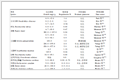
Crystal structures of 1 have been characterized at different temperatures by X-ray diffraction to confirm whether the phase transition is associated with structural changes. At room temperature (293 K) and low temperature (93 K),the crystals are in the monoclinic space groupP21/c,with a= 5.8349(12)Å ,b= 18.0020 (4) Å ,c= 7.7103(15) Å ,β= 104.840(3)°,V= 782.9(3) Å3 and Z=4at 293 K,anda= 10.6640(11) Å ,b= 18.0740(19) Å ,c= 11.9210(13) Å , β= 99.650(18)°,V= 2265(4) Å3 and Z= 12 at 93 K respectively. It shows that compound 1 undergoes a phase transition with two of the axes (aandc) andbangle changing significantly. Moreover,the cell volume of the low temperature structure is almost triple of that in room temperature,increasing from 782.9(3) Å3 to 2265(4) Å3 in the monoclinic cell. Although the temperature changes,the space group retains unchanged,meaning that there is no structurally symmetry-breaking occurrence in this phase transition. Crystallographic data and details of collection are listed in Table 1.
|
Table 1 Crystal data and structure refinement parameters |

In the room temperature (RTP),an asymmetric unit contains one [C4H5N2]+ cation and one [PF6]- anion as shown in Fig. 2a. All of the eleven atoms of the pyridazine cation are co-planar. Although two nitrogen atoms in pyridazine molecule have the same ability of getting the proton,only one of them could be protonated in the reaction due to the charge-effect. Further studies show that the protonation has a slight effect on the bond lengths of the pyridazine moiety,with the difference in the C4-N1 and C1-N2 lengths is only 0.021 Å (Table S1 in Supporting information). However,the intraring bond angle at the protonated nitrogen is opened by about 10°,corresponding to that found in the structure investigation of pyridazine hydrochloride [26]. It is worth noting that each F atom is orientationally disordered over two positions with occupation factors of 0.672(11) and 0.328(11). The P-F bond lengths range from 1.528 to 1.580 Å ,leading to a distorted octahedral geometry. Classic hydrogen bonds are found between a couple of adjacent pyridazine cations and between anions and cations as N(1)-H(1A)…(2),N(1)-H(1A)—(2),N(1)-H(1A)—(2´), N(1)-H(1A)—(1´),N(1)-H(1A)—(1) (Table 2).
|
|
Table 2 Classic hydrogen-bond parameters (Å ,°) in RTP (293 K) and LTP (93 K). |


In the low temperature (LTP) crystal structure,an asymmetric unit contains three [C4N2H5]+ cations and three [PF6]- anions as shown in Fig. 2b. Also,the pyridazine molecule was monoprotonated. Similar to that found in the RTP structure,the protonation has no distinct effect on the bond lengths of the pyridazine moiety with the C-N difference no more than 0.013 Å for each pyridazine cation (Table S2 in Supporting information). The intraring bond angle at the protonation nitrogen is opened by about 12°.However,the hexafluorophosphate anion becomes ordered as the temperature decreases,leading to a regular octahedral geometry with P-F bond distances ranging from 1.597 Å to 1.611 Å . Classical hydrogen bonds are found as N(1)-H(1A)—(11),N(1)-H(1A)—(12),N(1)- H(1A)…(2),N(3)-H(3A)—(4),N(3)-H(3A)—(6),N(3)-H(3A)…(6), ..N(6),N(5)-H(5A)—(15),N(5)-H(5A)—(17),N(5)-H(5A)…(4),to form bifurcated hydrogen bond system.
From the packing diagrams for RTP and LTP of compound1,a unit-cell of RTP consists of four [C4H5N2]+ cations and four [PF6]- anions (Fig. 3a),while there are twelve [C4H5N2]+ cations and twelve [PF6]- anions at LTP (Fig. 3b). In other words,the unit cell triples at LTP comparing with the molecules (ion pair) of RTP. The packing diagram for RTP shows that two symmetric pyridazine cations are linked together by the N-H… hydrogen bond with the bond distance of 3.112(5) Å . Besides,the N-H— hydrogen bonds are found to form interionic contacts with the [PF6]- anion. In comparison,the hydrogen-bonding interaction becomes stronger with the distance of N-H… ranging between 3.028(5) Å and 2.988(5) Å . In the LTP phase,two neighboring pyridazine rings also relate with each other through the intermolecular interaction while each of them acting as donor and acceptor simultaneously. Moreover,each pyridazine cation links with two hexafluorophosphate anions. Based on the neighboring hexafluorophosphate anions,we found that the shortest P-P bond distances are 5.835 Å and 5.565 Å at RTP and LTP respectively,indicating that as the temperature decreases the hexafluorophosphate anion changes its position and thus leads to relatively closer packing pattern in the low temperature. At both RTP and LTP,adjacent symmetry related pyridazine cations nearly fall in the same plane with only a slight deviation angle less than 3°.

|
Download:
|
| Fig. 3. View of the packings of 1 at 293 K (a) and 93 K (b). Gold dotted lines represent hydrogen bonds | |

To further confirm the phase transition occurring in this pyridazine compound,the temperature-dependent dielectric constant was measured at 10,100,1000 kHz as shown in Fig. 4. It is out of our expectation that the compound displays no observable dielectric anomaly within the measured temperature range. The result is verified by cooling and heating the sample over several cycles. This is probably because that the molecules are frozen at low temperature and responses slowly to the external electric field [27]. The dielectric anomaly should be too weak to be observable in this system. Further detailed studies still need to be carried out to understand other physical properties of this compound.

|
Download:
|
| Fig. 4. Temperature dependencies of the real part of the permittivity of 1 at 10- 1000 kHz. | |

In summary,DSC measurement and variable-temperature structure analysis reveal that pyridazine hexafluorophosphate under a reversible iso-structural phase transition atca.140 K. The single crystal X-ray diffraction data shows that the cell volume of low temperature phase is almost three times as that of the RTP phase. In both RTP and HTP,compound 1 crystallizes in the same space group,P21/c,with two of the axes (a and c) changing abruptly. The origin of the phase transition was attributed to the order-disorder transition of the hexafluorophosphate anion. Finally,it is part of our work on heterocyclic compounds,further studies are in progress.
AcknowledgmentsThis work was financially supported by the National Natural Science Foundation of China (No. 91222101). Also we gratefully thank Prof. Ren-Gen Xiong for revising this manuscript.
Appendix A. Supplementary dataCCDC-1014886 (93 K) and CCDC-1014887(293 K) contain the supplementary crystallographic data for this paper. This data can be obtained free of charge from the Cambridge Crystallographic Data Centre via www.ccdc.cam.ac.uk/data_request/cif. Supplementary data associated with this article can be found,in the online version, at http://dx.doi.org/10.1016/j.cclet.2014.09.024
| [1] | D.H. Wu, L. Jin, Temperature-induced-to-configuration-regulated reversible isostructural phase transition in bis(triethylbenzylammonium) tetrachlorocobaltate( II), Inorg. Chem. Commun. 23 (2012) 98-102. |
| [2] | W.Q. Liao, Q.Q. Zhou, P.F. Li, Y. Zhang, Crystal structure and phase transition of 2- methoxyanilinium perchlorate-18-crown-6, Chin. Chem. Lett. 25 (2014) 723- 726. |
| [3] | S.G. Li, J.H. Luo, Z.H. Sun, et al., Phase transition triggered by ordering of unique pendulum-like motions in a supramolecular complex: potassium hydrogen bis(- dichloroacetate)-18-crown-6, Cryst. Growth Des. 13 (2013) 2675-2679. |
| [4] | Z.H. Sun, X.Q. Wang, J.H. Luo, et al., Ferroelastic phase transition and switchable dielectric behavior associated with ordering of molecular motion in a perovskitelike architectured supramolecular cocrystal, J. Mater. Chem. C 1 (2013) 2561- 2567. |
| [5] | P. Zhou, Z.H. Sun, S.Q. Zhang, et al., A sequentially switchable molecular dielectric material tuned by the stepwise ordering in diisopropylammonium trifluoromethanesulfonate, J. Mater. Chem. C 2 (2014) 2341-2345. |
| [6] | Z.H. Sun, J.H. Luo, C.M. Ji, et al., Solid-state reversible quadratic nonlinear optical molecular switch with an exceptionally large-contrast, Adv. Mater. 25 (2013) 4159-4163. |
| [7] | X.J. Shi, J.H. Luo, Z.H. Sun, et al., Switchable dielectric phase transition induced by ordering of twisting motion in 1,4-diazabicyclo[2.2.2]octane chlorodifluoroacetate, Cryst. Growth Des. 13 (2013) 2081-2086. |
| [8] | Z.H. Sun, J.H. Luo, T.L. Chen, et al., Distinct molecular motions in a switchable chromophore dielectric 4-N,N-dimethylamino-4'-N'-methylstilbazolium trifluoromethanesulfonate, Adv. Funct. Mater. 22 (2012) 4855-4861. |
| [9] | C.M. Ji, Z.H. Sun, S.Q. Zhang, et al., N-Isopropylbenzylammonium tetrafluoroborate: an organic dielectric relaxor with a tunable transition between high and low dielectric states, J. Mater. Chem. C 2 (2014) 567-572. |
| [10] | M. Szafranski, Low-temperature and high-pressure phase transitions in ferroelectric dabcoHBF4, J. Phys.: Condens. Matter 16 (2004) 6053-6062. |
| [11] | H.Y. Ye, L.Z. Chen, R.G. Xiong, Reversible phase transition of pyridinium-3- carboxylic acid perchlorate, Acta Crystallogr. B 66 (2010) 387-395. |
| [12] | W. Zhang, R.G. Xiong, Ferroelectric metal-organic frameworks, Chem. Rev. 112 (2012) 1163-1195. |
| [13] | R. Jakubas, G. Bator, M. Gosniowska, et al., Crystal structure and phase transition of [(CH3)2NH2]GaCl4, J. Phys. Chem. Solids 58 (1997) 989-998. |
| [14] | D.W. Fu, W. Zhang, H.L. Cai, et al., Supramolecular bola-like ferroelectric: 4- methoxyanilinium tetrafluoroborate-18-crown-6, J. Am. Chem. Soc. 133 (2011) 12780-12786. |
| [15] | H.L. Cai, W. Zhang, J.Z. Ge, et al., 4-(Cyanomethyl)-anilinium perchlorate: a new displacive-type molecular ferroelectric, Phys. Rev. Lett. 14 (2011) 147601- 147604. |
| [16] | W.Q. Liao, Q.Q. Zhou, Y. Zhang, L. Jin, Synthesis, structures and dielectric properties of two five-coordinate copper (Ⅱ) complexes based on N-chloromethyl-1, 4- diazabicyclo[2.2.2]octane, Inorg. Chem. Commun. 33 (2013) 161-164. |
| [17] | D.H. Wu, L. Jin, Temperature-induced isosymmetric reversible structural phase transition in triethylbenzylammonium perchlorate, Inorg. Chem. Commun. 29 (2013) 151-156. |
| [18] | Z. Pająk, P. Czarnecki, B. Szafrańska, H. Małuszyńska, Z. Fojud, Ferroelectric ordering in imidazolium perchlorate, J. Chem. Phys. 124 (2006) 144502. |
| [19] | Z. Pajak, P. Czarnecki, B. Szafrańska, H. Małuszyńska, Z. Fojud, Ferroelectric order in highly disordered molecular-ionic crystals, Phys. Rev. B 69 (2004) 132102. |
| [20] | P. Czarnecki, W. Nawrocik, Z. Pajyk, J. Wasicki, Ferroelectric properties of pyridinium tetrafluoroborate, Phys. Rev. B 49 (1994) 1511-1512. |
| [21] | P. Czamecki, W. Nawrocik, Z. Pajyk, J. Wasicki, Ferroelectric properties of pyridinium perchlorate, J. Phys.: Condens. Matter 6 (1994) 4955-4960. |
| [22] | B. Kosturek, A. Wáskowska, S. Dacko, Z. Czapla, Structure and phase transition in pyridazine perchlorate, J. Phys.: Condens. Matter 19 (2007) 086219. |
| [23] | Z. Czapla, B. Kosturek, O. Czupiński, Structural phase transition in pyridazine fluoroborate crystal, Ferroelectrics 417 (2011) 76-81. |
| [24] | G.M. Sheldrick, SHELXS-97, Program for Crystal Structure Solution, University of Göttingen, Germany, 1997. |
| [25] | A. Altomare, M.C. Burla, M. Camalli, et al., SIR92 - a program for automatic solution of crystal structures by direct methods, J. Appl. Crystallogr. 27 (1994) 435-436. |
| [26] | T. Ottersen, Crystal and molecular-structure of pyridazine hydrochloride at 170 ℃, Acta Chem. Scand. A 29 (1975) 637-640. |
| [27] | J.Z. Ge, X.Q. Fu, T. Hang, Q. Ye, R.G. Xiong, Reversible phase transition of the 1:1 complexes of 18-crown-6 with 4-ethoxyanilinium perchlorate, Cryst. Growth Des. 10 (2010) 3632-3637.. |