


b Nanjing SimnovTecPharmaceuticals, Nanjing 210096, China;
c School of Pharmacy, Nanjing Medical University, Nanjing 210096, China
Acylals have the general structure R1-CH(OOCR2)2,which were introduced by Hurd and Cantor [1]. They are important starting materials in organic synthesis,particularly for the synthesis of dienes and chiral allylic esters. They also act as cross-linking reagents for cellulose in cotton [2]. In spite of the fact that the first acylal was synthesized more than 150 years ago and a number of methods have been developed since then for this purpose,two synthetic routes predominate [3]. The most widely used route is the reactionof aldehydeswith carboxylic anhydrides inthe presence of an acid catalyst such as protic or Lewis acid,iodine,and Nbromosuccinimide [4]. Several inorganic heterogeneous reagents have also been developed such as sulfated zirconia,montmorillonite clay,expansive graphite,and zeolite HSZ-360 [5]. Wicke and Engelhardt developed the second major route by the reaction of silver carboxylates with 1,1-dihaloalkanes.When cations other than silver ions were used as the carboxylate counterion,the reaction conditions were slightly modified [6].
Thus,although acylals are readily available,the existing methodologies suffer from one or more of the following disadvantages [7]: longer reaction time,low yields,the use of harmful solvents,the use of sensitive and costly catalysts and the requirement of special apparatus.
Recently,we developed a novel method for the conversion of acids and dihalomethane to the corresponding methylene diesters (acylals). Our method overcomes the abovementioned disadvantages that make this method attractive for large-scale synthesis. Surprisingly,dichloromethane,which is a relatively inert compound, seldom acts as a strong enough electrophile to react with carboxylic acids [8]. The formation of methylene diester (1a),as shown in Scheme 1,was unexpected.

|
Download:
|
| Scheme 1. Discovery of methylene diester. | |
Unless otherwise noted,all materials were obtained from commercial suppliers. 1H NMR and 13C NMR spectra were acquired on 300 or 500 MHz Bruker Avance spectrometer [9] with CDCl3 as the solvent and tetramethylsilane (TMS) as the internal standard. The chemical shiftswere reportedin δ (ppm).Mass spectra(MS) data were obtained using an Esquire 6000 Mass Spectrometer. The single crystal X-ray diffraction data was collected at 293 K with graphite monochromated Mo-Kα radiation (λ = 0.071073 nm),and a Rigaku SCX mini diffractometer with the ω-scan technique was used. The lattice parameters were integrated using vector analysis and refined from the diffraction matrix,and the absorption correction was carried out by using Bruker SADABS program with the multi-scan method [10]. CCDC reference numbers 978475 contains the supplementary crystallographic data in CIF format reported in this paper. These data can beobtained free of charge fromThe Cambridge Crystallographic Data Centre via www.ccdc.cam.ac.uk/data_request/ cif. Column chromatography was performed with silica gel (200-300 mesh,Qingdao Haiyang Chemical Co.,Ltd.,China). 3. Results and discussion
An impurity generated during the synthesis of Vinpocetine (API) aroused our attention. It is very interesting that the results of the reaction stirring in oil bath and microwave oven are very different. When the reaction was stirred in oil bath,the HPLC analyses showed that the content of impurity increased with increasing time. The reaction was continued for 7 days to obtain this impurity,and the yield of the impurity increased from 0.1% to 10%. But in the condition of microwave,it needs only 45 min to reach this result. Then,the impurity was purified by column chromatography and the structure was established by the MS,1H NMR,and 13C NMR spectral analyses. The main difference in the 1H NMR spectrum of the impurity than that of Vinpocetine was the disappearance of the H-20 (δ 4.40,2H) and H-21 (δ 1.37,3H) signals. New signals appeared at δ 6.25 in the 1H NMR spectrum and at δ 80.86 in the 13C NMR and DEPT (135) spectra of the impurity to confirmed the presence of a methylene (-CH2-) group. The ESI-MS analysis showed the mass of the impurity at m/z 657 [M+H]+. Thus,the structure of the impurity was established as the methylene diester (1a),as shown in Scheme 1.
Although the abovementioned diesterification between the acid and CH2Cl2 seemed to be an unexpected result for the synthesis of methylene diesters. To prove our conjecture,benzoic acid was chosen to test and verify the reaction. Methylene dibenzoate (2a) was isolated by column chromatography,and the molecular structure was unambiguously confirmed by the X-ray crystallographic analysis (Fig. 1).

|
Download:
|
| Fig. 1. Molecular structure of methylene dibenzoate. | |
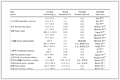
Various conditions were evaluated for optimizing the reaction conditions,and the results are shown in Table 1. Inorganic bases such as K2CO3,Cs2CO3,and NaOH slightly affected the reaction in oil bath and microwave,because they could not be dissolved in CH2Cl2. To our delight,1,8-diazabicyclo[5.4.0]undec-7-ene (DBU) or s-collidine improved the isolated yield to >90% in oil bath,and the reaction time significantly decreased. But it did not happen in the other reactions using the bases as N,N-diisopropylethylamine (DIPEA),4-methylmorpholine,triethylamine. Surprisingly,in the condition of microwave,the reactions using the organic bases were improved which afford methylene diesters in good to excellent yields (up to >99%).
|
Table 1 Optimization studies. |

To demonstrate the general applicability of this method,various para-substituted benzoic acids were reacted under the optimized reaction conditions,e.g.,-Me,-OMe,-F,and -NO2. The results are summarized in Table 2. The electronic effects and the nature of the substituents on the aromatic ring strongly affected the yields under the optimized reaction conditions. p-Nitrobenzoic acid was proved to be inert at low temperature. Several attempts to improve the outcome of this reaction by adding different catalysts (CuCl,CuBr, CuI,AgNO3,Pd(C2H3O2)2)were unsuccessful.When the temperature of the reaction was raised to 120 °C,the yield of the reaction improved. Assuming that C-Br bondwould bemore reactive thanC- Cl bond in this reaciton,CH2Br2 was reacted instead of CH2Cl2; however,the reaction was not successful. When the temperature of the reaction was raised up to 120 °C,the yield of the reaction improved. Intrigued by this result,we tried to synthesize methylidyne triesters by reacting benzoic acid (10 mmol) in CHCl3 (5 mL) and N-methyl-2-pyrrolidon (NMP) (10 mL) at 200 °C in a microwave reactor; a new spot was detected by TLC. However,it was difficult to isolate the product to confirm its structure.
|
|
Table 2 Effect of different functional groups. |

Based on the above-mentioned results,various heterocyclic carboxylic acids were investigated. They afforded the corresponding products in excellent yields. The results are summarized in Table 3.
|
|
Table 3 Direct synthesis of methylene diestersa |


From the abovementioned results (Table 2,entries 2-6; Table 3, entries 7-11),methylene diesters were observed unambiguously; other intermediates were not detected by the HPLC analyses except for the reaction between p-nitrobenzoic acid and CH2Cl2. When p-nitrobenzoic acid was used as the starting material,an intermediate was trapped. The 1H-NMR spectrum of this intermediate confirmed the structure as chloromethyl-4- nitrobenzoate (6b). This was the only case when substantial amounts of a chloromethyl ester was observed and ruled out the possibility of path 2 in Scheme 2. Thus,we propose that this direct esterification most probably proceed via a double successive SN2 processes.

|
Download:
|
| Scheme 2. Possible mechanism for the synthesis of methylene diesters [11]. | |

To prove our proposed mechanism,the first was to explain that the chloromethyl esters did not form in other reactions. Therefore,we designed two reactions: the first reaction is using p-nitrobenzoic acid and CH2ICl,and the result is shown in Scheme 3. As expected,both p-nitrobenzoic and chloromethyl- 4-nitrobenzoate did not have sufficient activity to continue.
The second reaction is using furan-2-carboxylic acid (20 mmol), benzoic acid (10 mmol) and CH2Cl2 (50 mL) as the starting materials. The result is shown in Scheme 4. Methylene dibenzoate was not detected by the HPLC analysis. Because furan-2-carboxylic acid is more reactive than benzoic acid,it first reacted with CH2Cl2. Because the C-Cl bond in the intermediate was more activated than that in CH2Cl2,it reacted with both the types of carboxylic acids without selectivity. This result verified the proposed double successive SN2 processes.

|
Download:
|
| Scheme 3. Selective reaction between acid and C-I bond. | |


|
Download:
|
| Scheme 4. Competitive reaction between furan-2-carboxylic acid and benzoic acid. | |

In summary,we established a facile,rapid and solvent-free method for preparing methylene diesters in good to excellent yields. Our studies show that CH2Cl2 is not an excellent solvent under mild reaction conditions. It is very important for the process development of active pharmaceutical ingredients. In this work,a "double successive SN2 reactions" mechanism is also proved.
| [1] | (a) C.D. Hurd, S.M. Cantor, The analytical separation of various classes of sugars, J. Am. Chem. Soc. 60 (1938) 2677-2687;(b) L.K. Sydnes, M. Sandberg, Aldehyde acylals-valuable compounds in synthesis when treated properly, PINSA 68 (2002) 141-174. |
| [2] | (a) B.B. Snider, S.G. Amin, An improved synthesis of 1α,3β-dihydroxycholesta- 5,7-diene, Synth. Commun. 8 (1978) 117-125;(b) G. Saucy, R. Marbet, H. Lindlar, O. Isler,Über eine neue synthese von citral und verwandten verbindungen, Helv. Chim. Acta 42 (1959) 1945-1955;(c) B.M. Trost, C.B. Lee, Geminal dicarboxylates as carbonyl surrogates for asymmetric synthesis. Part II: scope and applications, J. Am. Chem. Soc. 123 (2001) 3687-3696;(d) J.G. Frick, R.J. Harper, Acetals as crosslinking reagents for cotton, J. Appl. Polym. Sci. 29 (1984) 1433-1447;(e) V.T. Kamble, V.S. Jamode, An efficient method for the synthesis of acylals from aldehydes using silica-supported perchloric acid (HClO4-SiO2), Tetrahedron Lett. 47 (2006) 5573-5576. |
| [3] | L.K. Sydnes, M. Sandberg, The chemistry of acylals. Part I. The reactivity of acylals towards grignard and organolithium reagents, Tetrahedron 53 (1997) 12679- 12690. |
| [4] | (a) J.M. Thomas, Uniform heterogeneous catalysts: the role of solid-state chemistry in their development and design, Angew. Chem. Int. Ed. Engl. 27 (1988) 1673-1691;(b) M.D. Carrigan, K.J. Eash, M.C. Oswald, R.S. Mohan, An efficient method for the chemoselective synthesis of acylals from aromatic aldehydes using bismuth triflate, Tetrahedron Lett. 42 (2001) 8133-8135;(c) M. Curini, F. Epifano, M.C. Marcotullio, O. Rosati, M. Nocchetti, Preparation and deprotection of 1,1-diacetates (acylals) using zirconium sulfophenyl phosphonate as catalyst, Tetrahedron Lett. 43 (2002) 2709-2711. |
| [5] | (a) P. Kumar, V.R. Hegde, T.P. Kumar, An efficient synthsis of diacetates from aldehydes using beta zeolite, Tetrahedron Lett. 4 (1995) 601-603;(b) Y. Ishino, M. Mihara, Zinc-metal promoted selective a-haloacylation and gembisacylation of alkyl aldehydes in the presence of chlorotrimethylsilane, Tetrahedron Lett. 45 (2004) 3503-3506. |
| [6] | (a) H. Hopff, G. Hegar, Reaktionen des kohlensuboxids mit carbonylverbindungen, HeIv. Chim. Acta 44 (1961) 2016-2021; (b) D.A. Upson, V.J. Hruby, Synthesis of specifically deuterated S-benzylcysteines and of oxytocin and related diastereomers deuterated in the half-cystine positions, J. Org. Chem. 41 (1976) 1353-1358. |
| [7] | (a) N. Deka, D.J. Kalita, R. Borah, J.C. Sarma, Iodine as acetylation catalyst in the preparation of 1,1-diacetates from aldehydes, J. Org. Chem. 62 (1997) 1563-1564;(b) R. Ghosh, S. Maiti, A. Chakraborty, R. Halder, Indium triflate: a reusable catalyst for expeditious chemoselective conversion of aldehydes to acylals, J. Mol. Catal. 215 (2004) 49-53;(c) B. Karimi, J. Maleki, Lithium trifluoromethanesulfonate (LiOTf) as a recyclable catalyst for highly efficient acetylation of alcohols and diacetylation of aldehydes under mild and neutral reaction conditions, J. Org. Chem. 68 (2003) 4951-4953. |
| [8] | K. Holmberg, B. Hansen, Methylene diesters of carboxylic acids from dichloromethane, Tetrahedron Lett. 27 (1975) 2303-2306. |
| [9] | Z.G. Luo, Y. Zhao, F. Xu, Synthesis and thermal properties of novel calix[4]arene derivatives containing 1,2,3-triazole moiety via K2CO3 catalyzed 1,3-dipolarcycloaddition reaction, Chin. Chem. Lett. 25 (2014) 1346-1348. |
| [10] | J.H. Xue, X.H. Hua, L.M. Yang, Synthesis, crystal structures and luminescence properties of europium and terbium picolinamide complexes, Chin. Chem. Lett. 25 (2014) 887-891. |
| [11] | A.L. Cimecioglu, G.C. East, The synthesis of cyclic methylene dicarboxylates from caesium dicarboxylates and dibromomethane, Makromol. Chem. Rapid Commun. 8 (1987) 141-146. |