


Dihydroxybenzene,an important industrial bulk and processed material,is widely used in cosmetics,dyes,tanning,chemical and pharmaceutical industry. Dihydroxybenzene has three isomers, which are identified as hydroquinone (HQ),catechol (CA) and resorcinol (RE). The dihydroxybenzene isomers widely exist in the environment as harmful pollutants,since CA and HQ are significant air pollutants,RE damages human skin and causes poisoning due to absorption. Because they are toxic to humans and difficult to degrade in the ecological environment,it is very necessary to develop a simple and rapid analytical method for simultaneous determination of dihydroxybenzene isomers based on comprehensive consideration of industrial production and pollution prevention. However,dihydroxybenzene isomers have similar structures and characteristics,and consequently,are difficult to separate by physical or chemical means,and can create problems in quantitative analysis.
In recent years,electrochemical methods for the simultaneous determination of dihydroxybenzene isomers,especially the technique of the modified electrode,have significant advantages over other methods in terms of experimental procedure and sensitivity [1, 2, 3, 4, 5, 6, 7, 8, 9]. With the use of the modified electrode,the electropolymerized polymer film may be a good choice,because it can enhance both selectivity and sensitivity, improve response time,decrease the overpotential of the analytes in the redox process,and exhibits good stability [10]. Many electrodes modified with electropolymerized polymers have been used in the electrochemical analysis of dihydroxybenzene [8, 9]. For instance,2,5-dimercapto-1,3,4-thiadiazole (DMcT),a heterocyclic thiol compound,has been successfully used for the electrode modification and electrochemical analysis of biological samples and heavy metals [11, 12]. As a conducting polymer films,p-DMcT,is a promising material in modified electrodes for monitoring dihydroxybenzene isomers because of its high stability,uniformity,and reproducibility. On the basis of the previous study [12],we determined that dihydroxybenzene isomers have excellent response on the glassy carbon electrode modified by p-DMcT film,and so proceeded to investigate and develop a simultaneous,quantitative method for the analysis of dihydroxybenzene isomers. 2. Experimental
2.1. Chemicals and apparatus
The DMcT was purchased from J&K Chemical,Ltd. (Beijing, China). The DMcT solution (1.00 × 10⁻⁵ mol/L) was prepared by dissolving 15.0 mg of DMcT in absolute ethanol with 0.10 mol/L NaOH and diluting to 100-mL in a calibrated flask. The 0.1 mol/L phosphate buffer solutions (PBS) of various pH values were prepared using KH2PO4 and Na2HPO4,according to an appropriate proportion. The isomers,hydroquinone (HQ),catechol (CA),and resorcinol (RE),were purchased from Shanghai Chemical Reagent Co.,Ltd. (China). Their stock solutions were prepared by dissolving appropriate amounts of solid material in PBS and stored in brown reagent bottles. Low-concentration solutions of the dihydroxybenzene isomers for voltammetric investigations were freshly prepared from each stock solution with PBS. The standard samples of CA (GSB 07-1249-2000),RE (GSB 07-1250-2000) and HQ (GSB 07-1251-2000) were purchased from Northern Hanson Biotech Co.,Ltd. (Beijing,China) and used as the three certified reference materials (CRMs). High-purity nitrogen was used for solution deaeration and to maintain the nitrogen atmosphere within the electropolymerization process.
All other chemicals were of analytical grade or higher quality. Deionized water (>15 MΩ) was used throughout the present research and acquired from a KLUP-III water treatment system (Kang ning Water Industry,China).
All voltammetric experiments were carried out using a computer-controlled electrochemical system (CHI 832B,Shanghai Chenhua Instrument,Co.,Ltd.,China). The standard threeelectrode arrangement consisted of an Ag/AgCl reference electrode (CHI 111,Shanghai Chenhua Instrument,Co.,Ltd.,China),a Pt counter electrode (CHI 115,Shanghai Chenhua Instrument,Co., Ltd.,China),and a modified electrode as working electrode. A solution containing 0.1 mol/L PBS of pH 5.5 and 0.1 mol/L KCl was used as the electrolyte in the voltammetric investigations. 2.2. Preparation of electropolymerized DMcT film-electrode
A glassy carbon disk electrode (GCE,3.0 mmdiameter) was first polished to a mirror-like finish with 3000-mesh emery paper, followed by 1.0- and 0.05-μm alumina slurry. The GCE was then washed successively with 1:1 nitric acid and alcohol,sonicated in a deionized water bath to remove any residual alumina,and then dried in air before use. The 1.0 × 10⁻⁵ mol/L DMcT dissolved in 0.10 mol/L NaOH was employed as precursor for electropolymerization of DMcT. The electropolymerization of DMcT on the GCE was performed between -0.40 V and 1.00 V at a scan rate of 50 mV/s. When the scanning cycle had been repeated for 30 rounds,a smooth film was obtained on the surface of the GCE. After the electrode was washed thoroughly in PBS to remove the adsorbed DMcT monomer and dried in air,a poly(2,5-dimercapto- 1,3,4-thiadiazole)-modified GCE (p-DMcT/GCE) was obtained. From the p-DMcT/GCE surface,a fuscous film with isolated distribution was observed by scanning electron microscopy, suggesting that DMcT had been polymerized on the surface of the GCE to form a p-DMcT/GCE,as reported in the previous study [12]. 2.3. Determination of dihydroxybenzene isomers
10.0 mL of PBS containing an appropriate concentration or ratio of dihydroxybenzene isomers was transferred into an electrochemical cell. After the test solution was sufficiently mixed with a small magnetic stirrer,the test solution was held at static state for 30 s at open circuit potential. Then,the voltammetric curve was recorded by applying a differential pulse voltammetry (DPV) from -0.20 V to 1.00 V. Peak currents were measured at 0.16 V for HQ,0.27 V for CA and 0.68 V for RE. All experiments were repeated at least five times,and the mean values of measurements were presented with their relative standard deviations. 3. Results and discussion
3.1. Electrochemical responses of dihydroxybenzene isomers at p-DMcT/GCE
Fig. 1 showed the CVs and DPVs recorded for the mixture of dihydroxybenzene isomers in PBS at both the bare and p-DMcT/ GCE,respectively. The oxidation peaks of only two were observed for the three isomers on the bare GCE (black curve) at 0.32 V and 0.74 V,respectively,and showed a broad,unresolved peak at ca. 0.32 V for HQ and CA. In contrast,the oxidation waves of HQ,CA and RE were clearly resolved in CV or DPV with peak potentials (Epa) of 0.16,0.27 and 0.68 V on the p-DMcT/GCE (red curve), respectively. As can be observed in Fig. 1,dihydroxybenzene isomers can be clearly identified,due to two larger peak potential differences (ΔEpa) of 0.11 and 0.41 V between adjacent peaks. On the other hand,the peak potential of three isomers shifted negatively at p-DMcT/GCE,and their peak currents were larger and the peak shape was sharper,showing a higher sensibility for the responses of substrates.

|
Download:
|
| Fig. 1.(A) Cyclic voltammograms and (B) differential pulse voltammograms for the mixed solution with 70.0 μmol/L each dihydroxybenzene isomer in PBS (pH 5.5) at bare GCE (black curve) and p-DMcT/GCE (red curve). Conditions for DPV were: incr.E,0.004 V; pulse amplitude,0.05 V; pulse width,0.06 s; pulse period,0.2 s. (For interpretation of the references to color in this figure legend,the reader is referred to the web version of the article.). | |
DMcT is a heterocyclic thiol compound,providing the p-DMcT layer on the electrode with the -SH group [11]. The p-DMcT can forms a film with a negative charge on GCE in PBS of pH 5.5 because of two aqueous pKa values of -1.4 to 2.1 and 7.5 [13]. Both CA (pKa = 9.4) and HQ (pKa = 10.0) exist in their protonated forms at a pH of less than 7.0 [14]. Thus,the pH of the solution will affect the charged state of p-DMcT and phenolic compounds resulting in a change of ΔEpa because of the electrostatic interaction between the surface of p-DMcT/GCE and substrates. As can be observed in Fig. 2(A),the ΔEpa of CA and HQ varied with increasing pH and reached the maximum at pH 5.5. The enhanced resolution for CA and HQ can be attributed partly to the degree of the electrostatic interaction between the surface of p-DMcT/GCE and these analytes. The fraction of positively charged HQ was increased more than CA at the diffusion layer of p-DMcT/GCE,resulting in a more negative potential move than the latter at the p-DMcT/GCE. For the three isomers of dihydroxybenzene,the change of peak currents with increase of pH is shown in Fig. 2(B),respectively. The peak currents of substrates increased slightly with increasing pH at a lower pH range due to the increase of net negative charge of p-DMcT by the deprotonated of the nitrogen of p-DMcT. Along with the increase of pH,the peak currents of substrates presented a maximum value at around pH 5.0,and became gradually smaller. At a higher pH,the low response of the p-DMcT/GCE could be ascribed to the decrease of positive charge of the substrates. To synchronously achieve a good resolution and a higher sensitivity, the pH of PBS was controlled to 5.5 in subsequent experiments.

|
Download:
|
Fig. 2.(A) The peak potential difference (DEpa) of HQ with CA. (B) Peak currents (ipa)of HQ (▲),CA ( ),and RE ( ),and RE ( ) in various pHs. ) in various pHs.
|
|
The linear ranges for the simultaneous determination of HQ,CA and RE with the p-DMcT/GCE were investigated by using the DPV method. In the presence of constant concentrations of two counter parts,the experiments displaying HQ,CA and RE exhibited excellent response with the signal height of the other two isomers remaining unchanged,thus proving that the responses to three isomers were relatively independent. As shown in Fig. 3,the stripping peak currents increased with increasing substrate concentration. The oxidative peak currents were proportional to the HQ,CA and RE concentrations in the range 0.50-120,0.50-110 and 1.00-100 mmol/L,respectively. The calibration formulas and the linear correlation coefficients are given as:


|
Download:
|
| Fig. 3.Differential pulse voltammograms by p-DMcT/GCE in PBS containing 0,0.50,1.50,5.00,10.0,30.0,50.0,60.0,70.0,80.0 and 100 μmol/L of each dihydroxybenzene isomer,respectively. Conditions for DPV were the same as Fig. 1. | |
The detection limits of HQ,CA and RE were estimated to be 0.1, 0.1 and 0.3 mmol/L,respectively,at a signal/noise ratio of 3. Comparing with the method reported previously (Table 1),the p-DMcT/GCE showed good selectivity and sensitivity for the three isomers. The sensitivity of the method mainly depends on the amount of substance which is transferred to the p-DMcT/GCE surface during accumulation. The unique properties of the p-DMcT with electronegative and high conductivity,increased the capability to strongly adsorb target substrates,enhanced the surface concentration and improved the sensitivity. On the other hand,the determined range of p-DMcT/GCE for the three isomers is also wider to better meet the needs of quantitative analysis.
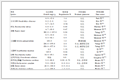
|
Table 1 Reported analyses of dihydroxybenzene isomers by electrochemical methods. |

In the establishment of accuracy for a new analytical method, use of CRMs has gradually become the practice. According to the proposed method,the CRMs containing 9.08 mmol/L of HQ,CA or RE were determined. The results obtained for 7 measurements were 9.02 ± 0.15,9.05 ± 0.12 and 9.12 ± 0.08 mmol/L (95% confidence interval) for each isomer,respectively,giving an acceptable accuracy and precision. The p-DMcT/GCE also shows a good reproducibility and a long lifespan. The relative standard deviations (RSDs) obtained for the same electrode in five successive measurements of the mixed solution with three isomers were 3.2%,2.8% and 2.7% for 50.0 mmol/L HQ,CA and RE,respectively. The RSDs of five p- DMcT/GCEs prepared by the same conditions for three substrates were 4.6%,3.8% and 3.5%,respectively. When the prepared p-DMcT/ GCE was stored above PBS,its responses to the substrates were 96%- 100% in daily tests over two weeks. Although its response slowly declined,the p-DMcT/GCE can maintain 89% of its original response after 30 days. The results indicate that the p-DMcT/GCE has a higher stability due to the insolubility of p-DMcT in aqueous acidic solutions. The influence of various foreign species on the determination of substrates was tested by analyzing a standard solution mixed with 50.0 mmol/L substrates. The concentration ratios of the added foreign substance and substrates for a ±5% peak current change were stipulated as a tolerable limit. The experimental results revealed that the determination of the substrates is not influenced by increases in phenol of 500-fold and nitrophenol of 100-fold. Other substances probably exist in real samples,such as Ca2+,Mg2+,Mn2+,Zn2+,Fe2+, Ni2+,Co2+,Al3+,NH4+,SO42-,NO3-,Cl- and CO32- of less than 1.00 mmol/L and ethanol and benzene of less than 0.20 mmol/L,does not affect the simultaneous determination of dihydroxybenzene isomers. 3.5. Simultaneous determination of dihydroxybenzene isomers in samples
The dihydroxybenzene isomers in three hair dyes were analyzed using the p-DMcT/GCE. Owing to the very complex compositions of the hair dyes,a simple pre-treatment was found essential. For this purpose,each hair color cream was weighed and mixed with 100 mL PBS. After the mixture was stirred vigorously for 20 min,the sample was filtered with a 0.22 μm membrane filter,and then diluted 5-fold with PBS to perform the measurement by DPV. The results summarized in Table 2 determined the relative standard deviation was less than 5.6% in five parallel measurements of the same sample,and the recovery was in the range 95.6%-106%. Additionally,the p-DMcT/GCE can be directly applied to the simultaneous analysis of dihydroxybenzene isomers in water simples. To investigate the applicability of the proposed method for the simultaneous determination of isomers,local tap water and seawater samples were used for quantitative analysis. Since the amounts of dihydroxybenzene isomers were unknown in water samples,the addition and recovery experiments were performed by measuring the DPV responses for the samples with known concentrations of substrates added. The amounts of HQ,CA and RE in the water samples were then determined by calibration method and are summarized in Table 3. The recoveries for dihydroxybenzene isomers were 96.8%-105%,and these results clearly indicated the applicability and reliability of the proposed method.
|
|
Table 2 Determination of dihydroxybenzene isomers in hair dyes. |

|
|
Table 3 Determination of dihydroxybenzene isomers in spiked water samples. |


The present study demonstrated that the p-DMcT/GCE has good sensitivity and high stability for simultaneously determining dihydroxybenzene isomers by the electrochemical technique. Especially,the functional electrode has the advantages of simple preparation,good reproducibility and long life. The proposed method could be conveniently applied to the determination of dihydroxybenzene isomers in real samples,which would be helpful for monitoring toxic compounds in commercial products and aqueous environmental samples.
| [1] | K.J. Huang, S. Yu, L. Wang, T. Gan, M. Li, Simultaneous determination of hydroquinone, catechol and resorcinol based on graphene/cobalt hexacyanoferrate modified glassy carbon, electrode, Acta Chim. Sinica 70 (2012) 735-740. |
| [2] | X. Zhang, S. Duan, X. Xu, S. Xu, C. Zhou, Electrochemical behavior and simultaneous determination of dihydroxybenzene isomers at a functionalized SBA-15 mesoporous silica modified carbon paste electrode, Electrochim. Acta 56 (2011) 1981-1987. |
| [3] | H.S. Yin, Q.M. Zhang, Y.L. Zhou, et al., Electrochemical behavior of catechol, resorcinol and hydroquinone at graphene-chitosan composite film modified glassy carbon electrode and their simultaneous determination in water samples, Electrochim. Acta 56 (2011) 2748-2753. |
| [4] | D.W. Li, Y.T. Li, W. Song, Y.T. Long, Simultaneous determination of dihydroxybenzene isomers using disposable screen-printed electrode modified by multiwalled carbon nanotubes and gold nanoparticles, Anal. Methods 2 (2010) 837-843. |
| [5] | D.D. Zhang, Y.G. Peng, H.L. Qi, Q. Gao, C.X. Zhang, Application of multielectrode array modified with carbon nanotubes to simultaneous amperometric determination of dihydroxybenzene isomers, Sens. Actuators B 136 (2009) 113-121. |
| [6] | L. Han, X.L. Zhang, Simultaneous voltammetry determination of dihydroxybenzene isomers by nanogold modified electrode, Electroanalysis 21 (2009) 124-129. |
| [7] | J.P. Dong, X.M. Qu, L.J. Wang, C.J. Zhao, J.Q. Xu, Electrochemistry of nitrogen-doped carbon nanotubes (CNx) with different nitrogen content and its application in simultaneous determination of dihydroxybenzene isomers, Electroanalysis 20 (2008) 1981-1986. |
| [8] | P.H. Yang,W.Z. Wei, C.Y. Tao, J.X. Zeng, Simultaneous voltammetry determination of dihydroxybenzene isomers by poly-bromophenol blue/carbon nanotubes composite modified electrode, Bull. Environ. Contam. Toxicol. 79 (2007) 5-10. |
| [9] | P.H. Yang, W.Z. Wei, L. Yang, Simultaneous voltammetric determination of dihydroxybenzene isomers using a poly(acid chrome blue K) carbon nanotube composite electrode, Microchim. Acta 157 (2007) 229-235. |
| [10] | S. Cosnier, M. Holzinger, Electrosynthesized polymers for biosensing, Chem. Soc. Rev. 40 (2011) 2146-2156. |
| [11] | P. Kalimuthu, S.A. John, Electropolymerized film of functionalized thiadiazole on glassy carbon electrode for the simultaneous determination of ascorbic acid, dopamine and uric acid, Bioelectrochemistry 77 (2009) 13-18. |
| [12] | C.Z. Zhao, H. Liu, L. Wang, Simultaneous determination of Pb(Ⅱ) and Cd(Ⅱ) using an electrode modified with electropolymerized thiadiazole film, Anal. Methods 4 (2012) 3586-3592. |
| [13] | T. Tatsuma, Y. Yokoyama, D.A. Buttry, N. Oyama, Electrochemical polymerization and depolymerization of 2,5-dimercapto-1,3,4-thiadiazole. QCM and spectroscopic analysis, J. Phys. Chem. B 101 (1997) 7556-7562. |
| [14] | D.T. Harvey, Modern Analytical Chemistry, McGraw-Hill, New York, 2000, p. 151. |