


 , Tao Lud,e
b National Nanjing Center for Drug Screening, China Pharmaceutical University, Nanjing 210009, China;
c Laboratory of Molecular Design and Drug Discovery, School of Sciences, China Pharmaceutical University, Nanjing 210009, China;
d State Key laboratory of Natural Medicines, China Pharmaceutical University, Nanjing 210009, China;
e The Headmaster's Office, China Pharmaceutical University, Nanjing 210009, China
The RAS-RAF-MEK-ERK signal transduction pathway plays a critical role in tumor biology. This pathway is controlled by extracellular signals through membrane receptors such as receptor tyrosine kinases and is activated by oncogenic mutations in many types of cancer [1, 2, 3, 4]. The most common mutation,V600E mutant (B-RafV600E) has been demonstrated in vitro to be constitutively active in carcinoma cells and to increases cell proliferation and survival [5, 6, 7]. Over the past decade extensive efforts have been devoted to developing B-Raf kinase inhibitors and there were three successful examples (Fig. 1). Sorafenib (Bayer/Onyx) was approved by the US Food and Drug Administration (FDA) for the treatment of hepatocellular carcinoma and renal cell carcinoma; Regorafenib was also approved for the treatment of advanced colorectal cancer several months ago and marketed by Bayer and Onyx,and its structure is very similar to that of Sorafenib. Different from Sorafenib and Regorafenib as multi-kinase inhibitors,Vemurafenib (Plexxikon/Recho) is a selective B-RafV600E kinase inhibitor,which was approved to treat patients with advanced or metastatic melanoma. So the B-Raf kinase deserves more attention.

|
Download:
|
| Fig. 1.Structures of Sorafenib,Regorafenib and Vemurafenib. | |
Employing receptor-based drug discovery approaches,our group found that there was a small hydrophobic pocket in B-Raf kinase beside the spot where the center ring of Sorafenib binds in a binding model,so a methyl or ethyl group was attempted at this position to increase the activity. The results evaluated by Discovery Studio were shown in Fig. 2a. They both superimpose well with Sorafenib. Then,we discovered that using an indole to replace the phenyl ring could better occupy the hydrophobic pocket,because the volume of pyrrole was similar to that of an ethyl group. Therefore,the compound A (Fig. 3) was synthesized. Furthermore, we found that if a methylene was introduced between the indole ring and the pyridine ring,the overlay of our hit compound and Sorafenib was better compared with compound A (Fig. 2b),though only one rather than two NH in the urea moiety formed hydrogen bond with side residue in Glu501. Moreover,many articles reported that only two hydrogen bonds were sufficient to produce the targeted binding affinity [8]. The design procedure was exhibited in Fig. 3.

|
Download:
|
| Fig. 2.(a) Predicted binding model (PDB: 1UWH) of Sorafenib (gray) and its derivatives with a methyl (brown) or ethyl (yellow) substitution center phenyl ring.(b) Overlap binding model of our hit compound (green) with compound A (purple),Sorafenib (blue) and its derivatives with a methyl (red) or ethyl (brown)substitution center phenyl ring. (c) The binding model of compound 7b. (For interpretation of the references to colour in this figure legend,the reader is referred to the web version of this article.) | |

|
Download:
|
| Fig. 3.Structures of Sorafenib,Regorafenib and Vemurafenib. | |
The commercially available ethyl isonicotinate 1 (5.00 g, 33.08 mmol) was dissolved in N-methylformamide (20 μL),and cold 98% H2SO4 (3.24 g,33.08 mmol) was added drop wise and the temperature was kept below 5℃. After the addition of H2SO4,30% H2O2 and a saturated solution of FeSO4 were added to the reaction mixture at 10-15℃ [9] until compound 1 disappeared. After extraction,washing,recrystallization,the pure compound 2 (4.04 g,19.40 mmol,58.64%) was obtained.
A mixture of compound 2 (2.08 g,10 mmol) and sodium borohydride (1.16 g,30 mmol) in ethylalcohol (50 μL) was allowed to stir overnight at room temperature,then the mixture was concentrated in vacuo and the purification of the curde product using silica gel chromatography,eluting with 80% acetoacetate in N-hexane afforded the compound 3 (1.58 g, 9.49 mmol,95.03%) [10].
Compound 3 (664 mg,4 mmol) was dissovled in anhydrous THF (20 μL),then triphenylphosphine (1.10 g,4.20 mmol) and carbon tetrabromide (1.39 g,4.20 mmol) were added. The reaction mixture was stirred at room temperature for 3 h. The mixture was then filtered to remove the precipitates and the filtrate was concentrated to an oil. The crude product was purified using flash silica chromatography (eluting with 80% acetoacetate in N-hexane) to afford the compound 4 (477 mg,2.09 mmol,52.34%) [11].
A mixture of 5-nitro-1H-indole (200 mg,1.23 mmol) or its derivatives and dry DMF (5 μL) was cooled to 0℃ and NaH (60 mg, 1.23 mmol) was added. After the addition,the reaction mixture was stirred at r.t. for 0.5-1 h,then compound 4(282 mg, 1.23 mmol) was added,and the reaction mixture was allowed to stirred for an additional 2 h. After a sequence of extraction,wash, and concentration,the crude product compound 5 (222 mg, 0.72 mmol,58.30%) was obtained and could be used in next step without further purifications [12].
Compound 5(222 mg,0.72 mmol) was dissolved in MeOH (10 μL),and 5%Pd/C (10 mg) was added,then H2 was ventilated. After 0.5 h the reaction completed. Pd/C was removed by filtration, the filtrate was condensed in vacuo and chromatographic purification of the curde product over silica gel,eluting with 50% acetoacetate in N-hexane afforded the compound 6 (194 mg, 0.69 mmol,96.5%).
A mixture of 4-chloro-3-(trifluoromethyl)aniline or its derivatives and CDI in dry CH2Cl2 (5 μL) was stirred for 1 h at room temperature,then compound 6 (194 mg,0.69 mmol) or its derivatives was added. The mixture was allowed to stir for an additional 1 h to afford white precipitates. The solid was collected by filtration under vacuum,washed with water for three times and dried under vaccum to give compound 7a-7m and 7p-7r [13],but 7m and 7n was synthesis by a condensation reaction between benzoic acid and compound 6 promoted by EDCI. The yields of all compounds were between 65.7% and 82.4%. The general synthetic route is depicted in Scheme 1.

|
Download:
|
| Scheme 1.Synthetic route of compounds 7a-7r . | |
7a: 273 mg,78.6%,mp 209℃. 1H NMR (300 MHz,DMSO-d6): δ 2.77 (d,1H),5.57 (s,2H,),6.50 (d,1H,J = 2.94 Hz),7.09 (d,1H, J = 8.97 Hz),7.27 (m,2H,J = 3.00 Hz,J = 8.97 Hz),7.51 (m,1H),7.58 (m,2H),7.73 (d,2H,),8.12 (s,1H),8.53 (dd,1H,J = 6.15 Hz, J = 2.85 Hz),8.60 (s,1H),8.73 (dd,1H,J = 6.15 Hz,J = 2.85 Hz),9.06 (s,1H); ESI (m/z): 501.6 [M+H]. Anal. Calcd. for C24H19ClF3N5O2: C, 57.43; H,3.82; N,13.95. Found: C,57.67; H,3.94; N: 13.79.
7b: 267 mg,75.9%,mp 248℃. 1H NMR (300 MHz,DMSO-d6): δ 2.78 (d,1H),5.53 (s,2H),7.13 (d,1H,J = 9.32 Hz),7.25 (m,1H),7.37 (m,1H,J = 9.32 Hz),7.51 (m,1H),7.59 (m,1H),7.63 (m,2H),7.76 (m,2H,J = 2.22 Hz,J = 5.28 Hz),8.12 (d,1H,J = 2.22 Hz),8.56 (m, 1H,J = 5.28 Hz),8.72 (m,2H),9.10 (s,1H); ESI (m/z): 520.1 [M+H]. Anal. Calcd. for C24H18ClF4N5O2: C,55.45; H,3.49; N,14.62. Found: C,55. 54; H,4.02; N: 14.63.
B-Raf kinase assay: Kinase activity was measured as the percentage of ATP consumed following the kinase reaction using luciferase-luciferin-coupled chemiluminescence system. Reactions were conducted in a 384-well plate (PerkinElmer). B-Raf kinase reactions were initiated by adding test compounds (1 μL/ well) and B-Raf kinase (4 μL/well,Signalchem) to the 384-well plate. The assay plate was centrifuged with 1000 rpm for 1 min to mix them and then pre-incubated at 30℃ for 30 min. ATPUnactive MEK1 mixture (5 μL/well,obtained by mixing an equal volume of ATP and inactive MEK1,Sigma and Signalchem, respectively) was added to the assay plate. The assay plate was centrifuged with 1000 rpm for 1 min and incubated at 30℃ for 1 h. ADP-Glo reagent was added to each well and the assay plate was incubated at 27℃ for 30 min. Finally,the luminescence signal was read with Envision (PerkinElmer). The IC50 value of each compound was calculated by Prism 5.0,using the inhibition rate. 3. Results and discussion
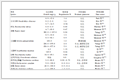
Thus,a series of novel indole analogs 7a-7r were prepared (Table 1). All compounds were evaluated against B-Raf kinase and HepG2 cells. Compound 7a was the most potent inhibitor with an IC50 value of 0.51 mmol/L against B-Raf. However,compound 7b (the binding model was exhibited in Fig. 2c) showed better inhibitory activity in HepG2 cells than 7a,with an IC50 value of 2.50 mmol/L and 6.63 mmol/L,respectively, although its IC50 value against B-Raf was on1y 1.36 mmol/L. Interestingly,both of them showed lower inhibitory activity against B-Raf than Sorafenib and better inhibitory activity in HepG2 than Sorafenib.
|
Table 1 B-Raf inhibitory activities of compounds 7a-7r. |


Altering the substitution groups at the 3-position of the indole with F,Cl,Br systematically (7b,7c,7d) while maintaining the rest of the molecule intact,we found the activity against B-Raf decreased in that order,and the same trend was observed in HepG2 cell assay except compound 7b. Using other groups (7f,7g, 7h,7i) instead of a trifluoromethyl group to determine its importance,the results showed that there were salient activity decrease in both enzymatic and cellular assays except compound 7h,which showed better B-Raf inhibitory activity than compound 7c. So the trifluoromethyl group in the meta position was crucial for the activity. Replacing the chlorine atom with a hydrogen (7e), the B-raf inhibitory activity decreased significantly,but the HepG2 cell activity was equivalent to that of compound 7c. Changing the moieties at both the meta and para positions of the phenyl ring (7j, 7k,7l,7m,7p,7q,7r) lead to a remarkable destruction of inhibitory activity in both B-Raf and HepG2 evaluation.
Compounds 7n and 7o were designed to investigate whether the urea group was necessary for the activity. The results validated that the urea moiety was very important for B-Raf and HepG2 inhibitory activity. 4. Conclusion
In summary,using computational approaches,we designed, synthesized and evaluated a series of indole derivatives,and some compounds showed moderate activity against B-Raf. Moreover, compound 7a and 7b showed better potency than Sorafenib in the HepG2 assay with about 2- and 6-fold improvement,respectively. Acknowledgments
This work was financially supported by the Natural Science Foundation of Jiangsu Province (No. BK2009303),the National Natural Science Foundation of China (No. 30973609),Fundamental Research Funds for the Central Universities (No. JKZ2011004) and Specialized Research Fund for the Doctoral Program of Higher Education (No. 20100096110007).
| [1] | L.R. Howe, S.J. Leevers, N. Gomez, et al., Activation of the MAP kinase pathway, Cell 71 (1992) 335-342. |
| [2] | M. Garnett, R. Marais, Guilty as charged: B-RAF is a human oncogene, Cancer Cell 6 (2004) 313-319. |
| [3] | C. Hagemann, U.R. Rapp, Isotype-specific functions of Raf kinases, Exp. Cell Res. 253 (1999) 34-46. |
| [4] | M. Malumbres, M. Barbacid, RAS oncogenes: the first 30 years, Nat. Rev. Cancer 3 (2003) 459-465. |
| [5] | H. Davies, G.P. Bignell, C. Cox, Mutation of the BRAF gene in human cancer, Nature 417 (2002) 949-954. |
| [6] | C. Michaloglou, L.C.W. Verdevedld, W.J. Mooi, BRAFE600 in benign and malignant human tumours, Oncogene 27 (2008) 877-895. |
| [7] | J. Xing, R.X. Liu, M.Z. Xing, The BRAFT1799A mutation confers sensitivity of thyroid cancer cells to the BRAFV600E inhibitor PLX4032(RG7204), Biochem. Biophys. Res. Commun. 404 (2011) 958-962. |
| [8] | A. Gopalsamy, G. Ciszewski, Y.B. Hu, Hit to lead optimization of pyrazolo[1,5- a]pyrimidines as B-Raf kinase inhibitors, Bioorg. Med. Chem. Lett. 19 (2009) 2735-2738. |
| [9] | F. Minisci, R. Galli, M. Cecere, et al., Nucleopphilic character of alkyl radicals generated in redox processes, Tetrahedron Lett. 9 (1968) 5609-5612. |
| [10] | I. Martin, J. Anvelt, L. Vares, An alternative synthesis of the NMDA antagonist CGS 19755 via free radical carbonylation of theyl isonicotinate, Acta Chem. Scand. 49 (1995) 230-232. |
| [11] | C. Brennan, J.A. Dixon, W.J. Scott, 2-Aminoarylcarboxamides useful as cancer chemotherapeutic agengs, US/05/022518 2005. |
| [12] | J.M. Frost, M.J. Dart, K.R. Tietje, Indol-3-ylcucloalkyl ketones: effects of N1 substituted indole side chain variations on CB2 cannabinoid receptor activity, J. Med. Chem. 53 (2006) 295-315. |
| [13] | L. Liu, Y.C. Cao, C. Chen, Sorafenib blocks the RAF/MEK/ERK pathway, inhibits tumors angiogenesis, and induces tumor cell apotosis in hepatocellular carcinoma model PLC/PRF/5, Cancer Res. 66 (2006) 11851-11859. |