


Artemisinin (Ars),a sesquiterpene lactone featuring an endoperoxide bond,is a high-performance antimalarial drug which is found in the interior of trichome glands located superficially on the leaves of Artemisia annua L.,and is mainly extracted for use as a herbal medicine [1, 2]. It has an excellent prospect for development with very important scientific value. Because of its unique structure and antimalarial mechanism,Ars has shown excellent antimalarial efficacy with low toxicity and thus is recommended as an antimalarial drug by World Health Organization (WHO) [3]. Unfortunately,it is not without complications in treating malaria only by herbal infusions due to high variability of the Ars extract from the leaves,which could compromise the efficient recovery of the patient and lead to the development of resistance of the plasmodium for the drug. However,with the rapid increase of market demand,the traditional extraction method is a time-consuming and multistep process in which a large percentage of the Ars is lost at each of these stages reducing yield and thus increasing the cost of the product [4, 5]. Therefore,since the administration of Ars in tablet format is essential,it is necessary to find a more effective extraction and purification method.
Molecular imprinting technology (MIT),as one of the most promising methodologies producing molecule-specific recognition sites in synthetic molecular imprinting polymers (MIPs),has already demonstrated its potential for separation and analytical applications and the development of limited applications in different fields [6, 7, 8]. Recently,significant attention has been paid to the surface molecular imprinting technique (SMIT) based on the surface modification of polymeric membranes. The combination of the MIT and the membrane technique has provided membranespecific selectivity and permeation for the separation of target analytes [9, 10, 11]. Molecular imprinting layer can be formed on the surface of the porous membrane with optimized flux via an interfacial polymerization technique. Herein,the imprinted membrane technique can not only overcome disadvantages,but also can endow the imprinted membrane with robust and selfsupporting properties [12]. Among the many membranes successfully used in membrane separation technology,the affinity or adsorptive membranes,which have functional groups on the membrane surface,has been experiencing an increasing growth in applications,such as in biomedical,biochemical and environmental fields [13, 14]. It has been reported that the conventional adsorptive membranes were usually prepared by surface modification [15, 16, 17].
Recently,regenerated cellulose (RC) membranes have found extensive commercial applications in membrane separation processes,because of their relatively low cost,good compatibility with biological compounds and their remarkable hydrophilic properties [18]. It is worth noting that utilizing abundant plant cellulose as a source material can not only reduce loss of limited petroleum resources,but also protect the environment. Among the various membrane surface modification methods,surface-initiated atom transfer radical polymerization (ATRP) is a relatively new method [19]. Thus,the hydroxyl groups can be used in surfaceinitiated polymerization on RC membranes to achieve the immobilization of the ATRP initiator on membrane surface. In comparison with other grafting methods,ATRP offers some advantages: the initiator is anchored on the membrane surface in advance,and the initiated polymerization of the monomers only happens on the surface. Also,the end of the molecular chain is still active after grafting,which can also initiate other monomers to polymerize.
In this article,molecular imprinting composite membranes (MICMs) for Ars onto the surface of RC membranes via ATRP method was first prepared by using acrylamide (AM) as monomer, Ars as template,and ethylene glycol dimethacrylate (EGDMA) as cross-linker,respectively. The characterization,adsorption capacity, kinetics and selectivity of the MICMs were investigated in detail. The MICMs for Ars show high adsorption capacity and good selectivity for Ars. 2. Experimental
Regenerated cellulose (RC) membranes (average pore diameter of 0.45 mm,25 mm in diameter,100 mm thick) were purchased from Sartorius. Artemisinin (Ars,98%),anhydrous tetrahydrofuran (THF,99.9%),acrylamide (AM,99.9%),ethylene glycol dimethacrylate (EDGMA,98%),2-bromoisobutyryl bromide (2-BIB), N,N,N',N",N"-pentamethyl diethylenetriamine (PMDETA,99%) and acetic acid (AR) were supplied by Aldrich-reagent (Shanghai). Triethylamine (TEA,AR),ethanol (AR) and methanol (AR) were obtained from Sinopharm Chemical Reagent Co.,Ltd. (Shanghai). CuBr was washed with dilute hydrochloric acid and acetone repeatedly,and then dried under vacuum. HPLC grade water was obtained from Sigma-Aldrich. All of the above reagents were analytical grade or better. Doubly distilled water was used for preparing all aqueous solutions and cleaning processes. The ATRP initiator could be immobilized on the surface of the RC membranes by reaction with the hydroxyl groups of the membranes. Because of the emergence of nitrogen element from the EGDMA and AM, the imprinting membranes could also be further analyzed by using XPS. Analysis was carried out with an ESCALAB 250 spectrometer using a monochromatic Al Kα X-ray source. The morphology of the MICMs was observed by using the scanning electron microscope (SEM,JSM-6360LV,JEOL,Japan).
A piece of RC membrane which was pre-wetted in methanol to remove resin and was then washed with doubly distilled water and triethylamine (1.0 mL),were added to anhydrous THF (30 mL) in a three-neck round-bottom flask (100 mL). After the reaction mixture was degasses three times with high-purity nitrogen for 20 min,2-BIB (1.0 mL) was added dropwise to start the reaction for 2.0 h in an ice bath. The mixture was vibrated at 25℃ for 12 h under the protection of nitrogen to obtain RC membrane@initiator. The membrane was then removed from the reaction mixture and washed thoroughly with THF and then HPLC water.
Ars (1.0 μmol) and AM (4.0 μmol) were dissolved in 50 mL ethanol in a 250 mL flask in accordance with the proportion of 1:4. After ultrasonic treatment for 30 min,the mixed system was incubated for 24 h to allow Ars molecules and AM molecules to form stable complexes. And then 20 μmol of EDGMA,a piece of membrane with anchored initiator,was added to the above complex system. Before polymerization,the flask was flushed with nitrogen for 30 min,then 0.1 μmol of CuBr and 0.2 μmol of PMDETA were added to the flask under the protection of nitrogen. The time of the ATRP process was 12 h with the reaction carried out at 50℃. The membranes were then extracted with ethanol/acetic acid (9:1,v/v) in a Soxhlet apparatus to remove non-grafted polymer,residual initiator and the template. As the control,nonimprinted composite membranes (NICMs) were prepared simultaneously without adding the template molecules. After drying, the membranes were weighted again and the degree of graft modification (DG) was calculated from mass differences. The variations of DG values for preparations repeated in triplicate were ≤10%. 3. Results and discussion
This study focused on the application of ATRP in the preparation of Ars-imprinted RC membranes. Fig. 1 illustrates the synthesis routes of MICMs. Firstly,for the surface-initiated ATRP of molecular imprinted polymerization on the RC membranes,2- BIB,triethylamine and membranes were added into anhydrous THF. The reaction between 2-BIB and the hydroxyl groups on the membrane surface was run for 12 h. Subsequently,AM was adopted to be functional monomer based on the consideration that the amido group of AM and the lactone group of Ars could provide multiple hydrogen-binding sits. In this work,the mol ratio of template and monomer was chosen 1:4,and EGDMA,as a crosslinking agent,was chosen to participate in the polymerization reaction. The polymerization was induced by the initiating radicals,which were stemmed from the reaction between an alkyl halide (2-BIB) and a transition metal complex (Cu+/PMDETA) in its lower oxidation state. The equilibrium between the dormant species (alkyl halides) and active species (radicals) can be quickly established soon after the initiation of polymerization,which is crucial for the achievement of the controlled polymerization. Moreover,the ATRP time of 12 h at 50℃ was used for the preparation of the MICMs.

|
Download:
|
| Fig. 1.Schematic representation of the synthesis process of the MICMs. | |
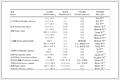
There was no obvious difference between MICMs and NICMs. The DG values for the MICMs and NICMs are 145 mg g-1 and 136 mg g-1,respectively,indicating the presence of a polymer layer. Fig. 2a shows an XPS wide-spectrum for an initiatorfunctionalized membrane. The spectra around 70 eV (top right insert of Fig. 2a) were recorded as Br3d spectra,indicating that the initiator had been anchored on the membrane surface. Fig. 2b is the XPS wide-spectrum for Ars imprinted membranes. The spectra around 400 eV were recorded as N1s spectra (top right insert of Fig. 2b),pointing out that the polymerization had been carried out due to the existence of N1s from the cross-linker (EGDMA) and functional monomer (AM). The atomic compositions of raw, functionalized membranes and MICMs are given in Table 1.
|
Table 1 XPS results for atomic compositions of membranes. |


|
Download:
|
| Fig. 2.XPS spectra of initiator-functionalized RC membranes (a) and imprinted RC membranes (b). | |
Membrane morphology was examined by SEM. From the crosssectional images (Fig. 3a and b),it is apparent that MICMs had the same asymmetric structure as RC membrane,demonstrating the robust RC membrane substrate made the imprint composite membrane stable and self-supported. The introduction of imprinted layer onto the membrane surface not only created imprinted sites as a result of surface chemistry change,but also altered the surface morphology of the membrane. It was evident that the surface of the Ars imprinted membrane was covered by a thin,imprinted layer after the polymerization process compared with the raw RC membrane (Fig. 3c and d).

|
Download:
|
| Fig. 3.SEM microphotographs of raw RC membrane (a,c) and Ars imprinted RC membrane (b,d). | |
To evaluate the adsorption capacity of the MICMs for Ars and the equilibrium constants,the adsorption isotherm experiments were performed at the different Ars concentrations ranging from 5.0 mg L-1 to 25 mg L-1. A high-performance liquid chromatographic system (Agilent 1200 series,U.S.A.) consisting of two LC-20AD pumps and a UV-vis detector (the maximum absorption wavelength was at 217 nm) was used to detect the concentrations of Ars and artemether. MICMs showed high binding capacities relative to NICMs,due to the recognition cavities formed on the imprinted layer of MICMs. When the feeding concentration of Ars was 5.0 mg L-1,the saturated binding capacity of MICMs was about 0.563 mg g-1,nearly 5.0 times that of NICMs. Also,the results showed that the analog template strategy was successful in this case. The Ars imprinted membrane could also used to recognize the template Ars in water,which was a cross-reaction of the imprinting effect. Here,the Langmuir isotherm model was used in the analysis experimental data. The nonlinear expression of the Langmuir model [20] was given by Eq. (1).

The regression curves of Langmuir model for MICMs and NICMs are obtained in Fig. 4,and the involved parameters are shown in Table 2. The results of regression (R2 values above 0.95) illustrated Langmuir isotherm fitted quite well with the experimental data. The calculated maximum monolayer adsorption capacities of MICMs and NICMs were 2.008 mg g-1 and 0.434 mg g-1,respectively. The imprinting factor estimated was 4.63,which suggested that the MICMs had highly specific adsorption for Ars molecules. The results demonstrated that the active sites distribution of MICMs and NICMs was homogeneous profiting from ATRP.
|
|
Table 2 Langmuir adsorption isotherm constants for Ars onto the MICMs and NICMs. |


|
Download:
|
| Fig. 4.Adsorption isotherms of Ars on the MICMs and NICMs with the fitting to the Langmuir model. | |
The adsorption rate is an important parameter used to image the adsorption process. Fig. 5 shows the adsorption kinetic curves of MICMs and NICMs from aqueous solution containing 25 mg L-1 Ars with various contact times. The Ars adsorption was observed to rapidly increase in the first 20 min,attributed to the presence of a large amount of unreacted,high-affinity binding sites on the surface of the membranes,and enabled template Ars to easily rebind with less mass resistance. In the subsequent step,when Ars occupied most of the binding sites,the equilibrium was slowly achieved.

|
Download:
|
| Fig. 5.Adsorption kinetics curves of Ars on the MICMs and NICMs with the fitting to pseudo-second-order model. | |
To investigate the rate-controlling mechanism of adsorption processes,such as mass transfer and chemical reaction,the kinetic data obtained from batch experiments was fitted with the pseudofirst- order [21] and pseudo-second-order rate equations,respectively [22]. The pseudo-first-order model could be expressed as follows:

The pseudo-two-order model can be expressed as Eq. (3):

The adsorption kinetics constants and linear regression values of the two models are listed in Table 3,and the nonlinear regression of the pseudo-second-order rate equation for Ars rebinding is shown in Fig. 5. The pseudo-first-order model exhibited relatively poor fitting with low regression coefficients value (R2) with variance between the experimental and theoretical values. The adsorption of Ars obeyed pseudo-second-order rate equation well due to the favorable agreement between experimental and calculated values of Qe (R2 values above 0.99). The results suggested that the pseudo-second-order mechanism was predominant and that chemisorption may be the rate-limiting step that controlled the adsorption process for Ars.
|
|
Table 3 Kinetics constants for the pseudo-first-order and pseudo-second-order rate equations. |


The selectivity permeation character of MICMs was evaluated toward competitive substrates Ars and artemether. The structure of the Ars (a) and artemether (b) are shown in Fig. 6 while Fig. 7 presents the digital photo of the H-model tube installation of the permeation experiment. The permeation experiments were conducted using the mixture solution in ethanol containing 5,10,15, 20,25 and 50 mg L-1 of Ars and artemether as the feeding solution respectively. The membrane,with an effective area of 1.5 cm2,was fixed solidly between two chambers of a permeation cell. The volume of each chamber was 150 mL. The mixture solution of Ars and artemether in ethanol (95 mL) was placed in the left-hand side chamber,while 95 mL ethanol was placed in the right-hand side chamber. In both half-cells,solutions were kept homogeneous by air vibration. The permeation experiments were done at 25℃. The permeation flux of Ars is much higher than that of artemether through the imprinted membrane with different concentrations of Ars and artemether mixture solution under the same conditions (Fig. 8). This can be explained by the polymerization of solutions by supramolecular assemblies of functional monomers and templates, the subsequent fixation of these groups followed by the removal of the template yielding the cavities predetermined by size and shape of the template. The cavities function as a specific molecular channel when the imprinted membrane is utilized in the permeation experiments. The spatial and functional complementary cavities enable the template analogs to transfer through the membrane in a rapid,continuous way. By the way,the permeate solutions through the imprinted membranes are concentrated to a large extent for both of the analytes.

|
Download:
|
| Fig. 6.Chemical structures of Ars (a) and artemether (b). | |


|
Download:
|
| Fig. 7.The H-model tube installation of permeation experiment. | |


|
Download:
|
| Fig. 8.Permeation rate (a) and separation factors (b) of imprinted membrane toward different targets. | |

In this case,there were three steps for the Ars to transport through the membrane. Firstly,Ars approached the surface of the membrane and was adsorbed by the binding sites. Secondly,the molecule left the cavity and moves to the next one. Finally,the molecule permeated through the imprinted layer and passed the support membrane.
The stability and potential regeneration of the MICMs were investigated. The regeneration experiment was performed at the concentration of 25 mg L-1. After adsorption of Ars onto the MICMs,the Ars-adsorbed was regenerated using the mixture of methanol and acetic acid (9:1,v/v) and then deionized water. The regenerated MICMs were used to adsorb Ars in subsequent cycles. The adsorption capacity of the MICMs adsorbent for Ars with four consecutive adsorption-desorption cycles was shown in Fig. 9. It was clearly seen that MICMs could be effectively regenerated for further use with only 5.68% loss of initial binding capacity after four cycles. Base on the selective permeation experiment performances after four regenerated cycles shown in Fig. 10,it is reasonable to assume that the MICMs can be reused at least four times without decreasing their adsorption capacities significantly. The permeation results indicated that MICMs kept nearly the same selectivity for Ars after four (adsorption/desorption) regeneration cycles.

|
Download:
|
| Fig. 9.The adsorption stability and regeneration performances of MICMs. | |


|
Download:
|
| Fig. 10.Permeation rate (a) and separation factors (b) of after four (adsorption/desorption) regeneration cycles MICMs toward different targets. | |

A novel,molecularly imprinted membrane technique for the selective recognition and permeation of Ars via ATRP was proposed. The prepared MICMs not only maintained the stability of RC membrane,but also exhibited good characteristics,such as excellent specific recognition and adsorption capacity. The ATRP initiator was first successfully grafted onto the surfaces of RC membranes via the immobilization process of 2-BIB,and then the ATRP was carried out by using the RC membrane@initiator. SEM and XPS were used to characterize the as-prepared MICMs for Ars. According to the adsorption isotherms,the adsorption capacity calculated by the Langmuir isotherm model had been found that MICMs had a higher adsorption amount than NICMs. Through the selective experiments,good selectivity was illustrated by MICMs for Ars. The regeneration of MICMs experiments also proved that the as-prepared MICMs had excellent stability and regeneration capability. It could be concluded that the MICMs will be successfully obtained to be applied to the extraction of Ars without physical method from the Artemisia annua L. samples in the further study. Acknowledgments
This work was financially supported by the National Natural Science Foundation of China (Nos. 21077046,21107037,21176107,21174057,2100403,21207051),National key basic research development program (973 Program,No. 2012CBB21500),Ph.D. Programs Foundation of Ministry of Education of China (No. 20123227120015) and Natural Science Foundation of Jiangsu Province (Nos. BK2011461,SBK2011459, BK2011514). China Postdoctoral Science Foundation funded project (Nos. 2012M511220,2013M530240).
| [1] | A.L. Schilmiller, R.L. Last, E. Pichersky, Harnessing plant trichome biochemistry for the production of useful compounds, Plant J. 54 (2008) 702-711. |
| [2] | A. Gautam, T. Ahmed, J. Paliwal, V. Batra, Pharmacokinetics and pharmacodynamics of endoperoxide antimalarials, Curr. Drug. Metab. 10 (2009) 289-306. |
| [3] | J.B. Jiang, G.Q. Li, X.B. Guo, Y.C. Kong, K. Arnold, Antimalarial activity of mefloquine and qinghaosu, Lancet 2 (1982) 285-288. |
| [4] | E.V. Piletska, K. Karim, M. Cutler, A.P. Sergey, Development of the protocol for purification of artemisinin based on combination of commercial and computationally designed adsorbents, J. Sep. Sci. 36 (2013) 400-406. |
| [5] | M.N. Maier, W. Lindner, Chiral recognition applications of molecularly imprinted polymers: a critical review, Anal. Bioanal. Chem. 389 (2007) 377-397. |
| [6] | G. Wulff, Molecular imprinting in cross-linked materials with the aid of molecular templates-a way towards artificial antibodies, Angew. Chem. Int. Ed. 34 (1995) 1812-1832. |
| [7] | P. Wang, X.F. Fu, J. Li, et al., Preparation of hydrophilic molecularly imprinted polymers for tetracycline antibiotics recognition, Chin. Chem. Lett. 22 (2011) 611-614. |
| [8] | Y. Wang, T.X. Wei, Surface plasmon resonance sensor chips for the recognition of bovine serum albumin via electropolymerized molecularly imprinted polymers, Chin. Chem. Lett. 24 (2013) 813-816. |
| [9] | S.A. Piletsky, T.L. Pansyuk, E.V. Piletskaya, I.A. Nichools, M. Ulbricht, Receptor and transport properties of imprinted polymer membranes - a review, J. Membr. Sci. 157 (1999) 263-278. |
| [10] | M. Ypsjolawa, K. Murakoshi, T. Kogita, et al., Chiral separation membranes from modified polysulfone having myrtenal-derived terpenoid side groups, Eur. Polym. J. 42 (2006) 2532-2539. |
| [11] | M. Ulbricht, Membrane separations using molecularly imprinted polymers, J. Chromatogr. B 804 (2004) 113-125. |
| [12] | R. Kiełczyński, M. Bryjak, Molecularly imprinted membranes for cinchona alkaloids separation, Sep. Purif. Technol. 41 (2005) 231-235. |
| [13] | I. Koyuncu, O.A. Arikan, M.R. Wiesner, C. Rice, Removal of hormones and antibiotics by nanofiltration membranes, J. Membr. Sci. 309 (2008) 94-101. |
| [14] | C.L. Winson, Y.L. Lay, A.G. Fane, Impacts of salinity on the performance of high retention membrane bioreactors for water reclamation: a review, Water Res. 44 (2010) 21-40. |
| [15] | M.E. Avramescu, W.F.C. Sager, M.H.V. Mulder, M. Wessling, Preparation of ethylene vinylalcohol copolymer membranes suitable for ligand coupling in affinity separation, J. Membr. Sci. 210 (2002) 155-173. |
| [16] | W. Albrecht, F. Santoso, K. Lutzow, et al., Preparation of aminated microfiltration membranes by degradable functionalization using plain PEI membranes with various morphologies, J. Membr. Sci. 292 (2007) 145-157. |
| [17] | S.A. Saufi, C.J. Fee, Fractionation of beta-lactoglobulin from whey by mixed matrix membrane ion exchange chromatography, Biotechnol. Bioeng. 103 (2009) 138- 147. |
| [18] | G. Yang, L. Zhang, Regenerated cellulose microporous membranes by mixing cellulose cuoxam with a water soluble polymer, J. Membr. Sci. 114 (1996) 149- 155. |
| [19] | K. Matyjaszewski, J. Xia, Atom transfer radical polymerization, Chem. Rev. 101 (2001) 2921-2990. |
| [20] | I. Langmuir, The adsorption of gases on plane surfaces of glass, mica and platinum, J. Am. Chem. Soc. 40 (1918) 1361-1403. |
| [21] | Y.S. Ho, G. McKay, The sorption of lead (Ⅱ) ions on peat, Water Res. 33 (1999) 578- 584. |
| [22] | Y.S. Ho, G. McKay, Pseudo-second order model for sorption processes, Process Biochem. 34 (1999) 451-465. |