


Over the past ten years,the applications of surfactants have been quiet diverse and of great practical importance as potential components in pharmaceuticals,personal care products and other detergents [1, 2, 3, 4]. Presently,in the field of energetic materials [5, 6], the use of common surfactants is also under the spotlight. It is worth noting that the addition of common surfactants as the inert substances remarkably influences the whole energy of energetic materials. It has been a research focus to find new surfactants with little effect on the entire energy of the energetic materials. Thus, researchers have paid much attention to the novel functional surfactants containing specific groups [7]. An energetic surfactant is a kind of functional surfactants bearing energetic groups [8, 9, 10] that have favorable performances,such as high thermal stability, high surfactivity,good compatibility,energetic insensitivity and environmental friendliness. The addition of energetic surfactants in the energetic materials can not only improve their physical and chemical properties and dispersibility,but also increase their entire energy,which has broadened applications in energetic materials,such as high-energy insensitive composite explosives [11],low-sensitivity propellants,and smokeless fireworks.
In this study,we have developed a mild and efficient synthetic route for 1-amino-3-dodecyl-1,2,3-triazolium nitrate as an energetic surfactant (Scheme 1),whose hydrophilic head is 1-amino- 1,2,3-triazolium and the hydrophobic tail is a dodecyl group. Four steps are designed to obtain the triazolium nitrate. Firstly,through addition-elimination and cyclization,we synthesized 1-amino- 1,2,3-triazole,which does not involve the use of expensive 1H- 1,2,3-triazole. Secondly,an alkylation reaction leads to the formation of 1-amino-3-dodecyl-1,2,3-trizaolium halide. Finally, by changing the halide for the nitrate anion,which proceeds smoothly and in a high yield,we prepared the product salt facilely. The synthesis,optimized conditions,spectra,physical and chemical properties of product salt are discussed.

|
Download:
|
| Scheme 1.Synthesis of 1-amino-3-dodecyl-1,2,3-triazolium nitrate. Condition and reagent: (a) CH3OH, 70℃; (b) CH3CN, 20℃; (c) CH3COOCH2CH3, 80℃; (d) CH3OH, 20℃. | |
All chemicals were of analytical grade,purchased from Sinopharm Chemical Reagent Company,and used without any further purification. 1H NMR was recorded on a Bruker 500 MHz spectrometer. IR spectra were obtained by a Nicolet IS-10 FT-IR spectrometer. Mass spectra were recorded on a Finnigan TSQ Quantum ultra AM mass spectrometer. The surface tension and critical micelle concentration (CMC) of the product were determined by a surface tension apparatus using the drop-volume method. Thermal analyses were conducted on a DSC823 Differential Scanning Calorimeter.
To a stirred solution of hydrazine hydrate (85%,22 mL) in methanol (46 mL) was added glyoxal (40%,18 mL) slowly over 1 h. The resulting mixture was stirred for 4 h at 70℃. After the reaction completed,the solution was distilled under high vacuum and the yellow solid solidified at lower temperatures. Subsequently,the solid was washed with isopropanol repeatedly and dried at 25℃ for several hours in vacuo to give glyoxal bishydrazone as a white crystal (7.92 g,90.3%). 1H NMR (500 MHz,DMSO-d6): δ 6.58 (s,4H, N-H),7.40 (s,2H,C-H); IR (neat,cm-1): ν 3329 (N-H),3155 (C-H), 1574 (C=N),917 (=C-H); MS (ESI): m/z 87.11 ([M+H]+).
To a solution of glyoxal bishydrazone (1.73 g,20.0 mmol) in acetonitrile (25.8 mL) was added activated MnO2 (3.43 g, 39.4 mmol) at 20℃ in batches,three fourths of which was added over 0.5 h and the rest was added after 1.5 h. The reaction was monitored by TLC (thin layer chromatography) analysis. Upon completion,manganese dioxide was recovered by filtration. Acetonitrile was easily removed under reduced pressure. A yellow crystal was obtained at low temperatures,washed with a small amount of chloroform and dried in vacuum to afford 1.49 g (88.2%) of 1-amino-1,2,3-triazole. 1H NMR (500 MHz,DMSO-d6): δ δ6.98 (s, 2H,NH2),7.63 (s,1H,C4-H),7.89 (s,1H,C5-H); IR (neat,cm-1): ν 3311 (N-H),3142 (=C-H),1639 (C=C),1115 (C-N),806 (N-H); MS (EI): m/z 85.10 ([M+H]+),107.04 ([M+Na]+),123.02 ([M+K]+), 139.05 ([M+Na+CH3OH]+).
1-Amino-1,2,3-triazole (0.569 g,6.50 mmol) was dissolved in ethyl acetate (30 mL) followed by the addition of bromododecane (3.7 mL) in the darkness. The reaction mixture was stirred under reflux for 40 h at 80℃. At the end of the reaction,the solution was cooled to room temperature and washed with ethyl acetate. Thereafter,the solvent was removed by evaporation in vacuo. The residue was dried to afford 1.46 g (64.5%) of 1-amino-1,2,3- triazolium bromide as a white crystal. 1H NMR (500 MHz, DMSO-d6): δ 0.86 (3H,CH3),1.2 (18H,CH2),1.88 (2H,C-H),4.53 (2H,C-H),8.30 (2H,N-H),8.64 (1H,C5-H),8.86 (1H,C4-H); IR (neat,cm-1): ν 3119 (N-H),3071 (=C-H),2962 (-CH3),1634 (C=C),1371 (-CH3),1466 (C-H),1216 (C-N),823 (N-H),718 (C-H),666 (C-H); MS (EI): m/z 53.06 ([M+]),85.03 ([M-]).
A solution of AgNO3 (0.297 g,1.70 mmol) in water (5 mL) was slowly added to a solution of 1-amino-3-dodecyl-1,2,3-triazolium bromide (0.439 g,1.30 mmol) in methanol (20 mL) at 20℃ in the darkness. The reaction mixture was stirred for 3.5 h. Silver bromide was filtered off and the filtrate was dried over anhydrous CaCl2. The solvent was evaporated under reduced pressure to give 0.353 g 80.4%) of 1-amino-3-dodecyl-1,2,3-triazolium nitrate a the white powder. 1H NMR (500 MHz,DMSO-d6): δ 0.86 (3H,CH3),1.2 (18H, CH2),1.88 (2H,C-H),4.53 (2H,C-H),8.30 (2H,N-H),8.64 (1H,C- H),8.86 (1H,C-H); IR (neat,cm-1): ν 3126 (N-H),3059 (=C-H), 2915 (-CH3),1647 (C=C),1373 (-CH3),1467 (C-H),1254 (C-N), 828 (N-H),718 (C-H),623 (C-H); MS (EI):m/z 253.17 ([M+]),62.09 ([M-]).
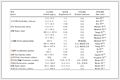
In the general synthesis of 1-amino-3-dodecyl-1,2,3-triazolium nitrate,cyclization of glyoxal bishydrazone and the use of MnO2 were critical. Thus,to optimize the conditions,the cyclization reaction was investigated under different reaction conditions (Table 1). We found that the increase of MnO2/glyoxal bishydrazone molar ratio and reaction time was beneficial to the formation of 1-amino-1,2,3-triazole. Considering the effect of increasing MnO2 and time on yields,we selected the molar ratio of 2:1 and reaction time of 3.0 h as the optimal values. Higher temperatures were more favorable to intramolecular electron transfer so promoted the decomposition of products,resulting in decreased yields (entry 8,9).
|
Table 1 Optimization of reaction conditions on the synthesis of 1-amino-1,2,3-triazole. |

In the alkylation reaction of 1-amino-1,2,3-triazole and bromododecane,reactants were highly soluble in acetonitrile, dimethylformamide and ethyl acetate. Because of low volatility of dimethylformamide and high toxicity of acetonitrile,we chose ethyl acetate as the solvent in which the reaction proceeded well. The reaction was further optimized under different conditions (Table 2). The yield was less affected by the increase of molar ratio bromododecane/1-amino-1,2,3-triazole,but it increased sharply at increased temperatures until 80℃. Thus,the reaction was carried out with the molar ratio,temperature and time being 1.5:1,80℃ and 40 h,respectively. Longer time and higher temperatures led to the triazolium bromide decomposition and side reactions,resulting in diminished yields.
|
|
Table 2 Optimization of reaction conditions on the synthesis of 1-amino-3-dodecyl-1,2,3- triazolium bromide. |


The metathesis involved in a reaction of 1-amino-3-dodecyl- 1,2,3-triazolium bromide with an excess of silver nitrate,producing the desired 1-amino-3-dodecyl-1,2,3-triazolium nitrate in excellent yield. To prevent the contamination of the product by elemental silver,reaction was carried out in the darkness. Methanol was chosen as a reaction media,because it easily dissolved the triazolium bromide and was removed after reaction completion. Silver nitrate was dissolved in water due to its low solubility in methanol. CaCl2 as the desiccant was used for absorbing the added water and precipitating excessive silver nitrate.
The surface tension of 1-amino-3-dodecyl-1,2,3-triazolium nitrate aqueous solutions was measured by a surface tension apparatus using the drop-volume method at 20℃. Fig. 1 shows a plot of surface tension versus log concentration (γ-log C) of 1- amino-3-dodecyl-1,2,3-triazolium nitrate. According to Fig. 1,CMC and surface tension at the CMC (γcmc) were 8 × 10⁻³ mol/L and 27.15 mN/m,respectively,which indicated a high surface activity. Thermal behaviors were examined by differential scanning calorimeter (DSC). As shown in Fig. 2,a sharp peak was present at the melting point of 151.39℃ and no exothermic peaks were present below 400℃,showing high thermal stability.

|
Download:
|
| Fig. 1.Surface tension of 1-amino-3-dodecyl-1,2,3-triazolium nitrate at 20℃. | |


|
Download:
|
| Fig. 2.DSC of 1-amino-3-dodecyl-1,2,3-triazolium nitrate. | |

In conclusion,we have successfully developed a facile and efficient method to prepare 1-amino-3-dodecyl-1,2,3-triazolium nitrate. The application of energetic surfactants in energetic materials can not only produce good surface activity,but also improve the energy,meeting the requirements of functional surfactants in the field of explosives. Also,this method provides an opportunity to synthesize more derivatives as energetic surfactants by changing the alkyl chains. Applications of energetic surfactants in energetic materials will be likely broadened.
| [1] | J.W. Guo, X. Zhong, H. Zhu, L.J. Feng, Y.D. Cui, Synthesis of novel quaternary ammonium surfactants containing adamantane, Chin. Chem. Lett. 23 (2012) 653-656. |
| [2] | X.M. Ran, X. Guo, J.T. Ding, Plasmid DNA induces dodecyl triethyl ammonium bromide to aggregate into vesicle, Chin. Chem. Lett. 23 (2012) 1396-1398. |
| [3] | T. Geng, X.G. Teng, Q.X. Li, Y.J. Jiang, G.J. Li, Synthesis and properties of long-chain quaternary ammonium hydroxides, Chin. Chem. Lett. 24 (2013) 494-496. |
| [4] | H. Li, X. Guo, Vesicle formation between single-chained cationic surfactants and ribo-oligonucleotides, Chin. Chem. Lett. 24 (2013) 82-84. |
| [5] | Z.Q. Xia, S.P. Chen, Q. Wei, C.F. Qiao, Syntheses and characterization of energetic compounds constructed from alkaline earth metal cations (Sr and Ba) and 1,2- bis(tetrazol-5-yl)ethane, J. Solid State Chem. 184 (2011) 1777-1783. |
| [6] | M.J. Rosen, Z.H. Zhu, T. Gao, Synergism in binary mixture of surfactants: 11. Mixtures containing mono- and disulfonated alkyl- and dialkyldiphenylethers, J. Colloid Interface Sci. 157 (1993) 254-259. |
| [7] | Y. Dong, Y. Jin, D.Q. Wei, Surface activity and solubilization of a novel series of functional polyurethane surfactants, Polym. Int. 56 (2007) 14-21. |
| [8] | F.T. Wu, P. Liu, X.W. Ma, Tetrazole-1-acetic acid as a ligand for copper-catalyzed N-arylation of imidazoles with aryl iodides under mild conditions, Chin. Chem. Lett. 24 (2013) 893-896. |
| [9] | H. Xue, Y. Gao, B. Twamley, J.M. Shreeve, New energetic salts based on nitrogencontaining heterocycles, Chem. Mater. 17 (2005) 191-198. |
| [10] | Y.G. Huang, H.X. Gao, B. Twamley, J.M. Shreeve, Highly dense nitranilates-containing nitrogen-rich cations, Chem.-A Eur. J. 15 (2009) 917-923. |
| [11] | S. Daoud, T.R. Berger, M.J. Villeburn, Insensitive munition-type BNCP explosive material and methods for forming the same, USP8444784. |