


Thiocyanate (SCN-) widely exists in sewage,industrial effluent, as well as the metabolites of organisms. If the level of SCN- is high in human body fluids,it will affect the dialysis of protein and even lead to some adverse symptoms,such as vertigo and unconsciousness [1]. Therefore,the determination of SCN- has a great significance in industrial production,life,medical care and so on.
There aremanymethods to determine SCN-,for example,SCN- selective electrode [2],spectrophotometry [3],capillary electrophoresis [4], ion chromatography [5],and ion-pair chromatography [6]. When using conventional ion chromatography and ionpair chromatography for the determination of SCN-, the retention times are usually a few minutes,sometimes even more than 10 min.
As a novel stationary phase,monolithic columns have been used in high-performance liquid chromatography (HPLC),capillary electrochromatography (CEC),and ion chromatography [7, 8, 9], which are attracting more and more attention and interest. Monoliths have two main forms,namely organic polymer monoliths and silica-based monoliths. Using silica-based monolithic column,there are twomethods for the separation of ions: (1) Monoliths can be modified with ionic surfactant to form ion- exchange sites,and then ions are separated by ion-exchange chromatography mode [10]; (2) Ion-pair reagents can be added into mobile phase,ions are separated by ion-pair chromatography mode [11, 12].
In this study,a silica-based monolithic column is employed to achieve rapid determination of SCN- by ion-pair chromatography with direct conductivity detection. Some factors that affect the retention of SCN- are investigated. A method for fast analysis of SCN- by ion-pair chromatography using silica-based monolithic column is established and applied to the determination of SCN- in ionic liquids.
2. ExperimentalTetrabutylammoniumhydroxide (TBA) as a 25% (w/w) solutio in water,thiocyanate,chlorate,iodide,nitrate,chloride and sulfat as their potassium or sodium salts,and phthalic acid,acetonitril were obtained from Tianjin Guangfu Fine Chemical Researc Institute (Tianjin,China). All these reagents were analytical grad or HPLC grade.
Standard solutions of all anions were prepared in 18.2 MΩ cm deionized distilled water from a Millipore Milli-Q water-purification system (Bedford,MA,USA). Stock standard solutions of 1000 mg/L concentration were prepared monthly and stored in a fridge at 4 ℃. Working standard solutions from each respective stock solution were prepared on a daily basis as required. The solutions were filtered through a 0.22 μm membrane filter prior to injections.
Milli-Q water was also used to prepare eluents. Aqueous TBA solution and acetonitrile were mixed in the appropriate proportions, and then phthalic acid was added to adjust the pH values. A model PHSF-3F pH meter (Shanghai Precision and Scientific Instrument,Shanghai,China) was used for pH measurement Before use,the eluentswere filtered through a 0.22 μm membrane filter,and then degassed for 15 min with a model DOA-P504-BN pump (IDEX,CHI,USA).
The whole chromatographic experimentation was carried out on an LC-20A ion chromatograph (Shimadzu,Kyoto,Japan),which consisted of a Model LP-20ADsp liquid delivery pump,a conductivity detector Model CDD-10Avp,an autosample injector Model SIL-20A,a Model CTO-20AC column oven and a system controller Model SCL-10Avp. The column and the conductivity detection cell were placed inside the CTO-20AC column oven for temperature control. The chromatograph control,data acquisition and data analysis were performed using a LC solution Ver. 1.1 workstation (Shimadzu,Kyoto,Japan).
All separationswere performed on a Chromolith Speed ROD RP- 18e column bonded with C18 (50 mm × 4.6 mm i.d.,Merk KGaA, Darmstadt,Germany). The optimized eluent for the fast analysis consisted of 0.25 mmol/L TBA-0.18 mmol/L phthalic acid-7% acetonitrile (pH 5.5). The flow rate was set at 6.0 mL/min. Column temperature was 30 ℃. Injection volume was 20 μm. Direct conductivity detection was employed. The column was flushed with the eluent to achieve stable baseline before injections. To eliminate hydrophobic TBA absorbed by the column,the column should be flushed with at least 30 mL of water-acetonitrile (95/5, v/v) every day,after analysis. In this way,the column could be recovered to the previous state.
3. Results and discussionEffect of eluent concentration on the retention time of thiocyanate was investigated using different concentrations of TBA-phthalic acid (pH 5.5) as eluents. In this experiment,flow rate was 5.0 mL/min and column temperature was 30 ℃. The TBA concentrations of 0.10,0.25,0.50,1.00,2.00,3.00,4.00,5.00,6.00 and 7.00 mmol/L were prepared,and then the solutions of TBA were titrated to pH 5.5 with phthalic acid,resulting in the corresponding concentrations of phthalic acid 0.07,0.18,0.37, 0.73,1.47,2.20,2.93,3.67,4.40 and 5.13 mmol/L,respectively. The retention time of SCN- increases with eluent concentration at low range. When the concentration of TBA was increased to a certain level,the retention time of SCN- changed little. This was likely resulted from the combined action of ion-pair reagent TBA and eluting ion phthalate. In ion-pair chromatography,when the concentration of ion-pair reagent TBA increases,the retention of solute ionswill increase to some extent and lead to a long retention time,especially for relatively hydrophobic ion (SCN-); however, increasing the concentration of eluting ion phthalate will shorten retention times of solute ions. As observed in the experiment, when TBA concentration varied from 0.10 mmol/L to 7.00 mmol/L, the background conductivity of the eluent increased from 15 μS/ cmto 614 μS/cmas a result,while the baseline noise (0.04-0.05 μS/ cm) remained constant. As for direct conductivity detection,lower background conductivity has the advantage of higher sensitivity. When the concentration of TBAwas 0.25mmol/L,the retention time of SCN- was shorter,the background conductivity of the eluentwas low,and the separation among SCN-1 and other common anions (Cl-, NO3 -,SO4-2,I -)was good. Therefore,the optimized concentration of TBA was 0.25mmol/L,the corresponding concentration of phthalic acid was 0.18mmol/L.
Acetonitrile,methanol and isopropyl alcohol are usually used as organic modifiers in ion chromatographic separation. Among the three kinds of organicmodifiers,acetonitrile is the best,because its water solution has lowest viscosity. To investigate the effect of acetonitrile concentration on the retention of thiocyanate,different volume fractions of acetonitrile were added into the eluents that consisted of 0.25 mmol/L TBA-0.18 mmol/L phthalic acid (the flow-rate was 5.0 mL/min,the column temperature was 30 ℃). As the acetonitrice concentration increased,the retention time of SCN- was reduced. Thiswas because that the hydrophobicity of the eluent increased when acetonitrile was added,thus the eluent can more efficiently access hydrophobic stationary phase,then the affinity of ion-pairs to the stationary phase was reduced and the retention time shortened. 7%was selected as the optimized volume fraction for acetonitrile.
In order to further optimize the separation,the effect of eluent pH value on the retention was studied. The suitable pH range is 2.0-7.5 for the silica-based monolithic column. Higher pH eluents will dissolve the silica,creating voids in the column. Lower pH eluents can eventually strip away some of the bonded phase. Both will cause changes in retention times and loss of resolution. To inspect the influence of pH on the retention of anions,the column temperature was set at 30 ℃,flow rate was set at 1.0 mL/min,and the pH value of the eluent was adjusted by adding phthalic acid into 0.25 mmol/L TBA-7% acetonitrile. It was found that when pH value was lower than 4.5 or higher than 6.5,the baseline was instable,and system peaks interfered with separation; when the change of pH was in the range of 4.5-6.5,the retention time of SCN- changed little,the eluent background conductivity (28- 39 μS/cm) and the baseline noise (0.04-0.05 μS/cm) also changed little. When pH value was 5.5,the retention time of SCN- was shorter,and other common anions and system peaks did not interfere the separation. Eluent pH value of 5.5 was selected.
The retention time of SCN- was measured at column temperatures of 25,30,35 and 40 8C. In this research,eluent was 0.25 mmol/L TBA-0.18 mmol/L phthalic acid-7% acetonitrile (pH 5.5) and flowratewas 5.0 mL/min.When elevating the column temperature,retention time of SCN- shortened a little. Thus,the column temperature resulted in little effect on the retention of thiocyanate,the column temperature of 30 8C was chosen.
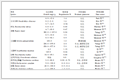
When eluentwas 0.25 mmol/L TBA-0.18 mmol/L phthalic acid- 7% acetonitrile (pH5.5) and column temperature was 30 8C,the effect of flow rate on the retention time of thiocyanate,column back-pressure and column efficiency was investigated. Seen from Table 1,with the increased flow rate,retention time of SCN- shortened. Andwhen flow rate was 6.0 mL/min,the retention time was the shortest. Although column back-pressure increased with the increased flow rate,common liquid chromatographic equip- ment could bear the pressure even if flow rate was 6.0 mL/min. Column efficiency changed slightly with the increased flow rate. The above studies clearly prove the suitability ofmonoliths for fast and efficient separations.
|
Table 1 Effect of flow rate on retention time of thiocyanate,column back-pressure and column efficiency. |

Considering all factors above,the optimized chromatographic conditions were using 0.25 mmol/L TBA-0.18 mmol/L phthalic acid-7% acetonitrile (pH 5.5) as eluent,column temperature of 30 ℃,and flow rate of 6.0 mL/min. The chromatogram of a standard solution is shown in Fig. 1. The retention time of SCN- waswithin 1 min,and other common anions did not interfere with the determination of SCN-. Comparing to general methods using ion chromatography or ion-pair chromatography [5, 6],the retention time was significantly shortened when using this method for the analysis of SCN-.

|
Download:
|
| Figure. 1. Ion-pair chromatogram of a standard mixture of thiocyanate and other five common anions. Chromatographic conditions: Chromolith Speed ROD RP-18e column (50 mm × 4.6 mm i.d.); eluent of 0.25 mmol/L TBA-0.18 mmol/L phthalic acid-7% acetonitrile (pH 5.5); flow rate of 6.0 mL/min; column temperature of 30 ℃; 20 μL inject volume; direct conductivity detection. Peaks: (1) Cl -1 (4.0 mg/L); (2) NO3-1 (8.0 mg/L); (3) ClO3-1 (4.0 mg/L); (4) I-1 (8.0 mg/L); (5) SCN-1 (12.0 mg/L); (6) SO4-2 (8.0 mg/L); sp: system peak. | |
Detection limit,calibration curve and precision were obtained by determining a series of standard solutions of SCN- using the above optimized chromatographic conditions. The detection limit of SCN- was 0.96 mg/L,which was obtained by tripling the signal- to-noise ratio (S/N = 3). Relative standard deviation (RSD) o chromatographic peak area for SCN- was determined by five repeatedmeasurements of 12.0 mg/L SCN- as 1.4%. Linearity range was 2.0-100.0 mg/L. The linear regression equations is y = 160.0x - 141.9,where y is peak area (integral value),,x is concentration of SCN- (mg/L); correlation coefficient r = 0.9993 (n = 5).
The proposedmethodwas applied to the determination of SCN in ionic liquids,groundwater and juice. The 1-butyl-3-methyl imidazolium thiocyanate ionic liquids of exactly quantified weights (0.1-0.2 g) were diluted to 100 mL with the eluent as stock solutions. Then 0.6 mL of the stock solution was diluted to 25 mL. The groundwater and juice samples were diluted with the eluent,and the proportions were 1:2.5 and 1:25,respectively. The diluents were filtered through 0.22 μm membrane filter before determination. The chromatograms of ionic liquids are shown in Fig. 2. No signal corresponding to SCN- was evident in chromatograms obtained fromthe groundwater and juice samples. According to the contrast with blank sample,recoveries were tested by standard addition method. Analytical results and recoveries of SCN- in the samples are listed in Table 2. The results indicate that this method has the advantages of high accuracy and good precision.

|
Download:
|
| Figure. 2. Chromatogram of ionic liquid sample. Chromatographic conditions are the same as Fig. 1. | |
|
|
Table 2 Analytical results and recoveries of thiocyanate founded in ionic liquid,groundwater and juice. |


This research established a simple method for fast separation and determination of SCN- using ion-pair chromatography with silica-based monolithic column and direct conductivity detection. The retention time of SCN- was within 1 min,and common anions did not interfere with the determination. It is very suitable to use monolithic column for the analysis of SCN- whose retention is strong. This method has been successfully applied to the quantitative analysis of SCN- in ionic liquids,the results of which are accurate and reliable.
AcknowledgmentThis work was supported by the Program for Scientific and Technological Innovation Team Construction in Universities of Heilongjiang Province (No. 2011TD010).
| [1] | C. Steinmaus, M.D. Miller, R. Howd, Impact of smoking and thiocyanate on perchlorate and thyroid hormone associations in the 2001-2002 national health and nutrition examination survey, Environ. Health Perspect. 115 (2007) 1333-1338. |
| [2] | P.H. Yang, W.Z. Wei, C.Y. Tao, Determination of trace thiocyanate with nano-silver coated multi-walled carbon nanotubes modified glassy carbon electrode, Anal. Chim. Acta 585 (2007) 331-336. |
| [3] | J.F. Van Staden, A. Botha, Spectrophotometric determination of thiocyanate by sequential injection analysis, Anal. Chim. Acta 403 (2000) 279-286. |
| [4] | Y. Tanaka, N. Naruishi, H. Fukuya, et al., Simultaneous determination of nitrite, nitrate, thiocyanate and uric acid in human saliva by capillary zone electrophoresis and its application to the study of daily variations, J. Chromatogr. A 1051 (2004) 193-197. |
| [5] | B.C. Blount, L. Valentin-Blasini, Analysis of perchlorate, thiocyanate, nitrate and iodide in human amniotic fluid using ion chromatography and electrospray tandem mass spectrometry, Anal. Chim. Acta 567 (2006) 87-93. |
| [6] | D. Connolly, L. Barron, B. Paull, Determination of urinary thiocyanate and nitrate using fast ion-interaction chromatography, J. Chromatogr. B 767 (2002) 175-180. |
| [7] | A. Nordborg, E.F. Hilder, P.R. Haddad, Monolithic phases for ion chromatography, Annu. Rev. Anal. Chem. 4 (2011) 197-226. |
| [8] | X.X. Li, X. Liu, L.H. Bai, et al., Preparation of imprinted monolithic column under molecular crowding conditions, Chin. Chem. Lett. 22 (2011) 989-992. |
| [9] | H.W. Zhang, K. Li, Z.X. Liang, F.Y. Wang, Q.W. Lu, Development of a monolithic polymer pipette for solid-phase extraction of liquiritigenin in rat plasma, Chin. Chem. Lett. 23 (2012) 723-726. |
| [10] | J. Li, Y. Zhu, Y.Y. Guo, Fast determination of anions on a short coated column, J. Chromatogr. A 1118 (2006) 46-50. |
| [11] | X. Huang, H. Yu, Y.J. Dong, Rapid and simultaneous determination of imidazolium and pyridinium ionic liquid cations by ion-pair chromatography using a monolithic column, Chin. Chem. Lett. 23 (2012) 843-846. |
| [12] | S.W. Li, H. Yu, Y.J. Ma, Rapid determination of trifluoromethanesulfonate and ptoluenesulfonate by ion-pair chromatography using a reversed-phase silicabased monolithic column: application to the analysis of ionic liquids, Chromatographia 74 (2011) 759-765. |