 2016, Vol. 32


2. 安徽省地质测绘技术院, 合肥 230022
2. Institute of Geological Surveying and Mapping of Anhui Province, Hefei 230022, China
无水、碱性和非造山是A型花岗岩的属性特征(Loiselle and Wones, 1979),然而对于其源岩组成、岩浆形成条件和产出环境仍存在多种认识(Whalen et al., 1987; Eby et al., 1990,1992; Creaser et al., 1991; Douce,1997; Bonin,2007; Frost and Frost, 2011; Green and Falloon, 2015)。A型花岗岩常与同时代基性岩体相伴生(Haapala and Rämö,1992; Peccerillo et al., 2003),具有高的形成温度(King et al., 1997),其形成过程中往往存在幔源物质或热源贡献(Wu et al., 2002; Bonin,2007)。A型花岗岩通常形成于有利于地幔上涌的构造环境中,如造山后伸展、非造山伸展(Whalen et al., 1987; Dargahi et al., 2010)和俯冲相关伸展(Zhao et al., 2008; Li et al., 2012)环境下。A型花岗岩的成因研究可以为揭示壳幔相互作用和约束区域构造演化提供重要依据。
郯庐断裂带南段夹持于大别造山带和长江中下游地区之间,发育一系列沿断裂带走向展布的白垩纪双峰式火山岩和中酸性侵入岩(图 1)。其中双峰式火山岩主要分布于巢湖-庐江段,根据年代学资料可分为早、晚两期(125~119Ma和100~93Ma; 谢成龙等, 2008a,b)。侵入岩大多出露于张八岭隆起和肥东地区,虽然它们都形成于早白垩世(136~103Ma),但是前人研究结果显示不同期次岩石的地球化学特征和源区组成存在明显差异;根据形成时代及地球化学特征,可将其分为三期:早期为高镁埃达克质岩(136~125Ma; 资锋等,2008; Liu et al., 2010a; Wang et al., 2013; Hu et al., 2014),中期为低镁埃达克质岩(127~115Ma; 牛漫兰等, 2008,2010),晚期则为A型花岗岩(108~103Ma; 牛漫兰等,2010)。断裂带西侧大别造山带和东侧长江中下游地区出露的典型A型花岗岩,形成时代分别集中于120~119Ma(谢智等,2004; Chen et al., 2009)和127~123Ma(范裕等,2008; Wong et al., 2009; Li et al., 2011,2012; Yan et al., 2015),都明显早于断裂带内A型花岗岩。另外,牛漫兰等(2010)中报道的肥东早白垩世晚期花岗岩虽具有A型花岗岩的某些特征,如富碱、高Ga/Al和FeOT/MgO值及强烈的Eu负异常,但同样也表现出富硅(SiO2>75%)、高分异程度、低锆石饱和温度和低Zr+Nb+Y+Ce含量的特征;A型花岗质岩浆或I型花岗质岩浆高分异都可以形成这类岩石(Chappell and White, 1992; Jiang et al., 2009),因而其是否具有A型花岗岩属性尚有待商榷。目前郯庐断裂带内缺乏真正A型花岗岩的发现及对其成因研究,而我们在断裂带内庐江段长岗地区新发现一具A型花岗岩特征的侵入岩体,它们可为研究断裂带内A型花岗岩岩石成因和侵入岩由加厚下地壳来源(埃达克质)转变为正常下地壳来源的准确时间问题提供载体。本文将对郯庐断裂带庐江段内长岗岩体,开展系统的年代学、地球化学和锆石Hf-O同位素综合研究,探讨岩石成因及源区特征,为研究断裂带内岩浆演化提供制约。
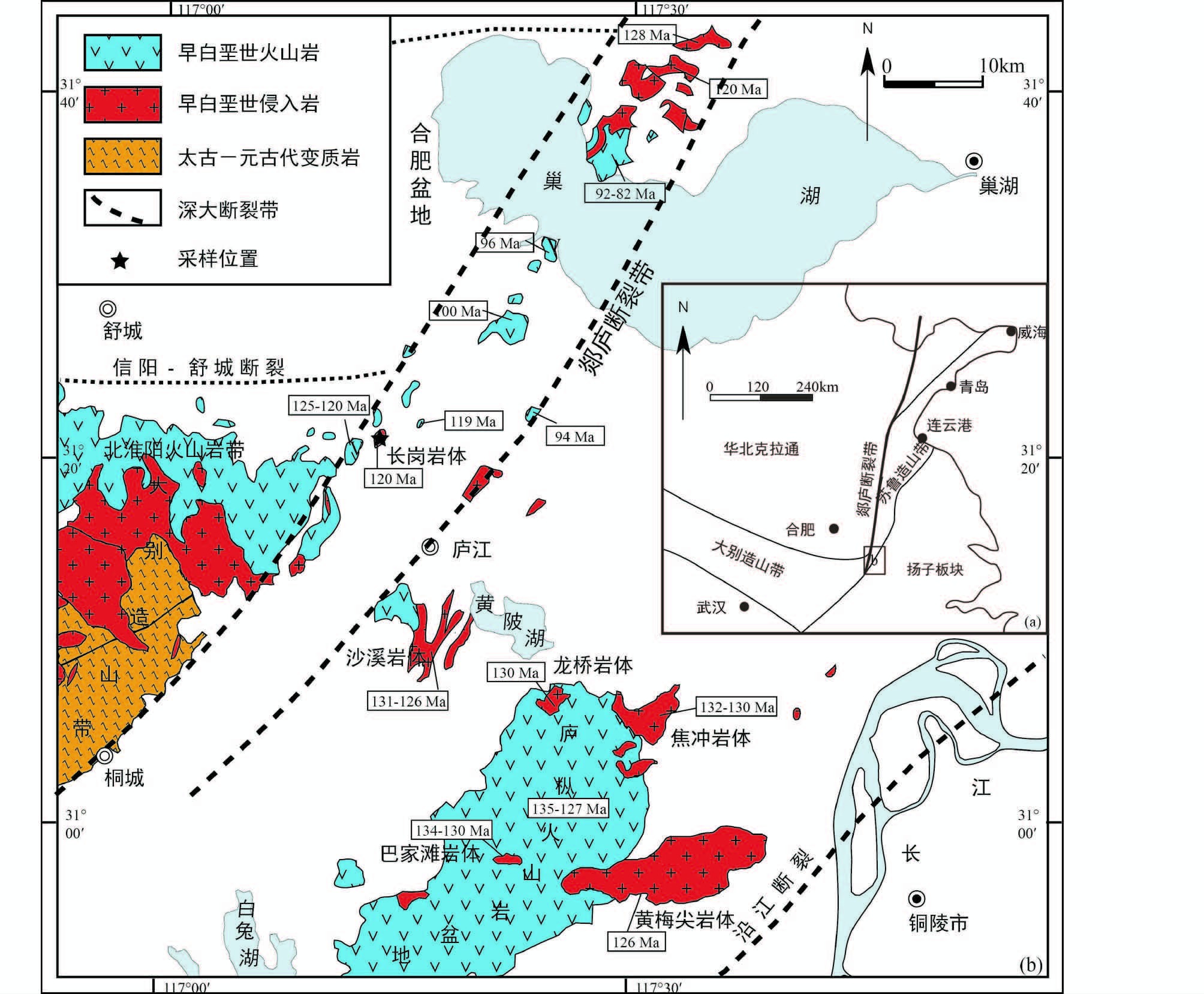 | 图 1 郯庐断裂带庐江段及其邻区晚中生代岩浆岩分布简图(据谢成龙等,2008b) 图中岩浆岩锆石U-Pb年龄来源:巢湖侵入岩(牛漫兰等,2008);巢湖火山岩(作者未发表数据);庐江火山岩(谢成龙等,2008a);庐枞盆地火山岩(Zhou et al., 2008);庐枞盆地侵入岩(范裕等,2008; 薛怀民等,2010; 周涛发等,2010; 陈志洪等,2013; 王世伟等,2014) Fig. 1 Geological sketch map of the Lujiang segment of the Tan-Lu fault zone and its adjacent area,showing the distribution of the Late Mesozoic magmatic rocks in studied area(after Xie et al., 2008b) Geochronology data sources: Chaohu intrusions(Niu et al., 2008); Chaohu volcanic rocks(unpublished data); Lujiang volcanic rocks(Xie et al., 2008a); Volcanic rocks from the Luzong basin(Xie et al., 2008a; Zhou et al., 2008); Intrusions from the Luzong basin(Fan et al., 2008; Xue et al., 2010; Zhou et al., 2010; Chen et al., 2013; Wang et al., 2014) |
郯庐断裂带以左行平移方式起源于中三叠世-晚三叠世华北与杨子板块的陆-陆碰撞过程中(Zhu et al., 2009),并于晚侏罗世-早白垩世初(~145Ma)再次发生左行平移(Zhu et al., 2010)。郯庐断裂带庐江段西侧为合肥盆地和大别造山带,东侧为扬子克拉通庐枞盆地(图 1b)。合肥盆地侏罗纪时为前陆盆地,白垩纪-古近纪发展为伸展断陷盆地,其东部的断陷受控于郯庐断裂带的伸展活动。北淮阳和大别造山带早白垩世岩浆活动形成于143~111Ma,峰期为130~125Ma(Zhao and Zheng, 2009),庐枞盆地内岩浆岩形成时代变化于137~123Ma之间(Zhou et al., 2008; 周涛发等,2010; Chen et al., 2014)。断裂带庐江段主要出露白垩纪玄武岩、粗面岩和流纹岩及少量正长岩(谢成龙等,2008b),火山岩喷发时代为125~93Ma,明显晚于两侧岩浆岩。
庐江长岗岩体位于庐江县长岗镇以北约5km处,为岩株状产出,平面上呈椭圆状,出露面积约0.5km2。为确定长岗岩体的形成时代和岩石特征,我们采集了多件侵入岩样品,在镜下岩相学观察基础上,挑选了2件样品(11LJ14、11LJ16)进行了主量、微量元素测试。镜下观察显示长岗岩体岩性主要为正长花岗斑岩(图 2),具有似斑状结构;斑晶约占10%~20%,主要为正长石和斜长石,基质中正长石含量最高,约45%~55%,其次为斜长石占20%~30%,石英占15%~20%,并含少量黑云母;长石普遍发生蚀变,出现高岭土化等。
 | 图 2 长岗A型花岗岩正交偏光显微照片 Or-正长石;Pl-斜长石;Qtz-石英 Fig. 2 Representative cross-polarized light microphotographs of the Changgang A-type granites Or-orthoclase; Pl-plagioclase; Qtz-quartz |
为确定长岗岩体的侵位时代,我们在野外进行了锆石测年样品(11LJ14)的采集。将样品常规粉碎后,通过重液和磁选法分选出锆石颗粒,该项工作由河北省区域地质矿产调查研究所实验室完成。在双目镜下将样品锆石颗粒和锆石标样一起粘贴在环氧树脂靶上,将其剖光至一半厚度,使得锆石内部结构暴露。随后进行透射光、反射光及阴极发光图像的照射,获得锆石内部结构信息,并选择合适的测试位置。锆石制靶及阴极发光图像采集工作是在中国科学院地质与地球物理研究所进行的。
SIMS锆石U-Pb定年是在中国科学院地质与地球物理研究所Cameca IMS-1280 SIMS仪器上开展的,测试方法详见Li et al.(2009a)。锆石标样与锆石样品以13比例交替测定。U-Th-Pb同位素比值通过标准锆石Plesovice(337Ma; Sláma et al., 2008)校正获得,U含量采用标准锆石91500(U=81×10-6; Wiedenbeck et al., 1995)矫正获得,以长期检测标准样品获得的标准偏差(1SD=1.5%; Li et al., 2010a)和单点测试内部精度共同传递得到样品单点分析误差,用标准样品Qinghu(159.5Ma; Li et al., 2013)作为未知样监测数据的精确度。普通Pb的矫正采用实测204Pb值,由于所测普通Pb含量非常低,可以假定其主要来源于制样过程中带入的表面Pb污染,以现代地壳平均Pb同位素组成(Stacey and Kramers, 1975)作为普通Pb组成进行矫正。SIMS锆石U-Pb同位素分析数据列于表 1,数据结果处理采用Isoplot3(Ludwig,2003)。
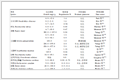 | 表 1 长岗A型花岗岩SIMS锆石U-Pb定年结果 Table 1 SIMS zircon U-Pb dating results of the Changgang A-type granite |
锆石激光原位U-Pb同位素定年和微量元素含量是在合肥工业大学资源与环境工程学院质谱实验室内使用LA-ICP-MS完成的。采用的激光剥蚀系统为GeoLas 193,工作参数为:剥蚀物质载He为0.65L/min,激光脉冲频率为6Hz,剥蚀孔径为32μm,剥蚀时间为50s,背景信号时间为25s,脉冲能量密度为10J/cm2,质谱仪为Agilent 7500a。微量元素含量是使用NIST SRM610玻璃作为外标、91Zr作为内标的方法进行计算的。U-Th-Pb同位素比值是通过采用锆石标样91500(206Pb/238U=1065.4±0.6Ma; Wiedenbeck et al., 1995)作为内标进行矫正的,并使用锆石标样Plesovice用于监控测试的准确度和精度,其中91500传递误差设置为2.5%。数据处理利用ICPMSDataCal 9.6进行(Liu et al., 2010b),普通铅校正使用ComPbCorr#3.15软件(Andersen,2002)完成。选取谐和度>90%的测试点,在Isoplot3(Ludwig,2003)软件上绘制锆石U-Pb年龄谐和图并计算加权平均年龄。LA-ICP-MS锆石U-Pb同位素分析结果见表 2,锆石微量元素测试结果列于表 3中。
| 表 2 长岗A型花岗岩LA-ICP-MS锆石U-Pb定年结果 Table 2 LA-ICP-MS zircon U-Pb dating results of the Changgang A-type granite |
| 表 3 长岗A型花岗岩LA-ICP-MS锆石微量元素分析结果(×10-6) Table 3 Zircon trace element concentrations(×10-6)of the Changgang A-type granite |
主量元素、微量元素和Rb-Sr、Sm-Nd同位素测试均在西北大学大陆动力学国家重点实验室完成。主量元素含量采用RIGAKU 2100型XRF进行测定,元素分析误差<5%。微量元素和稀土元素测定在Elan 6100DRC型ICP-MS上进行,分析精度为5%~10%。详细的分析方法见Gao et al.(1999)。主量元素和微量元素分析测试结果见表 4。
| 表 4 长岗A型花岗岩主量元素(wt%)、微量和稀土元素(×10-6)分析结果 Table 4 Major(wt%) and trace(×10-6)element compositions of the Changgang A-type granites |
Rb-Sr、Sm-Nd同位素比值通过Nu Plasma多接收等离子质谱仪测得。Sr、Nd同位素分别采用87Sr/86Sr=0.1194和146Nd/144Nd=0.7219进行质量分馏校正。在样品分析测试 过程中,标样NIST SRM 987测得的87Sr/86Sr平均值为0.710137±0.000010(2σ,n=21),标样JNDI-1获得的146Nd/144Nd平均值为0.512239±0.000005(2σ,n=22)。同位素分析结果见表 5。
| 表 5 长岗A型花岗岩(样品11LJ14)全岩Sr-Nd同位素分析结果 Table 5 Whole-rock Sr-Nd isotopic compositions of the Changgang A-type granite(Sample11LJ14) |
为获得锆石O-Hf同位素组成,对已开展SIMS定年分析的锆石颗粒,开展了锆石原位O-Hf同位素分析。锆石O同位素测试是在中国科学院地质与地球物理研究所离子探针实验室Cameca IMS-1280型双离子源多接收器二次离子质谱仪上进行的,分析步骤类似于Li et al.(2009b)。单点分析精度以2σ表示,单组18O/16O数据内部测试精度一般优于0.2‰(2SD)。仪器质量分馏(IMF)矫正采用Penglai标准锆石,其中Penglai标准锆石δ18O为5.31‰(Li et al., 2010b)。氧同位素分析结果采用δ18O表示,其代表样品和VSMOW间氧同位素组成的差异。锆石Lu-Hf同位素原位分析是在中国科学院地质与地球物理研究所内,配备Geolas193激光剥蚀系统的Neptune多接收-电感耦合等离子体质谱仪上进行的。Lu-Hf同位素分析是在已进行O和U-Pb同位素测试的锆石上开展的,测试时激光束斑直径为55μm,剥蚀时间为26s,激光脉冲频率为8Hz,脉冲能量密度10J/cm2。具体测试步骤和原始数据矫正方法详见Wu et al.(2006)。锆石原位Hf-O同位素测试结果见表 6。
| 表 6 长岗A型花岗岩原位Hf-O同位素分析结果 Table 6 In situ zircon Hf and O isotopic data of the Changgang A-type granite |
长岗正长花岗斑岩(11LJ14)中锆石为无色透明或淡黄色,以自形-半自形为主,多数呈短柱状或近等粒状,长约80~150μm,长宽比约11~31。CL图像显示(图 3a),锆石内部不发育核幔边结构,普遍显示出明显的震荡环带或扇形环带。
 | 图 3 长岗A型花岗岩代表性锆石CL图像(a)、SIMS(b)及LA-ICP-MS锆石U-Pb谐和图(c) Fig. 3 Selected zircon CL images(a),SIMS(b) and LA-ICP-MS zircon U-Pb concordia(c)diagrams for the Changgang A-type granite |
我们选取15颗锆石内15个无明显裂隙和包裹体的点位进行SIMS法U-Pb测试,分析结果显示测点Th、U、Pb含量分别为115×10-6~1191×10-6、82.6×10⁻⁶~475×10-6、2.21×10⁻⁶~17.3×10⁻⁶,Th/U值为1.17~2.59,这表明这些锆石都是典型的岩浆成因锆石(Hoskin and Schaltegger, 2003)。15个测点获得的年龄均落在谐和线上,它们的206Pb/238U年龄变化于116~124Ma之间,206Pb/238U加权平均年龄为120±2Ma(MSWD=2.1)(图 3b)。
为测得锆石内稀土元素含量,进而估算锆石结晶时岩浆氧逸度,我们还对其进行了LA-ICP-MS U-Pb定年。我们对该样品30颗锆石中30个点位进行了LA-ICP-MS U-Pb同位素分析,除4个测点谐和度低于90%(点02、05、24、30)外,其它测点谐和度均高于90%(表 2)。这26个测点的Th(185×10-6~3251×10-6)、U(130×10-6~897×10-6)含量变化范围大,具有高的Th/U值(1.33~4.3),这指示它们应为岩浆成因锆石;它们206Pb/238U年龄变化于112~126Ma之间,产生的加权平均年龄为120±2Ma(MSWD=0.79),与SMIS法获得的结果在误差范围内相一致,这表明长岗花岗斑岩形成于早白垩世(120Ma)。
长岗岩体形成时代和庐江早期流纹岩(120Ma; 谢成龙等,2008a)、大别造山带A型花岗岩(120~119Ma; 谢智等,2004; Chen et al., 2009)相近,略晚于庐江早期玄武岩(125Ma; 谢成龙等,2008a)、张八岭高镁埃达克岩(136~125Ma; 资锋等,2008; Liu et al., 2010a; Wang et al., 2013; Hu et al., 2014)和长江中下游A型花岗岩(127~123Ma; 范裕等,2008; Li et al., 2012; Yan et al., 2015)。
4.2 主量元素
长岗花岗岩具有高SiO2含量(70.35%~71.89%)和分异指数(DI=89.6~91.5),类似于张八岭低镁埃达克质侵入岩(后文简写为LMA)(DI=86.6~82.5),明显高于高镁埃达克质岩(后文简写为HMA)(DI=64.0~82.5)。样品全碱含量为8.97%~9.75%,里特曼指数为2.77~3.45,落入碱性/亚碱性系列分界线附近(图 4a)。它们K2O含量(5.89%~6.21%)和K2O/Na2O值(1.75~1.91)明显高于LMA(4.01%~4.78%;0.90~1.22)和HMA(3.40%~4.17%;0.83~1.02;Liu et al., 2010a),属橄榄安粗岩系列(图 4b)。岩石表现出较低的A/CNK值(0.94~1.08),落入准铝质-弱过铝质范围内。同时,长岗花岗岩具有较低的MgO含量(0.40%~0.46%)和Mg#值(25.5~26.1),落在变玄武岩/变泥岩在1~4GPa条件下熔融产生的熔体范围内,明显不同于俯冲大洋板片熔融产生的埃达克质岩(图 5a,b)。
 | 图 4 长岗岩体岩石分类图解 (a)TAS(Middlemost,1994),碱性分界线引自Irvine and Baragar(1971);(b)SiO2-K2O(Peccerillo and Taylor, 1976);(c)A/CNK-ANK(Maniar and Piccoli, 1989).数据来源:张八岭高镁埃达克岩(Liu et al., 2010a);张八岭低镁埃达克岩(作者未发表数据);庐江早期玄武岩、早期流纹岩(谢成龙等,2008b及作者未发表数据);长岗岩体(本文).图 5、图 6、图 7的图例及数据来源同此图 Fig. 4 Classification of the Changgang intrusive rocks (a)the TAS diagram(Middlemost,1994),alkaline/subalkaline dividing line in Fig. 4a after Irinvine and Baragar(1971);(b)SiO2-K2O(Peccerillo and Taylor, 1976);(c)A/CNK versus A/NK diagram(Maniar and Piccoli, 1989). Data sources: High-Mg# adakitic intrusive rocks from the Zhangbaling lifting(Liu et al., 2010a); Low-Mg# adakitic intrusive rocks from the Zhangbaling lifting(unpublished data); The early stage of the basalts and rhyolites in Lujiang(Xie et al., 2008b and unpublished data); Changgang intrusive rocks(This article). Symbols and data sources in Fig. 5,Fig. 6 and Fig. 7 are the same as this figure |
 | 图 5 长岗A型花岗岩SiO2-MgO(a,据Liu et al., 2010a)和SiO2-Mg#(b,据Rapp et al., 1999)协变图解 Fig. 5 SiO2 vs. MgO(a,after Liu et al., 2010a) and SiO2 vs. Mg#(b,after Rapp et al., 1999)diagrams for the Changgang A-type granites |
长岗花岗岩具有高的稀土总量(461×10-6~472×10-6),富集轻稀土元素、相对亏损重稀土元素(La/Yb)N=25.8~27.5),中等的Eu负异常(Eu/Eu*=0.43~0.62),这暗示成岩过程中经历了强烈的斜长石分离结晶作用或原岩熔融时残留相中存在斜长石。稀土元素球粒陨石标准化配分图解中(图 6a)可以看出,长岗花岗岩显示出轻稀土富集、重稀土亏损的右倾配分模式,比LMA、HMA具有更高的稀土总量(尤其是重稀土)、更弱的轻重稀土分异和更明显的Eu异常。同时,长岗花岗岩和庐江流纹岩都出现Ho相对Yb、Lu等稀土元素轻微亏损,这可能是由角闪石、单斜辉石分离结晶或者源区残留相含角闪石、单斜辉石引起的;因为这两种矿物在低压条件下,中稀土元素的分配系数高于重稀土元素,轻稀土元素分配系数最低(Green,1994; Huang et al., 2006)。
 | 图 6 长岗A型花岗岩球粒陨石标准化稀土元素配分图(a,标准化值据Boynton,1984)及原始地幔标准化微量元素蛛网图(b,标准化值据Sun and McDonough, 1989) Fig. 6 Chondrite-normalized REE patterns(a,normalization values after Bonynton,1984) and primitive mantle-normalized trace element spider diagrams(b,normalization values after Sun and McDonough, 1989)of the Changgang A-type granites |
在微量元素原始地幔标准化蛛网图上(图 6b),长岗岩体样品富集Th、U、K、Pb等大离子亲石元素,并亏损Nb、Ta、Ti等高场强元素。长岗花岗岩具有较高的Rb(196×10-6~203×10-6)、Th(46.6×10⁻⁶~58.9×10⁻⁶)、U(5.75×10⁻⁶~8.17×10⁻⁶)含量和Th/U(7.21~8.11)比值,较低的Sr含量(203×10-6~327×10-6)和Sr/Y比(6.33~11.7)。它们落入岛弧ADR系列范围内(图 7a,b),不具备埃达克岩的典型特征(Defant and Drummond, 1990; Castillo,2012),明显不同于张八岭LMA、HMA。
 | 图 7 长岗岩体Y-Sr/Y(a,据Defant and Drummond, 1990)及YbN-(La/Yb)N(b,据Drummond and Defant, 1990)关系图解 Fig. 7 Y vs. Sr/Y(a,after Defant and Drummond, 1990) and YbN vs.(La/Yb)N(b,after Drummond and Defant, 1990)diagrams for the Changgang intrusive rocks |
长岗花岗岩具有富集的Sr-Nd同位素组成((87Sr/86Sr)i=0.7082,εNd(t)=-14.9),类似于庐江早期流纹岩、大别造山带低镁埃达克岩和正常花岗岩,明显不同于张八岭LMA和HMA(图 8)。
 | 图 8 长岗A型花岗岩初始Sr-Nd同位素组成 数据来源:张八岭低镁埃达克质侵入岩(牛漫兰等,2010及作者未发表数据);张八岭高镁埃达克质侵入岩(资锋等,2008; Liu et al., 2010a);庐江早期玄武岩、流纹岩(谢成龙等,2008b; 作者未发表数据);长岗岩体(本文);大别造山带低镁埃达克岩、高镁埃达克岩和正常花岗岩引自He et al.(2013) Fig. 8 Sr-Nd initial isotopic composition of the Changgang A-type granites Data sources: Low-Mg# adakitic intrusive rocks from the Zhangbaling lift(Niu et al., 2010 and unpublished data); High-Mg# adakitic intrusive rocks from the Zhangbaling lift(Zi et al., 2008; Liu et al., 2010a); The early stage of the basalts and rhyolites in Lujiang(Xie et al., 2008b and unpublished data); Changgang intrusive rocks(This article); Low-Mg# adakitic granites,high-Mg# adakitic granites and normal granitoids from the Dabie orogen(He et al., 2013) |
对长岗花岗岩(11LJ14)中15颗已经SIMS U-Pb定年样品开展了Hf同位素分析,εHf(t)值集中于-19.5~-16.9之间,加权平均值为-18.3±0.4(图 9a),相应两阶段Hf模式年龄变化于2417~2248Ma之间,加权平均值为2334±26Ma(图 9b)。对其中13颗锆石进行了O同位素分析,δ18O变化于5.48‰~6.24‰,都高于典型地幔锆石的δ18O值(5.3‰±0.3‰; Valley et al., 1998),相应的加权平均值为5.99‰±0.11‰(图 9c)。
 | 图 9 长岗A型花岗岩锆石εHf(t)(a)、两阶段模式年龄(b)和δ18O值(c)频谱图 Fig. 9 Histograms of zircon εHf(t)values(a),tDM2 model ages(b) and δ18O values(c)for the Changgang A-type granites |
样品中锆石具有一致的稀土元素配分型式(图 10a),表现出典型岩浆锆石的特征,如轻稀土亏损、重稀土富集、明显的Ce正异常和Eu负异常(Belousova et al., 2002; Hoskin and Schaltegger, 2003)。根据Ballard et al.(2002)中方法,计算得出锆石Ce4+/Ce3+比值变化于11~92之间(平均值为43,n=26),暗示它们形成于低氧逸度条件下。锆石中Ti元素含量对于温度变化敏感(Watson et al., 2006),因此锆石Ti温度计可以有效估计锆石结晶时熔体的温度,计算得出样品锆石Ti温度变化于748~811℃之间。长岗花岗岩锆石Ce4+/Ce3+、Eu/Eu*值和Ti温度都类似郯庐断裂带南段埃达克岩(Wang et al., 2013)和长江中下游A型花岗岩(Li et al., 2012),明显不同于长江中下游埃达克岩(图 10b,c),暗示该样品锆石可能结晶于干的、高温、低氧逸度岩浆。
 | 图 10 长岗A型花岗岩锆石稀土元素球粒陨石标准化配分图(a)、锆石Ce4+/Ce3+-Eu/Eu*(b)和锆石Ti温度箱型图(c) 数据来源:郯庐断裂带南段埃达克岩和长江中下游埃达克岩锆石数据引自(Wang et al., 2013);HMJ、BSL、MT、XSJ分别代表长江中下游黄梅尖A1、白石岭A1、茅坦A1和响水涧A2型花岗岩(Li et al., 2011,2012) Fig. 10 Chondrite-normalized rare earth element patterns(a) and Ce4+/Ce3+ vs. Eu/Eu* diagram(b)of zircons, and boxplot of the Ti-in-zircon temperatures(c)for the Changgang A-type granites Data sources: Zircon data from the STLF and LYRB adakites(Wang et al., 2013); HMJ,BSL,MT and XSJ represent Huangmeijian,Baishiling,Maotan A1-type granite and Xiangshuijian A2-type granite in LYRB(Li et al., 2011,2012) |
庐江长岗岩体具有低的A/CNK值(0.94~1.08)、P2O5含量(0.11%~0.16%)且镜下观察未见过铝质矿物(如白云母、石榴子石等),这都不符合沉积岩熔融形成S型花岗岩的特征(A/CNK>1.1,P2O5>0.20%; Chappell,1999; Chappell and White, 2001)。同时,沉积岩一般具有高δ18O值(大于10‰),由此部分熔融形成的岩浆岩也会继承其高δ18O值(Li et al., 2009b; Hoefs,2009)。长岗正长花岗斑岩锆石δ18O值集中在5.48‰~6.24‰之间,明显低于典型S型花岗岩的锆石氧同位素组成,这些都表明其不是S型花岗岩。
长岗样品具有高的全碱含量(8.97%~9.75%)和K2O/Na2O(1.79~1.91)、FeOT/MgO值(5.13~5.26),低的TiO2、MgO、CaO和P2O5含量,富集稀土元素(>460×10-6;图 6a)、大离子亲石元素(Rb、Th、U)和高场强元素(Zr+Nb+Ce+Y=732×10-6~775×10-6),并相对亏损Ba、Sr、P、Ti(图 6b)。在Zr+Nb+Ce+Y-FeOT/MgO(图 11a; Whalen et al., 1987)和Zr+Nb+Ce+Y-(Na2O+K2O)/CaO(图 11b; Whalen et al., 1987)图解中,它们都落入A型花岗岩范围内。更为重要的是,它们具有高的锆石饱和温度(876~883℃;表 4),与典型的A型花岗岩相一致(>870℃; King et al., 1997),明显不同于典型的I型花岗岩(<800℃; King et al., 1997)。本文样品中未见继承锆石,其锆石饱和温度可以代表初始岩浆的最低温度(Miller et al., 2003),因而它们源自高温岩浆(>870℃)。综合上述特征,我们认为长岗正长花岗斑岩属A型花岗岩。
 | 图 11 A型花岗岩判别图解(据Whalen et al., 1987) (a)Zr+Nb+Ce+Y-FeOT/MgO图解;(b)Zr+Nb+Ce+Y-(Na2O+K2O)/CaO图解 Fig. 11 Discriminant diagrams of A-type granites(after Whalen et al., 1987) (a)Zr+Nb+Ce+Y vs. FeOT/MgO diagram;(b)Zr+Nb+Ce+Y vs.(Na2O+K2O)/CaO diagram |
A型花岗岩可以源于多种成因过程,主要包括:①幔源拉斑玄武质岩浆或碱性岩浆的结晶分异,并伴随或不伴随地壳混染(Loiselle and Wones, 1979; Mushkin et al., 2003; Bonin,2007);②壳-幔混合作用(Kerr and Fryer, 1993; Yang et al., 2006; Wong et al., 2009);③I型或S型花岗质岩浆抽取后富F/Cl的下地壳麻粒岩残留体小比例部分熔融(Collins et al., 1982; Whalen et al., 1987; King et al., 1997);④中基性结晶基底(Creaser et al., 1991; Douce,1997; Frost et al., 2001; Wang et al., 2010)或变沉积岩熔融(Huang et al., 2011; Sun et al., 2011),并伴随基性岩浆的底侵。
长岗正长花岗斑岩不太可能是由幔源基性岩浆分离结晶和地壳混染作用形成。首先,基性岩浆结晶分异而成的A型花岗岩通常和大规模同期基性-超基性岩共生(Turner et al., 1992);庐江早期玄武岩发育规模较小且喷出时代(125Ma; 谢成龙等,2008a)略早于长岗A型花岗岩,同时大别造山带和长江中下游地区内也缺乏同长岗A型花岗岩时间相一致的基性岩浆岩(Zhao and Zheng, 2009; Yan et al., 2015)。其次,幔源基性岩浆分异和同化作用通常会产生在组成上由基性向中性、酸性连续变化的一系列岩石(Wang et al., 2010):如玄武质岩浆在4.3kbar压力下经96%~97%结晶分异可以产生高硅流纹质的钾质残留熔体,但会伴生中性的中间产物(Whitaker et al., 2008),而研究区内缺乏中性岩浆岩。
幔源镁铁质岩浆与壳源岩浆混合形成的A型花岗岩普遍发育大量暗色镁铁质微粒包体,并表现出较宽的锆石Hf-O同位素变化范围(Yang et al., 2006; Kemp et al., 2007; Wong et al., 2009)。长岗A型花岗岩中不仅未见暗色包体和捕获锆石(图 3),还具有较均一的锆石Hf-O同位素组成(图 9),这表明其不是由岩浆混合作用形成的。
长岗正长花岗斑岩具有与中下地壳熔融而成的庐江早白垩世流纹岩(谢成龙等,2008b)类似的Sr-Nd同位素组成(图 8),并表现出明显低的εHf(t)(-19.5~-16.9)和古老的Hf同位素两阶段模式年龄(2417~2248Ma),这表明它们应来源于古老的地壳。I型或S型岩浆出熔后残留的下地壳麻粒岩物质熔融产生的熔体虽可以拥有符合A型花岗岩的低水逸度和高卤特征(Collins et al., 1982),但无法获得A型花岗岩的某些特征(如高FeOT/MgO),且通常具有低K、Si、K/Na比值和明显的Sr负异常(Creaser et al., 1991; Wu et al., 2002),显然这种模式难以形成具有高K、Si、K/Na和FeOT/(FeOT+MgO)及明显Sr负异常特征的长岗A型花岗岩。
实验岩石学和实例研究都证明,中下地壳的中基性岩石(紫苏花岗质-英云闪长质-花岗闪长质岩石)在不同地壳深度的脱水熔融可以形成A型花岗熔体(King et al., 1997; Skjerlie and Johnston, 1993; Douce,1997),如西天山晚石炭世-早二叠世下地壳来源的A型花岗岩、流纹岩(Li et al., 2015)和华南新元古代复合岩套中紫苏花岗岩熔融形成的A型花岗岩(Zhao et al., 2008);通常地壳熔融产生的A型花岗岩,在低压条件下为准铝质,高压条件下为过铝质(Frost and Frost, 2011)。长岗A型花岗岩较低的Sr/Y、(La/Yb)N比值和高的重稀土含量(图 6和图 7、表 4),表明源区熔融时残留相中缺乏石榴子石(Defant and Drummond, 1990; He et al., 2011)。另一方面,它们具有较低的Sr含量和一定程度的Eu负异常(Eu/Eu*=0.43~0.62),并在微量元素蛛网图上具明显的Ba、Sr负异常,这暗示源区残留相中可能存在斜长石。石榴子石在玄武质岩石熔融时的稳定压力大于1.0~1.2GPa,在中酸性源区熔融时稳定压力的下限更低(Rapp and Watson, 1995; Benn et al., 2006; He et al., 2011);当压力大于1.5GPa时,斜长石会变得不稳定(Sen and Dunn, 1994; Rapp and Watson, 1995),因而长岗A型花岗岩形成压力应小于1.2GPa,对应的岩浆深度应<40km。结合它们具有与干的、加厚下地壳拆沉成因的张八岭HMA类似的氧逸度和锆石Ti温度特征(图 10),我们认为长岗正长花岗斑岩是正常厚度(<40km)的古元古代(2417~2248Ma)中下地壳物质部分熔融的产物。与长岗A型花岗岩不同的是,张八岭隆起HMA和LMA源区残留相都存在石榴子石且不含斜长石,前者是榴辉岩相加厚下地壳拆沉熔融产生熔体与地幔橄榄岩反应的产物(136~125Ma; 资锋等,2008; Liu et al., 2010a; Wang et al., 2013; Hu et al., 2014),后者是含石榴子石加厚下地壳部分熔融的结果(127~115Ma; 牛漫兰等,2010),表明早白垩世郯庐断裂带的地壳厚度发生了明显变化,早期(136Ma)地壳厚度应大于40~50km,在经过加厚下地壳拆沉后(127Ma)地壳厚度仍大于40km,最终在120Ma才转变为正常厚度(<40km)。
5.3 郯庐断裂带南段内不同期次侵入岩间锆石Hf同位素组成差异及对断裂带内中下地壳组成的约束郯庐断裂带南段内早白垩世(136~120Ma)侵入岩的岩石地球化学特征随时间推移发生显著的变化,即早期为高镁埃达克质 、中期为低镁埃达克质、晚期为A型花岗质岩石,这反映了源区残留相和地壳厚度的逐渐变化。虽然这三类岩石的形成都与地壳物质熔融密切相关,但是它们的Sr-Nd同位素组成存在一定程度的差异(图 9),那么是否表明断裂带内不同深度地壳组成存在差异呢?另外对于郯庐断裂带南段下地壳的属性尚存在争议,主要有属扬子克拉通下地壳(Wang et al., 2013; Hu et al., 2014)和华北克拉通下地壳(谢成龙等,2008b; 牛漫兰等,2010)两种观点。由于锆石极高的稳定性和高的封闭温度,使得其Lu-Hf同位素体系较少受后期构造热事件的影响,所测锆石的176Hf/177Hf值不仅能极好的反映其形成时体系的同位素组成,还可记录岩浆源区不同源岩物质的信息(Griffin et al., 2002)。因此可以通过对断裂带内不同期次侵入岩及邻区同时代侵入岩的锆石Hf同位素组成进行对比研究(图 12),来解决前面提及的两个问题。
 | 图 12 郯庐断裂带南段内及其邻区早白垩世花岗岩类锆石εHf(t)和两阶段模式年龄频谱图
数据来源:张八岭隆起低镁埃达克岩(128Ma; 作者未发表数据);张八岭隆起高镁埃达克岩(资锋等,2008; Wang et al., 2013及作者未发表数据);北大别低镁埃达克岩(132Ma)、正常花岗岩(128Ma)(续海金等,2008);庐枞盆地侵入岩(134~123Ma; 邱宏,2014);繁昌盆地A型花岗岩(127~133Ma; Yan et al., 2015) Fig. 12 Histograms of zircon εHf(t)values and tDM2 model ages for the granitoids from the southern segment of the Tan-Lu fault zone and its adjacent area Data sources: Low-Mg# adakitic rocks from the Zhangbaling lifting(unpublished data); High-Mg# adakitic rocks from the Zhangbaling lifting(Zi et al., 2008; Wang et al., 2013 and unpublished data); High-Mg# adakitic rocks(132Ma) and normal granite(128Ma)(Xu et al., 2008); A-type granite from the Fanchang basin(Yan et al., 2015) |
研究显示郯庐断裂带南段内HMA、LMA和A型花岗岩的锆石Hf同位素组成存在明显差异(图 12a,c)。LMA的εHf(t)值变化于-32.0~-14.1之间,tDM2介于3204~2077Ma之间,可进一步分为两组:第一组εHf(t)值变化于-32.0~-27.5之间,加权平均为-29.5±0.9,tDM2年龄介于3204~2940Ma之间,加权平均为3049±65Ma;第二组εHf(t)值为-26.4~-22.8,加权平均为-24.5±0.7,tDM2年龄为2854~2631Ma,加权平均为2739±42Ma,这表明LMA主要源自中-晚太古代下地壳物质的部分熔融。另外,LMA的tDM2年龄明显大于郯庐断裂带南段内张八岭群、肥东群中变质岩的原岩年龄(800~745Ma; Zhao et al., 2014)和肥东群中磁铁石石榴角闪岩透镜体的变质年龄(3049±65Ma; 聂峰等,2014),这表明断裂带内地壳底部可能曾存在中-晚太古代物质。HMA的εHf(t)值(-29.4~-16.4)和tDM2(3040~2224Ma)具有较大的变化范围,相对于LMA而言,总体上εHf(t)值相对偏大、tDM2相对偏小(图 12a,b);HMA虽然也以中-晚太古代物质为主,但是也含有一定的古元古代物质信息,两者之间的差异可能是HMA存在幔源物质的贡献引起的。长岗A型花岗岩的锆石εHf(t)值和tDM2年龄明显不同于LMA和HMA,源于相对年轻的古元古代地壳物质(2417~2248Ma)。这种差异性也同样存在北大别早白垩世两期花岗岩中(图 12e,g),续海金(2008)认为早期低镁埃达克岩(132Ma)源自加厚的3.0Ga和2.7Ga下地壳,而晚期正常花岗岩(128Ma)则源自加厚下地壳上部2.6~2.2Ga的地壳物质;结合郯庐断裂带南段内LMA和A型花岗岩来源深度的差异,我们认为断裂带最下部的加厚下地壳可能主要为中-新太古代地壳物质,其上部可能存在古元古代地壳物质。
郯庐断裂带南段内LMA的两组Hf同位素组成与北大别低镁埃达克岩的两组Hf同位素组成完全一致(图 12a,e),且它们的Sr-Nd同位素组成也相类似,这暗示它们可能源自类似的加厚下地壳。同时,北大别正常花岗岩(128Ma)具有两组锆石Hf同位素组成,其中一组和长岗A型花岗岩锆石Hf同位素范围相近(图 12a,g),这表明断裂带内和北大别的下地壳物质可能存在相似性。由于大别造山带早白垩世碰撞后花岗岩锆石含新元古代和三叠纪继承核,被认为是扬子克拉通陆壳物质熔融的产物(Zhao et al., 2007; Zhao and Zheng, 2009);另外,郯庐断裂带南段内LMA中也含有少量中新元古代继承锆石(812~657Ma; 作者未发表资料),新元古代中期岩浆作用在扬子克拉通周缘普遍存在,而在华北克拉通未见报道(Tang et al., 2007)。因而我们认为断裂带内加厚下地壳应该属于扬子克拉通。断裂带南段内和北大别早白垩世花岗岩都表现出比庐枞盆地早白垩世侵入岩(134~123Ma; 邱宏,2014)和繁昌盆地早白垩世A型花岗岩(127~125Ma; Yan et al., 2015)明显低的εHf(t)值和小的tDM2年龄,暗示它们源区性质存在明显的差异。Zhao and Zheng(2009)认为长江中下游及其南部地区新生地壳时代为中元古代晚期至新元古代早期,而大别-苏鲁造山带新生地壳时代为古元古代中期,这表明扬子克拉通横向存在不均一型,这可能导致了大别造山带、郯庐断裂带南段早白垩世花岗岩与长江中下游早白垩世花岗岩Hf同位素组成上的巨大差异。
6 结论
(1)郯庐断裂带庐江段长岗正长花岗斑岩形成时代为120Ma。
(2)长岗正长花岗斑岩属A型花岗岩。
(3)元素地球化学特征、锆石Hf-O同位素组成显示,长岗A型花岗岩是扬子克拉通古元古代中期中-下地壳在斜长石稳定且无石榴子石区域(<40km),高温、低氧逸度条件下部分熔融形成的。在120Ma之前,作为郯庐断裂带南段埃达克岩主要源区的含石榴子石的中-新太古代加厚下地壳(>40~50km)已经移除。
致谢 SIMS锆石U-Pb定年工作得到中国科学院地质与地球物理研究所唐国强、刘宇、凌潇潇等人的协助,岩石地球化学分析得到西北大学大陆动力学重点实验室的协助。感谢审稿人对本文修改提出的建设性意见。
| [1] | Anderson T. 2002. Correction of common lead in U-Pb analyses that do not report 204Pb. Chemical Geology, 192(1-2): 59-79 |
| [2] | Ballard JR, Palin JM and Campbell IH. 2002. Relative oxidation states of magmas inferred from Ce (Ⅳ)/Ce (Ⅲ) in zircon: Application to porphyry copper deposits of northern Chile. Contributions to Mineralogy and Petrology, 144(3): 347-364 |
| [3] | Belousova EA, Griffin WL, O'Reilly SY and Fisher NI. 2002. Igneous zircon: Trace element composition as an indicator of source rock type. Contributions to Mineralogy and Petrology, 143(5): 602-622 |
| [4] | Benn K, Mareschal JC and Condie KC. 2006. Experimental constraints on TTG petrogenesis: Implications for Archean geodynamics. In: Moyen JF, Stevens G, Benn K, Mareschal JC and Condie KC (eds.). Archean Geodynamics and Enviorments, Monographs. New York: American Geophysical Union, 164: 149-178 |
| [5] | Blichert-Toft J and Albarède F. 1997. The Lu-Hf geochemistry of chondrites and evolution of the mantle-crust system. Earth and Planetary Science Letters, 148(1-2): 243-258 |
| [6] | Bonin B. 2007. A-type granites and related rocks: Evolution of a concept, problems and prospects. Lithos, 97(1-2): 1-29 |
| [7] | Boynton WV. 1984. Geochemistry of the rare earth elements: Meteorite studies. In: Henderson P (ed.). Rare Earth Element Geochemistry. Amsterdam: Elsevier, 63-114 |
| [8] | Castillo PR. 2012. Adakite petrogenesis. Lithos, 134-135: 304-316 |
| [9] | Chappell BW and White AJR. 1992. I- and S-type granites in the Lachlan Fold Belt. Transactions of the Royal Society of Edinburgh: Earth Sciences, 83(1-2): 1-26 |
| [10] | Chappell BW. 1999. Aluminium saturation in I- and S-type granites and the characterization of fractionated haplogranites. Lithos, 46(3): 535-551 |
| [11] | Chappell BW and White AJR. 2001. Two contrasting granite types: 25 years later. Australian Journal of Earth Sciences, 48(4): 489-499 |
| [12] | Chen L, Ma CQ, She ZB, Mason R, Zhang JY and Zhang C. 2009. Petrogenesis and tectonic implications of A-type granites in the Dabie orogenic belt, China: Geochronological and geochemical constraints. Geological Magazine, 146(5): 638-651 |
| [13] | Chen L, Zhao ZF and Zheng YF. 2014. Origin of andesitic rocks: Geochemical constraints from Mesozoic volcanics in the Luzong basin, South China. Lithos, 190-191: 220-239 |
| [14] | Chen ZH, Yan J, Li QZ, Chu XQ and Peng G. 2013. Zircon LA-ICPMS dating of the Bajiatan pluton in Luzong volcanic basin and its significance. Journal of Mineralogy and Petrology, 33(2): 19-25 (in Chinese with English abstract) |
| [15] | Collins WJ, Beams SD, White AJR and Chappell BW. 1982. Nature and origin of A-type granites with particular reference to southeastern Australia. Contributions to Mineralogy and Petrology, 80(2): 189-200 |
| [16] | Crease RA, Price RC and Wormald RJ. 1991. A-type granites revisited: Assessment of a residual-source modal. Geology, 19: 163-166 |
| [17] | Darghi S, Arvin M, Pan YM and Babaei A. 2010. Petrogenesis of post-collisional A-type granitoids from the Urumieh-Dokhtar magmatic assemblage, Southwestern Kerman, Iran: Constraints on the Arabian-Eurasian continental collision. Lithos, 115 (1-4):190-204 |
| [18] | Defant MJ and Drummond MS. 1990. Derivation of some modern arc magmas by melting of young subducted lithosphere. Nature, 347(6294): 662-665 |
| [19] | Douce AEP. 1997. Generation of metaluminous A-type granites by low-pressure melting of calc-alkaline granitoids. Geology, 25(8): 743-746 |
| [20] | Drummond MS and Defant MJ. 1990. A model for trondhjemite-tonalite-dactite genesis and crustal growth via slab melting: Archean to modern comparisons. Journal of Geophysical Research, 95(B13): 21503-21521 |
| [21] | Eby GN. 1990. A-type granitoids: A review of their occurrence and chemical characteristics and speculations on their petrogenesis. Lithos, 26(1-2): 115-134 |
| [22] | Eby GN. 1992. Chemical subdivision of the A-type granitoids: Petrogenetic and tectonic implications. Geology, 20(7): 641-644 |
| [23] | Fan Y, Zhou TF, Yuan F, Qian CC, Lu SM and David C. 2008. LA-ICP-MS zircon U-Pb ages of the A-type granites in the Lu-Zong (Lujiang-Zongyang) area and their geological significances. Acta Petrologica Sinica, 24(8): 1715-1724 (in Chinese with English abstract) |
| [24] | Frost BR, Barnes CG, Collins WJ, Arculus RJ, Ellis DJ and Frost CD. 2001. A geochemical classification for granitic rocks. Journal of Petrology, 42(11): 2033-2048 |
| [25] | Frost CD and Frost BR. 2011. On ferroan (A-type) granitoids: Their compositional variability and modes of origin. Journal of Petrology, 52(1): 39-53 |
| [26] | Gao S, Ling WL, Qiu YM, Lian Z, Hartmann G and Simon K. 1999. Contrasting geochemical and Sm-Nd isotopic compositions of Archean metasediments from the Kongling high-grade terrain of the Yangtze craton: Evidence for cratonic evolution and redistribution of REE during crustal anatexis. Geochemica et Cosmochimica Acta, 63(13-14): 2071-2088 |
| [27] | Goldstein SL, Onions RK and Hamilton PJ. 1984. A Sm-Nd isotopic study of atmospheric dusts and particulates from major river systems. Earth and Planetary Science Letters, 70(2): 221-236 |
| [28] | Greem TH. 1994. Experimental studies of trace-element partitioning applicable to igneous petrogenesis: Sedona 16 years later. Chemical Geology, 117(1-4): 1-36 |
| [29] | Green DH and Falloon TJ. 2015. Mantle-derived magmas: Intraplate, hot-spots and mid-ocean ridges. Science Bulletin, 60(22): 1873-1900 |
| [30] | Griffin WL, Pearson NJ, Belousova E, Jackson SE, Van Achterbergh E, O'Reilly SY and Shee SR. 2000. The Hf isotope composition of cratonic mantle: LAM-MC-ICPMS analysis of zircon megacrysts in kimberlites. Geochimica et Cosmochimica Acta, 64(1): 133-147 |
| [31] | Griffin WL, Wang X, Jackson SE, O'Reilly SY, Xu XS and Zhou XM. 2002. Zircon chemistry and magma mixing, SE China: In-situ analysis of Hf isotopes, Tonglu and Pingtan igneous complexes. Lithos, 61(3-4): 237-269 |
| [32] | Haapala I and Rämö OT. 1992. Tectonic setting and origin of the Proterozoic rapakivi granites of the southeastern Fennoscandia. Earth & Environmental Science Transactions of the Royal Society of Edinburgh, 83(1-2): 165-171 |
| [33] | He YS, Li SG, Hoefs J, Huang F, Liu SA and Hou ZH. 2011. Post-collisional granitoids from the Dabie orogen: New evidence for partial melting of a thickened continental crust. Geochimica et Cosmochimica Acta, 75(13): 3815-3838 |
| [34] | He YS, Li SG, Hoefs J and Kleinhanns IC. 2013. Sr-Nd-Pb isotopic compositions of Early Cretaceous granitoids from the Dabie orogen: Constraints on the recycled lower continental crust. Lithos, 156-159: 204-217 |
| [35] | Hoefs J. 2009. Stable Isotope Geochemistry. 6th Edition. Heidelberg: Springer-Verlag, 1-284 |
| [36] | Hoskin PWO and Schaltegger U. 2003. The composition of zircon and igneous and metamorphic petrogenesis. Reviews in Mineralogy and Geochemistry, 53(1): 27-62 |
| [37] | Hu ZL, Yang XY, Duan LA and Sun WD. 2014. Geochronological and geochemical constraints on genesis of the adakitic rocks in Outang, South Tan-Lu Fault Belt (Northeastern Yangtze Block). Tectonophysics, 626: 86-104 |
| [38] | Huang F, Lundstrom CC and McDonough WF. 2006. Effect of melt structure on trace-element partitioning between clinopyroxene and silicic, alkaline, aluminous melts. American Mineralogist, 91(8-9): 1385-1400 |
| [39] | Huang HQ, Li XH, Li WX and Li ZX. 2011. Formation of high 18O fayalite-bearing A-type granite by high-temperature melting of granulitic metasedimentary rocks, southern China. Geology, 39(10): 903-906 |
| [40] | Irvine TN and Baragar WRA. 1971. A guide to the chemical classification of the common volcanic rocks. Canadian Journal of Earth Sciences, 8(5): 523-548 |
| [41] | Jahn BM and Condie KC. 1995. Evolution of the Kaapvaal Craton as viewed from geochemical and Sm-Nd isotopic analyses of intracratonic pelites. Geochimica et Cosmochimica Acta, 59(11): 2239-2258 |
| [42] | Jiang N, Zhang SQ, Zhou WG and Liu YS. 2009. Origin of a Mesozoic granite with A-type characteristics from the North China craton: Highly fractionated from I-type magmas? Contributions to Mineralogy and Petrology, 158(1): 113-130 |
| [43] | Kemp AIS, Hawkesworth CJ, Foster GL, Paterson BA, Woodhead JD, Hergt JM, Gray CM and Whitehouse MJ. 2007. Magmatic and crustal differentiation history of granitic rocks from Hf-O isotopes in zircon. Science, 315(5814): 980-983 |
| [44] | Kerr A and Fryer BJ. 1993. Nd isotope evidence for crust-mantle interaction in the generation of A-type granitoid suites in Labrador, Canada. Chemical Geology, 104(1-4): 39-60 |
| [45] | King PL, White AJR, Chappell BW and Allen CM. 1997. Characterization and origin of aluminous A-type granites from the Lachlan Fold Belt, Southeastern Australia. Journal of Petrology, 38(3): 371-391 |
| [46] | Li H, Zhang H, Ling MX, Wang FY, Ding X, Zhou JB, Yang XY, Tu XL and Sun WD. 2011. Geochemical and zircon U-Pb study of the Huangmeijian A-type granite: Implications for geological evolution of the Lower Yangtze River belt. International Geology Review, 53(5-6): 499-525 |
| [47] | Li H, Ling MX, Li CY, Zhang H, Ding X, Yang XY, Fan WM, Li YL and Sun WD. 2012. A-type granite belts of two chemical subgroups in central eastern China: Indication of ridge subduction. Lithos, 150: 26-36 |
| [48] | Li NB, Niu HC, Shan Q and Yang WB. 2015. Two episodes of Late Paleozoic A-type magmatism in the Qunjisayi area, western Tianshan: Petrogenesis and tectonic implications. Journal of Asian Earth Sciences, 113: 238-253 |
| [49] | Li QL, Li XH, Liu Y, Tang GQ, Yang JH and Zhu WG. 2010a. Precise U-Pb and Pb-Pb dating of Phanerozoic baddeleyite by SIMS with oxygen flooding technique. Journal of Analytical Atomic Spectrometry, 25(7): 1107-1113 |
| [50] | Li XH, Liu Y, Li QL, Guo CH and Chamberlain KR. 2009a. Precise determination of Phanerozoic zircon Pb/Pb age by multicollector SIMS without external standardization. Geochemistry, Geophysics, Geosystems, 10(4): Q04010, doi: 10.1029/2009GC002400 |
| [51] | Li XH, Li WX, Wang XC, Li QL, Liu Y and Tang GQ. 2009b. Role of mantle-derived magma in genesis of Early Yanshanian granites in the Nanling Range, South China: In situ zircon Hf-O isotopic constraints. Science in China (Series D), 52(9): 1262-1278 |
| [52] | Li XH, Li WX, Wang XC, Li QL, Liu Y, Tang GQ, Gao YY and Wu FY. 2010b. SIMS U-Pb zircon geochronology of porphyry Cu-Au-(Mo) deposits in the Yangtze River Metallogenic Belt, eastern China: Magmatic response to early Cretaceous lithospheric extension. Lithos, 119(3-4): 427-438 |
| [53] | Li XH, Tang GQ, Guo B, Yang YH, Hou KJ, Hu ZC, Li QL, Liu Y and Li WX. 2013. Qinghu zircon: A working reference for microbeam analysis of U-Pb age and Hf and O isotopes. Chinese Science Bulletin, 58(36): 4647-4654 |
| [54] | Liu SA, Li SG, He YS and Huang F. 2010a. Geochemical contrasts between early Cretaceous ore-bearing and ore-barren high-Mg adakites in central-eastern China: Implications for petrogenesis and Cu-Au mineralization. Geochimica et Cosmochimica Acta, 74(24): 7160-7178 |
| [55] | Liu YS, Gao S, Hu ZC, Gao CG, Zong KQ and Wang DB. 2010b. Continental and oceanic crust recycling-induced melt-peridotite interactions in the Trans-North China Orogen: U-Pb dating, Hf isotopes and trace elements in zircons from mantle xenoliths. Journal of Petrology, 51(1-2): 537-571 |
| [56] | Loiselle MC and Wones DR. 1979. Characterization and origin of anorogenic granites. Geological Society of America, Abstracts with Programs, 11: 468 |
| [57] | Ludwig KR. 2003. Isoplot 3.00: A Geochronological Toolkit for Microsoft Excel. California, Berkeley: Berkeley Geochronology Center |
| [58] | Maniar PD and Piccoli PM. 1989. Tectonic discrimination of granitoids. Geological Society of America Bulletin, 101(5): 635-643 |
| [59] | Middlemost EAK. 1994. Naming materials in the magma/igneous rock system. Earth-Science Reviews, 37(3-4): 215-224 |
| [60] | Miller CF, McDowell SM and Mapes RW. 2003. Hot and cold granites? Implications of zircon saturation temperatures and preservation of inheritance. Geology, 31(6): 529-532 |
| [61] | Mushkin A, Navon O, Halicz L, Hartmann G and Stein M. 2003. The petrogenesis of A-type magmas from the Amram Massif, southern Israel. Journal of Petrology, 44(5): 815-832 |
| [62] | Nie F, Shi YH, Wang J, Kang T and Cao S. 2014. Investigation on the metamorphic conditions and geochronology for the magnet garnet amphibole in the Tan-Lu fault zone (Anhui segment), and discussion of ites tectonic attribution. Acta Petrologica Sinica, 30(6): 1718-1730 (in Chinese with English abstract) |
| [63] | Nie F, Shi YH, Wang J, Kang T and Cao S. 2014. Investigation on the metamorphic conditions and geochronology for the magnet garnet amphibole in the Tan-Lu fault zone (Anhui segment), and discussion of ites tectonic attribution. Acta Petrologica Sinica, 30(6): 1718-1730 (in Chinese with English abstract) |
| [64] | Niu ML, Zhu G, Xie CL, Liu XM, Cao Y and Xie WY. 2008. LA-ICP MS zircon U-Pb ages of the granites from the southern segment of the Zhangbaling uplift along the Tan-Lu fault zone and their tectonic significances. Acta Petrologica Sinica, 24(8): 1839-1847 (in Chinese with English abstract) |
| [65] | Peccerillo A and Taylor SR. 1976. Geochemistry of Eocene calc-alkaline volcanic rocks from the Kastamonu area, Northern turkey. Contributions to Mineralogy and Petrology, 58(1): 63-81 |
| [66] | Peccerillo A, Barberio MR, Yirgu G, Ayalew D, Barbieri M and Wu TW. 2003. Relationships between mafic and peralkaline silicic magmatism in continental rift settings: A petrological, geochemical and isotopic study of the Gedemsa volcano, central Ethiopian rift. Journal of Petrology, 44(11): 2003-2032 |
| [67] | Peucat JJ, Vidal P, Bernard-Griffiths J and Condie KC. 1988. Sr, Nd, and Pb isotopic systematics in the Archean low- to high-grade transition zone of southern India: Syn-accretion vs. post-accretion granulites. Journal of Geology, 97(5): 537-549 |
| [68] | Peucat JJ, Vidal P, Bernard-Griffiths J and Condie KC. 1988. Sr, Nd, and Pb isotopic systematics in the Archean low- to high-grade transition zone of southern India: Syn-accretion vs. post-accretion granulites. Journal of Geology, 97(5): 537-549 |
| [69] | Rapp RP and Watson EB. 1995. Dehydration melting of metabasalt at 8-32kbar: Implications for continental growth and crust-mantle recycling. Journal of Petrology, 36(4): 891-931 |
| [70] | Rapp RP, Shimizu N, Norman MD and Applegate GS. 1999. Reaction between slab-derived melts and peridotite in the mantle wedge: Experimental constraints at 3.8GPa. Chemical Geology, 160(4): 335-356 |
| [71] | Sen C and Dunn T. 1994. Dehydration melting of a basaltic composition amphibolite at 1.5 and 2.0GPa: Implications for the origin of adakites. Contributions to Mineralogy and Petrology, 117(4): 394-409 |
| [72] | Skjerlie KP and Johnston AD. 1993. Fluid-absent melting behavior of an F-rich tonalitic gneiss at mid crustal pressures: Implications for the generation of anorogenic granites. Journal of Petrology, 34(4): 785-815 |
| [73] | Sláma J, Košler J, Condon DJ et al. 2008. Plešovice zircon: A new natural reference material for U-Pb and Hf isotopic microanalysis. Chemical Geology, 249(1-2): 1-35 |
| [74] | Söderlund U, Patchett PJ, Vervoort JD and Isachsen CE. 2004. The 176Lu decay constant determined by Lu-Hf and U-Pb isotope systematics of Precambrian mafic intrusions. Earth and Planetary Science Letters, 219(3-4): 311-324 |
| [75] | Stacey JS and Kramers JD. 1975. Approximation of terrestrial lead isotope evolution by a two-stage model. Earth and Planetary Science Letters, 26(2): 207-221 |
| [76] | Sun SS and McDonough WF. 1989. Chemical and isotopic systematics of oceanic basalts: Implications for mantle composition and processes. In: Saunders AD and Norry MJ (eds.). Magmatism in the Oceanic Basins. Geological Society, London, Special Publications, 42(1): 313-345 |
| [77] | Sun Y, Ma CQ, Liu YY and She ZB. 2011. Geochronological and geochemical constraints on the petrogenesis of Late Triassic aluminous A-type granites in southeast China. Journal of Asian Earth Sciences, 42(6): 1117-1131 |
| [78] | Tang J, Zheng YF, Wu YB, Gong B and Liu XM. 2007. Geochronology and geochemistry of metamorphic rocks in the Jiaobei terrane: Constraints on its tectonic affinity in the Sulu orogen. Precambrian Research, 152(1-2): 48-82 |
| [79] | Turner SP, Foden JD and Morrison RS. 1992. Derivation of some A-type magmas by fractionation of basaltic magma: An example from the Padthaway ridge, South Australia. Lithos, 28(2): 151-179 |
| [80] | Valley JW, Kinny PD, Schulze DJ and Spicuzza MJ. 1998. Zircon megacrysts from kimberlite: Oxygen isotope variability among mantle melts. Contributions to Mineralogy and Petrology, 133(12): 1-11 |
| [81] | Valley JW, Kinny PD, Schulze DJ and Spicuzza MJ. 1998. Zircon megacrysts from kimberlite: Oxygen isotope variability among mantle melts. Contributions to Mineralogy and Petrology, 133(12): 1-11 |
| [82] | Wang FY, Liu SA, Li SG and He YS. 2013. Contrasting zircon Hf-O isotopes and trace elements between ore-bearing and ore-barren adakitic rocks in central-eastern China: Implications for genetic relation to Cu-Au mineralization. Lithos, 156-159: 97-111 |
| [83] | Wang FY, Liu SA, Li SG and He YS. 2014. Contrasting zircon Hf-O isotopes and trace elements between ore-bearing and ore-barren adakitic rocks in central-eastern China: Implications for genetic relation to Cu-Au mineralization. Lithos, 156-159: 97-111 |
| [84] | Wang Q, Wyman DA, Li ZX, Bao ZW, Zhao ZH, Wang YX, Jian P, Yang YH and Chen LL. 2010. Petrology, geochronology and geochemistry of ca.780Ma A-type granites in South China: Petrogenesis and implications for crustal growth during the breakup of the supercontinent Rodinia. Precambrian Research, 178(1-4): 185-208 |
| [85] | Watson EB and Harrison TM. 1983. Zircon saturation revisited: Temperature and composition effects in a variety of crustal magma types. Earth and Planetary Science Letters, 64(2): 295-304 |
| [86] | Watson EB, Wark DA and Thomas JB. 2006. Crystallization thermometers for zircon and rutile. Contributions to Mineralogy and Petrology, 151(4): 413-433 |
| [87] | Whalen JB, Currie KL and Chappell BW. 1987. A-type granites: Geochemical characteristics, discrimination and petrogenesis. Contributions to Mineralogy and Petrology, 95(4): 407-419 |
| [88] | Whitaker ML, Nekvasil H, Lindsley DH and McCurry M. 2008. Can crystallization of olivine tholeiite give rise to potassic rhyolites? An experimental investigation. Bulletin of Volcanology, 70(3): 417-434 |
| [89] | Whitaker ML, Nekvasil H, Lindsley DH and McCurry M. 2008. Can crystallization of olivine tholeiite give rise to potassic rhyolites? An experimental investigation. Bulletin of Volcanology, 70(3): 417-434 |
| [90] | Wong J, Sun M, Xing GF, Li XH, Zhao GC, Wong K, Yuan C, Xia XP, Li LM and Wu FY. 2009. Geochemical and zircon U-Pb and Hf isotopic study of the Baijuhuajian metaluminous A-type granite: Extension at 125-100Ma and its tectonic significance for South China. Lithos, 112(3-4): 289-305 |
| [91] | Wu FY, Sun DY, Li HM, Jahn BM and Wilde SA. 2002. A-type granites in northeastern China: Age and geochemical constraints on their petrogenesis. Chemical Geology, 187(1-2): 143-173 |
| [92] | Wu FY, Yang YH, Xie LW, Yang JH and Xu P. 2006. Hf isotopic compositions of the standard zircons and baddeleyites used in U-Pb geochronology. Chemical Geology, 234(1-2): 105-126 |
| [93] | Wu FY, Yang YH, Xie LW, Yang JH and Xu P. 2006. Hf isotopic compositions of the standard zircons and baddeleyites used in U-Pb geochronology. Chemical Geology, 234(1-2): 105-126 |
| [94] | Xie CL, Zhu G, Niu ML, Wang YS, Xiang BW and Hu ZQ. 2008a. Zircon U-Pb geochronology of the Late Mesozoic volcanic rocks from the Chaohu-Lujiang segment of the Tan-Lu fault zone. Chinese Journal of Geology, 43(2): 294-308 (in Chinese with English abstract) |
| [95] | Xie CL, Zhu G, Niu ML and Liu XM. 2008b. Geochemistry of Late Mesozoic volcanic rocks from the Chaohu-Lujiang segment of the Tan-Lu fault zone and Lithospheric thinning processes. Acta Petrologica Sinica, 24(8): 1823-1838 (in Chinese with English abstract) |
| [96] | Xu HJ, Ye K and Ma CQ. 2008. Early Cretaceous granitoids in the North Dabie and their tectonic implications: Sr-Nd and zircon Hf isotopic evidences. Acta Petrologica Sinica, 24(1): 87-103 (in Chinese with English abstract) |
| [97] | Xu HJ, Ye K and Ma CQ. 2008. Early Cretaceous granitoids in the North Dabie and their tectonic implications: Sr-Nd and zircon Hf isotopic evidences. Acta Petrologica Sinica, 24(1): 87-103 (in Chinese with English abstract) |
| [98] | Yan J, Liu JM, Li QZ, Xing GF, Liu XQ, Xie JC, Chu XQ and Chen ZH. 2015. In situ zircon Hf-O isotopic analyses of Late Mesozoic magmatic rocks in the Lower Yangtze River Belt, central eastern China: Implications for petrogenesis and geodynamic evolution. Lithos, 227: 57-76 |
| [99] | Yang JH, Wu FY, Chung SL, Wilde SA and Chu MF. 2006. A hybrid origin for the Qianshan A-type granite, Northeast China: Geochemical and Sr-Nd-Hf isotopic evidence. Lithos, 89(1-2): 89-106 |
| [100] | Zhao T, Zhu G, Lin SZ, Yan LJ and Jiang QQ. 2014. Protolith ages and deformation mechanism of metamorphic rocks in the Zhangbaling uplift segment of the Tan-Lu fault zone. Science China (Earth Sciences), 57(11): 2740-2757 |
| [101] | Zhao XF, Zhou MF, Li JW and Wu FY. 2008. Association of Neoproterozoic A- and I-type granites in South China: Implications for generation of A-type granites in a subduction-related environment. Chemical Geology, 257(1-2): 1-15 |
| [102] | Zhao ZF, Zheng YF, Wei CS and Wu YB. 2007. Post-collisional granitoids from the Dabie orogen in China: Zircon U-Pb age, element and O isotope evidence for recycling of subducted continental crust. Lithos, 93(3-4): 248-272 |
| [103] | Zhao ZF and Zheng YF. 2009. Remelting of subducted continental lithosphere: Petrogenesis of Mesozoic magmatic rocks in the Dabie-Sulu orogenic belt. Science in China (Series D), 52(9): 1295-1318 |
| [104] | Zhou TF, Fan Y, Yuan F, Lu SM, Shang SG, Cooke D, Meffre S and Zhao GC. 2008. Geochronology of the volcanic rocks in the Lu-Zong basin and its significance. Science in China (Series D), 51(10): 1470-1482 |
| [105] | Zhou TF, Fan Y, Yuan F, Lu SM, Shang SG, Cooke D, Meffre S and Zhao GC. 2010. Geochronology of the volcanic rocks in the Lu-Zong basin and its significance. Science in China (Series D), 51(10): 1470-1482 |
| [106] | Zhu G, Liu GS, Niu ML, Xie CL, Wang YS and Xiang BW. 2009. Syn-collisional transform faulting of the Tan-Lu fault zone, East China. Internationa Journal of Earth Sciences, 98(1): 135-155 |
| [107] | Zhu G, Niu ML, Xie CL and Wang YS. 2010. Sinistral to normal faulting along the Tan-Lu fault zone: Evidence for geodynamic switching of the East China continental margin. The Journal of Geology, 118(3): 277-293 |
| [108] | Zhu G, Niu ML, Xie CL and Wang YS. 2010. Sinistral to normal faulting along the Tan-Lu fault zone: Evidence for geodynamic switching of the East China continental margin. The Journal of Geology, 118(3): 277-293 |
| [109] | 陈志洪, 闫峻, 李全忠, 初晓强, 彭戈. 2013. 下扬子庐枞盆地巴家滩岩体锆石LA-ICPMS定年及意义. 矿物岩石, 33(2): 19-25 |
| [110] | 范裕, 周涛发, 袁峰, 钱存超, 陆三明, David C. 2008. 安徽庐江-枞阳地区A型花岗岩的LA-ICP-MS定年及其地质意义. 岩石学报, 24(8): 1715-1724 |
| [111] | 聂峰, 石永红, 王娟, 康涛, 曹晟. 2014. 郯庐断裂带(安徽段)内磁铁石榴角闪岩的形成条件、年代学及构造归属的探究. 岩石学报, 30(6): 1718-1730 |
| [112] | 牛漫兰, 朱光, 谢成龙, 柳小明, 曹洋, 谢文雅. 2008. 郯庐断裂带张八岭隆起南段花岗岩LA-ICP MS锆石U-Pb年龄及其构造意义. 岩石学报, 24(8): 1839-1847 |
| [113] | 牛漫兰, 朱光, 谢成龙, 吴齐, 刘国生. 2010. 郯庐断裂带张八岭隆起南段晚中生代侵入岩地球化学特征及其对岩石圈减薄的指示. 岩石学报, 26(9): 2783-2804 |
| [114] | 邱宏. 2014. 安徽庐枞地区中酸性侵入岩成岩作用研究. 硕士学位论文. 合肥: 合肥工业大学 |
| [115] | 王世伟, 周涛发, 袁锋, 范裕, 俞沧海, 葛岭虹, 石诚, 池月余. 2014. 安徽沙溪斑岩型铜金矿床成岩序列及成岩成矿年代学研究. 岩石学报, 30(4): 979-994 |
| [116] | 谢成龙, 朱光, 牛漫兰, 王勇生, 向必伟, 胡召齐. 2008a. 郯庐断裂带巢湖-庐江段晚中生代火山岩的锆石U-Pb年代学. 地质科学, 43(2): 294-308 |
| [117] | 谢成龙, 朱光, 牛漫兰, 柳小明. 2008b. 郯庐断裂带巢湖-庐江段晚中生代火山岩地球化学特征与岩石圈减薄过程. 岩石学报, 24(8): 1823-1838 |
| [118] | 谢智, 郑永飞, 闫峻, 钱卉. 2004. 大别山沙村中生代A型花岗岩和基性岩的源区演化关系. 岩石学报, 20(5): 1175-1184 |
| [119] | 续海金, 叶凯, 马昌前. 2008. 北大别早白垩纪花岗岩类的Sm-Nd和锆石Hf同位素及其构造意义. 岩石学报, 24(1): 87-103 |
| [120] | 薛怀民, 董树文, 马芳. 2010. 长江中下游地区庐(江)-枞(阳)和宁(南京)-芜(湖)盆地内与成矿有关潜火山岩体的SHRIMP锆石U-Pb年龄. 岩石学报, 26(9): 2653-2664 |
| [121] | 周涛发, 范裕, 袁锋, 宋传中, 张乐骏, 钱存超, 陆三明, David RC. 2010. 庐枞盆地侵入岩的时空格架及其对成矿的制约. 岩石学报, 26(9): 2694-2714 |
| [122] | 资锋, 王强, 唐功建, 宋彪, 谢烈文, 杨岳衡, 梁细荣, 涂湘林, 刘颖. 2008. 皖中管店岩体的SHRIMP锆石U-Pb年代学与地球化学: 岩石成因和动力学意义. 地球化学, 37(5): 462-480 |