 2013, Vol. 29


二长岩(包括石英二长岩和二长闪长岩)是中国东南部晚中生代火成岩组合中重要的岩石类型,它们可以呈岩株状单独产出,或者与花岗岩共生形成复式杂岩体,部分与火山岩密切共生构成环状火山-侵入杂岩,且与其共生的其它岩石具有密切的成因联系,因此是研究中国东南部晚中生代岩石圈演化和岩浆作用的理想对象。
前人针对二长岩的成因提出了多种模式,概括起来主要有:(1)由下地壳物质经部分熔融形成(Köksal et al., 2013; Xu et al., 2004);(2)由起源于交代富集的岩石圈地幔部分熔融的原始岩浆(有或无地壳混染)经进一步的分离结晶作用形成(Aghazadeh et al., 2010; Li et al., 2009; Liu et al., 2008; Jiang et al., 2002; and Pankhurst, 1996; Wang et al., 2007);(3)由岩浆混合作用形成,主要是幔源镁铁质岩浆与其诱发熔融的壳源长英质岩浆的混合并经进一步的分异作用,此外也有由幔源岩浆与下地壳花岗质岩浆混合形成(Ackerman et al., 2010; Donskaya et al., 2013; Ferréet al., 1998; Gagnevin et al., 2004; Lan et al, 2011, 2012, 2013; Liu et al., 2013; Mao et al., 2013; Neves and Mariano, 1997; Wang et al., 2013; Yaliniz et al., 1999; Yang et al., 2011)。因此,二长岩的成因仍存在广泛争议,最基本的问题是二长岩能否纯粹起源于地壳,该成岩过程中是否必须有幔源组分参与,抑或是否可以单纯由幔源岩浆通过分异演化形成。
浙江晚中生代发育有一系列二长质-二长闪长质侵入体,它们主要分布在江绍断裂以南的华夏地块内,其中产于政和-大浦断裂以西(浙西)的典型二长质侵入体有沐尘、马头和大莱等岩体,产于政和-大浦断裂以东(浙东)者包括黄坛洋、 猫狸岭和康谷等岩体 (图 1a)。前人对浙西地区的二长质侵入体进行过一定程度的研究(卢成忠,2007;Liu et al., 2013),而对浙东相关岩体的研究则相对薄弱。此外,前人对二长质侵入岩与其伴生的花岗岩的复合关系及成因联系的认识也明显不足。为此,本文选择浙东沿海地区的猫狸岭石英二长闪长岩及其伴生的细粒花岗岩开展了系统的岩石学、锆石U-Pb年代学和Lu-Hf同位素、全岩元素地球化学和Sr-Nd同位素组成研究,以期阐明该岩体中石英二长闪长岩和细粒花岗岩的岩石成因及二者的相互关系,揭示壳幔组分在二长质岩体成岩过程中的作用,并据此进一步探讨中国东南部晚中生代壳幔岩浆相互作用过程。
 | 图 1 猫狸岭岩体地质简图 (据浙江省地质局. 1981①.修改) Fig.1 Sketch geological map of the Maoliling pluton |
猫狸岭岩体位于浙江省临海县汇溪镇北部仙人桥-猫狸岭一带,出露面积约为60km2 (图 1a),侵入于下白垩统磨石山群火山岩-沉积火山岩系中(图 1b)。岩体中可见深色镁铁质微粒包体,它们在寄主岩中呈随机分布,多数包体个体较小,长径一般为5~15cm。包体形态多样,多呈椭球形或者卵形等浑圆状外形(图 2a)。包体与寄主岩石界线较为模糊,呈现一种渐变的过渡关系(图 2a),岩体边缘可见火山岩围岩角砾。
 | 图 2 猫狸岭岩体野外照片(a)及岩相学显微照片(b-d) (a)-石英二长闪长岩中呈阴影状产出的镁铁质包体;(b)-石英二长闪长岩;(c)-石英二长岩;(d)-花岗岩.Qtz-石英;Af-碱性长石;Pl-斜长石;Amp-角闪石;Bi-黑云母;Cpx-单斜辉石;Opx-斜方辉石 Fig.2 Field picture (a) and microphotographs (b-d) of the Maoliling pluton (a)-mafic enclave with a shadow-like shape in the quartz monzodiorite; (b)-quartz monzodiorite; (c)-quartz monzonite; (d)-granite. Qtz-quartz; Af-alkali-feldspar; Pl-plagioclase; Amp-amphibole; Bi-biotite; Cpx-clinopyroxene; Opx-orthopyroxene |
在严格避免污染的条件下,对全岩样品进行破碎、淘洗和磁选以及重液分离,分离出锆石精样。然后在双目镜下观察所分离锆石的特征(如颜色、透明度、晶型等),挑选出表面平整光洁,具不同长宽比例、不同锥面特征和颜色的锆石颗粒。将挑选的锆石颗粒用环氧树脂胶结,待固结后细磨至锆石颗粒中心露出,并抛光制成样品靶。对抛光后的锆石样品,先在西北大学大陆动力学国家重点实验室采用安装有Mono CL3+型阴极荧光探头(Gatan, Pleasanton, CA, USA)的扫描电镜(Quanta 400 FEG, Hillsboro, OR,USA)进行阴极发光(CL)图像拍摄,以了解被测锆石的内部结构,并作为锆石年龄测定选取分析点位的依据。除CL图像拍摄外,本次研究其它测试项目(锆石U-Pb年龄和Hf同位素,以及全岩主量、微量、稀土元素和Sr-Nd同位素)均在南京大学内生金属矿床成矿机制研究国家重点实验室完成。
锆石U-Pb年龄测定采用与Aglient 7500a ICP-MS连接起来的New Wave 213 nm激光取样系统,激光脉冲重复频率为5Hz,熔蚀孔径为25μm,剥蚀时间为60s,背景测量时间为40s。样品经剥蚀后,由He气作为载体,再与Ar气混合后进入ICP-MS进行分析。U-Pb分馏根据澳大利亚锆石标样GEMOC/GJ-1 (207Pb/206Pb年龄为608.5±1.5Ma,Jackson et al, 2004)来校正,采用锆石标样Mud Tank(732±5Ma, Black and Gulson, 1978)作为内标以控制分析精度。每个测试的流程约分析15~20个样品,开始和结束前分别分析2次GJ标样,另外测试1个MT标样,期间一般测10~15个待测样品点。U-Pb年龄和U、Th、Pb的计数由Glitter (ver. 4.4)获得。详细的分析方法和流程类似于Griffin et al. (2004)及Jackson et al. (2004)。由于204Pb的信号极低,以及载气中204Hg的干扰,该方法不能直接精确测得其含量,因此,使用嵌入Excel 的ComPbCorr#3-15G 程序(Andersen, 2002)来进行铅校正,年龄谐和图用Isoplot程序(ver2.49, Ludwig, 2001)获得。样品点的Th、U含量及Th/U比值通过与澳大利亚锆石标样GEMOC/GJ-1 (其Th、U含量分别为8×10⁻⁶和330×10-6)的平均计数率比较获得。
锆石原位Lu-Hf 同位素组成分析是在LA-ICP-MS 锆石U-Pb定年的基础上,参照锆石阴极发光(CL)图像,选择在U-Pb年龄测定点之上或者附近进行,所用仪器为New Wave UP193 激光剥蚀系统及与其相连接的Thermo Scientific Neptune Plus 多接收等离子体质谱仪(MC-ICP-MS),以He作为载气,分析中使用的激光束斑直径为35μm,脉冲重复频率为7或8Hz,脉冲能量为12~13J/cm2。本次实验采用锆石MT和91500作为外部标样,获得的上述2个标样的176Hf/177Hf比值分别为0.282502±0.000008(n=14, 2σ)和0.282307±0.000014(n=8, 2σ),两值均与标样推荐值在误差范围内一致(Griffin et al., 2007),详细分析方法参考侯可军等(2007)。
全岩地球化学分析先经岩相学观察与鉴定,以选出新鲜均匀具代表性的样品,然后进行破碎、研磨至200目以上以待测试。主量元素采用XRF方法测定,测试仪器为Thermo Scientific ARL 9900型X射线荧光光谱仪,使用四硼酸锂、偏硼酸锂混合助熔剂(49.75% Li2B4O7 + 49.75% LiBO2 + 0.5% LiBr)和高温自动燃气熔样机制样,测试条件为:X射线工作电压50kV,电流50mA,每个元素扫描时间20s。根据标样(GSR-1 和GSR-3)的测定值,相对误差在元素丰度大于1.0%时为±1%,元素丰度小于1.0%时为±10%。微量元素和稀土元素采用德国生产的高分辨率电感耦合等离子体质谱仪(Finnigan Element Ⅱ HR-ICP-MS)测定,样品用1mL浓HF+0.5mL浓HNO3在190℃溶解48h,以保证样品完全溶解,同时在测试的过程中采用F-基体匹配分析技术,有效地解决了Nb、Ta、Zr、Hf等元素在稀硝酸介质中不稳定问题。对USGS国际标准样品(BHVO-2)的测定结果表明,样品测定值和推荐值的相对误差小于10%,且绝大多数值在5%以内,详细的分析方法见高剑峰等(2003)。
Rb-Sr同位素组成采用Finnigan Triton TI 表面热电离质谱(TIMS)测定,Sm-Nd同位素组成采用Thermo Scientific Neptune Plus 多接收等离子体质谱仪(MC-ICP-MS)测定。将样品烘干后称取50mg,完全溶解于HF+HNO3的混合酸中,采用Bio Rad50WX8阳离子交换树脂分离提纯出Sr和Nd,详细的分析流程参考濮巍等(2004,2005)。Sr、Nd同位素比值分别采用86Sr/88Sr=0.1194、146Nd/144Nd=0.7219进行质量分馏校正,实验过程测定的标样NIST SRM 987的87Sr/86Sr=0.710248±4 (2σ),标样JNdi-1的143Nd/144Nd=0.512096±8 (n=18; 2σ),与这两个标样的推荐值十分吻合。
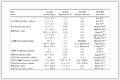
本次研究选取石英二长闪长岩(MLL-3)和细粒花岗岩(MLL-8)两件样品进行锆石U-Pb年龄测定,被测样品的详细经纬度坐标及LA-ICP-MS锆石定年结果列于表 1,代表性被测锆石颗粒的阴极发光(CL)图像及测定点位和相应的206Pb/238U表面年龄示于图 3,图 4为年龄谐和图。
|
表 1 猫狸岭岩体锆石LA-ICP-MS U-Pb定年结果 Table 1 Zircon LA-ICP-MS U-Pb dating results of the Maoliling pluton |
 | 图 3 猫狸岭岩体代表性被测锆石的阴极发光图像及分析点位 小圈为U-Pb年龄分析点,数据为206Pb/238U表面年龄;大圈为Hf同位素分析点,数据为εHf(t)值; 圆圈直径代表分析测试直径 Fig.3 Cathodoluminescence (CL) images, localities of the points for measurements of representative detected zircons from the Maoliling pluton The morphology of zircon grains, their 206Pb/238U ages and εHf(t) values are shown. Small circles indicate the U-Pb dating positions, and large circles indicate the positions for Hf isotope analysis, with their diameters approximating the spot sizes |
 | 图 4 猫狸岭岩体石英二长闪长岩(a)和细粒花岗岩(b)锆石U-Pb谐和图 Fig.4 U-Pb concordia diagrams of zircons for the quartz monzodiorites (a) and fine-grained granites (b) from the Maoliling pluton |
表 2列出了猫狸岭岩体代表性样品的主量、微量和稀土元素的分析结果。
|
|
表 2 猫狸岭岩体主量元素(wt%)及微量和稀土元素(×10-6)分析结果 Table 2 Major (wt%), trace and rare earth element (×10-6) contents of the Maoliling pluton |
 | 图 5 猫狸岭岩体主量元素关系图 图a底图据Middlemost, 1994,其中碱性与亚碱性系列分界线据Irvine and Baragar (1971);图c实线据Peccerillo and Taylor (1976),虚线据Middlemost (1985);图d底图据Maniar and Piccoli (1989) Fig.5 Major element variation diagrams of the Maoliling pluton The base map for diagram (a) is after Middlemost, 1994, and the boundary between the alkaline and subalkaline series is after Irvine and Baragar (1971); The solid dividing lines in diagram (c) are after Peccerillo and Taylor (1976), and the dashed lines are after Middlemost (1985); The base map for diagram (d) is after Maniar and Piccoli (1989) |
稀土元素组成上,石英二长闪长岩稀土配分形式呈明显的右倾斜型(图 6a),岩石稀土总量中等,∑REE=188.2×10⁻⁶~224.2×10⁻⁶,富集轻稀土,(La/Yb)N=13.3~19.0,轻稀土分馏程度较重稀土明显,(La/Sm)N=4.40~5.10,(Gd/Yb)N=1.71~2.05;铕负异常不明显,为弱到中度负异常(Eu/Eu*=0.77~0.95)。细粒花岗岩稀土配分形式、稀土总量均与石英二长闪长岩相似,∑REE=199.9×10-6~226.1×10-6,轻重稀土分馏程度则相对偏低,(La/Yb)N=9.9~13.2,但仍具富集轻稀土的特征,并具一定程度的铕负异常(Eu/Eu*=0.55~0.78),指示其成岩过程中存在长石的分离结晶作用。
 | 图 6 猫狸岭岩体稀土元素球粒陨石标准化配分曲线 (a, 标准化值据Boynton, 1984) 及微量元素原始地幔标准化蛛网图 (b, 标准化值据McDonough and Sun, 1995) Fig.6 Chondrite-normalized REE distribution patterns (a, the normalized values after Boynton, 1984) and primitive mantle-normalized trace element spidergrams (b, the normalized values after McDonough and Sun, 1995) of the Maoliling pluton |
表 3列出了猫狸岭岩体代表性样品的Rb-Sr和Sm-Nd同位素组成测定结果及根据年龄计算的相关参数。由表中数据可以看出,猫狸岭石英二长闪长岩和细粒花岗岩具有相似的Sr-Nd同位素组成,ISr分别为0.7088和0.7079~0.7088,εNd(t)值分别为-7.57~-7.56和-8.06~-7.95,暗示二者在成因上应存在紧密联系。石英二长闪长岩和细粒花岗岩都具有偏低的二阶段Nd模式年龄(tDM2),分别为1.53Ga和1.56~1.57Ga,较华夏地块基底变质岩的Nd模式年龄(=1.8~2.2Ga,陈江峰等,1999)也显著偏低。值得注意的是,猫狸岭岩体石英二长闪长岩和细粒花岗岩的Sr-Nd同位素组成和浙东白垩纪玄武岩和流纹质火山岩的Sr-Nd同位素组成均相似(图 7)。
|
|
表 3 猫狸岭岩体的Rb-Sr、Sm-Nd同位素组成 Table 3 Rb-Sr and Sm-Nd isotopic results of the Maoliling pluton |
 | 图 7 猫狸岭岩体εNd(t)-ISr图解 雁荡山正长岩数据引自He et al. (2009);小雄正长岩数据引自He and Xu (2012);沐尘岩体数据引自Liu et al.(2013);浙东白垩纪流纹岩和玄武岩引自俞云文等(1993)、杨祝良等(1999)、沈渭州等(1999)、陈荣和周金城(1999);大容山堇青石花岗岩引自Hsieh et al.(2008);清湖二长岩数据引自Li et al. (2004); 洋坊霓辉石正长岩数据引自Wang et al. (2005) Fig.7 εNd(t)-ISr diagram for the Maoliling pluton For comparison, illustrations are shown for the Yandangshan syenites (He et al., 2009), Xiaoxiong syenites (He and Xu, 2012), Muchen quartz monzonites (Liu et al., 2013), the Cretaceous basalts and rhyolites of eastern Zhejiang (Yu et al., 1993; Chen and Zhou, 1999; Shen et al., 1999; Yang et al., 1999), Darongshan cordierite granites (Hsieh et al., 2008); the Qinghu monzonite (Li et al., 2004) and the Yangfang aegirine-augite syenites (Wang et al., 2005) |
表 4列出了猫狸岭岩体代表性样品的锆石Lu-Hf 同位素组成测定结果及根据单颗粒锆石表面年龄计算的有关参数。由表 4及图 8可以看出,石英二长闪长岩和细粒花岗岩样品 具有大致相似的Hf同位素组成,εHf(t)值分别为-12.2~-6.6和-9.6~-4.4,其共同特点表现为εHf(t)值变化范围较大,变化幅度达5~6个ε单位,经过年龄计算后的二阶段Hf模式年龄(tDM2)分别为1.55~1.90Ga和1.41~1.74Ga。在εHf(t)-t关系图解上,大部分数据点分布于华夏地块地壳基底演化域之上(图 9)。这些偏高的εHf(t)值和相对年轻的二阶段Hf模式年龄暗示着一定量的地幔组分参与了其成岩过程。
|
|
表 4 猫狸岭岩体锆石原位Hf同位素组成 Table 4 Zircon in-situ Hf isotopic compositions of the Maoliling pluton |
 | 图 8 猫狸岭岩体石英二长闪长岩(a)和细粒花岗岩(b)的锆石εHf(t)值频数分布直方图 富集地幔以福建西部洋坊霓辉石正长岩εHf(t)值为代表(Wang et al., 2005; He et al., 2010) Fig.8 Histograms of zircon εHf(t) values for the quartz monzodiorites (a) and fine-grained granites (b) from the Maoliling pluton Enriched mantle is represented by Yangfang aegirite-augite syenite in western Fujian (Wang et al., 2005; He et al., 2010) |
 | 图 9 猫狸岭岩体石英二长闪长岩和细粒花岗岩锆石εHf(t)-t 关系图 华夏地块地壳基底演化域据Xu et al. (2007) Fig.9 Zircon εHf(t)-t diagram for the quartz monzodiorites and fine-grained granites from the Maoliling pluton The evolutionary area shown for the crustal basement of the Cathaysia Block is after Xu et al. (2007) |
石英二长闪长岩和细粒花岗岩具有相同的锆石U-Pb年龄和相似的全岩Sr-Nd同位素和锆石Lu-Hf同位素组成,这暗示着二者可能具有大致相似的岩浆源区,并且为同一期岩浆活动的产物。而在主量和微量元素组成上,石英二长闪长岩和细粒花岗岩既表现出相似性也表现出一定的差异,这指示了二者经历不同的岩浆分异演化过程或者演化程度。
首先,细粒花岗岩较石英二长闪长岩明显具更高的分异指数D.I,这暗示着细粒花岗岩具更高的分异演化程度。其次,细粒花岗岩较石英二长闪长岩亏损Sr,具明显Eu负异常,在Eu/Eu*-CaO图解上(图 10a),Eu/Eu*与CaO具有明显的正相关关系,暗示了细粒花岗质岩浆可由石英二长闪长质岩浆经一定程度的斜长石分离结晶作用形成。第三,在CaO/Al2O3-SiO2图解上(图 10b),所有样品的CaO/Al2O3与SiO2具有明显的负相关关系,表明细粒花岗岩和石英二长闪长岩的岩浆演化过程中均经历了富钙辉石(可能为单斜辉石)分离结晶作用,其中细粒花岗岩成岩过程中辉石的分离结晶程度更明显。此外,Naumann and Geist (1999)研究表明Sc/Y比值并不受岩浆中橄榄石和斜长石分离结晶影响,而Sc/Y随着Y递减而递减往往指示了岩浆过程演化中存在明显的单斜辉石分离结晶作用,这与本文中猫狸岭所有样品Sc/Y与Y正相关关系相吻合(图 10c),进一步表明形成细粒花岗岩和石英二长闪长岩的岩浆体系同时经历了单斜辉石的分离结晶作用。第四,细粒花岗岩相对于石英二长闪长岩更亏损P和Ti(图 6b),指示了细粒花岗岩经历更高程度的磷灰石及含钛矿物(如榍石或者钛铁矿)的分离结晶作用。
 | 图 10 猫狸岭岩体主量及微量元素关系图解 图(d)底图据Jiang et al. (2013),纯地壳部分熔融产生的熔体区域均基于实验岩石学研究,低钾玄武岩(8~16kbar, 1000~1050℃)脱水部分熔融区域据Rapp and Waston (1995);中-高钾玄武岩(1.7%~2.3% H2O, 7kbar,825~950℃)部分熔融区域据Sisson et al.(2005);泥质岩(7~13kbar, 825~950℃)部分熔融区域据Patiño Douce and Johnston(1991) Fig.10 Major and trace element variation diagrams of the Maoliling pluton The base map for diagram (d) is after Jiang et al. (2013). The fields of pure crustal partial melts determined in experimental studies on dehydration melting of low-K basaltic rocks at 8~16kbar and 1000~1050℃ are from Rapp and Watson (1995), of moderately hydrous (1.7%~2.3% H2O) medium- to high-K basaltic rocks at 7kbar and 825~950℃ are from Sisson et al. (2005), and of pelitic rocks at 7~13kbar and 825~950℃ are from Patiño Douce and Johnston(1991) |
猫狸岭岩体位于浙江省东部,其石英二长闪长岩ISr和εNd(t)值分别为0.7088和-7.57~-7.56,浙江省内几个同时期的正长-二长质岩体也具有大致相似的Sr-Nd同位素组成,已有研究表明它们具有不同的岩石成因,比如,雁荡山正长岩(~98Ma)具有大致相似的ISr (0.7086~0.7089)和εNd(t)值(-7.64 ~ -6.57),被认为由富集地幔起源的岩浆经进一步的分离结晶作用形成(He et al., 2009);小雄正长岩(~88Ma)同样具有相似的ISr(0.7082~0.7085)和偏高的εNd(t)值(-4.0~-3.8),被认为由亏损地幔熔体和俯冲相关的富集地幔熔体通过岩浆混合形成(He and Xu, 2012);沐尘石英二长岩(~112Ma)具有偏低的ISr (0.7062~0.7065)和偏高的εNd(t)值(-3.2~-2.4),研究表明其为亏损的幔源基性岩浆与其诱发熔融的壳源长英质通过岩浆混合作用形成(Liu et al., 2013)。因此,壳源组分和幔源组分在不同二长-正长质岩石成岩过程的作用是各异的,对猫狸岭岩体成因解析必须首先判别其岩浆源区。
Mg#值是区分幔源组分是否参与壳源岩浆的良好指示剂(Smithies, 2000)。典型大洋中脊拉斑玄武岩(MORB)的Mg#值约为60,实验岩石学研究表明,玄武质下地壳发生部分熔融产生的熔体,无论熔融程度高低,其Mg#值均较低(<40),只有存在地幔物质参与成岩时,才能导致熔体的Mg#值大于40(Rapp and Watson, 1995),如当与地幔橄榄岩发生10%的混染时,可以促使熔体的Mg#值从44提高到55 (Rapp et al., 1999)。猫狸岭石英二长闪长岩和细粒花岗岩均具较高的MgO,其Mg#值(分别为47.6~50.6和41.6~47.0)均高于纯地壳物质部分熔融形成的岩石的Mg#值(图 10d;Jiang et al., 2013及其引用文献),表明必须有幔源组分参与其成岩过程。锆石Hf同位素同样支持这一观点,在εHf(t)-t关系图解上(图 9),猫狸岭石英二长闪长岩和细粒花岗岩大部分数据点分布于华夏地块地壳基底演化域之上,对应的二阶段Hf模式年龄最年轻可达1.41Ga,明显年轻于华夏地壳基底变质岩(1.85Ga,Xu et al, 2007),这也为成岩过程中存在幔源组分参与提供了有力的证据。现有的研究表明,华南板块中生代岩石圈地幔为EMII型(Wang et al, 2005, 2008; He et al., 2010;闫峻, 2003, 2005; 章邦桐等,2004),其Nd-Hf同位素特征可以用闽西的洋坊霓辉石正长岩来代表(图 7、图 8)。猫狸岭石英二长闪长岩和细粒花岗岩大部分锆石的εHf(t)值明显偏高于富集地幔源区起源的洋坊霓辉石正长岩相应值,暗示了其成岩过程中必须有亏损地幔物质的参与。中国东南部燕山晚期几个二长-正长质岩体,同样表现出了较高的锆石εHf(t)值,比如康里正长岩(εHf(t)最高为+2.6)、福州正长岩(最高为+2.6)和小雄正长岩(最高为+0.6),以及沐尘石英二长岩(最高为+1.8),这些白垩纪二长-正长质岩石均被认为存在有亏损地幔组分参与成岩过程(He and Xu, 2012;Liu et al., 2013)。
值得提出的,猫狸岭石英二长闪长岩同时也具有与壳源岩石相似的微量元素及同位素特征,比如富集大离子亲石元素(如Rb、K和Pb;表 2;图 6b)和轻稀土元素(表 2;图 6a),亏损高场强元素(如Nb、Ta和Ti;表 2;图 6b),且具相对较高的ISr。同时它们具有低的Nb/U(2.0~3.2)和Ce/Pb(1.9~4.6)比值,相似于大陆地壳的平均值(Nb/U=6.2和Ce/Pb=3.9, Rudnick and Fountain, 1995),而与大洋中脊和洋岛玄武岩有明显区别(MORB和OIB; Nb/U=47±10 和Ce/Pb=25±5; Hofmann et al., 1986)。
一般而言,Nb/U比值很难因源区部分熔融程度或者岩浆分离结晶作用而发生改变,因而能够较好的用来反映岩浆源区(Hofmann, 1988; Xu et al., 2005; Sun et al., 2008; Ma et al., 2013)。然而,猫狸岭石英二长闪长岩Nb/U(2.0~3.2)比值明显低于下地壳的估算值(Nb/U≈25; Rudnick and Gao, 2003),并且低于上地壳的平均值(Nb/U≈4.5; Rudnick and Gao, 2003),暗示了即使纯粹起源于大陆地壳物质部分熔融的岩浆也不可能形成如此低的Nb/U比值。研究表明,大离子亲石元素相对于高场强元素更容易转移到俯冲板片脱水的流体中,而高场强元素极可能储存于俯冲板片脱水熔融残留的金红石或者钛铁矿之中,从而造成起源于俯冲板片脱水熔融的流体具有明显低的Nb/U比值(~0.22)(Ayers, 1998; Ryerson and Watson, 1987)。李献华等(1997)指出华南岩石圈地幔在中生代经历了俯冲古太平洋板片的改造。因此,猫狸岭石英二长闪长岩低的Nb/U比值最可能继承于因俯冲流体交代富集的岩石圈地幔,岩石低的Ta/U(0.15~0.23)同样支持这一观点。此外,富集地幔中含挥发分的矿物(如金云母或者角闪石)往往能够为这些大离子亲石元素(如Ba,Sr)提供载体,从而造成富集地幔起源的岩浆富集Ba和Sr(Ionov et al., 1997)。石英二长闪长岩富集大离子亲石元素(如Ba=845×10-6~ 1098×10-6,Sr=636×10-6~856×10-6),明显高于I、S、M和A型花岗岩平均值(Ba=263×10-6~ 538×10-6,Sr=48×10-6~282×10-6; Whalen et al., 1987),并且高于地壳的平均值(Ba=390×10-6,Sr=350×10-6; Rudnick and Fountain, 1995),同样佐证了这一观点。因此,亏损地幔组分和富集地幔组分同时参与了猫狸岭石英二长闪长岩的成岩过程。另一方面,猫狸岭石英二长闪长岩部分锆石具有明显低的εHf(t)值(-12.2),在εHf(t)-t关系图解上,这些样品点落于华夏地块地壳基底演化域中,表明其岩浆源区有古老基底地壳物质的加入(Griffin et al., 2000; Xu et al., 2007)。此外,细粒花岗岩SiO2含量最高可达69.35%,组成矿物中石英含量最高可达30%,而其D.I最高仅为86.8,表明其属于中等演化程度的花岗岩类。上述特征并不支持细粒花岗岩直接起源于幔源岩浆的分异演化,其成岩过程中必须有地壳物质的加入,因而与其同源的石英二长闪长岩的源区也应该有地壳组分的参与。总之,石英二长闪长岩与壳源岩石相似的微量元素及同位素特征应该由于其源区来自富集地幔和地壳物质两方面的贡献所致。
综上所述,幔源物质和壳源物质同时参与了猫狸岭岩体的成岩过程,猫狸岭石英二长闪长岩和细粒花岗岩最可能为幔源基性玄武质岩浆和古老地壳物质熔融的熔体通过岩浆混合作用形成,这可以从岩石学、地球化学及同位素等方面找到相应证据。首先,猫狸岭石英二长闪长岩中存在暗色镁铁质微粒包体,这些包体与寄主岩边界呈浑圆形或者扩散形态,包体中常见与寄主岩相似的长石斑晶(图 2a),暗示了包体与寄主岩岩浆曾塑性共存,且岩体成岩过程中应该存在岩浆混合作用。包体中的长石斑晶则应该为酸性岩浆早期结晶的长石呈固态运移到基性岩浆(包体)中及其边缘的结果(周金城等,1994)。其次,在地球化学方面,石英二长闪长岩和细粒花岗岩样品在Rb/Sr-Rb和Na2O/CaO-FeOT/Al2O3图解上表现出良好的协变关系(图 10e, f),同样指示了它们为岩浆混合成因(Langmuir et al., 1978)。第三,猫狸岭石英二长闪长岩及细粒花岗岩的锆石Hf同位素组成不均一,离散度较大,εHf(t)值分别散布于-12.2~-6.6和-9.6~-4.4之间,变化幅度达5~6个ε单位,这一特点表明其源区不可能为单一组分构成,至少应存在两种具有明显不同εHf(t)值的岩浆参与成岩过程,为岩浆混合成因提供了最直接的证据(Yang et al, 2006, 2007; Zhao et al., 2012)。
大量证据表明中国东南部晚中生代存在明显的幔源玄武质岩浆底侵作用(Zhou and Li, 2000; Zhou et al., 2006)。玄武质岩浆底侵作用是促使地壳岩石熔融产生长英质岩浆的重要机制之一(Huppert and Sparks, 1988; Petford and Gallagher, 2001),玄武质岩浆能够同时为地壳熔融提供“成分”和“热”两方面的贡献(Grunder, 1995; Xu et al., 2004)。中国东南部晚中生代玄武岩或者 辉长岩被认为起源于富集地幔或者俯冲交代改造的地幔源区(Xing et al., 2004; Chen et al., 2008;谢昕等,2001;杨祝良等,1999),或者起源于亏损特性的软流圈地幔源区(周金城等,2006)。本文猫狸岭石英二长闪长岩的成因暗示了亏损地幔和富集地幔组分可能同时为中国东南部晚中生代底侵玄武质岩浆的形成提供贡献。
猫狸岭岩体位于浙东沿海地区,形成于早白垩世晚期。闽浙沿海广泛发育白垩纪的A型花岗岩以及大量流纹岩和少量玄武岩构成的双峰式火山岩(Martin et al., 1994; Qiu et al., 2004; Zhou et al., 2006;Chen et al., 2013),暗示了中国东南部燕山晚期处于伸展拉张的构造背景。多数学者主张中国东南部燕山晚期的伸展引张背景,与太平洋板块往欧亚板块的俯冲有关(Li et al., 2007; Zhou and Li, 2000)。华南燕山晚期构造环境由挤压转为拉张的时期大致为110Ma(He and Xu, 2012; 陶奎元等, 2000),该时期,古太平洋板片俯冲速度加快和角度增大,会导致海沟向太平洋一侧的后退,从而在弧后产生具拉张性质的构造环境(Stern, 2002)。在Pearce et al. (1984)提出的Nb-Y构造判别图解上(图 11),猫狸岭岩体所有样品均位于VAG及syn-COLG区域;被认为形成于后碰撞伸展拉张背景的几个二长质岩体,如Terlemez二长岩、沐尘石英二长岩、沙河湾石英二长岩、建平二长岩等(Liu et al., 2013; Yaliniz et al., 1999; Wang et al., 2007; Wang et al., 2013),同样位于该区域。作为对比,形成于板内伸展环境的Errakonda 和Uppalapadu正长岩以及洋坊和铁山正长岩则均投影于WPG区域。因此,猫狸岭岩体最可能形成于后碰撞的伸展拉张背景,而这一背景十分有利于幔源玄武质岩浆的底侵,与猫狸岭岩体成因是相吻合的。
 | 图 11 猫狸岭岩体Nb-Y构造判别图解底图据Pearce et al. (1984);洋坊和铁山正长岩数据引自Wang et al., 2005,Errakonda和Uppalapadu正长岩数据引自Kumar et al., 2007,Terlemez二长岩数据引自Yaliniz et al., 1999,沐尘石英二长岩数据引自Liu et al., 2013,沙河湾石英二长岩和建平二长岩数据引自Wang et al., 2013.WPG-板内花岗岩;VAG-火山弧花岗岩;Syn-COLG-同碰撞花岗岩;ORG-大洋脊花岗岩 Fig.11 Nb-Y tectonic discrimination diagram of the Maoliling pluton The base map is after Pearce et al. (1984), also included are the fields for the Yangfang and Tieshan syenite (Wang et al., 2005), the Errakonda and Uppalapadu syenite (Kumar et al., 2007), Terlemez monzonite (Yaliniz et al., 1999), Muchen quartz monzonite (Liu et al., 2013), Shahewan quartz monzonite (Wang et al., 2007) and Jianping monzonite (Wang et al., 2013). WPG: within-plate granites; VAG: volcanic arc granites; syn-COLG: syn-collision granites; and ORG: Oceanic ridge granites |
(1)猫狸岭石英二长闪长岩和细粒花岗岩的锆石U-Pb年龄分别为105.6±1.0Ma和104.8±0.9Ma,属早白垩世晚期岩浆活动产物。
(2)石英二长闪长岩具中性、准铝质、钙碱性和富钾的特征;细粒花岗岩同样富钾和准铝质,但偏酸性,铁镁含量相对偏低。微量和稀土元素组成上,石英二长闪长岩富集Rb、Th、U、Pb,贫Nb、Ta、P、Ti,且Zr、Hf、Sr含量相对较高,铕负异常不显著(Eu/Eu*=0.77~0.95)。细粒花岗岩具有相似的微量元素特征,但P、Ti亏损程度更明显,且明显贫Sr,并具一定的铕负异常(Eu/Eu*=0.55~0.78)。
(3)石英二长闪长岩和细粒花岗岩具有相似的Sr-Nd同位素组成,ISr分别为0.7088和0.7079~0.7088,εNd(t)值分别为-7.57~-7.56和-8.06~-7.95。同时,二者具有大致相似的锆石Hf同位素组成,εHf(t)值分别为-12.2~-6.6和-9.6~-4.4。
(4)岩石学及元素与Sr-Nd-Hf同位素组成特征综合指示,猫狸岭石英二长闪长岩和细粒花岗岩最可能是在区域伸展拉张的构造背景下,由底侵或内侵的幔源岩浆与其诱发的壳源岩浆经混合后,并经过不同程度的分异演化,最后在浅成环境侵位的产物。
致谢锆石U-Pb定年和全岩Sr-Nd同位素分析分别得到了武兵老师和濮巍老师的指导与帮助;审稿专家严谨认真的评审为本文提供了十分有益的修改意见;谨此一并表示衷心的感谢。
| [1] | Ackerman L, Krñanská M, Siebel W and Strnad L. 2010. Geochemistry of the Drahotín and Mutěnín intrusions, West Bohemian shear zone, Bohemian massif: Contrasting evolution of mantle-derived melts. Mineralogy and Petrology, 99(3-4): 185-199 |
| [2] | Andersen T. 2002. Correction of common lead in U-Pb analyses that do not report 204Pb. Chemical Geology, 192(1-2): 59-79 |
| [3] | Aghazadeh M, Castro A, Omran NR, Emami MH, Moinvaziri H and Badrzadeh Z. 2010. The gabbro (shoshonitic)-monzonite-granodiorite association of Khankandi pluton, Alborz Mountains, NW Iran. Journal of Asian Earth Sciences, 38(35): 199-219 |
| [4] | Ayers J. 1998. Trace element modeling of aqueous fluid-peridotite interaction in the mantle wedge of subduction zones. Contributions to Mineralogy and Petrology, 132(4): 390-404 |
| [5] | Black LP and Gulson BL. 1978. The age of the mud tank carbonatite, Strangways range, Northern territory. BMR Journal of Australian Geology and Geophysics, 3: 227-232 |
| [6] | Bouvier A, Vervoort JD and Patchett PJ. 2008. The Lu-Hf and Sm-Nd isotopic composition of CHUR: Constraints from unequilibrated chondrites and implications for the bulk composition of terrestrial planets. Earth and Planetary Science Letters, 273(1-2): 48-57 |
| [7] | Boynton WV. 1984. Geochemistry of the rare earth elements: Meteorite studies. In: Henderson P (ed.). Rare Earth Elements Geochemistry. Amsterdam: Elservier, 63-144 |
| [8] | Chen CH, Lee CY and Shinjo R. 2008. Was there Jurassic paleo-Pacific subduction in South China? Constraints from 40Ar/39Ar dating, elemental and Sr-Nd-Pb isotopic geochemistry of the Mesozoic basalts. Lithos, 106(1-2): 83-92 |
| [9] | Chen JF, Guo XS, Tang JF and Zhou TX. 1999. Nd isotopic model ages: Implications of the growth of the continental crust of southeastern China. Journal of Nanjing University (Natural Sciences), 35(6): 649-58 (in Chinese with English abstract) |
| [10] | Chen JY, Yang JH, Zhang JH, Sun JF and Wilde SA. 2013. Petrogenesis of the Cretaceous Zhangzhou batholith in southeastern China: Zircon U-Pb age and Sr-Nd-Hf-O isotopic evidence. Lithos, 162-163: 140-156 |
| [11] | Chen R and Zhou JC. 2012. Information of crust mantle interaction implied in Early Cretaceous composite lavas and dikes from eastern Zhejiang. Geological Review, 45(7): 784-795 (in Chinese with English abstract) |
| [12] | Corfu F, Hanchar JM, Hoskin PWO and Kinny P. 2003. Atlas of zircon textures. Reviews in Mineralogy and Geochemistry, 53(1): 469-500 |
| [13] | Donskaya TV, Gladkochub DP, Mazukabzov AM and Ivanov AV. 2013. Late Paleozoic-Mesozoic subduction-related magmatism at the southern margin of the Siberian continent and the 150 million-year history of the Mongol-Okhotsk Ocean. Journal of Asian Earth Sciences, 62: 79-97 |
| [14] | Ferré EC, Caby R, Peucat JJ, Capdevila R and Monié P. 1998. Pan-African, post-collisional, ferro-potassic granite and quartz-monzonite plutons of Eastern Nigeria. Lithos, 45(1-4): 255-279 |
| [15] | Gagnevin D, Daly JS and Poli G. 2004. Petrographic, geochemical and isotopic constraints on magma dynamics and mixing in the Miocene Monte Capanne monzogranite (Elba Island, Italy). Lithos, 78(1-2): 157-195 |
| [16] | Gao JF, Lu JJ, Lai MY, Lin YP and Pu W. 2003. Analysis of trace elements in rock samples using HR-ICPMS. Journal of Nanjing University (Natural Sciences), 39(6): 844-850 (in Chinese with English abstract) |
| [17] | Griffin WL, Pearson NJ, Belousova E, Jackson SE, van Achterbergh E, O'Reilly SY and Shee SR. 2000. The Hf isotope composition of cratonic mantle: LAM-MC-ICPMS analysis of zircon megacrysts in kimberlites. Geochimica et Cosmochimica Acta, 64(1): 133-147 |
| [18] | Griffin WL, Belousova EA, Shee SR, Pearson NJ and OReilly SY. 2004. Archean crustal evolution in the northern Yilgarn Craton: U-Pb and Hf-isotope evidence from detrital zircons. Precambrian Research, 131(3-4): 231-282 |
| [19] | Griffin WL, Pearson NJ, Belousova EA and Saeed A. 2007. Reply to "Comment to short-communication 'Comment: Hf-isotope heterogeneity in zircon 91500' by Griffin WL, Pearson NJ, Belousova EA and Saeed A (Chemical Geology 233 (2006) 358-363)" by Corfu F. Chemical Geology, 244(1-2): 350-353 |
| [20] | Grunder AL. 1995. Material and thermal roles of basalt in crustal magmatism: Case study from eastern Nevada. Geology, 23(10): 952-956 |
| [21] | He ZY, Xu XS, Yu Y and Zou HB. 2009. Origin of the Late Cretaceous syenite from Yandangshan, SE China, constrained by zircon U-Pb and Hf isotopes and geochemical data. International Geology Review, 51(6): 556-582 |
| [22] | He ZY, Xu XS and Niu YL. 2010. Petrogenesis and tectonic significance of a Mesozoic granite-syenite-gabbro association from inland South China. Lithos, 119(3-4): 621-641 |
| [23] | He ZY and Xu XS. 2012. Petrogenesis of the Late Yanshanian mantle-derived intrusions in southeastern China: Response to the geodynamics of paleo-Pacific plate subduction. Chemical Geology, 328: 208-221 |
| [24] | Hofmann A, Jochum K, Seufert M and White M. 1986. Nb and Pb in oceanic basalts: New constraints on mantle evolution. Earth and Planetary Science Letters, 79(1-2): 33-45 |
| [25] | Hofmann AW. 1988. Chemical differentitation of the Earth: The relationship between mantle, continental crust, and oceanic crust. Earth and Planetary Science Letters, 90: 297-314 |
| [26] | Hou KJ, Li YH, Zou TR, Qu XM, Shi YR and Xie GQ. 2007. Laser ablation-MC-ICP-MS technique for Hf isotope microanalysis of zircon and its geological applications. Acta Petrologica Sinica, 23(10): 2595-2604 (in Chinese with English abstract) |
| [27] | Hsieh PS, Chen CH, Yang HJ and Lee CY. 2008. Petrogenesis of the Nanling Mountains granites from South China: Constraints from systematic apatite geochemistry and whole-rock geochemical and Sr-Nd isotope compositions. Journal of Asian Earth Sciences, 33(5-6): 428-451 |
| [28] | Huppert HE and Sparks RSJ. 1988. The generation of granitic magma by intrusion of basalt into continental crust. Journal of Petrology, 29(3): 599-624 |
| [29] | Irvine TN and Baragar WRA. 1971. A guide to the chemical classification of the common volcanic rocks. Canadian Journal of Earth Sciences, 8(5): 523-548 |
| [30] | Jackson SE, Pearson NJ, Griffin WL and Belousoval EA. 2004. The application of laser ablation-inductively coupled plasma-mass spectrometry to in situ U-Pb zircon geochronology. Chemical Geology, 211(1-2): 47-69 |
| [31] | Jahn BM and Condie KC. 1995. Evolution of the Kaapvaal craton as viewed from geochemical and Sm-Nd isotopic analyses of intracratonic pelites. Geochimica et Cosmochimica Acta, 59(11): 2239-2258 |
| [32] | Jiang YH, Jiang SY, Ling HF, Zhou XR, Rui XJ and Yang WZ. 2002. Petrology and geochemistry of shoshonitic plutons from the western Kunlun orogenic belt, Xinjiang, northwestern China: Implications for granitoid geneses. Lithos, 63(3-4): 165-187 |
| [33] | Jiang YH, Jia RY, Liu Z, Liao SY, Zhao P and Zhou Q. 2013. Origin of Middle Triassic high-K calc-alkaline granitoids and their potassic microgranular enclaves from the western Kunlun orogen, Northwest China: A record of the closure of Paleo-Tethys. Lithos, 156-159: 13-30 |
| [34] | Köksal S, Toksoy-Köksal F, Göncüo[KG-*4]g[DD(-1]ˇ[DD)]lu MC, Möller A, Gerdes A and Frei D. 2013. Crustal source of the Late Cretaceous Satansar monzonite stock (central Anatolia-Turkey) and its significance for the Alpine geodynamic evolution. Journal of Geodynamics, 65: 82-93 |
| [35] | Kumar KV, Frost CD, Frost BR and Chamberlain KR. 2007. The Chimakurti, Errakonda, and Uppalapadu plutons, Eastern Ghats Belt, India: An unusual association of tholeiitic and alkaline magmatism. Lithos, 97(1-2): 30-57 |
| [36] | Lan TG, Fan HR, Hu FF, Tomkins AG, Yang KF and Liu YS. 2011. Multiple crust-mantle interactions for the destruction of the North China Craton: Geochemical and Sr-Nd-Pb-Hf isotopic evidence from the Longbaoshan alkaline complex. Lithos, 122(1-2): 87-106 |
| [37] | Lan TG, Fan HR, Santosh M, Hu FF, Yang KF, Yang YH and Liu YS. 2012. Early Jurassic high-K calc-alkaline and shoshonitic rocks from the Tongshi intrusive complex, eastern North China Craton: Implication for crust-mantle interaction and post-collisional magmatism. Lithos, 140-141: 183-199 |
| [38] | Lan TG, Fan HR, Santosh M, Hu FF, Yang KF, Yang YH, Yang YH and Liu YS. 2013. Crust-mantle interaction beneath the Luxi Block, eastern North China Craton: Evidence from coexisting mantle- and crust-derived enclaves in a quartz monzonite pluton. Lithos, 177: 1-6 |
| [39] | Langmuir CH, Vocke RD, Hanson GN and Hart SR. 1978. A general mixing equation with applications to icelandic basalts. Earth and Planetary Science Letters, 37(3): 380-392 |
| [40] | Li XH, Hu RZ and Rao B. 1997. Geochronology and geochemistry of Cretaceous mafic dikes from northern Guangdong, SE China. Geochimica, 26(2): 14-31 (in Chinese with English abstract) |
| [41] | Li XH, Chung SL, Zhou HW, Lo CH, Liu Y and Chen CH. 2004. Jurassic intraplate magmatism in southern Hunan-eastern Guangxi: 40Ar/39Ar dating, geochemistry, Sr-Nd isotopes and implications for tectonic evolution of SE China. In: Malpas J, Fletcher CJ, Aitchison JC et al. (eds.). Aspects of the Tectonic Evolution of China. Geological Society, London, Special Publications, 226: 193-216 |
| [42] | Li XH, Li ZX, Li WX, Liu Y, Yuan C, Wei GJ and Qi CS. 2007. U-Pb zircon, geochemical and Sr-Nd-Hf isotopic constraints on age and origin of Jurassic I- and A-type granites from central Guangdong, SE China: A major igneous event in response to foundering of a subducted flat-slab? Lithos, 96(1-2): 186-204 |
| [43] | Li XH, Li WX, Wang XC, Li QL, Liu Y and Tang GQ. 2009. Role of mantle-derived magma in genesis of Early Yanshanian granites in the Nanling Range, South China: In situ zircon Hf-O isotopic constraints. Science in China (Series D), 52(9): 1262-1278 |
| [44] | Liu L, Qiu JS and Li Z. 2013. Origin of mafic microgranular enclaves (MMEs) and their host quartz monzonites from the Muchen pluton in Zhejiang Province, Southeast China: Implications for magma mixing and crust-mantle interaction. Lithos, 160-161: 145-163 |
| [45] | Liu S, Hu RZ, Gao S, Feng C, Qi YQ, Wang T, Feng GY and Coulson IM. 2008. U-Pb zircon age, geochemical and Sr-Nd-Pb-Hf isotopic constraints on age and origin of alkaline intrusions and associated mafic dikes from Sulu orogenic belt, Eastern China. Lithos, 106(3-4): 365-379 |
| [46] | Lu CZ. 2007. Geochemical characteristics and tectonic implications of Muchen quartz monzonite pluton in Zhejiang Province. Geochimica, 36(5): 457-466 (in Chinese with English abstract) |
| [47] | Ludwig KR. 2001. Isoplot/Ex (rev. 2.49): A geochronological toolkit for Microsoft Excel. Berkeley Geochronology Center, Special Publication, No.1, 1-58 |
| [48] | Ma L, Jiang SY, Hou LM, Dai BZ, Jiang YH, Yang T, Zhao KD, Pu W, Zhu ZY and Xu B. 2013. Geochemistry of Early Cretaceous calc-alkaline lamprophyres in the Jiaodong Peninsula: Implication for lithospheric evolution of the eastern North China Craton. Gondwana Research, doi: 10.1016/j.gr.2013.05.012 |
| [49] | Maniar PD and Piccoli PM. 1989. Tectonic discrimination of granitoids. Geological Society of American Bulletin, 101(5): 635-643 |
| [50] | Mao JR, Ye HM, Liu K, Li ZL, Takahashi Y, Zhao XL and Kee WS. 2013. The Indosinian collision-extension event between the South China Block and the Palaeo-Pacific plate: Evidence from Indosinian alkaline granitic rocks in Dashuang, eastern Zhejiang, South China. Lithos, 172-173: 81-97 |
| [51] | Martin H, Bonin B, Capdevila R, Jahn, BM, Lameyre J and Wang Y. 1994. The Kuiqi peralkaline granitic complex (SE China): Petrology and geochemistry. Journal of Petrology, 35(4): 983-1015 |
| [52] | McDonough WF and Sun SS. 1995. The composition of the Earth. Chemical Geology, 120(3-4): 223-253 |
| [53] | Middlemost EAK. 1985. Magma and Magmatic Rocks: An Introduction to Igneous Petrology. London: Longman |
| [54] | Middlemost EAK. 1994. Naming materials in the magma/igneous rock system. Earth-Science Reviews, 37(3-4): 215-224 |
| [55] | Miller RG and O'Nions RK. 1985. Source of Precambrian chemical and clastic sediments. Nature, 314(6009): 325-330 |
| [56] | Naumann TR and Geist DJ. 1999. Generation of alkalic basalt of crystal fractionation of tholeiitic magma. Geology, 27(5): 423-426 |
| [57] | Neves SP and Mariano G. 1997. High-K calc-alkalic plutons in Northeast Brazil: Origin of the biotite diorite/quartz monzonite to granite association and implications for the evolution of the Borborema Province. International Geology Review, 39(7): 621-638 |
| [58] | Patiño Douce AE and Johnston AD. 1991. Phase equilibria and melt productivity in the pelitic system: Implications for the origin of peraluminous granitoids and aluminous granulites. Contributions to Mineralogy and Petrology, 107(2): 202-218 |
| [59] | Pearce JA, Harris NBW and Tindle AG. 1984. Trace element discrimination diagrams for the tectonic interpretation of granitic rocks. Journal of Petrology, 25(4): 956-983. |
| [60] | Peccerillo A and Taylor SR. 1976. Geochemistry of Eocene calc-alkaline volcanic rocks from the Kastamonu area, Northern Turkey. Contributions to Mineralogy and Petrology, 58(1): 63-81 |
| [61] | Petford N and Gallagher K. 2001. Partial melting of mafic (amphibolitic) lower crust by periodic influx of basaltic magma. Earth and Planetary Science Letters, 193(3-4): 483-499 |
| [62] | Pu W, Zhao KD, Ling HF and Jiang SY. 2004. High precision Nd isotope measurement by Triton TI Mass Spectrometry. Acta Geoscientica Sinica, 25(2): 271-274 (in Chinese with English abstract) |
| [63] | Pu W, Gao JF, Zhao KD, Lin HF and Jiang SY. 2005. Separation method of Rb-Sr, Sm-Nd using DCTA and HIBA. Journal of Nanjing University (Natural Sciences), 41(4): 445-450 (in Chinese with English abstract) |
| [64] | Qiu JS, Wang DZ, Mclnnes BIA, Jiang SY, Wang RC and Kanisawa S. 2004. Two subgroups of A-type granites in the coastal area of Zhejiang and Fujian provinces, SE China: Age and geochemical constraints on their petrogenesis. Transactions of the Royal Society of Edinburgh: Earth Sciences, 95(1-2): 227-236 |
| [65] | Rapela CW and Pankhurst RJ. 1996. Monzonite suites: The innermost Cordilleran plutonism of Patagonia. Transactions of the Royal Society of Edinburgh: Earth Sciences, 87(1-2): 193-203 |
| [66] | Rapp RP and Watson EB. 1995. Dehydration melting of metabasalt at 8-32kbar: Implications for continental growth and crust-mantle recycling. Journal of Petrology, 36(4): 891-931 |
| [67] | Rapp PR, Shimizu N, Norman MD and Applegate GS. 1999. Reaction between slab-derived melts and peridotite in the mantle wedge: Experimental constraints at 3.8GPa. Chemical Geology, 160(4): 335-356 |
| [68] | Rudnick RL and Fountain DM. 1995. Nature and composition of the continental crust: A lower crustal perspective. Reviews of Geophysics, 33(3): 267-309 |
| [69] | Rudnick RL and Gao S. 2003. Composition of the continental crust. In: Holland HD and Turekian KK (eds.). The Crust. Treatise on Geochemistry. Oxford: Elsevier-Pergamon, 3: 1-64 |
| [70] | Ryerson FJ and Watson EB. 1987. Rutile saturation in magmas: Implications for Ti-Nb-Ta depletion in island-arc basalts. Earth and Planetary Science Letters, 86(2-4): 225-239 |
| [71] | Shen WZ, Ling HF, Wang DZ, Xu BT and Yu YW. 1999. Study on Nd-Sr isotopes of Mesozoic igneous rocks in Zhejiang, China. Scientia Geologica Sinica, 34(2): 223-232 (in Chinese with English abstract) |
| [72] | Sisson TW, Ratajeski K, Hankins WB and Glazner AF. 2005. Voluminous granitic magmas from common basaltic sources. Contributions to Mineralogy and Petrology, 148(6): 635-661 |
| [73] | Smithies RH. 2000. The Archaean tonalite-trondhjemite-granodiorite (TTG) series is not an analogue of Cenozoic adakite. Earth Planetary Science Letters, 182(1): 115-125 |
| [74] | Soderlund U, Patchett PJ, Vervoort JD and Isachsen CE. 2004. The 176Lu decay constant determined by Lu/Hf and U/Pb isotope systematics of Precambrian mafic intrusions. Earth and Planetary Science Letters, 219: 311-324 |
| [75] | Stern RJ. 2002. Subduction zones. Reviews of Geophysics, 40(4): 1012-1049 |
| [76] | Sun WD, Hu YH, Kamenetsky VS, Eggins SM, Chen M and Arculus RJ. 2008. Constancy of Nb/U in the mantle revisited. Geochimica et Cosmochimica Acta, 72(14): 3542-3549. |
| [77] | Tao KY, Xing GF, Yang ZL, Mao JR, Zhao Y and Xu NZ. 2000. Determination of and discussion on the ages of Mesozoic volcanic rocks in Zhejiang: Comments on the argumentation by Lapierre et al. Geology Review, 46(1): 14-21 (in Chinese with English abstract) |
| [78] | Vervoort JD and Blichert-Toft J. 1999. Evolution of the depleted mantle: Hf isotope evidence from juvenile rocks through time. Geochimica et Cosmochimica Acta, 63: 533-556 |
| [79] | Wang F, Lu XX, Lo CH, Wu FY, He YH, Yang LK and Zhu RX. 2007. Post-collisional, potassic monzonite-minette complex (Shahewan) in the Qinling Mountains (central China): 40Ar/39Ar thermochronology, petrogenesis, and implications for the dynamic setting of the Qinling orogen. Journal of Asian Earth Sciences, 31(2): 153-166 |
| [80] | Wang Q, Li JW, Jian P, Zhao ZH, Xiong XL, Bao ZW, Xu JF, Li CF and Ma JL. 2005. Alkaline syenites in eastern Cathaysia (South China): Link to Permian-Triassic transtension. Earth and Planetary Science Letters, 230(3-4): 339-354 |
| [81] | Wang W, Liu SW, Bai X, Li QG, Yang PT, Zhao Y, Zhang SH and Guo RR. 2013. Geochemistry and zircon U-Pb-Hf isotopes of the late Paleoproterozoic Jianping diorite-monzonite-syenite suite of the North China Craton: Implications for petrogenesis and geodynamic setting. Lithos, 162-163: 175-194 |
| [82] | Wang YJ, Fan WM, Cawood PA and Li SZ. 2008. Sr-Nd-Pb isotopic constraints on multiple mantle domains for Mesozoic mafic rocks beneath the South China Block hinterland. Lithos, 106(3-4): 297-308 |
| [83] | Whalen JB, Currie KL and Chappell BW. 1987. A-type granites: Geochemical characteristics, discrimination and petrogenesis. Contributions to Mineralogy and Petrology, 95(4): 407-419 |
| [84] | Wu YB and Zheng YF. 2004. Genesis of zircon and its constraints on interpretation of U-Pb age." target=_blank> Chinese Science Bulletin, 49(15): 1554-1569 |
| [85] | Xie X, Xu XS, Zou HB and Xing GF. 2001. Trace element and Nd-Sr-Pb isotope studies of Mesozoic and Cenozoic basalts in coastal area of SE China. Acta Petrologica Sinica, 17(4): 617-628 (in Chinese with English abstract) |
| [86] | Xing GF, Yang ZL, Chen R, Shen JL, Wei NY and Zhou YZ. 2004. Three stages of Mesozoic bimodal igneous rocks and their tectonic implications on the continental margin of Southeastern China. Acta Geologica Sinica, 78(1): 27-39 |
| [87] | Xu XS, O'Reilly SY, Griffin WL, Wang XL, Pearson NJ and He ZY. 2007. The crust of Cathaysia: Age, assembly and reworking of two Terranes. Precambrian Research, 158(1-2): 51-78 |
| [88] | Xu YG, Huang XL, Ma JL, Wang YB, Iizuka Y, Xu JF, Wang Q and Wu XY. 2004. Crust-mantle interaction during the tectono-thermal reactivation of the North China Craton: Constraints from SHRIMP zircon U-Pb chronology and geochemistry of Mesozoic plutons from western Shandong. Contributions to Mineralogy and Petrology, 147(6): 750-767 |
| [89] | Xu YG, Ma JL, Frey FA, Feigenson MD and Liu JF. 2005. Role of lithosphere-asthenosphere interaction in the genesis of Quaternary alkali and tholeiitic basalts from Datong, western North China Craton. Chemical Geology, 224(4): 247-271 |
| [90] | Yaliniz MK, Aydin NS, Göncüoglu MC and Parlak O. 1999. Terlemez quartz monzonite of central Anatolia (Aksaray-Sarkaraman): Age, petrogenesis and geotectonic implications for ophiolite emplacement. Geological Journal, 34(3): 233-242 |
| [91] | Yan J, Chen JF, Yu G, Qian H and Zhou CX. 2003. Pb isotopic characteristics of Late Mesozoic mafic rocks from the Lower Yangtze region: Evidence for enriched mantle. Geological Journal of China Universities, 9(2): 193-206 (in Chinese with English abstract) |
| [92] | Yan J, Chen JF, Xie Z, Yang G, Yu G and Qian H. 2005. Geochemistry of Late Mesozoic basalts from Kedoushan in the Middle and Lower Yangtze regions: Constraints on characteristics and evolution of the lithosphere mantle. Geochimica, 34(5): 455-469 (in Chinese with English abstract) |
| [93] | Yang CH, Xu WL, Yang DB, Wang W, Wang WD and Liu JM. 2008. Petrogenesis of Shangyu gabbro-diorites in western Shandong: Geochronological and geochemical evidence. Science in China (Series D), 51(4): 481-492 |
| [94] | Yang JH, Wu FY, Chung SL, Wilde SA and Chu MF. 2006. A hybrid origin for the Qianshan A-type granite, northeast china: geochemical and Sr-Nd-Hf isotopic evidence. Lithos, 89(1-2): 89-106 |
| [95] | Yang JH, Wu FY, Wilde SA, Xie LW, Yang YH and Liu XM. 2007. Tracing magma mixing in granite genesis: In situ U-Pb dating and Hf-isotope analysis of zircons. Contributions to Mineralogy and Petrology, 153(2): 177-190 |
| [96] | Yang SY, Jiang SY, Jiang YH, Zhao KD and Fan HH. 2011. Geochemical, zircon U-Pb dating and Sr-Nd-Hf isotopic constraints on the age and petrogenesis of an Early Cretaceous volcanic-intrusive complex at Xiangshan, Southeast China. Mineralogy and Petrology, 101(1-2): 21-48 |
| [97] | Yang ZL, Shen WZ, Tao KY and Shen JL. 1999. Sr, Nd and Pb isotopic characteristics of Early Cretaceous basaltic rocks from the coast of Zhejiang and Fujian: Evidences for ancient enriched mantle source. Scientia Geologica Sinica, 34(1): 59-68 (in Chinese with English abstract) |
| [98] | Yu YW, Zhou TX and Chen JF. 1993. The characteristics and origin of Xuantandi bimodal volcanic rocks of the late stages of Early Cretaceous, Zhejiang. Journal of Nanjing University (Earth Science), 5(4): 420-429 (in Chinese with English abstract) |
| [99] | Zhang BT, Chen PR, Ling HF and Kong XG. 2004. Pb-Nd-Sr isotopic study of the Middle Jurassic basalts in Southern Jiangxi Province: Characteristics of mantle source and tectonic implication. Geological Journal of China Universities, 10(2): 145-156 (in Chinese with English abstract) |
| [100] | Zhao KD, Jiang SY, Yang SY, Dai BZ and Lu JJ. 2012. Mineral chemistry, trace elements and Sr-Nd-Hf isotope geochemistry and petrogenesis of Cailing and Furong granites and mafic enclaves from the Qitianling batholith in the Shi-Hang zone, South China. Gondwana Research, 22(1): 310-324 |
| [101] | Zhou JC, Zhang HJ and Yu YW. 1994. Magma mixing in Early Cretaceous composite lava flows in Xinchang, Zhejiang. Acta Petrologica Sinica, 10(3): 236-247 (in Chinese with English abstract) |
| [102] | Zhou JC, Jiang SY, Wang XL, Yang JH and Zhang MQ. 2006. Re-Os isotopic compositions of Late Mesozoic mafic rocks from southeastern coast of China. Acta Petrologica Sinica, 22(2): 407-413 (in Chinese with English abstract) |
| [103] | Zhou XM and Li WX. 2000. Origin of Late Mesozoic igneous rocks in southeastern China: Implications for lithosphere subduction and underplating of mafic magmas. Tectonophysics, 326(3-4): 269-287 |
| [104] | Zhou XM, Sun T, Shen WZ, Shu LS and Niu YL. 2006. Petrogenesis of Mesozoic granitoids and volcanic rocks in South China: A response to tectonic evolution. Episodes, 29(1): 26-33 |
| [105] | 陈江峰, 郭新生, 汤加富, 周泰禧. 1999. 中国东南地壳增长与Nd 同位素模式年龄. 南京大学学报(自然科学版), 35(6): 649-668 |
| [106] | 陈荣, 周金城. 2012. 浙东早白垩世复合岩流和岩墙中蕴含的壳幔作用信息. 地质论评, 45(7): 784-795. |
| [107] | 高剑峰, 陆建军, 赖鸣远, 林雨萍, 濮巍. 2003. 岩石样品中微量元素的高分辨率等离子质谱分析. 南京大学学报(自然科学版), 39(6): 844-850 |
| [108] | 侯可军, 李延河, 邹天人, 曲晓明, 石玉若, 谢桂青. 2007. LA-MC-ICP-MS 锆石Hf同位素的分析方法及地质应用. 岩石学报, 23(10): 2595-2604 |
| [109] | 李献华, 胡瑞忠, 饶冰. 1997. 粤北白垩纪基性岩脉的年代学和地球化学. 地球化学, 26(2): 14-31 |
| [110] | 卢成忠. 2007. 浙江沐尘石英二长岩体的岩石地球化学特征及构造意义. 地球化学, 36(5): 457-466 |
| [111] | 濮巍, 赵葵东, 凌洪飞, 蒋少涌. 2004. 新一代高精度高灵敏度的表面热电离质谱仪(Triton TI)的Nd同位素测定. 地球学报, 25(2): 271-274 |
| [112] | 濮巍, 高剑峰, 赵葵东, 凌洪飞, 蒋少涌. 2005. 利用DCTA和HIBA快速有效分离Rb-Sr、Sm-Nd的方法. 南京大学学报(自然科学版), 41(4): 445-450 |
| [113] | 沈渭洲, 凌洪飞, 王德滋, 徐步台, 俞云文. 1999. 浙江省中生代火成岩的Nd-Sr同位素研究. 地质科学, 34(2): 223-232 |
| [114] | 陶奎元, 邢光福, 杨祝良, 毛建仁, 赵宇, 许乃政. 2000. 浙江中生代火山岩时代厘定和问题讨论: 兼评Lapierre等关于浙江中生代火山活动时代的论述. 地质论评, 46(1): 14-21 |
| [115] | 谢昕, 徐夕生, 邹海波, 邢光福. 2001. 中国东南沿海中-新生代玄武岩微量元素和Nd-Sr-Pb同位素岩浆. 岩石学报, 17(4): 617-628 |
| [116] | 闫峻, 陈江峰, 喻钢, 钱卉, 周春禧. 2003. 长江中下游晚中生代中基性岩的铅同位素特征: 富集地幔的证据. 高校地质学报, 9(2): 195-206 |
| [117] | 闫峻, 陈江峰, 谢智, 杨刚, 喻钢, 钱卉. 2005. 长江中下游地区蝌蚪山晚中生代玄武岩的地球化学研究: 岩石圈地幔性质与演化的制约. 地球化学, 34(5): 455-469 |
| [118] | 杨祝良, 沈渭洲, 陶奎元, 沈加林. 1999. 浙闽沿海早白垩世玄武岩锶、钕、铅同位素特征--古老富集型地幔的证据. 地质科学, 34(1): 59-68 |
| [119] | 俞云文, 周泰禧, 陈江峰. 1993. 浙江玄坛地早白垩世晚期双峰式火山岩特征及其成因. 南京大学学报(地球科学), 5(4): 420-429 |
| [120] | 章邦桐, 陈培荣, 凌洪飞, 孔兴功. 2004. 赣南中侏罗世玄武岩的Pb-Nd-Sr同位素地球化学研究: 中生代地幔源区特征及构造意义. 高校地质学报, 10(2): 145-156 |
| [121] | 周金城, 张海进, 俞云文. 1994. 浙江新昌早白垩世复合岩流中的岩浆混合作用. 岩石学报, 10(3): 236-247 |
| [122] | 周金城, 蒋少涌, 王孝磊, 杨竞红, 张孟群. 2006. 东南沿海晚中生代镁铁质岩的Re-Os同位素组成. 岩石学报, 22(2): 407-413 |