 2013, Vol. 29


2. 中国地质大学研究生院,武汉 430074;
3. 中国地质大学地球科学与资源学院, 北京 100083
2. Graduate School, China University of Geosciences, Wuhan 430074, China;
3. School of Earth Science and Resources, China University of Geosciences, Beijing 100083, China
印度与亚洲板块从约55Ma以来的碰撞形成了正在活动的喜马拉雅造山带。从位于巴基斯坦的西喜马拉雅构造结到位于中国西藏的东喜马拉雅构造结(南迦巴瓦构造结),喜马拉雅造山带延伸超过2400km,是板块构造形成的大自然杰作(图 1)。新生代的喜马拉雅造山作用发生在印度大陆北缘、亚洲板块(拉萨地体)南缘和它们之间的新特提斯洋缝合带(图 1)。构成喜马拉雅造山带的主体是印度大陆物质。一般认为,喜马拉雅造山带由沿平行造山带走向分布的四个构造单元组成,从南到北依次为:次喜马拉雅单元(或前陆盆地)、低喜马拉雅岩系、高喜马拉雅结晶岩系和特提斯喜马拉雅系列。它们之间依次分别为主边界逆冲断裂,主中央逆冲断裂和藏南拆离(断裂)系(Le Fort, 1975; Burg et al., 1984; Burchfiel and Royden, 1985; Hodges, 2000; Yin and Harrison, 2000; Yin, 2006)。高喜马拉雅结晶岩系是一个厚约30km的高级变质岩系,主要由800Ma之后形成的变质沉积岩组成,发育早奥陶纪和新生代的花岗岩,普遍经历了中压型区域变质作用(Parrish and Hodges, 1996; Robinson et al., 2001, 2006; Richards et al., 2005)。在喜马拉雅造山带的西段,高喜马拉雅结晶岩系经历了超高压变质作用,形成了含柯石英的榴辉岩(O'Brien and Sachan, 2000; O'Brien et al., 2001;Kaneko et al., 2003;Guillot et al., 2003; Mukheerjee et al., 2003; de Sigoyer et al., 2004; Ahmad et al., 2006;Parrish et al., 2006;Guillot et al., 2008)。在喜马拉雅造山带的中段,近十年来陆续发现了高压变质的榴辉岩和麻粒岩(Lombardo and Rolfo, 2000; Groppo et al., 2007; Cottle et al., 2009;Chakungal et al., 2010)。而且,最近的研究也证明大面积分布的正、副片麻岩也经历了高压变质作用(Liu et al., 2007a; Kali et al., 2010)。在喜马拉雅造山带东端,即东喜马拉雅构造结,尽管现有的研究都表明,高喜马拉雅结晶岩系(南迦巴瓦杂岩)经历了高压变质作用(Zhong and Ding, 1996; Liu and Zhong, 1997; Ding and Zhong, 1999; Ding et al., 2001;Geng et al., 2006),但是,高压变质岩系的组成与形成时代,高压变质作用的温、压条件及P-T轨迹,以及高压变质过程中的部分熔融作用都还存在不同的认识(Liu et al., 2007b; Booth et al., 2009; Guilmette et al., 2011; Zhang et al., 2010; Su et al., 2012)。然而,造山带中变质岩的温压条件及P-T轨迹是重塑造山过程中变质演化和构造模式的重要参数,同时地壳部分熔融与花岗质岩浆作用具有密切的成因联系并强烈影响地壳流变学性质。本文对东喜马拉雅构造结核部南迦巴瓦杂岩中的代表性岩石--泥质高压变质岩进行了岩石学和相平衡模拟研究,较精确地计算了其变质作用的温、压条件,以及峰期变质过程中的部分熔融程度和熔体成分,探讨了喜马拉雅造山带核部变质作用与岩浆作用之间的关系和青藏高原中下地壳的流变学性质。

|
图 1 东喜马拉雅构造结地质简图 Fig. 1 Geological map of the Eastern Himalayan Syntaxis |
东喜马拉雅构造结处于喜马拉雅造山带的东端。在这一地区,由于印度大陆板块的东北角向北嵌入欧亚板块,导致近东西走向的喜马拉雅造山带转变成南北走向。研究区由三个构造单元组成,从北到南依次是:拉萨地体,即欧亚大陆板块的南缘,雅鲁藏布江缝合带,代表欧亚与印度板块之间新特提斯洋残余,和喜马拉雅带,代表印度板块的北缘。喜马拉雅带以高喜马拉雅结晶岩,即南迦巴瓦杂岩为中心,其边缘被特提斯-喜马拉雅带围绕(Yin and Harrison, 2000; Booth et al., 2004, 2009)。特提斯-喜马拉雅带主要由古生代到中生代的沉积地层组成,经历了绿片岩相到绿帘角闪岩相变质作用(Booth et al., 2004, 2009)。南迦巴瓦杂岩由片麻岩、角闪岩、大理岩、麻粒岩和混合岩组成(Liu and Zhong, 1997; Burg et al., 1998; Ding and Zhong, 1999)。Geng et al. (2006) 和Booth et al. (2009) 认为南迦巴瓦杂岩可以划分三个单元,上部单元主要由长英质片麻岩组成,含层状大理岩和钙硅酸岩,中部单元为混合岩化的片麻岩,下部为含高压麻粒岩相的长英质片麻岩。但是, Zhang et al. (2010) 认为南迦巴瓦杂岩一起经历了早期的高压麻粒岩相变质作用和后来的角闪岩相退变质作用。而且,Zhang et al. (2012) 研究表明,南迦巴瓦杂岩中正片麻岩的原岩形成在晚古元古代(~1610Ma)和早古生代(ca. 490~500Ma),角闪岩的原岩形成在1645~1590Ma。副片麻岩中的碎屑锆石具有从新太古代至早古生代的继承年龄。杂岩中的钙硅酸岩经历了早古生代(~538Ma)的变质作用。所有这些岩石都在新生代的碰撞造山过程中经历了高级变质作用和深熔作用。
3 岩石学所研究的泥质变质岩为石榴石-蓝晶石石英片岩(LZ06-20-19),由石英、钾长石、蓝晶石、石榴石、黑云母、金红石、夕线石和石墨组成,具有明显的面状组构,其中浅色体、石英条带和蓝晶石定向分布(图 2)。石榴石变斑晶粒径可达1cm,其核部包裹有大量石英、长石、黑云母、金红石等细小包裹体,呈筛状,靠近边部的包裹体具有定向性,与基质面理方向一致。石榴石边部较干净,包裹体较少(图 2a)。蓝晶石多为长柱状,可达8mm,部分颗粒具有明显的变形(图 2c, d)。局部可见毛发状的夕线石替代蓝晶石或石榴石(图 2a, b)。基质中黑云母含量较少(<5%),多呈细小鳞片状围绕在石榴石和蓝晶石变斑晶周围。金红石仅以石榴石包裹体的形式出现。基质中缺乏金红石,而含少量钛铁矿。因此,所研究的岩石含两期矿物组合,即早期的高压矿物组合:石榴石+蓝晶石+黑云母+石英+斜长石+钾长石+金红石,和晚期相对低压矿物组合:石榴石+夕线石+黑云母+石英+斜长石+钾长石+钛铁矿。

|
图 2 南迦巴瓦高压泥质麻粒岩的显微照片 (a)-石榴石变斑晶核部含大量包裹体,边缘较干净;(b)-蓝晶石变斑晶边缘被夕线石部分替代; (c、d)-变形的蓝晶石变斑晶、石英条带和少量黑云母及石墨平行分布,构成片理.本文所使用矿物代号:Gt-石榴石;Bt-黑云母;Ms-白云母;Pl-斜长石;Kf-钾长石;Ky-蓝晶石;Sil-夕线石;Q-石英;Rt-金红石;ilm-钛铁矿;Sp-尖晶石;Crd-堇青石;St-十字石;melt-熔体 Fig. 2 Photomicrographs of the high-pressure granulite from the Namche Barwa complex |
|
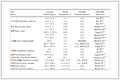
表 1 代表性的石榴石电子探针分析结果(wt%) Table 1 Representative electron microprobe analyses of garnet (wt%) |
石榴石的电子探针成分分析结果见表 1。石榴石富集Fe、贫Mg、Ca、Mn,XFe在0.74~0.67之间,XMg=0.24~0.17, XCa 在0.08~0.05之间,主要集中在0.07~0.06之间,XMn多低于0.02,Mg#多集中在0.25~0.20之间。石榴石具有弱的成分环带,核部成分相对均一,从核到边,MgO、Mg#略微升高、FeO略微降低,而CaO、MnO含量变化不明显;而在边部,MgO和Mg#迅速降低,而FeO、MnO明显升高,CaO变化不明显(图 3)。

|
图 3 高压麻粒岩中石榴石成分剖面图 Fig. 3 Compositional profiles of garnet in the high-pressure pelitic granulite (LZ06-20-19) |
相平衡模拟使用Perple_X 程序(Connolly, 2005, 2013年升级的6.6.8版),数据库选择Holland and Powell (1998) 的升级版。所涉及的矿物及熔体相的活度-成分关系模型选自Perple_X文件(solution_model.dat),包括:石榴石-Gt(WPH);黑云母-Bio(TCC);白云母-Mica(CHA1);长石(斜长石和钾长石)-feldspar; 堇青石-hCrd;尖晶石-Sp(HP);十字石-St(HP);斜方辉石-Opx(HP);单斜辉石-Cpx(HP);钛铁矿-Ilm(WPH)。考虑到P2O5主要形成磷灰石,且在所研究的样品中含量很低,因此忽略该组分。岩石中含有较多石墨,且未见有磁铁矿或其他富含Fe3+的矿物,因此假设Fe均为Fe2+。因此在相平衡模拟过程中选择接近岩石实际成分的MnO-Na2O-CaO-K2O-FeO-MgO-Al2O3-SiO2-H2O-TiO2 (MnNCKFMASHT) 体系。
|
|
表 2 全岩及计算的熔体成分(wt%) Table 2 Composition of bulk rock and the calculated melts(wt%) |
相平衡模拟计算时采用的全岩成分为XRF(X荧光光谱分析)测试结果(表 2)。我们对该样品计算了两组视剖面图。其中第一组视剖面计算采用的实测的全岩成分,水含量0.4% (图 4)。野外及显微证据均表明岩石发生了强烈的深熔作用,且有明显的熔体迁移。因此该视剖面图反映的是熔体丢失后的变质演化历史(White and Powell, 2002; Kelsey et al., 2003; Chen et al., 2008)。为了限定岩石的实际部分熔融程度与熔体成分,通过实测的全岩成分加上丢失的熔体成分恢复出原岩成分,再进行相平衡模拟计算得到第二组视剖面图(图 5)。

|
图 4 南迦巴瓦高压泥质麻粒岩相平衡模拟结果(根据实测全岩成分) (a)-利用实测全岩成分计算出的高压麻粒岩的P-T视剖面图; (b)-石榴石成分等值线图, 实线为Mg#=Mg/(Fe+Mg),虚线为XCa=Ca/(Fe+Mg+Ca+Mn);(c)-熔体含量等值线图 Fig. 4 The result of phase equilibria modeling for HP high-pressure pelitic granulite of NBC (using the natural sample composition) (a)-P-T pseudosection for HP high-pressure granulite modeled using the nature sample composition; (b)-the garnet composition isopleths. The solid line is Mg#=Mg/(Fe+Mg), and the dashes line is XCa=Ca/(Fe+Mg+Ca+Mn); (c)-the melt proportion isopleths (vol%) |

|
图 5 南迦巴瓦高压泥质麻粒岩相平衡模拟结果(根据熔体还原后的全岩成分) (a)-利用熔体还原后的全岩成分计算出的高压麻粒岩P-T视剖面图; (b)-石榴石成分等值线图, 实线为Mg#=Mg/(Fe+Mg),虚线为XCa=Ca/(Fe+Mg+Ca+Mn);(c)-熔体含量等值线图 Fig. 5 The result of phase equilibria modeling for HP high-pressure pelitic granulite of NBC (using the melt-reintegrated whole-rock composition) (a)-P-T pseudosection of the HP high-pressure granulite calculated using the melt-reintegrated whole-rock composition; (b)-the garnet composition isopleths. The solid line is Mg#=Mg/(Fe+Mg), and the dashes line is XCa=Ca/(Fe+Mg+Ca+Mn); (c)-the melt proportion isopleths (vol%) |
图 4a是根据实测的全岩成分以及水含量计算得到的石榴石-蓝晶石石英片岩的P-T视剖面图。在计算的温度(600~100℃)和压力(4~16kb)范围内,石榴石均稳定存在,金红石稳定在>8.5kb的高压区域,堇青石仅稳定在<6kb的低压区域,白云母稳定在低温高压区域,黑云母的消失线>770~925℃,在高压区域固相线与白云母消失线相近,>770℃。观察到的早期高压峰期矿物组合石榴石+蓝晶石+黑云母+斜长石+钾长石+石英+金红石+熔体稳定在10~15kb和800~850℃条件下。基于实测的石榴石成分,其Mg#=~0.24和XCa=0.06~0.07等值线在上述矿物组合的稳定区域内相交在~820℃和~13.6kb(图 4b)。因此,上述P-T条件相当于高压麻粒岩的峰期变质条件。图 4c为计算出的岩石中熔体含量等值线,在峰期条件下,干的高压麻粒岩部分熔融程度大至在4vol%~5vol%。由于金红石仅存在石榴石中呈包体,以及基质中蓝晶石被夕线石替代,这表明该岩石在退变质阶段进入到了钛铁矿和夕线石稳定域,反映高压麻粒岩经历了降压退变质过程(图 4a)。
在高级变质的深熔岩石中,熔体比例超过临界值时会发生熔体迁移丢失(Arzi, 1978; Brown, 2004;Vanderhaege, 2001; Rosenberg and Handy, 2005)。在峰期之后,熔体的结晶并释放出大量的水,会促进峰期高压麻粒岩相矿物的退变(White et al., 2001; White and Powell, 2002; Kelsey et al., 2003; Chen et al., 2008)。所研究的高压泥质麻粒岩很好地保留了峰期高压麻粒岩相矿物,也指示其曾发生了明显的熔体的迁移丢失。对于天然的岩石,很难还原熔体丢失历史,并确定丢失熔体的数量和成分。然而模拟计算表明,不同的熔体丢失方案,不会明显改变干固相线以上区域固相的成分参数(White and Powell, 2002; Indares et al., 2008; Guilmette et al., 2011)。因此我们简单地假设熔体是在峰期一次性丢失的。对于所研究的样品,还原的熔体成分采用在820℃和13kb条件下计算出的熔体成分。通过调节还原熔体的比例,使岩石在固相线以下,水刚好饱和,即在部分熔融前含水矿物相的量达到最大。最终,确定加入19wt%(约23.5vol%)的熔体,熔体还原后的全岩成分见(表 2)。该熔体比例也与野外观察到的高压麻粒岩中浅色脉体的实际比例相当。
图 5为利用熔体还原后的全岩成分计算出的P-T视剖面图。与图 4相比,在干固相线以上的区域,两者总体相似,除了钾长石在高温、低压区域消失外。在低温部分,两者具有截然不同的特征。在图 5a中,固相线温度显著降低,在13kb时,位于650℃左右。白云母稳定域延伸到了低压区域,钾长石仅稳定在较高的P-T范围内。观察到的峰期矿物组合石榴石+蓝晶石+黑云母+斜长石+钾长石+石英和金红石仅稳定在固相线以上的一个较小的区域,温压范围在780~850℃,10~15kb之间,与利用岩石实测成分模拟出的稳定P-T范围相似(图 4a)。图 5b为计算的石榴石Mg#和XCa等值线图,Mg#在高温部分具有非常陡的斜率,而XCa相对较缓。在峰期矿物组合稳定区域内,测得的石榴石Mg#=~0.24和XCa=0.065~0.070等值线交于820℃和13.0~13.5kb条件下,应代表峰期变质的温压条件。计算结果显示,在峰期变质阶段有~27vol% (~22wt%)的熔体产生(图 5c)。当熔体在峰期迁移丢失后,体系中仅残余<5vol%的熔体时,体系的全岩成分与实测的全岩成分一致(表 2)。这说明熔体恢复后的全岩成分是合理。
为了进一步了解进变质过程中的部分熔融过程,我们推测进变质作用沿通过峰期变质条件的P-T轨迹(图 5a中直线AB,从600℃和8kb 到950℃和16kb)进行。由此计算出的各物相和熔体的含量变化如图 6。在相对低温(672~800℃)区域,随着温压增加,白云母和石英的含量显著降低,而熔体、蓝晶石和斜长石的含量逐渐升高。该阶段白云母共消耗了17.5vol%,而产生了14vol%的熔体,表明该阶段主要是白云母部分脱水熔融。而在800~807℃的狭窄温度范围内,白云母含量从16.4%突然变为0,同时斜长石和石英含量也明显降低,相应地熔体含量增加了约10.1vol%,蓝晶石和钾长石含量显著增加。相应的熔融生成反应为:

|
图 6 高压麻粒岩中矿物和熔体相含量与P-T条件的相关性图 温度、压力沿图 5a中的直线AB变化 Fig. 6 Correlation between the mineral and melt phase proportions and P-T conditions of the high-pressure granulite The temperature and pressure change along the line AB in Fig. 5a |
白云母+石英+斜长石=蓝晶石+钾长石+熔体。
从807℃开始,随着温度增加,黑云母、斜长石、石英含量逐渐减少,直到842℃黑云母完全分解,相应地,熔体、石榴石和钾长石逐渐增加。在该阶段为黑云母脱水熔融,熔体增加了4.7vol%,相应的熔融生成反应为:
黑云母+石英+斜长石=石榴石+钾长石+熔体。
在更高温条件下,含水矿物相已完全消失,主要是长英质矿物的部分熔融,表现为钾长石、斜长石和石英逐渐减少而熔体逐渐增加。但对于所研究的高压泥质麻粒岩,其峰期变质温度低于842℃,其部分熔融应为白云母和黑云母脱水熔融。
5 讨论 5.1 变质作用P-T条件以前的研究表明,南迦巴瓦杂岩经历了高压麻粒岩相变质作用(Liu and Zhong, 1997; Ding and Zhong, 1999; Zhang et al., 2007)。高压基性麻粒岩的矿物组成是石榴石+单斜辉石+斜长石+石英,长英质和泥质麻粒岩的高压矿物组合是石榴石+蓝晶石+钾长石+三元长石+石英。这些矿物组合是高压麻粒岩的典型矿物组合(O'Brien and Rötzler, 2003; Zhang et al., 2006)。Liu and Zhong(1997) 研究认为,南迦巴瓦高压麻粒岩的峰期变质条件是17~18kb和890℃,Ding and Zhong (1999) 认为是14~18kb和750~850℃。而Burg et al. (1998) 认为是720~760℃和8~10kb。Zhang et al. (2007) 认为南迦巴瓦杂岩中的石榴石辉石岩形成在800~900℃和26~28kb。Booth et al. (2009) 计算得出的P-T条件在5~14kb和700~900℃。最近,Guilmette et al. (2011) 通过副片麻岩的相平衡模拟研究表明,其高压变质矿物组合是黑云母+蓝晶石+石榴石+石英+斜长石+钾长石+金红石+钛铁矿+熔体,变质作用条件是约800~875℃和约10~17kb。
本文通过对石榴石-蓝晶石石英片岩的相平衡模拟研究表明,其峰期变质温压条件为~820℃和13.0~13.5kb,在退变过程中经历了明显的降压过程,进入夕线石和钛铁矿稳定区域,很可能具有顺时针的P-T演化轨迹(图 4、图 5)。
5.2 部分熔融机制在喜马拉雅造山带广泛发育第三系的岩浆作用,形成了高喜马拉雅和北喜马拉雅淡色花岗岩带(Harrison et al., 1997a)。较早的研究认为,俯冲岩片(低喜马拉雅带)脱水形成的流体进入到高温的上盘(高喜马拉雅带)导致了淡色花岗岩的形成(Le Fort, 1981; Le Fort et al., 1987)。随着花岗岩结晶年龄的不断确定,中新世淡色花岗岩的形成被认为与藏南拆离系在约20Ma的同造山伸展有关(Edwards and Harrison, 1997; Harrison et al., 1997b)。相关模式认为部分熔融的主要原因是高级变质岩在剥露过程中发生了降压熔融(Hodges et al., 1992; Harris and Massey, 1994)。此外,基于始新世榴辉岩的产出,部分学者认为在始新世,高喜马拉雅的地壳岩石被俯冲到了~100km的地幔深度,当它们从地幔岩石圈拆离后在浮力作用下上升,并发生部分熔融形成了淡色花岗岩(Chemenda et al., 2000; Yin and Harrison, 2000; Kohn and Parkinson, 2002)。Burg et al.(1998) 和Booth et al.(2004) 也认为在高喜马拉雅结晶岩系的快速折返过程中发生减压熔融形成了渐新世至中新世的淡色花岗岩。Guo and Wilson (2012) 基于地球化学研究,再次认为在印度大陆向北俯冲过程中,起源于低喜马拉雅带的流体进入到上面的高喜马拉雅带,被交代地壳的减压部分熔融形成了淡色花岗岩。但是,Guilmette et al. (2011) 的相平衡模拟表明,高压变质岩的部分熔融应该主要发生在进变质过程中。他们的研究表明,对于高含水量的副片麻岩来说,在高压麻粒岩相峰期变质条件下可形成20vol%~25vol%的熔体,而且可能有约15vol%~20vol% 的熔体已经从岩石中析出。
我们的研究也表明,南迦巴瓦杂岩中的泥质岩石经历了高压和高温麻粒岩相变质作用。这样的变质条件足以使富水的泥质岩在进变质和峰期变质过程中发生由含水矿物白云母和黑云母脱水引起的部分熔融,其部分熔融程度可达27vol%,所形成的熔体成分与高喜马拉雅带的淡色花岗岩成分一致(表 2)。同时,年代学研究结果表明,南迦巴瓦杂岩的高压麻粒岩相变质作用发生在渐新世至中新世,与喜马拉雅造山淡色花岗岩的形成年龄一致。这些结果均表明,高喜马拉雅结晶岩在约45km的下地壳高压和高温条件下,含水矿物在增温和增压过程中发生脱水反应导致了广泛的深熔作用,构成了陆-陆碰撞造山带淡色花岗岩的源区。
5.3 构造意义大陆中、下地壳发生部分熔融形成花岗岩,是地球大陆演化的重要过程(Brown, 2007)。而且,含熔体岩石的流变学性质在造山高原的形成中起着重要作用(Nelson et al., 1996; Beaumont et al., 2001)。研究表明,造山带的下地壳处在麻粒岩相变质作用条件下。青藏高原后碰撞岩浆岩中所捕获的下地壳包体记录了超过17kb和850℃的温压条件 (Hacker et al., 2000, 2005; Ducea et al., 2003; Jolivet et al., 2003; Ding et al., 2007; Chan et al., 2009)。这样的条件足以使长英质岩石发生部分熔融。本研究表明,印度大陆地壳已经被俯冲到了拉萨地体之下,构成了青藏高原的加厚下地壳。这些下地壳岩石不仅经历了高压、高温变质,而且发生了广泛的部分熔融,这使青藏高原下地壳发生流动成为可能。
正如前面描述的,高喜马拉雅结晶岩系构成了喜马拉雅造山带的核部,其上、下分别为低级变质的特提斯喜马拉雅岩系和低喜马拉雅岩系,它们之间为韧性剪切带。高喜马拉雅结晶岩系的下部发育典型的反转变质梯度带。目前主要有三种构造模式来解释高级变质岩系在低级变质岩系之间的产出和反转变质带的形成机制:楔形挤出模型(Burchfiel and Royden, 1985; Grujic et al., 1996; Kohn, 2008), 隧道流模型(Beaumont et al., 2001; Hodges et al., 2001)和构造楔模型(Yin, 2006; Webb et al., 2007)。隧道流模型认为, 高喜马拉雅结晶岩系代表青藏高原的中、下地壳。这种部分熔融的中、下地壳岩石在高原双倍加厚地壳的重力作用下,在上地壳与地幔之间向南流动(Beaumont et al., 2001, 2004; Godin et al., 2006)。本研究结果为隧道流模型的存在提供了重要支持。
目前和本文的研究结果表明,喜马拉雅造山带西段发生了超高压变质作用,造山带中段发生了高压榴辉岩相变质作用,而造山带东端仅仅发生了高压麻粒岩相变质作用。这很可能说明印度大陆的俯冲角度和俯冲深度存在空间上的变化(Guillot et al., 2007)。在西喜马拉雅造山带,特别是西构造结,印度大陆的俯冲角度较陡,被俯冲到了超过100km的深度,形成了含柯石英或金刚石的超高压变质岩。相反,在喜马拉雅造山带中、东段印度板块以9°倾角俯冲到亚洲大陆之下,最大的地壳俯冲深度不超过80km,仅仅能够形成高压变质岩(Guillot et al., 2008)。
6 结论本文对东喜马拉雅构造结南迦巴瓦杂岩中的代表性泥质变质岩进行了岩石学研究。结果表明,泥质岩石经历了高压麻粒岩相变质作用,峰期矿物组成是石榴石+蓝晶石+黑云母+斜长石+钾长石+石英+金红石,峰期变质条件是~820℃,13.0~13.5kb,表明印度大陆至少俯冲到了约45km深度。高压泥质麻粒岩在进变质和峰期变质过程中经历了白云母和黑云母脱水反应引起的部分深熔,熔融程度可达27vol%,其中白云母脱水熔融阶段最多可产生24vol%的熔体, 形成了与淡色花岗质成分相似的熔体,构成了喜马拉雅造山带淡色花岗岩的可能源区。因此,青藏高原具有一个加厚的深熔融下地壳,具有发生侧向流动的流变学条件。
致谢 感谢赵志丹和朱弟成教授在研究工作中的支持与帮助!刘景波研究员和另一位评审专家对本文进行了细致的评阅,提出了有益的修改意见,在此表示感谢。| [] | Ahmad T, Tanaka T, Sachan HK, Mukherjee PK. 2006. Petrogenesis of coesite bearing Tso Morari eclogites: Isotopic and elemental constraints. Journal of Asian Earth Sciences, 26: 121. DOI:10.1016/j.jseaes.2006.02.001 |
| [] | Arzi AA. 1978. Critical phenomena in the rheology of partially melted rocks. Tectonophysics, 44(1-4): 173–184. DOI:10.1016/0040-1951(78)90069-0 |
| [] | Beaumont C, Jamieson RA, Nguyen MH, Lee B. 2001. Himalayan tectonics explained by extrusion of a low-viscosity channel crustal coupled to focused surface denudation. Nature, 414(6865): 738–742. DOI:10.1038/414738a |
| [] | Beaumont C, Jamieson RA, Nguyen MH, Medvedev S. 2004. Crustal channel flows: 1. numerical models with applications to the tectonics of the Himalayan-Tibetan orogen. Journal of Geophysical Research, 109(B6): B06406. DOI:10.1029/2003JB002809 |
| [] | Booth AL, Zeitler PK, Kidd WSF, Wooden J, Liu YP, Idleman B, Hren M, Chamberlain CP. 2004. U-Pb zircon constraints on the tectonic evolution of southeastern Tibet, Namche Barwa area. American Journal of Science, 304(10): 889–929. DOI:10.2475/ajs.304.10.889 |
| [] | Booth AL, Chamberlain CP, Kidd WSF, Zeitler PK. 2009. Constraints on the metamorphic evolution of the eastern Himalayan Syntaxis from geochronologic and petrologic studies of Namche Barwa. Geological Society of America Bulletin, 121(3-4): 385–407. DOI:10.1130/B26041.1 |
| [] | Brown M. 2004. The mechanism of melt extraction from lower continental crust of orogens. Transactions of the Royal Society of Edinburgh: Earth Sciences, 95(1-2): 35–48. DOI:10.1017/S0263593300000900 |
| [] | Brown M. 2007. Crustal melting and melt extraction, ascent and emplacement in orogens: Mechanisms and consequences. Journal of the Geological Society of London, 164(4): 709–730. DOI:10.1144/0016-76492006-171 |
| [] | Burchfiel BC, Royden LH. 1985. North-south extension within the convergent Himalayan region. Geology, 13(10): 679–682. DOI:10.1130/0091-7613(1985)13<679:NEWTCH>2.0.CO;2 |
| [] | Burg JP, Guiraud M, Chen GM, Li GC. 1984. Himalayan metamorphism and deformations in the north Himalayan belt (southern Tibet, China). Earth and Planetary Science Letters, 69(2): 391–400. DOI:10.1016/0012-821X(84)90197-3 |
| [] | Burg JP, Nievergelt P, Oberli F, Seward D, Davy P, Maurin JC, Diao ZZ, Meier M. 1998. The Namche Barwa syntaxis: Evidence for exhumation related to compressional crustal folding. Journal of Asian Earth Sciences, 16(2-3): 239–252. DOI:10.1016/S0743-9547(98)00002-6 |
| [] | Chakungal J, Dostal J, Grujic D, Duchene S, Ghalley KS. 2010. Provenance of the Greater Himalayan sequence: Evidence from mafic granulites and amphibolites in NW Bhutan. Tectonophysics, 480(1-4): 198–212. DOI:10.1016/j.tecto.2009.10.014 |
| [] | Chan GHN, Waters DJ, Searle MP, Aitchison JC, Horstwood MSA, Crowley Q, Lo CH, Chan JSL. 2009. Probing the basement of southern Tibet: Evidence from crustal xenoliths entrained in a Miocene ultrapotassic dyke. Journal of the Geological Society of London, 166(1): 45–52. DOI:10.1144/0016-76492007-145 |
| [] | Chemenda AI, Burg JP, Mattauer M. 2000. Evolutionary model of the Himalaya-Tibet system: Geopoem: Based on new modelling, geological and geophysical data. Earth and Planetary Science Letters, 174(3-4): 397–409. DOI:10.1016/S0012-821X(99)00277-0 |
| [] | Chen Y, Ye K, Liu JB, Sun M. 2008. Quantitative P-T-X constraints on orthopyroxene-bearing high-pressure granulites in felsic-metapelitic rocks: evidence from the Huangtuling granulite, Dabieshan Orogen. Journal of Metamorphic Geology, 26(1): 1–15. |
| [] | Connolly JAD. 2005. Computation of phase equilibria by linear programming: A tool for geodynamic modeling and its application to subduction zone decarbonation. Earth and Planetary Science Letters, 236(1-2): 524–541. DOI:10.1016/j.epsl.2005.04.033 |
| [] | Cottle JM, Searle MP, Horstwood MSA, Waters DJ. 2009. Timing of midcrustal metamorphism, melting, and deformation in the Mount Everest region of southern Tibet revealed by U(-Th)-Pb geochronology. The Journal of Geology, 117(6): 643–664. DOI:10.1086/605994 |
| [] | de Sigoyer J, Guillot S, Dick P. 2004. Exhumation of the ultrahigh-pressure Tso Morari unit in eastern Ladakh (NW Himalaya): A case study. Tectonics, 23(3): TC3003. DOI:10.1029/2002TC001492 |
| [] | Ding L, Zhong DL. 1999. Metamorphic characteristics and geotectonic implications of the high-pressure granulites from Namjagbarwa, eastern Tibet. Science in China (Series D), 42(5): 491–505. DOI:10.1007/BF02875243 |
| [] | Ding L, Zhong DL, Yin A, Kapp P, Harrisson TM. 2001. Cenozoic structural and metamorphic evolution of the eastern Himalayan syntaxis (Namche Barwa). Earth and Planetary Science Letters, 192(3): 423–438. DOI:10.1016/S0012-821X(01)00463-0 |
| [] | Ding L, Kapp P, Yue YH, Lai QZ. 2007. Postcollisional calc-alkaline lavas and xenoliths from the southern Qiangtang terrane, central Tibet. Earth and Planetary Science Letters, 254(1-2): 28–38. DOI:10.1016/j.epsl.2006.11.019 |
| [] | Ducea MN, Lutkov V, Minaev VT, Hacker BR, Ratschbacher L, Luffi P, Schwab M, Gehrels GE, McWilliams M, Vervoot J, Metcalf J. 2003. Building the Pamirs: The view from the underside. Geology, 31(10): 849–852. DOI:10.1130/G19707.1 |
| [] | Edwards MA, Harrison TM. 1997. When did the roof collapse? Late Miocene north-south extension in the high Himalaya revealed by Th-Pb monazite dating of the Khula Kangri Granite. Geology, 25(6): 543–546. DOI:10.1130/0091-7613(1997)025<0543:WDTRCL>2.3.CO;2 |
| [] | Geng QR, Pan GT, Zheng LL, Chen ZL, Fisher RD, Sun ZM, Ou CS, Dong H, Wang XW, Li S, Lou XY, Fu H. 2006. The eastern Himalayan syntaxis: Major tectonic domains, ophiolitic mélanges and geologic evolution. Journal of Asian Earth Sciences, 27(3): 265–285. DOI:10.1016/j.jseaes.2005.03.009 |
| [] | Godin L, Grujic D, Law RD, Searle MP. 2006. Channel flow, extrusion and exhumation in continental collision zones: An introduction. Geological Society, London, Special Publications, 268: 1–23. DOI:10.1144/GSL.SP.2006.268 |
| [] | Groppo C, Lombardo B, Rolfo F, Pertusati P. 2007. Clockwise exhumation path of granulitized eclogites from the Ama Drime range (Eastern Himalayas). Journal of Metamorphic Geology, 25(1): 51–75. DOI:10.1111/jmg.2007.25.issue-1 |
| [] | Grujic D, Casey M, Davidson C, Hollister LS, Kundig R, Pavlis T, Schmid S. 1996. Ductile extrusion of the Higher Himalayan Crystalline in Bhutan: Evidence from quartz microfabrics. Tectonophysics, 260(1-3): 21–43. DOI:10.1016/0040-1951(96)00074-1 |
| [] | Guillot S, Garzanti E, Baratoux D, Marquer D, Mahéo G and de Sigoyer J. 2003. Reconstructing the total shortening history of the NW Himalaya. Geochemistry, Geophysics, Geosystems, 4(7): 1–10. DOI:10.1029/2002GC000484 |
| [] | Guillot S, Replumaz A, Hattori KH, Strzerzynski P. 2007. Initial geometry of western Himalaya and ultrahigh-pressure metamorphic evolution. Journal of Asian Earth Sciences, 30(3-4): 557–564. DOI:10.1016/j.jseaes.2007.01.004 |
| [] | Guillot S, Mahéo G, de Sigoyer J, Hattori KH, Pêcher A. 2008. Tethyan and Indian subduction viewed from the Himalayan high- to ultrahigh-pressure metamorphic rocks. Tectonophysics, 451(1-4): 225–241. DOI:10.1016/j.tecto.2007.11.059 |
| [] | Guilmette C, Indares A, Hébert R. 2011. High-pressure anatectic paragneisses from the Namche Barwa, Eastern Himalayan Syntaxis: Textural evidence for partial melting, phase equilibria modeling and tectonic implications. Lithos, 124(1-2): 66–81. DOI:10.1016/j.lithos.2010.09.003 |
| [] | Guo ZF, Wilson M. 2012. The Himalayan leucogranites: Constraints on the nature of their crustal source region and geodynamic setting. Gondwana Research, 22(2): 360–376. DOI:10.1016/j.gr.2011.07.027 |
| [] | Hacker B, Luffi R, Lutkov V, Minaev V, Ratschbacher L, Plank T, Ducea M, Patio-Douce A, McWilliams M, Metcalf J. 2005. Near-ultrahigh pressure processing of continental crust: Miocene crustal xenoliths from the Pamir. Journal of Petrology, 46(8): 1661–1687. DOI:10.1093/petrology/egi030 |
| [] | Hacker BR, Gnos E, Ratschbacher L, Grove M, McWilliams M, Sobolev SV, Wan J, Wu ZH. 2000. Hot and dry deep crustal xenoliths from Tibet. Science, 287(5462): 2463–2466. DOI:10.1126/science.287.5462.2463 |
| [] | Harris NBW, Massey J. 1994. Decompression and anatexis of Himalayan metapelites. Tectonics, 13(6): 1537–1546. DOI:10.1029/94TC01611 |
| [] | Harrison TM, Lovera OM, Grove M. 1997a. New insights into the origin of two contrasting Himalayan granite belts. Geology, 25(10): 899–902. DOI:10.1130/0091-7613(1997)025<0899:NIITOO>2.3.CO;2 |
| [] | Harrison TM, Ryerson FJ, Le Fort P, Yin A, Lovera OM, Catlos EJ. 1997b. A Late Miocene-Pliocene origin for the Central Himalayan inverted metamorphism. Earth and Planetary Science Letters, 146(1-2): E1–E7. DOI:10.1016/S0012-821X(96)00215-4 |
| [] | Hodges KV, Parrish RR, Housh TB, Lux DR, Burchfiel BC, Royden LH, Chen Z. 1992. Simultaneous Miocene extension and shortening in the Himalayan Orogen. Science, 258(5087): 1466–1470. DOI:10.1126/science.258.5087.1466 |
| [] | Hodges KV. 2000. Tectonics of the Himalaya and southern Tibet from two perspectives. Geological Society of America Bulletin, 112(3): 324–350. DOI:10.1130/0016-7606(2000)112<324:TOTHAS>2.0.CO;2 |
| [] | Hodges KV, Hurtado JM Jr and Whipple KX. 2001. Southward extrusion of Tibetan crust and its effect on Himalayan tectonics. Tectonics, 20(6): 799–809. DOI:10.1029/2001TC001281 |
| [] | Holland TJB, Powell R. 1998. An internally consistent thermodynamic data set for phases of petrological interest. Journal of Metamorphic Geology, 16(3): 309–343. |
| [] | Indares A, White RW, Powell R. 2008. Phase equilibria modelling of kyanite-bearing anatectic paragneisses from the central Grenville Province. Journal of Metamorphic Geology, 26(8): 815–836. DOI:10.1111/jmg.2008.26.issue-8 |
| [] | Jolivet M, Brunel M, Seward D, Xu Z, Yang J, Malavieille J, Roger F, Leyreloup A, Arnaud N, Wu C. 2003. Neogene extension and volcanism in the Kunlun Fault Zone, northern Tibet: New constraints on the age of the Kunlun Fault. Tectonics, 22(5): 1052. DOI:10.1029/2002TC001428 |
| [] | Kali E, Leloup PH, Arnaud N, Maheo G, Liu DY, Boutonnet E, Van der Woerd J, Liu XH, Jing LZ, Li HB. 2010. Exhumation history of the deepest central Himalayan rocks, Ama Drime range: Key pressure-temperature-deformation-time constraints on orogenic models. Tectonics, 29(2). DOI:10.1029/2009TC002551 |
| [] | Kaneko Y, Katayama I, Yamamoto H, Misawa K, Ishikawa M, Rehman HU, Kausar AB, Shiraishi K. 2003. Timing of Himalayan ultrahigh-pressure metamorphism: Sinking rate and subduction angle of the Indian continental crust beneath Asia. Journal of Metamorphic Geology, 21(6): 589–599. DOI:10.1046/j.1525-1314.2003.00466.x |
| [] | Kelsey DE, White RW, Powell R. 2003. Orthopyroxene-sillimanite-quartz assemblages: Distribution, petrology, quantitative P-T-X constraints and P-T paths. Journal of Metamorphic Geology, 21(5): 439–453. DOI:10.1046/j.1525-1314.2003.00456.x |
| [] | Kohn MJ, Parkinson CD. 2002. Petrologic case for Eocene slab breakoff during the Indo-Asian collision. Geology, 30(7): 591–594. DOI:10.1130/0091-7613(2002)030<0591:PCFESB>2.0.CO;2 |
| [] | Kohn MJ. 2008. P-T-t data from central Nepal support critical taper and repudiate large-scale channel flow of the Greater Himalayan sequence. Geological Society of America Bulletin, 120(3-4): 259–273. DOI:10.1130/B26252.1 |
| [] | Le Fort P. 1975. Himalayas-collided range-present knowledge of continental arc. American Journal of Science, A275: 1–44. |
| [] | Le Fort P. 1981. Manaslu leucogranite: A collision signature of the Himalaya: A model for its genesis and emplacement. Journal of Geophysical Research, 86(B11): 10545–10568. DOI:10.1029/JB086iB11p10545 |
| [] | Le Fort P, Cuney M, Deniel C, France-Lanord C, Sheppard SMF, Upretti BN, Vidal P. 1987. Crustal generation of the Himalayan leucogranites. Tectonophysics, 134(1-3): 39–57. DOI:10.1016/0040-1951(87)90248-4 |
| [] | Liu Y, Zhong D. 1997. Petrology of high-pressure granulites from the eastern Himalayan syntaxis. Journal of Metamorphic Geology, 15(4): 451–466. DOI:10.1111/j.1525-1314.1997.00033.x |
| [] | Liu Y, Siebel W, Massonne HJ, Xiao XC. 2007a. Geochronological and petrological constraints for tectonic evolution of the central Greater Himalayan Sequence in the Kharta area, southern Tibet. The Journal of Geology, 115(2): 215–230. DOI:10.1086/510806 |
| [] | Liu Y, Yang ZQ, Wang M. 2007b. History of zircon growth in a high-pressure granulite within the eastern Himalayan syntaxis, and tectonic implications. International Geology Review, 49(9): 861–872. DOI:10.2747/0020-6814.49.9.861 |
| [] | Lombardo B, Rolfo F. 2000. Two contrasting eclogite types in the Himalayas: Implications for the Himalayan orogeny. Journal of Geodynamics, 30(1-2): 37–60. DOI:10.1016/S0264-3707(99)00026-5 |
| [] | Mukheerjee BK, Sachan HK, Ogasawaray Y, Muko A, Yoshioka N. 2003. Carbonate-bearing UHPM rocks from the Tso-Morari Region, Ladakh, India: Petrological implications. International Geology Review, 45(1): 49–69. DOI:10.2747/0020-6814.45.1.49 |
| [] | Nelson KD, Zhao W, Brown LD, Kuo J, Che J, Liu XW, Klemperer S, Makovsky Y, Meissner R, Mechie J, Kind R, Wenzel F, Ni J, Nabelek J, Chen LS, Tan HD, Wei WB, Jones AG, Booker J, Unsworth M, Kidd WSF, Hauk M, Alsdorf D, Ross A, Cogan M, Wu C, Sandvol EA, Edwards M. 1996. Partially molten middle crust beneath southern Tibet: Synthesis of Project INDEPTH results. Science, 274(5293): 1684–1688. DOI:10.1126/science.274.5293.1684 |
| [] | O'Brien PJ, Sachan HK. 2000. Diffusion modelling in garnet from Tso Morari eclogite and implications for exhumation models. Earth Science Frontiers(S1): 25–27. |
| [] | O'Brien PJ, Zotov N, Law R, Khan AM, Jan MQ. 2001. Coesite in Himalayan eclogite and implications for models of India-Asia collision. Geology, 29(5): 435–438. DOI:10.1130/0091-7613(2001)029<0435:CIHEAI>2.0.CO;2 |
| [] | O'Brien PJ, Röetzler J. 2003. High-pressure granulites: Formation, recovery of peak conditions and implications for tectonics. Journal of Metamorphic Geology, 21(1): 3–20. DOI:10.1046/j.1525-1314.2003.00420.x |
| [] | Parrish RP, Hodges V. 1996. Isotopic constraints on the age and provenance of the Lesser and Greater Himalayan sequences, Nepalese Himalaya. Geological Society of American Bulletin, 108(7): 904–911. DOI:10.1130/0016-7606(1996)108<0904:ICOTAA>2.3.CO;2 |
| [] | Parrish RR, Gough SJ, Searle M, Waters DJ. 2006. Plate velocity exhumation of ultrahigh-pressure eclogites in the Pakistan Himalaya. Geology, 34(11): 989–992. DOI:10.1130/G22796A.1 |
| [] | Richards A, Argles T, Harris N, Parrish R, Ahmad T, Darbyshire F, Draganits E. 2005. Himalayan architecture constrained by isotopic tracers from clastic sediments. Earth and Planetary Science Letters, 236(3-4): 773–796. DOI:10.1016/j.epsl.2005.05.034 |
| [] | Robinson DM, DeCelles PG, Patchett PJ, Garzione CN. 2001. The kinematic evolution of the Nepalese Himalaya interpreted from Nd isotopes. Earth and Planetary Science Letters, 192(4): 507–521. DOI:10.1016/S0012-821X(01)00451-4 |
| [] | Robinson DM, DeCelles PG, Copeland P. 2006. Tectonic evolution of the Himalayan thrust belt in western Nepal: Implications for channel flow models. Geological Society of America Bulletin, 118(7-8): 865–885. DOI:10.1130/B25911.1 |
| [] | Rosenberg CL, Handy MR. 2005. Experimental deformation of partially melted granite revisited: Implications for the continental crust. Journal of Metamorphic Geology, 23(1): 19–28. DOI:10.1111/jmg.2005.23.issue-1 |
| [] | Su W, Zhang M, Liu XH, Lin JF, Ye K, Liu X. 2012. Exact timing of granulite metamorphism in the Namche-Barwa, eastern Himalayan syntaxis: New constrains from SIMS U-Pb zircon age. International Journal of Earth Sciences, 101(1): 239–252. DOI:10.1007/s00531-011-0656-0 |
| [] | Vanderhaege O. 2001. Melt segragation, pervasive melt migration and magma mobility in the continental crust: The structural record from pores to orogens. Physics and Chemistry of the Earth, Part A: Solid Earth and Geodesy, 26(4-5): 213–223. DOI:10.1016/S1464-1895(01)00048-5 |
| [] | Webb AAG, Yin A, Harrison TM, Célérier J, Burgess WP. 2007. The leading edge of the Greater Himalayan Crystalline complex revealed in the NW Indian Himalaya: Implications for the evolution of the Himalayan Orogen. Geology, 35(10): 955–958. DOI:10.1130/G23931A.1 |
| [] | White RW, Powell R, Holland TJB. 2001. Calculation of partial melting equilibria in the system Na2O-CaO-K2O-FeO-MgO-Al2O3-SiO2-H2O (NCKFMASH). Journal of Metamorphic Geology, 19(2): 139–153. |
| [] | White RW, Powell R. 2002. Melt loss and the preservation of granulite facies mineral assemblages. Journal of Metamorphic Geology, 20(7): 621–632. |
| [] | Yin A, Harrison TM. 2000. Geologic evolution of the Himalayan-Tibetan orogen. Annual Review of Earth and Planetary Sciences, 28(1): 211–280. DOI:10.1146/annurev.earth.28.1.211 |
| [] | Yin A. 2006. Cenozoic tectonic evolution of the Himalayan orogen as constrained by along-strike variation of structural geometry, exhumation history, and foreland sedimentation. Earth-Science Reviews, 76(1): 1–131. |
| [] | Zhang HF, Harris N, Parrish R, Kelley S, Zhang L, Rogers N, Argles T, King J. 2004. Causes and consequences of protracted melting of the mid-crust exposed in the North Himalayan antiform. Earth and Planetary Science Letters, 228(1-2): 195–212. DOI:10.1016/j.epsl.2004.09.031 |
| [] | Zhang J, Zhao GC, Sun M, Wilde SA, Li SZ, Liu SW. 2006. High-pressure mafic granulites in the Trans-North China Orogen: Tectonic significance and age. Gondwana Research, 9(3): 349–362. DOI:10.1016/j.gr.2005.10.005 |
| [] | Zhang ZM, Zheng LL, Wang JL, Zhao XD, Shi C. 2007. Garnet pyroxenite in the Namjagbarwa Group-complex in the eastern Himalayan tectonic syntaxis, Tibet, China: Evidence for subduction of the Indian continent beneath the Eurasian plate at 80~100km depth. Geological Bulletin of China, 26(1): 1–12. |
| [] | Zhang ZM, Zhao GC, Santosh M, Wang JL, Dong X, Liou JG. 2010. Two stages of granulite facies metamorphism in the eastern Himalayan syntaxis, south Tibet: Petrology, zircon geochronology and implications for the subduction of Neo-Tethys and the Indian continent beneath Asia. Journal of Metamorphic Geology, 28(7): 719–733. |
| [] | Zhang ZM, Dong X, Santosh M, Liu F, Wang W, Yiu F, He ZY, Shen K. 2012. Petrology and geochronology of the Namche Barwa Complex in the eastern Himalayan syntaxis, Tibet: Constraints on the origin and evolution of the north-eastern margin of the Indian Craton. Gondwana Research, 21(1): 123–137. DOI:10.1016/j.gr.2011.02.002 |
| [] | Zhong DL, Ding L. 1996. Discovery of high-pressure basic granulite in Namjagbarwa area, Tibet, China. Chinese Science Bulletin, 41(1): 87–88. |