 2013, Vol. 28
The Chinese Meteorological Society
Article Information
- QI Yanjun, ZHANG Renhe, ZHAO Ping, ZHAI Panmao. 2013.
- Comparison of the Structure and Evolution of Intraseasonal Oscillations Before and After Onset of the Asian Summer Monsoon
- J. Meteor. Res., 28(5): 684-700
- http://dx.doi.org/10.1007/s13351-013-0511-2
-
Article History
- Received December 25, 2012
- in final form July 1, 2013


Intraseasonal oscillation(ISO)is one of the mostsignificant modes of variability in the tropical atmosphere. This oscillation was first detected by Madden and Julian in the early 1970s(Madden and Julian, 1971, 1972) and is now often referred to as theMadden-Julian Oscillation(MJO). The major featuresof the observed MJO include eastward propagationwith a zonal wavenumber-1 structure and a periodof 45-50 days. This characteristic oscillation is mostfrequently observed during boreal winter, with eastward propagation considerably weakened during boreal summer(Wang and Rui, 1990; Jiang et al., 2004;Lin and Li, 2008). The atmospheric ISO propagatesnorthward in the Indian monsoon sector and northwestward off the equator in the western Pacific duringboreal summer(Yasunari, 1979, 1980; Lau and Chan, 1986; Wang and Rui, 1990; Wang and Xu, 1997). TheMJO signal appears in a wide variety of meteorologicalvariables, including wind, surface air pressure, cloudamount, outgoing longwave radiation(OLR), precipitation, and water vapor(Madden and Julian, 1971, 1972; Murakami, 1976; Yasunari, 1979; Wang and Rui, 1990; Guan et al., 1995; Zhan et al., 2006). The northward propagation of the boreal summer ISO over theSouth Asian monsoon region was first described by Yasunari(1979). This northward propagation fromthe equatorial ocean toward the South Asian subcontinent is often associated with transitions between active and break cycles of the Indian monsoon(Yasunari, 1979, 1980; Sikka and Gadgil, 1980; Krishnamurti and Subrahmanyam, 1982; see also review by Li and Wang, 2005). A large number of studies have documented close relationships between ISO propagation inthe eastern Indian Ocean and western Pacific and localweather and climate anomalies in South and Southeast Asia(Shukla and Paolino, 1983; Huang, 1994;Goswami and Mohan, 2001; Zhu et al., 2003; Ju and Zhao, 2005; Li et al., 2005; Wang et al., 2005).
The northward propagation of ISO over the SouthAsian monsoon region is intimately related to fluctuations in Indian summer monsoon precipitation anomalies(i.e., active and break phases of the monsoon)witha characteristic period of 30-40 days(Krishnamurti and Bhalme, 1976; Gadgil, 2003). Strong interannualvariations in the propagation and intensity of borealsummer ISO may cause changes in the duration of therainy or dry season in the Indian summer monsoon region(Mehta and Krishnamurti, 1988; Hendon et al., 1999; Kemball-Cook and Wang, 2001; Kripalani et al., 2004). Interannual variations in sea surface temperature(SST)in the Indian Ocean can also affect themeridional propagation and intensity of ISO(Rao and Yamagata, 2004; Yang et al., 2007; Lin et al., 2010, 2011). Variability in ISO activity in the tropical Indian Ocean has a substantial impact on monsoon cycles in South Asia.
Previous studies have shown that the easternequatorial Indian Ocean(EEIO)is a center of strongISO variability and a preferred region for ISO amplification(Murakami et al., 1986; Wang and Rui, 1990).Interannual variations of ISO intensity over the tropical Indian Ocean appear to be controlled in part bychanges in mean convective activity over the EEIO(Li et al., 2003; Teng and Wang, 2003; Qi et al., 2008).Changes in the intensity and propagation of ISO overthe tropical Indian Ocean may in turn affect the onset and retreat of the Indian summer monsoon(Yasunari, 1979, 1980; Krishnamurti and Subrahmanyam, 1982;Li et al., 2013), as nonlinear eddy momentum transport associated with ISO contributes significantly tothe development of low-level westerlies during the onset and initial development of the monsoon(Qi et al., 2009). ISO convective anomalies during boreal summer first initiate in the western and central equatorial Indian Ocean(Jiang and Li, 2005; Wang et al., 2005), and then propagate eastward along the equator(Jiang et al., 2004; Wang et al., 2006). These anomalies then tend to turn northward as they approach theMaritime Continent. However, several open questionsremain. For instance, does ISO activity differ significantly between the periods before and after the onsetof the Indian summer monsoon? Do the structure and evolution of ISO before monsoon onset resemble thestructure and evolution of ISO after monsoon onset?Motivated by these questions, we use a suite of satellite and other observational datasets to investigate thetemporal and spatial structures of ISO over the tropical Indian Ocean.2. Data and methods
High-resolution satellite data have been widelyapplied in studies of ISO and monsoons in recent years.These data compensate for the lack of traditional meteorological data over the tropical oceans(Wang et al., 2005, 2006). The Tropical Rainfall Measuring Mission(TRMM)Microwave Imager(TMI)provides observations of a variety of parameters, including precipitation rate, SST, and cloud liquid water. Here, we usedaily estimates of precipitation rate and SST derivedfrom TMI at a horizontal resolution of 0.25°×0.25°.We also use daily sea surface winds derived fromNASA JPL QuikSCAT scatterometer observations ata resolution of 0.5°×0.5°. We describe the verticalstructure of the ISO using daily mean estimates ofspecific humidity and vertical velocity from the NCEPNCAR reanalysis, at a resolution of 2.5°×2.5°.
We isolate the ISO signal by applying a b and passfilter to each meteorological variable at each pressurelevel. A total of 7-12 harmonics are extracted for eachyear, corresponding to periods of 20-50 days. We construct a composite analysis of each phase to describethe structure and evolution of ISO cycles over the tropical Indian Ocean. The analysis period extends from1998 to 2005. The statistical significance of the composite ISO cycles is evaluated using a Student's t-test.3. Variance of summertime ISO over EEIO
The EEIO west of Sumatra is a permanent centerof convective activity during boreal summer on bothseasonal and intraseasonal timescales(Yasunari, 1979;Sikka and Gadgil, 1980; Kemball-Cook and Wang, 2001; Teng and Wang, 2003; Wang et al., 2005). Thedominant periods of ISO in this region vary from boreal winter to summer. For example, the dominant period of the MJO during boreal winter is approximately50 days, but this period is shortened to approximately35 days during boreal summer(Hartmann et al., 1992;Wang et al., 2005, 2006). The dominant period overthe EEIO is 20-50 days during boreal summer. Wanget al.(2005, 2006)showed that fluctuations that occurat periods of 20-50 days account for 60%-70% of thetotal variance of daily precipitation over the EEIO.Wehave verified that the fraction of variance accountedfor by the 20-50-day b and is predominant over theEEIO during boreal summer in the data we use. Thisresult indicates that the EEIO is a preferred region forISO variability with a period of 20-50 days. For theremainder of this study, we will focus exclusively onISO with periods of 20-50 days.
We identify the center of ISO activity during boreal summer by calculating the variances of both dailyprecipitation(with the seasonal cycle removed) and 20-50-day b and pass-filtered TMI precipitation. Bothvariances are calculated for the period from May toSeptember. The distribution of variance(Fig. 1)indicates that maxima in ISO activity occur over the EEIO and the South China Sea. TMI precipitation averagedover the eastern equatorial Indian Ocean(5°S-5°N, 75°-100°E)is selected as the reference time series toaccount for the link between variations of convectionover the EEIO and anomalies in rainfall over the Indian monsoon region(Teng and Wang, 2003; Qi et al., 2008). We then describe the structural evolution ofISO in this region using the 20-50-day filtered timeseries. This approach enables us to evaluate the characteristics of ISO initiation, amplification, and propagation both before and after the onset of the Indiansummer monsoon.
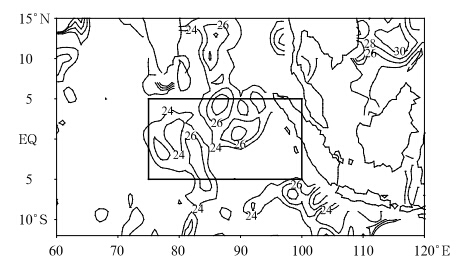 |
| Fig. 1. Spatial distribution of the fraction of variance(%)in deseasonalized daily mean precipitation explainedby fluctuations on 20-50-day timescales during boreal summer(May-September)1998-2005. |
The time series of daily mean and 20-50-day filtered precipitation anomalies over the EEIO(Fig. 2)include several transitions between active and breakphases. We construct the composite analysis usingonly those ISO cases with amplitudes exceeding one(or negative one)st and ard deviation. Each selectedISO cycle was divided into eight consecutive phases.The composites were constructed separately for periods before and after monsoon onset in order to bestdescribe the distinctive behavior of ISO over the tropical Indian Ocean during each period.
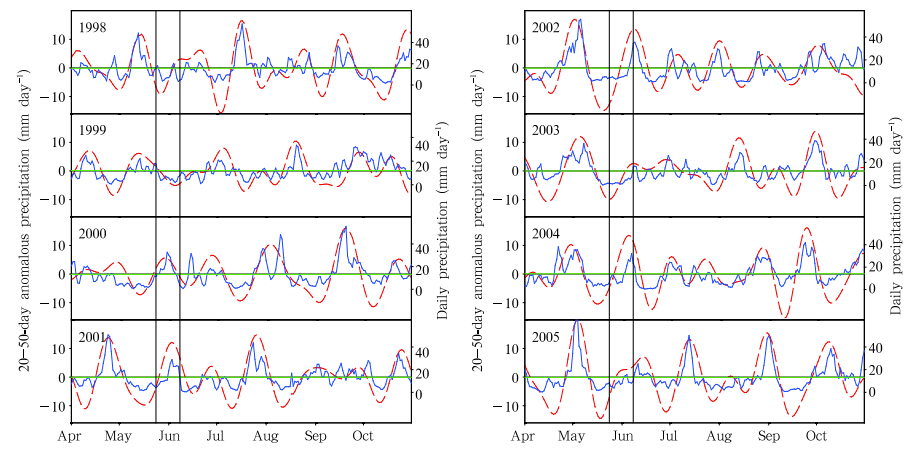 |
| Fig. 2. Time series of area-averaged 20-50-day ¯ltered anomalous precipitation rate(mm day-1; dashed lines) and deseasonalized daily precipitation rate anomalies(mm day-1; solid lines)during boreal summer from 1998 to 2005. |
The statistical long-term mean date of summermonsoon onset over southwestern India(Kerala)is 1June, with a st and ard deviation of 8 days(Joseph et al., 1994). The two vertical lines shown in Fig. 2 represent the earliest and latest dates of Indian summermonsoon onset, respectively. The ISO cycles chosenfor creating composites of ISO evolution before and after monsoon onset are selected according to the estimated onset dates for each year from 1998 to 2005.These selected ISO cycles in the EEIO are in responseto significant northward-propagating convective rainfall anomalies associated with the active/break spellsof the Indian summer monsoon rainfall(figure omitted).
We regard an ISO cycle as the period from a negative peak through a positive peak and then back toa negative peak(Fig. 2). The first negative peak ofeach ISO cycle is defined as Phase 1, the first instanceof zero amplitude is defined as Phase 3 and the positive peak is defined as Phase 5. The composite ISOcycle is thus broken down into a total of eight phases(the phase after Phase 8 is identical to Phase 1). Thisphase composite strategy is the same as that used by Wang et al.(2005, 2006). A total of 27 cycles withsu°ciently large amplitude are identified in the timeseries, including 7 cycles that occurred before monsoononset and 20 cycles that occurred after monsoon onset. Two eight-phase composites are constructed, onefor the 7 cycles identified before monsoon onset and one for the 20 cycles identified after monsoon onset.This approach enables a discussion of similarities and differences in ISO evolution before and after the onsetof the monsoon.4. Structure and evolution of ISO before and after monsoon onset
The purpose of this analysis is to characterizethe initiation, development, and propagation of ISOover the tropical Indian Ocean. The high-resolutionsatellite estimates of daily precipitation rate and SSTintroduced in Section 2 are used to depict the spatiotemporal evolution of an ISO life cycle. We describe the evolution of the precipitation anomalies indetail for each of the eight phases and document differences between the periods before and after monsoononset.4.1 Characteristics of ISO precipitation anomalies before monsoon onset4.1.1 Initiation of ISO precipitation anomalies
Figure 3 shows the composite life cycle(eightphases)of ISO anomalies in precipitation and SSTin the tropical Indian Ocean region be fore monsoononset. Phases 1 and 2 represent the initial stages ofthe ISO cycle. Negative precipitation anomalies dominate the central and eastern equatorial Indian Oceaneast of 65°E during Phase 1. The largest negativeprecipitation anomalies occur in the eastern equatorial Indian Ocean near 90°E. The dry anomalies moveeastward along the equator during Phase 2, with themaximum negative anomalies located in the easternIndian Ocean to the west of Sumatra. Meanwhile, apositive precipitation anomaly emerges in the westernequatorial Indian Ocean near 55°-70°E.
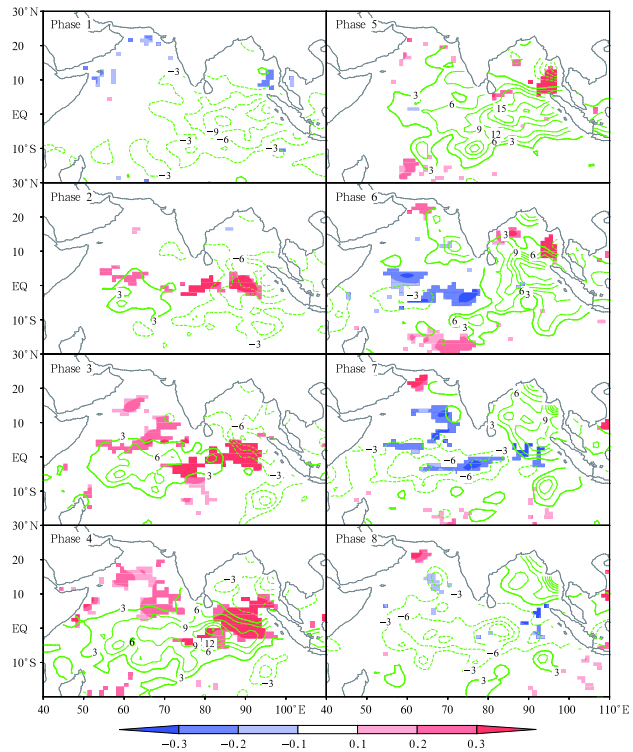 |
| Fig. 3. Composite life cycle of 20-50-day filtered precipitation rate and sea surface temperature(SST)before onset ofthe Indian summer monsoon. The green contours represent precipitation anomalies starting from ±3 mm day-1 with a contour interval of 3 mm day-1. The shading represents SST anomalies in unit of ℃. |
The positive precipitation anomalies strengthenconsiderably during Phase 3. These positive anomalies(with typical precipitation rates exceeding 6 mmday-1)exp and eastward along the equator from thewestern equatorial Indian Ocean near 60°E. Negativeprecipitation anomalies in the eastern equatorial Indian Ocean grow progressively weaker, then largelydisappear in Phase 4 as enhanced positive anomaliesexp and to cover the entire equatorial Indian Ocean.The maximum positive precipitation anomalies during Phase 4 are located in the eastern Indian Oceaneast of 80°E(Fig. 3). The ISO precipitation anomalies continue to move eastward along the equator intoPhase 5, with positive anomalies in the EEIO reaching peak precipitation rates larger than 18 mm day-1near 82°-85°E in Phase 5. The spatial pattern of precipitation during Phase 5 is nearly the mirror imageof that during Phase 1 with respect to the sign of theprecipitation anomalies. Phase 5 represents the peakprecipitation phase in the eastern equatorial IndianOcean.4.1.3 Weakening of ISO precipitation anomalies
The positive precipitation anomalies associatedwith ISO start to move northwestward and southwestward in Phase 6, forming a V shape(Fig. 3). Thenorthern branch of the rainb and is much stronger thanthe southern branch, possibly due to a hemisphericasymmetry in the vertical shear of the backgroundeasterly winds and the spatial distribution of SST(Li and Wang, 1994; Wang and Xie, 1997; Kemball-Cook and Wang, 2001; Lawrence and Webster, 2001; Fu et al., 2003). Stronger easterly vertical shear favors stronger westward-propagating equatorial Rossbywaves and deep convection in the Northern Hemisphere(Wang and Xie, 1996). High SST and highspecific humidity in the northern Indian Ocean basinare also favorable for Rossby wave generation and deep convection(Li and Wang, 1994; Wang and Xie, 1997). The northern rainb and is oriented northwestsoutheast during Phases 6-8. Negative precipitationanomalies are generated in the western equatorial Indian Ocean(50°-60°E)starting from Phase 6. Thesubsequent evolution of these negative precipitationanomalies is similar to that of the positive anomaliesduring Phases 2-4. The lifecycle of ISO precipitationbefore monsoon onset is therefore mainly characterized by alternating eastward-propagating precipitationanomalies.4.2 Characteristics of ISO precipitation anomalies after monsoon onset4.2.1 Initiation of ISO precipitation anomalies
Figure 4 shows the composite life cycle of ISOprecipitation and SST anomalies over the tropical Indian Ocean after monsoon onset. Negative ISO precipitation anomalies dominate the central and easternequatorial Indian Ocean during Phase 1. The ISO convective precipitation anomaly in the EEIO is out ofphase with the precipitation anomaly over the SouthAsian subcontinent(Wang et al., 2005). More specifically, the tropical Indian Ocean experiences less precipitation when precipitation is high over the Indiansubcontinent(i.e., an active phase of the summer monsoon) and more precipitation when precipitation is lowover the Indian subcontinent(i.e., a break phase). Thenegative precipitation anomalies in the eastern equatorial Indian Ocean move northward during Phase 2.The convective rainb and in the monsoon region alsopropagates northward at this stage. The first positive anomalies in the ISO precipitation signal appearin the central equatorial Indian Ocean during Phase3. This result is substantially different from the constructed composite of ISO activity before monsoononset, in which positive precipitation anomalies appear one phase(about 5 days)earlier. The negativeanomalies move northward rather than eastward withthe appearance of the positive precipitation anomaliesin the central equatorial Indian Ocean during Phase3. These northward-moving anomalies are responsiblefor the transition of the Indian summer monsoon froma wet phase(active monsoon)to a dry phase(breakmonsoon).
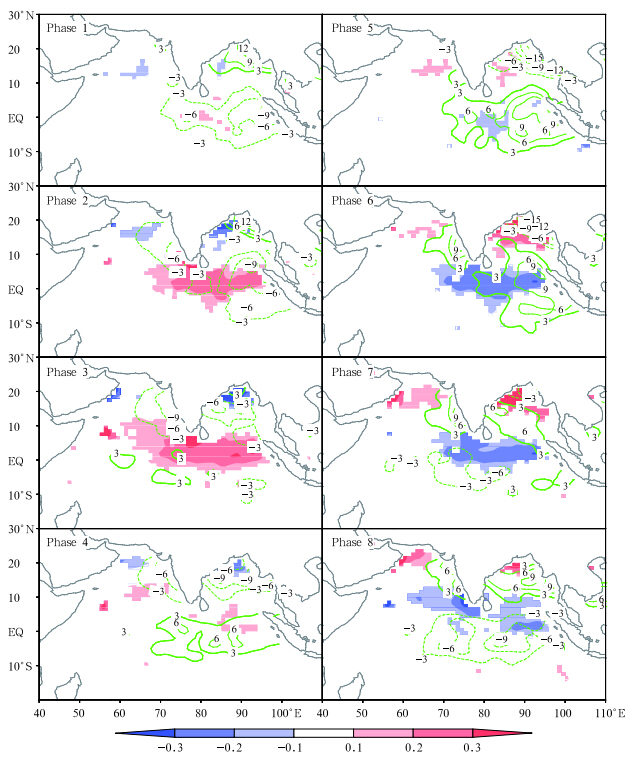 |
| Fig. 4. As in Fig. 3, but for the situation after monsoon onset. |
The ISO precipitation anomalies intensify and shift eastward along the equator during Phases 3 and 4. The ISO-related convective precipitation covers asmaller area than that before monsoon onset. Strongconvective precipitation is mainly concentrated in theeastern equatorial Indian Ocean east of 70°E. The positive anomaly in the eastern equatorial Indian Oceanreaches its maximum during the mature stage of theISO(i.e., Phase 5). Meanwhile, negative precipitation anomalies prevail over most parts of the Indiansubcontinent and Bay of Bengal. Meridional expansion of ISO convective anomalies over the EEIO during Phases 4 and 5 is much weaker after monsoon onset than before monsoon onset. This difference in themeridional structure of the rainb and may be causedby the relative weakness of Rossby wave generationin June-August when compared with that in May(Kemball-Cook and Wang, 2001; Lawrence and Webster, 2001). The area of positive convective anomalieswith anomalous precipitation rates exceeding 3 mmday-1 during Phases 4 and 5 was also much smallerafter monsoon onset than before monsoon onset. Aftermonsoon onset, ISO convective precipitation is mainlyconfined to the eastern equatorial Indian Ocean(eastof 70°E)between 10°S and 10°N. Before monsoon onset, ISO convective precipitation covers the entire central and eastern tropical Indian Ocean(east of 60°E).4.2.3 Weakening of ISO precipitation anomalies
ISO precipitation anomalies over the EEIOweaken and become negative from Phase 6 to 8. As toISO activity before monsoon onset, positive anomaliesin ISO convective precipitation exp and northwestward and southwestward after reaching the eastern equatorial Indian Ocean. Unlike ISO activity before monsoononset, the major center of convective activity continues moving northward away from the equator, whilethe southern branch weakens rapidly. The northernrainb and eventually moves over the Indian subcontinent. The eastern equatorial Indian Ocean is exclusively covered by negative precipitation anomalies asa consequence of this northward propagation, settingthe stage for the next phase of the ISO cycle.
The evolution of ISO convective precipitationanomalies before and after monsoon onset can be summarized as follows. Phase 1 is the peak dry phase forthe entire central and eastern tropical Indian Ocean.Positive ISO precipitation anomalies appear and beginto develop in the central and western equatorial IndianOcean during Phases 2 and 3. This development occurs one phase earlier before monsoon onset than after monsoon onset. This difference can be attributedto the monsoon cycle requiring time to spin up during mid and late summer, when upwelling cold wateralong the east coast of Africa inhibits the formationof deep convection over the western equatorial IndianOcean(Webster et al., 1999). ISO convective anomalies in the equatorial Indian Ocean before monsoon onset propagate eastward from initiation, through theirdevelopment and maturation and to their eventual decay. By contrast, ISO convective anomalies after monsoon onset move primarily northward toward the l and , causing alternating dry and rainy periods of the subcontinental monsoon.4.3 Sea surface temperature anomalies
The evolution of SST anomalies in the easternequatorial Indian Ocean is largely similar before and after the onset of the monsoon, except that SSTanomalies are greater in magnitude before onset thanafter onset. Positive SST anomalies dominate thecentral-eastern equatorial Indian Ocean during Phases1-4(corresponding to the initiation and developmentof ISO precipitation anomalies; see Figs. 3 and 4).SST anomalies transit from positive to negative during the peak wet phase over the EEIO(Phase 5), whenconvective precipitation reaches its maximum value.Negative SST anomalies accompany the weakening ofconvective precipitation over the EEIO from Phase 6to 8. Positive SST anomalies are located to the northeast of positive precipitation anomalies from Phases 2to 5, leading to the northeastward movement of therainb and . During the development stage(i.e., Phases2 and 3), positive SST anomalies tend to enhance precipitation. Decreases in cloud amount during the dryphase over the central equatorial Indian Ocean(Phase8 and the following Phase 1 of a new ISO cycle)lead toincreases in solar radiation reaching the surface. Reductions in evaporation and entrainment cooling dueto decreases in the near-surface wind speed may alsoplay a role by reducing energy loss from the surface.All of these features conspire to warm the sea surface in the EEIO during Phases 2 and 3. Sea surfacewarming in the Indian Ocean results in large-scale surface moisture convergence. In addition, sensible heatfluxes induced by surface warming tend to warm theair immediately above the surface and reduce the surface pressure. The drop in surface pressure in turnenhances moisture convergence in the boundary layer and promotes organized deep convection. Local air-seainteraction therefore plays an important role in the initiation of each new ISO cycle. These conclusions areconsistent with previous studies of summertime ISO inthe Northern Hemisphere(Kemball-Cook and Wang, 2001; Fu et al., 2003; Li et al., 2005; Wang et al., 2005).4.4 Surface wind anomalies
Figures 5 and 6 show composites of ISO anoma-lies in surface wind and divergence/convergence before and after monsoon onset, respectively. Negative precipitation anomalies correspond to anomalously strongdivergence in the surface wind, while positive precipitation anomalies correspond to anomalously strongconvergence. In other words, the strength of convection is closely related to convergence/divergence in thesurface wind. Significant easterly anomalies during theinitiation and developing phases of ISO(Phases 1-3)dominate the surface wind fields over the eastern central equatorial Indian Ocean both before and after theonset of the monsoon(Figs. 5 and 6). These easterliestend to be even stronger during the initiation and developing phases of ISO(Phases 1-3). These equatorialeasterly anomalies correspond to negative anomalies inconvective precipitation(Figs. 3 and 4). By contrast, anomalous westerlies prevail over the equatorial IndianOcean during Phases 5-7. These westerly anomaliescorrespond to positive precipitation anomalies duringPhases 5-7, which are collocated but largely opposite in sign to negative precipitation anomalies during Phases 1-3. Anomalies in the near-surface windfields are weak during the transition phases(Phases 4 and 8); consequently, no zonal dipole is apparent inthe convective precipitation anomalies over the tropical Indian Ocean(Figs. 3 and 4).
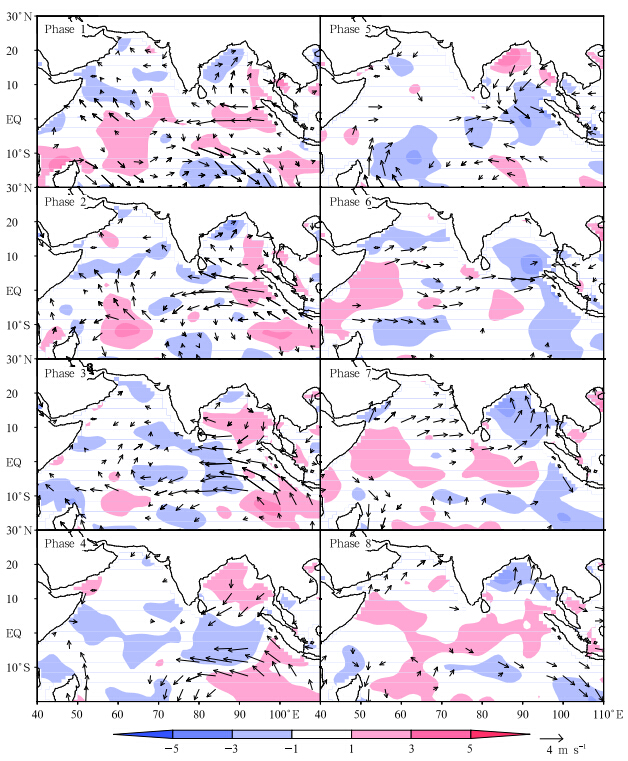 |
| Fig. 5. Composite of anomalies in 20-50-day filtered surface wind(m s-1) and divergence(10-6 s-1)before the onset of the Indian summer monsoon. Only anomalies that are significant at the 90% confidence level are shown. |
The equatorial easterly anomalies north of theequator during Phase 1 are associated with an anomalous anticyclone(Figs. 5 and 6). Wind speeds decrease westward along the equator, favoring boundarylayer moisture convergence over the central tropicalIndian Ocean. After monsoon onset, anomalous westerlies in the Bay of Bengal north of 10°N are associated with strong precipitation in the monsoon region during Phase 1(Fig. 6). Moisture convergenceover the western-central equatorial Indian Ocean increases during Phase 2, enhancing convection and resulting in positive precipitation anomalies. Surfacemoisture convergence and precipitation both continueto increase significantly during Phases 3 and 4(Figs.3 and 4). Westerly anomalies along the equator increase from west to east during Phase 5(Figs. 5 and 6)when positive precipitation anomalies over the EEIOare the largest in magnitude. An anomalous cycloniccirculation appears to the north of the center of convective activity, with easterly anomalies to the northof the convection and westerly anomalies both within and to the south of the convection. These results indicate that surface wind and moisture convergence playa critical role in initiating and organizing the ISO convection.
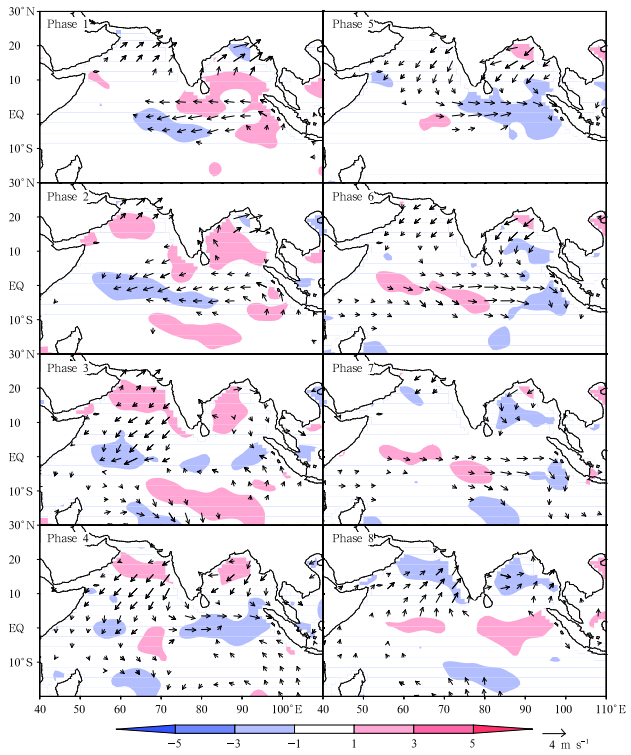 |
| Fig. 6. As in Fig. 5, but for the situation after monsoon onset. |
We use the same approach to compare and con-trast the vertical structures of ISO before and aftermonsoon onset. Figures 7 and 8 show composite vertical distributions of vertical velocity and specific humidity along the equator(5°S-5°N)for each of theeight ISO phases. Anomalies in vertical motion and specific humidity propagate from west to east acrossthe entire tropical Indian Ocean. The weakening ofconvection in Phase 1 corresponds to large-scale sinking motion over the equatorial Indian Ocean east of70°E. The surface wind convergence in the western Indian Ocean during Phase 1(Figs. 5 and 6)enhanceswater vapor concentration in the boundary layer tothe west of 70°E. This moisture convergence promotesthe development of convection in this region.
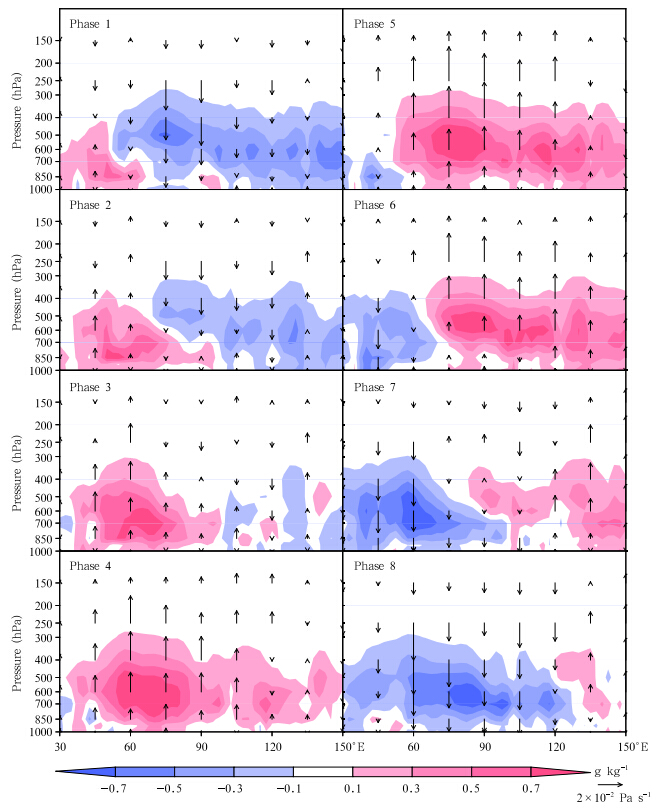 |
| Fig. 7. Composite vertical structure of 20-50-day filtered vertical velocity(arrows; 10-2 Pa s-1) and specific humidity anomalies(shading; g kg-1)averaged between 5±S and 5°N for ISO before the onset of the Indian summer monsoon. |
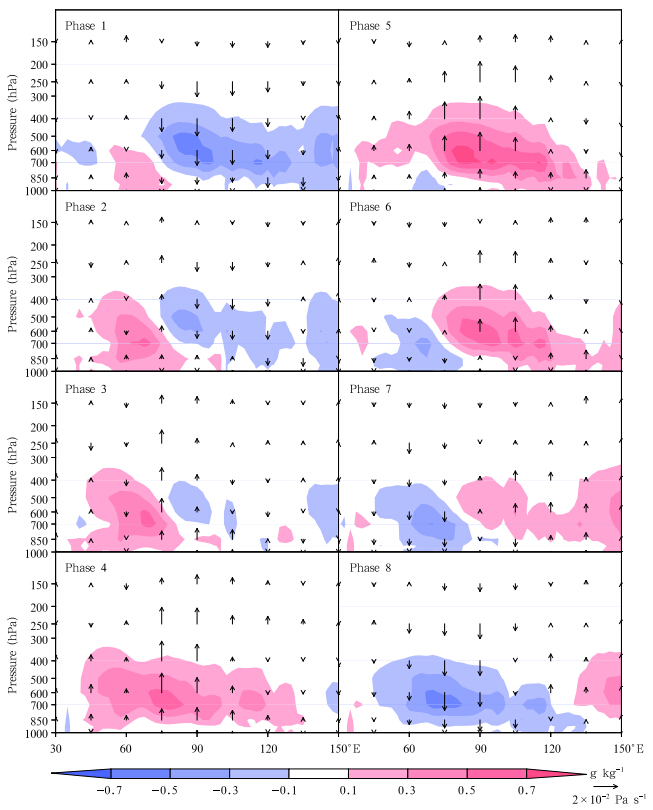 |
| Fig. 8. As in Fig. 7, but for the situation after monsoon onset. |
The phase-by-phase evolutions of vertical motion and specific humidity in ISO before and after monsoononset have several features in common. Positiveanomalies in specific humidity during Phase 1 are located near the east coast of Africa, extending eastward to 60°-70°E. These specific humidity anomaliesincrease in magnitude and exp and eastward along theequator in Phase 2, along with the appearance of upward motion in the lower troposphere(Fig. 7). Thisupward motion increases rapidly through Phase 3 and comes to dominate the entire equatorial Indian Oceanin Phase 4. The positive moisture anomalies continueto increase and exp and eastward along the equatorduring this time, leading to an enhancement of convective precipitation. Convective activity in the easternequatorial Indian Ocean peaks during Phase 5. Themaximum upward motion is located at approximately 300 hPa, while the maximum specific humidity anomaly is located near 500 hPa. The decaying phases of ISO convection over the eastern IndianOcean(Phases 6-8)feature reductions in upward motion along the equator associated with the northwardmovement of ISO precipitation. Sinking motion overthe western Indian Ocean strengthens and moves eastward along the equator. Negative anomalies in specific humidity associated with near-surface divergencein the boundary layer over the eastern Indian Oceanalso exp and eastward during this time.4.5.2 Vertical structure of ISO over the eastern Indian Ocean
Figures 9 and 10 show the composite verticalstructures of anomalies in vertical motion and specifichumidity over the eastern Indian Ocean(zonal meansaveraged over 85°-95°E)before and after monsoon onset. ISO anomalies in both vertical motion and specific humidity propagate northward in this region during both periods. The troposphere over the easternequatorial Indian Ocean is dry during Phase 1, withthe largest negative specific humidity anomaly in themiddle and lower troposphere. Vertical motion is predominantly downward to the south of 10°N. A positive anomaly in specific humidity begins to develop inthe boundary layer, with the sinking motion shiftingnorthward during Phases 1 and 2. Both upward motion and positive specific humidity anomalies increasesignificantly during the developing stages of ISO convection(Phases 3 and 4). These anomalies propagateboth southward and northward from the equator, corresponding to the meridional movement of convectionin the EEIO. Convective precipitation over the EEIOincreases substantially during these stages as a resultof surface wind convergence, which increases tropospheric moisture content and enhances upward motion. The moisture anomalies during the wet phase(Phase 5)are nearly opposite to those during Phase 1, with a deep layer of enhanced water vapor in the midlower troposphere below 300 hPa. The tropospheresouth of 10°N is characterized by strong upward motion during this stage of the ISO. Convection begins toweaken from Phase 6. Specific humidity and upwardmotion tend to decrease, with the positive anomalies shifting northward due to the propagation of theRossby wave. Sinking motion and negative specifichumidity anomalies appear near the equator duringPhase 7, re-establishing the dry phase(Phase 8) and setting the stage for the next ISO cycle.
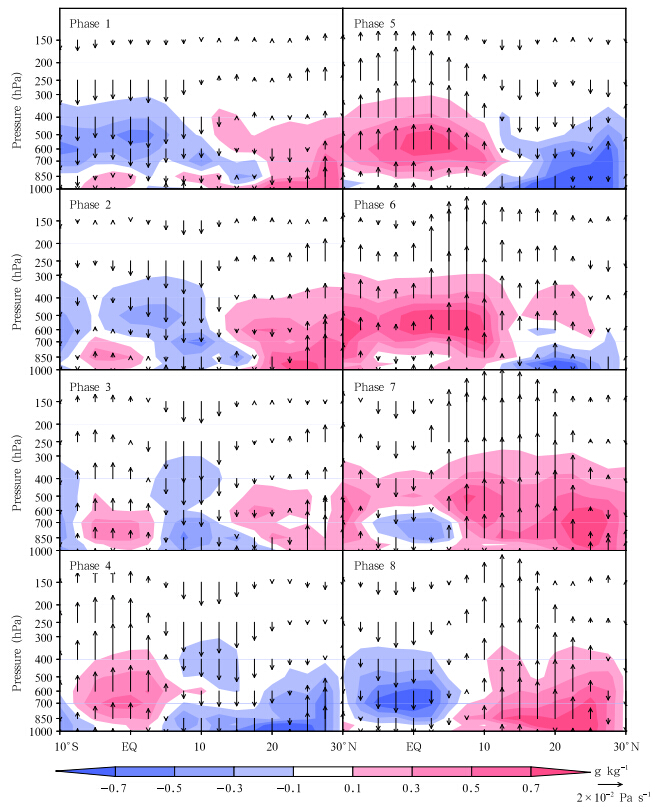 |
| Fig. 9. Composite vertical structure of 20-50-day filtered vertical velocity(arrows; 10-2 Pa s-1) and specific humidityanomalies(shading; g kg-1)averaged between 85° and 95°E before the onset of the Indian summer monsoon. |
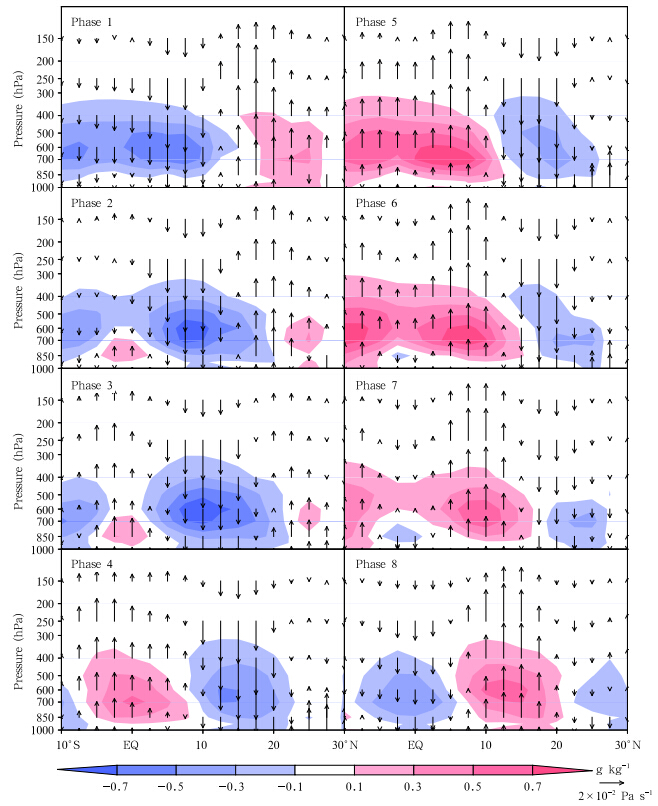 |
| Fig. 10. As in Fig. 9, but for the situation after monsoon onset. |
The vertical structures of vertical motion and specific humidity anomalies evolve in similar ways before and after monsoon onset, but with some subtle differences. For instance, the positive specific humidityanomaly begins to develop in the boundary layer near5°S during Phase 1 before onset of monsoon, but doesnot appear until Phase 2 after monsoon onset. Accordingly, the ISO convective precipitation anomalyover the EEIO occurs one phase later after monsoononset(cf., Figs. 3 and 4).5. Summary and discussion
In this study, we have compared the structure and evolution of ISO before and after the onset ofthe Indian summer monsoon using high-resolutionsatellite data and other observational data. The timeseries of 20-50-day filtered precipitation rate averaged over the eastern equatorial Indian Ocean is usedas a reference to select strong ISO cases and construct composites of ISO behavior over the tropicalIndian Ocean. We have focused on the general characteristics and vertical structure of the ISO duringits life cycle, including the initiation, development, propagation, and decay of the ISO. We have presented and discussed differences in the evolution ofISO before and after monsoon onset. ISO convectiveprecipitation anomalies appear first in the westernequatorial Indian Ocean, and then intensify and exp and eastward along the equator. Afterwards, thesepositive convective precipitation anomalies propagatenorthwestward and southwestward after reaching theEEIO. The northern branch is substantially strongerthan the southern branch. The timing and locationof the initial ISO convective precipitation anomaliesafter monsoon onset are different from those beforemonsoon onset. Before monsoon onset, positive precipitation anomalies associated with ISO initiate inthe western equatorial Indian Ocean during Phase 2 and then propagate eastward along the equator. Theseprecipitation anomalies initiate one phase later aftermonsoon onset, and their propagation has a muchmore pronounced northward component in the EEIO.
Differences in the evolution of ISO convective precipitation anomalies before and after monsoon onsetreflect differences in the background distributions ofsea surface temperature and low-level specific humidity. Surface wind convergence and air-sea interactionsplay critical roles in initiating each new ISO cycle.Differences in the structure and evolution of ISOin the tropical Indian Ocean between the periods before and after monsoon onset may be attributed to differences in ISO intensity and sea surface temperatureanomalies. Anomalies in both ISO convective precipitation and sea surface temperature have greater amplitudes and larger areas before monsoon onset thanafter monsoon onset. The intensity of ISO over thetropical Indian Ocean has been shown to vary on subseasonal timescales(Kemball-Cook and Wang, 2001).Observations show that the variance and eastwardpropagation of ISO in the tropical Indian Ocean areboth stronger during early summer(May-June)th and uring late summer(July-September). ISO anomalies in convective precipitation and associated SSTanomalies are accordingly greater before the onset ofthe monsoon. By contrast, the convective activity and eastward propagation of ISO are weaker during latesummer, after monsoon onset. The major ISO convective anomalies during late summer move northwardinto the Asian monsoon region, contributing to active and break cycles in monsoon rainfall.
Acknowledgments: The authors thank theanonymous reviewers for their valuable comments and suggestions. The language editor for this manuscriptis Dr. Jonathon S. Wright.| [1] | Fu, X. H., B. Wang, T. Li, et al., 2003: Coupling between northward propagating, intraseasonal oscillations, and sea-surface temperature in the Indian Ocean. J. Atmos. Sci., 60, 1733-1753. |
| [2] | Gadgil, S., 2003: The Indian monsoon and its variability. Annu. Rev. Earth Planet. Sci., 31, 429-467. |
| [3] | Goswami, B. N., and R. S. A. Mohan, 2001: Intraseasonal oscillations and interannual variablity of the Indian summer monsoon. J. Climate, 14, 1180-1198. |
| [4] | Guan Zhaoyong and Zhao Hui, 1995: Analysis of quasi-periodic disturbances of summer low-level flow field with ECMWF long-term mean and 1980 data. J. Nanjing Inst. Meteor., 18(4), 518-522. (in Chinese) |
| [5] | Hartmann, D. L., M. L. Michelsen, and S. A. Klein, 1992: Seasonal variations of tropical intraseasonal oscillations: A 20-25-day oscillation in the western Pacific. J. Atmos. Sci., 49, 1277-1289. |
| [6] | Hendon, H. H., C. D. Zhang, and J. D. Glick, 1999: Interannual variation of the Madden-Julian oscillation during austral summer. J. Climate, 12, 2538-2550. |
| [7] | Huang Ronghui, 1994: Interactions between the 30-60 day oscillation, the Walker circulation and the convective activities in the tropical western Pacific and their relations to the interannual oscillation. Adv. Atmos. Sci., 11(3), 367-384. |
| [8] | Jiang, X. N., T. Li, and B. Wang, 2004: Structures and mechanisms of the northward propagating boreal summer intraseasonal oscillation. J. Climate, 17,1022-1039. |
| [9] | —-, and —-, 2005: Reinitiation of the boreal summer intraseasonal oscillation in the tropical Indian Ocean. J. Climate, 18, 3777-3795. |
| [10] | Joseph, P. V., J. K. Eischeid, and R. J. Pyle, 1994: Inter-annual variability of the onset of the Indian summer monsoon and its association with atmospheric features, El Ninõ, and sea surface temperature anomalies. J. Climate, 7, 81-105. |
| [11] | Ju Jianhua and Zhao Erxu, 2005: Impacts of the low frequency oscillation in East Asian summer monsoon on the drought and flooding in the middle and lower valley of the Yangtze River. J. Trop. Meteor.,21(2), 163-171. (in Chinese) |
| [12] | Kemball-Cook, S., and B. Wang, 2001: Equatorial waves and air-sea interaction in the boreal summer intraseasonal oscillation. J. Climate, 14, 2923-2942. |
| [13] | Kripalani, R. H., A. Kulkarni, S. S. Sabade, et al., 2004: Intra-seasonal oscillations during monsoon 2002 and 2003. Curr. Sci., 87, 325-331. |
| [14] | Krishnamurti, T. N., and H. N. Bhalme, 1976: Oscillations of a monsoon system. Part I: Observational aspects. J. Atmos. Sci., 33, 1937-1954. |
| [15] | —-, and D. Subrahmanyam, 1982: 30-50-day mode at 850 mb during MONEX. J. Atmos. Sci., 39, 2088-2095. |
| [16] | Lau, K. M., and P. H. Chan, 1986: Aspects of the 40-50-day oscillation during the northern summer as inferred from outgoing longwave radiation. Mon. Wea. Rev., 114, 1354-1367. |
| [17] | Lawrence, D. M., and P. J. Webster, 2001: Interan-nual variations of the intraseasonal oscillation in the South Asian summer monsoon region. J. Climate,14, 2910-2922. |
| [18] | Li, K. P., W. D. Yu, T. Li, et al., 2013: Structures and mechanisms of the first-branch northwardpropagating intraseasonal oscillation over the tropical Indian Ocean. Climate Dyn., 40, 1707-1720. |
| [19] | Li, T., and B. Wang, 1994: The influence of sea surface temperature on the tropical intraseasonal oscillation: A numerical study. Mon. Wea. Rev., 122,2349-2362. |
| [20] | —-, —-, C. -P. Chang, et al., 2003: A theory for the Indian Ocean dipole-zonal mode. J. Atmos. Sci.,60, 2119-2135. |
| [21] | —-, and —-, 2005: A review on the western North Pacific monsoon: Synoptic-to-interannual variabilities. Terr. Atmos. Ocean Sci., 16, 285-314. |
| [22] | Li Chongyin, Hu Ruijin, and Yang Hui, 2005: Intrasea-sonal oscillation in the tropical Indian Ocean. Adv. Atmos. Sci., 22, 617-624. |
| [23] | Lin, A. L., and T. Li, 2008: Energy spectrum charac-teristics of boreal summer intraseasonal oscillations: Climatology and variations during the ENSO developing and decaying phases. J. Climate, 21, 6304-6320. |
| [24] | —-, —-, Li Chunhui, et al., 2010: Relationships between interannual anomalies of sea surface temperature in the Indian Ocean and tropical boreal summer intraseasonal oscillations: Observations and simulations. Acta Meteor. Sinica, 68(5), 617-630. (in Chinese) |
| [25] | —-, —-, X. H. Fu., et al., 2011: Effects of air-sea cou-pling on the boreal summer intraseasonal oscillations over the tropical Indian Ocean. Climate Dyn., 37,2303-2322. |
| [26] | Madden, R. A., and P. R. Julian, 1971: Description of a 40-50-day oscillation in the zonal wind in the tropical Pacific. J. Atmos. Sci., 28, 702-708. |
| [27] | —-, and —-, 1972: Description of global-scale circulation cells in the tropics with a 40-50-day period. J. Atmos. Sci., 29, 1109-1123. |
| [28] | Mehta, A. V., and T. N. Krishnamurti, 1988: Interan-nual variability of the 30-50-day wave motions. J. Meteor. Soc. Japan, 66, 535-548. |
| [29] | Murakami, T., 1976: Cloudiness fluctuations during the summer monsoon. J. Meteor. Soc. Japan, 54, 175-181. |
| [30] | —-, L. X. Chen, and A. Xie, 1986: Relationship among seasonal cycles, low-frequency oscillations, and transient disturbances as revealed from outgoing long-wave radiation data. Mon. Wea. Rev., 114, 1456-1465. |
| [31] | Qi, Y. J., R. H. Zhang., T. Li, et al., 2008: Interactions between the summer mean monsoon and the intraseasonal oscillation in the Indian monsoon region. Geophys. Res. Lett., 35, L17704, doi:10.1029/2008GL034517. |
| [32] | —-, —-, —-, et al., 2009: Impacts of intraseasonal oscillation on the onset and interannual variation of the Indian summer monsoon. Chinese Sci. Bull., 54,880-884. |
| [33] | Rao, S. A., and T. Yamagata, 2004: Abrupt termination of Indian Ocean dipole events in response to intraseasonal disturbances. Geophys. Res. Lett.,31, L19306. doi: 10.1029/2004GL020842. |
| [34] | Shukla, J., and D. A. Paolino, 1983: The southern oscillation and long-range forecasting of the summer monsoon rainfall over India. Mon. Wea. Rev., 111,1830-1837. |
| [35] | Sikka, D. R., and S. Gadgil, 1980: On the maximum cloud zone and the ITCZ over Indian, longitudes during the Southwest monsoon. Mon. Wea. Rev.,108, 1840-1853. |
| [36] | Teng, H. Y., and B. Wang, 2003: Interannual variations of the boreal summer intraseasonal oscillation in the Asian-Pacific region. J. Climate, 16, 3572-3584. |
| [37] | Wang, B., and H. Rui, 1990: Synoptic climatology of transient tropical intraseasonal convection anomalies: 1975-1985. Meteor. Atmos. Phys., 44, 43-61. |
| [38] | —-, and X. S. Xie, 1996: Low-frequency equatorial waves in vertically sheared zonal flow. Part I: Stable waves. J. Atmos. Sci., 53, 449-467. |
| [39] | —-, and —-, 1997: A model for the boreal summer intraseasonal oscillation. J. Atmos. Sci., 54, 72-86. |
| [40] | —-, and X. H. Xu, 1997: Northern Hemisphere summer monsoon singularities and climatological intraseasonal oscillation. J. Climate, 10, 1071-1085. |
| [41] | —-, P. J. Webster, and H. Y. Teng, 2005: Antecedents and self-induction of active-break south Asian monsoon unraveled by satellites. Geophys. Res. Lett.,32, L04704, doi: 10.1029/2004GL020996. |
| [42] | —-, P. J. Webster, K. Kikuchi, et al., 2006: Boreal summer quasi-monthly oscillation in the global tropics. Climate Dyn., 27, 661-675. |
| [43] | Webster, P. J., A. M. Moore, J. P. Loschnig, et al., 1999: Coupled ocean-atmosphere dynamics in the Indian Ocean during 1997-1998. Nature, 401, 356-360. |
| [44] | Yang Yanjuan, Guan Zhaoyong, and Zhu Baolin, 2007: Possible influences of the Indian Ocean dipole on the intensity of intraseasonal oscillation in Boreal summer. J. Nanjing Inst. Meteor., 30(2), 224-230. (in Chinese) |
| [45] | Yasunari, T., 1979: Cloudiness fluctuations associated with the Northern Hemisphere summer monsoon. J. Meteor. Soc. Japan, 57, 227-242. |
| [46] | —-, 1980: A quasi-stationary appearance of 30-40 day period in the cloudiness fluctuations during the summer monsoon over India. J. Meteor. Soc. Japan,58, 225-229. |
| [47] | Zhan, R., J. Li, and A. Gettelman, 2006: Intraseasonal variations of upper tropospheric water vapor in Asian monsoon region. Atmos. Chem. Phys. Discuss, 6, 8069-8095. |
| [48] | Zhu, C. W., T. Nakazawa, J. P. Li, et al., 2003: The 30-60 day intraseasonal oscillation over the western North Pacific Ocean and its impacts on summer flooding in China during 1998. Geophys. Res. Lett.,30, doi: 10.1029/2003GL017817. |