 2017, Vol. 19


乙烯是一种常见的植物激素,能够在植物生长和发育过程中诱发一系列的生理生化反应,如促进发芽及果实成熟软化,调整开花和脱落等[1-2]。研究表明,园艺产品腐烂、软化和衰老主要是由乙烯引起的,因而抑制乙烯的合成以延长采摘后的货架期,一直是花卉和蔬菜保鲜的关注热点[3]。乙烯的生物合成主要是由1-氨基环丙烷羧酸 (1-aminocyclopropane-1-carboxylic acid, ACC) 合成酶 (ACS酶) 和ACC氧化酶控制[4-5],其中ACS酶起主要作用。氨基乙氧乙烯基甘氨酸 (aminoethoxyvinylglycine,AVG)(图式1) 是20世纪70年代从链霉菌sp.X-11085中发现的一种代谢产物,后被证实其能够竞争性地抑制乙烯的合成[6]。研究发现,AVG通过模仿S-腺苷基甲硫氨酸 (S-adenosyl methionine, SAM) 而占据ACS酶的活性空腔,从而阻断SAM进攻磷酸吡哆醛 (pyridoxal-5′-phosphate, PLP)(PLP是ACC合成的关键辅因子,图式1),进而竞争性地抑制乙烯的合成[6-7]。

|
图式1 PLP辅因子与SAM、AVG和目标化合物结构 Scheme1 PLP with SAM, AVG and title compounds |
AVG使用安全、活性高,在贮存保鲜和延长货架期方面有很大应用潜力,采摘后应用AVG能够延缓苹果[8]、梨[9]、杏[10]和番茄[11]的果实软化速率。但目前AVG合成成本高[12],发酵产率低[13],价格昂贵,很难大面积推广使用;此外,虽然氨氧乙酸[14]和2-氨基丁酸[15]也具有抑制乙烯合成的功能,但活性均没有AVG的高。所以寻找新的活性高、易获取的乙烯合成抑制剂具有重要意义。
本研究通过保留AVG的氨基和羧基不变,在碳链中引入酯基,合成了8个未见文献报道的O-酰基化丝氨酸,对其结构进行了表征,并初步测定了目标化合物在室温[(23 ± 1) ℃]下对樱桃番茄乙烯合成量和硬度的影响;同时运用分子对接的方法分析了目标化合物与番茄ACS酶 (1IAY) 可能的结合模式。
目标化合物合成路线见图式2。

|
图式2 目标化合物合成路线 Scheme2 The synthsis route of target compounds |
1 实验部分 1.1 仪器与试剂
Bruker Avance DPX300 核磁共振仪 (以TMS为内标,D2O为溶剂);Brucker APEX IV高分辨质谱仪 (德国不莱梅公司);岛津GC-2010气相色谱 (配FID检测器,岛津企业管理中国有限公司);GY-1果实硬度计 (温州三和量具仪器有限公司);WRS-1B熔点测定仪 (温度未校正,日本MFG公司);BSA124S-CW电子天平 (赛多利斯科学仪器北京有限公司)。
对照药剂AVG(纯度96%) 和所用试剂均购于Sigma公司。
樱桃番茄Lycopersivon esculentumMill.,采摘于北京上庄。
1.2 化合物合成 1.2.1 化合物3的合成以环己烷酰氯 (3a) 的合成为例。参考文献[16]方法。在250 mL圆底烧瓶中,依次加入环己烷羧酸 (50 mmol)、二氯甲烷 (50 mL)、二氯亚砜 (75 mmol) 和二甲基甲酰胺 (DMF,0.05 mmol),在室温 (25 ℃) 下搅拌反应1 h。减压蒸馏除去溶剂,得到无色液体,不经提纯直接进行下一步反应。
1.2.2 目标化合物2的合成以2a的合成为例。参考文献[17]方法。在500 mL圆底烧瓶中加入三氟乙酸 (TFA,120 mL),冰浴 (0 ℃) 下缓慢加入干燥的L-丝氨酸29.78 g(250 mmol,70~75 ℃干燥24 h),冰浴下搅拌15 min后移除冰浴,在室温下继续搅拌反应5 min。缓慢滴加环己烷酰氯 (3a,375 mmol),滴加完毕室温搅拌1 h,得无色液体。冰浴下分批缓慢加入无水乙醚 (360 mL),有大量固体析出,减压抽滤,用无水乙醚 (360 mL) 洗涤,干燥,得到白色固体2a。同法合成其余7个目标化合物2b~2h。
1.3 生物活性测定以北京上庄的樱桃番茄 (圣桃) 绿熟期果实为材料,采摘时期参照文献[18]。挑选大小均匀的樱桃番茄,用蒸馏水清洗干净,风干,于25 ℃的储藏室中存放。
1.3.1 番茄处理方法分别用蒸馏水将目标化合物和药剂对照AVG配制成1 mmol/L的药液,备用。将番茄在药液中浸泡10 min后取出风干,以蒸馏水处理作为空白对照。每处理30个番茄,设3次重复。将处理后的番茄置于 (23 ± 1) ℃、相对湿度75%的储藏室中,备用。每处理取3个番茄调查果实硬度和乙烯合成量。
1.3.2 果实硬度测定方法参考文献[19]方法。将待测番茄果实去皮,用GY-1果实硬度计测量10 mm深度的果实硬度,每个番茄测3处,取平均值,单位为kg/cm2。
1.3.3 乙烯合成量测定方法将待测番茄放入10 cm × 10 cm的密闭容器中,于 (23 ± 1) ℃、相对湿度75%的环境中放置2 h。抽取1 mL气体,用气相色谱仪测定乙烯含量,单位为mL/(kg·h)。按 (1) 式计算乙烯合成抑制率。
| $\text{乙烯合成抑制率}/{{\% }} = \left( {Y_{\rm{0}} - Y_{\rm 1}} \right)/Y_{\rm{0}}$ | (1) |
其中,Y0为空白对照处理乙烯合成量;Y1为药剂处理乙烯合成量。
气相色谱条件:载气为氦气,流速0.5 mL/s,检测器温度125 ℃,进样口温度50 ℃。
1.4 分子对接采用Sybyl-X2.0软件进行柔性对接[20]。番茄ACS酶的晶体结构来自RCSB蛋白数据库 (PDB ID:1IAY),蛋白通过Amber力场优化。目标化合物在Sybyl-X2.0构建后,通过Tripos力场和Gasteiger-Huckel电荷进行优化,最后将小分子通过Surfelx-Dock对接到ACS酶的活性空腔中。
1.5 统计分析利用SPSS 21数据处理软件对樱桃番茄的品质指标进行显著性分析,以P=0.05水平为显著。
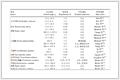
2 结果与讨论 2.1 化合物的合成目标化合物的理化性质及高分辨质谱数据见表1,核磁共振氢谱及碳谱数据见表2。
|
表 1 目标化合物2a~2h的理化性质及高分辨质谱数据 Table 1 The analytical data and HRMS of title compounds 2a-2h |
|
|
表 2 目标化合物2a~2h的 1H NMR和 13C NMR Table 2 1H NMR and 13C NMR of compounds 2a-2h |
2.2 化合物对樱桃番茄果实硬度的影响
结果 (表3) 表明:在1 mmol/L处理浓度下,大部分目标化合物具有较好的延缓果实软化的活性。处理后第3天,大部分化合物与空白对照以及药剂对照AVG处理之间无显著性差异;处理后第5天,2c~2f和2h处理组果实硬度与空白对照相比分别提高了27.62%、24.86%、33.89%、20.81%和40.04%,具有很好的延缓果实软化的活性,其中2c、2e和2h处理效果与对照药剂AVG处理之间无显著性差异。
2.3 化合物对樱桃番茄果实乙烯合成量的影响结果 (表3) 表明:在1 mmol/L处理浓度下,大部分目标化合物对乙烯的合成量具有一定的抑制作用。处理后第3天,2a、2c~2f和2h对乙烯合成的抑制率与AVG处理之间无显著性差异;处理后第5天,2a的抑制效果减弱,而2c~2f和2h仍保持着较高的抑制活性,抑制率分别为71.77%、41.41%、35.53%、34.07%和53.07%,其中2c处理抑制效果最好,显著高于对照药剂AVG。而2g对乙烯合成有促进作用。
|
|
表 3 不同处理对樱桃番茄贮藏期果实硬度和乙烯合成量的影响 Table 3 Effects of different treatments on fruit firmness and ethylene production of cherry tomato during storage |
2.4 目标化合物2c与番茄ACS酶的构效关系
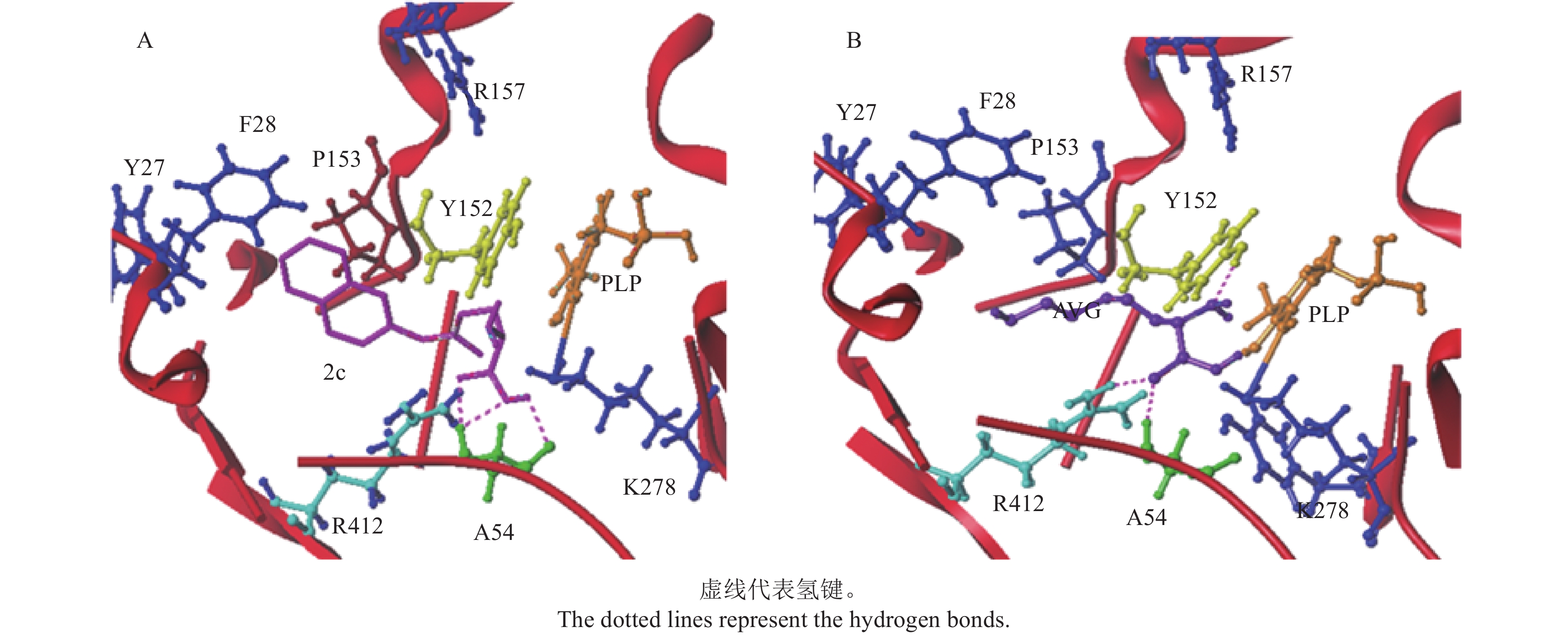
为了确定目标化合物与1IAY可能的结合模式,运用Sybyl-X2.0的Surflex-Dock模块,将活性较好的化合物2c和对照AVG对接入1IAY的活性空腔中[20],得到可能的结合模式 (图1)。结果发现,2c在活性空腔中的结合方式与AVG的类似。图1A中2c的萘环与1IAY的残基Phe28的苯环存在π-π相互作用,同时其羧基分别与氨基酸Ala54和Arg412形成氢键,从而固定2c骨架,占据了ACS活性空腔。图1B中,发现AVG的羧基同样与Ala54和Arg412形成了氢键,从而使AVG骨架得以固定,并占据了ACS活性空腔,这与已解析出的AVG与番茄ACS的复合晶体结构结果一致[6],即AVG占据ACS活性空腔,阻断了SAM与PLP辅因子的结合,从而抑制了乙烯的合成。也有研究表明,AVG在占据ACS活性空腔的同时,其氨基可能还会进攻PLP辅因子[7],具体有待进一步研究。本研究中化合物2c与ACS活性空腔的结合模式与文献[6]研究结果一致。
|
图 1 化合物2c(粉红色) 在ACS活性空腔中可能的结合模式 (A) 和AVG在ACS活性空腔中的结合模式 (B) Fig. 1 Possible model of substrate 2c (pink) in active site of ACS (A), and AVG in active site of ACS (B) |
3 结论与讨论
通过L-丝氨酸与不同的酰氯在室温下反应,合成了8个未见文献报道的O-酰基化丝氨酸,生物活性测定结果表明,大部分目标化合物展示出较好抑制樱桃番茄乙烯合成的活性和延缓樱番茄果实软化的作用,其中化合物2c和2h的作用效果较为突出,二者对果实硬度的影响均与对照AVG处理无显著性差异,而2c对乙烯合成量的抑制效果显著高于AVG处理。将活性较好的目标化合物2c对接到番茄ACS受体 (1IAY) 的活性空腔中,得到2c与1IAY可能的结合模式。结果显示,与AVG类似,2c羧基可与Ala54和Arg412形成氢键,以及萘环与Phe28的苯环存在π-π相互作用,从而占据番茄ACS的活性空腔,阻断SAM与PLP辅因子结合,最终抑制乙烯的合成。
在已解析的AVG与番茄1AIY复合晶体结构中,AVG末端的碳链并未与活性空腔中的残基相互作用[6],而2c、2d和2f中萘环以及苯环的引入均表现出了抑制乙烯合成的活性,推测ACS酶的活性空腔可能并非只允许末端碳链进入。2c中萘环的引入反而有助于目标化合物与1AIY受体更好地结合,这为开发AVG功能类似物奠定了理论基础。同时这些化合物合成步骤简单,成本低,有利于推广使用。
| [1] | WILKINSON J Q, LANAHAN M B, YEN H C, et al. An ethylene-inducible component of signal transduction encoded by never-ripe[J]. Science, 1995, 270(5243): 1807–1809. doi:10.1126/science.270.5243.1807 |
| [2] | SRIVASTAVA A, HANDA A K. Hormonal regulation of tomato fruit development: a molecular perspective[J]. J Plant Growth Regul, 2005, 24(2): 67–82. doi:10.1007/s00344-005-0015-0 |
| [3] | BOWYER M C, WILLS R B H, BADIYAN D, et al. Extending the postharvest life of carnations with nitric oxide-comparison of fumigation and in vivo delivery [J]. Postharvest Biol Tec, 2003, 30(3): 281–286. doi:10.1016/S0925-5214(03)00114-5 |
| [4] | KENDE H. Ethylene biosynthesis[J]. Annu Rev Plant Physiol Plant Mol Biol, 1993, 44: 283–307. doi:10.1146/annurev.pp.44.060193.001435 |
| [5] | OELLER P W, LU M W, TAYLOR L P, et al. Reversible inhibition of tomato fruit senescence by antisense RNA[J]. Science, 1991, 254(5030): 437–439. doi:10.1126/science.1925603 |
| [6] | HUAI Q, XIA Y H, CHEN Y Q, et al. Crystal structures of 1-aminocyclopropane-1-carboxylate (ACC) synthase in complex with aminoethoxyvinylglycine and pyridoxal-5'-phosphate provide new insight into catalytic mechanisms[J]. J Biol Chem, 2001, 276(41): 38210–38216. |
| [7] | BERKOWITZ D B, CHARETTE B D, Karukurichi K R, et al. α-vinylic amino acids: occurrence, asymmetric synthesis, and biochemical mechanisms [J]. Tetrahedron Asymmetry, 2006, 17(6): 869–882. doi:10.1016/j.tetasy.2006.02.026 |
| [8] | FADHIL N N, AL-BAMARNY S F. Postharvest aminoethoxyvinylglycine (AVG) dips on storage characteristics of 'golden delicious' and 'red delicious' apples[C]//ERKAN M, AKSOY U. VI International postharvest symposium. Antalya, Turkey: ISHS, 2010, 877: 881-885. |
| [9] | ANDREOTTI C, BREGOLI A M, COSTA G. Pre-and post-harvest aminoethoxyvinylglycine (AVG) application affects maturity and storage of pear fruit[J]. Eur J Hortic Sci, 2004, 69(4): 147–152. |
| [10] | PALOU L, CRISOSTO C H. Postharvest treatments to reduce the harmful effects of ethylene on apricots[C]//NICOLAÏ B M, DE BAERDEMAEKER G. Proceedings of the international conference: postharvest unlimited. Leuven, Belgium: ISHS, 2003(599): 31-38. |
| [11] | CANDIR E, CANDIR A, SEN F. Effects of aminoethoxyvinylglycine treatment by vacuum infiltration method on postharvest storage and shelf life of tomato fruit[J]. Postharvest Biol Tec, 2017, 125: 13–25. doi:10.1016/j.postharvbio.2016.11.004 |
| [12] | KEITH D D, TORTORA J A, YANG R. Synthesis of L-2-amino-4-methoxy-trans-but-3-enoic acid [J]. J Org Chem, 1978, 43(19): 3711–3713. doi:10.1021/jo00413a016 |
| [13] | PRUESS D L, SCANNELL J P, KELLETT M, et al. Antimetabolites produced by microorganisms. L-2-amino-4-(2-aminoethoxy)-trans-3-butenoic acid [J]. J Antibiot, 1974, 27(4): 229–233. doi:10.7164/antibiotics.27.229 |
| [14] | FUJINO D W, REID M S. Factors affecting the vase life of fronds of maidenhair fern[J]. Sci Hortic, 1983, 21(2): 181–188. doi:10.1016/0304-4238(83)90164-4 |
| [15] | SERRANO M, ROMOJARO F, CASAS J L, et al. Action and mechanism of α-aminoisobutyric acid as a retardant of cut carnation senescence[J]. Sci Hortic, 1990, 44(1-2): 127–134. doi:10.1016/0304-4238(90)90023-8 |
| [16] | ZHANG F Z, DAS S, WALKINSHAW A J, et al. Cu-catalyzed cascades to carbocycles: union of diaryliodonium salts with alkenes or alkynes exploiting remote carbocations[J]. J Am Chem Soc, 2014, 136(25): 8851–8854. doi:10.1021/ja504361y |
| [17] | WU C L, FU X K, MA X B, et al. Threonine-surfactant organocatalysts for the highly diastereo- and enantioselective direct anti-Mannich reactions of hydroxyacetone [J]. Tetrahedron Lett, 2010, 51(44): 5775–5777. doi:10.1016/j.tetlet.2010.08.085 |
| [18] | HELYES L, PÉK Z, LUGASI A. Tomato fruit quality and content depend on stage of maturity[J]. Hortscience, 2006, 41(6): 1400–1401. |
| [19] | ZHU T, TAN W R, DENG X G, et al. Effects of brassinosteroids on quality attributes and ethylene synthesis in postharvest tomato fruit[J]. Postharvest Biol Tec, 2015, 100: 196–204. doi:10.1016/j.postharvbio.2014.09.016 |
| [20] | JAIN A N. Surflex-Dock 2.1: robust performance from ligand energetic modeling, ring flexibility, and knowledge-based search[J]. J Comput Aided Mol Des, 2007, 21(5): 281–306. doi:10.1007/s10822-007-9114-2 |