 2015, Vol. 17


 , Ni Yun2, Kong Xiaoyan2, Huang Hongying1, Li Jiao1, Tang Wei1, Zhang Ruirui1, Kong Xiaolin1,2, Ji Wenjuan1, Xu Tianming1
2. College of Chemical Engineering, Zhejiang University of Technology, Hangzhou 310014, China
2. 浙江工业大学 化学工程学院, 杭州 310014
Carbendazim is a widely used,broad-spectrum benzimidazole fungicide and a metabolite of benomyl[1, 2]. It was one of the inhibitor of microtubute assembly used commercially for the control of oomycetes. However carbamate exhibit cross-resistance with zoxamide and dietho-fencarb against Botrytis cinerea,Venturia inaequalis,Monilinia fructicola,Mycosphaerella fijiensis,Cercospora beticola and so on[3]. Studies have revealed that high doses of carbendazim cause infertility and destroy the testicles of laboratory animals[4].
Oxime ether derivatives exhibit broad-spectrum bioactivities such as insecticidal,antiphytoviral,antitumor,herbicidal and fungicidal activities. A large number of investigations on their synthesis and biological activities have been reported during the last twenty years[5, 6]. Scientists found that strobilurins bearing the oxime ether exhibit outstanding activity against powdery mildews in several crops,such as trifloxystrobin[7].
Isoxazoline derivatives were also found to possess good bioactivities in agrochemical and medicinal research,and attracted considerable attention recently[8, 9]. Isoxazoline derivatives SYP-Z048 is a type of Sterol Biosynthesis Inhibitors,which exhibits excellent fungicidal activity against B.cinerea and Sphaerotheca fuliginea[10].
Since oxime ether and isoxazoline moiety possess such unique bioactivity,if those two moieties were introduced into carbendazim,there might be profound and unexpected changes in biological activity based on the theory of structure-activity relationship. We designed and synthesized a series of {2-chloro-5- [1-(5-methyl-3-phenyl-4,5-dihydro-isoxazol-5-yl meth-oxyimino)-ethyl]-benzyl} -carbamic acid methyl esters and hypothesized to the find lead compound with outstanding fungicidal activity. All the structures of the compounds were verified by 1H NMR and MS. It is noteworthy that,except good fungicidal activity,the compounds also exhibit good herbicidal activity unexpectedly. The relationship between structure and bioactivity was also studied.
The structural designing of the title compounds is shown in Scheme 1.The synthetic route is shown in Scheme 2.
 | Scheme 1 Structural overlay of commercial fungicides towards title compounds |
 | 11a: R=2-OH; 11f: R=4-i-Pr;11b: R=4-Cl; 11g: R=4-OH-3-OMe;11c: R=2-Cl;11h: R=2,3,4-(OMe)3;11d: R=4-OMe;11i: R=2-Cl-6-F;11e: R=2-OEt; 11j: R=2,6-F2 Scheme 2 The synthetic route of title compounds |
Melting points were determined with the WRS-1A numeral melting point instrument and were uncorrected. The 1H NMR spectra were recorded on a BRUKER AVANCE Ⅲ HD 600 MHz pulse Fourier-transform NMR spectrometer in CDCl3 using TMS as an internal standard,the MS spectra were recorded on a LCQ- advantage mass-spectrometer (ESI-MS). The reagents were all analytical reagent or chemically pure.
1.2 Synthesis of the compounds 1.2.1 Substitutional benzaldoxime(2)A mixture of 10.43 g (0.15 mol) NH2OH·HCl and 9.01 g (0.085 mol) Na2CO3 in 100 mL water were stirred at room temperature until no bubbles arose. Then the NH2OH solution was prepared for the next step.
0.10 mol substitutional benzaldehydes 1 was dissolved in 50 mL EtOH and NH2OH solution was added dropwise.The mixture were stirred for 1 h at room temperature,monitored by TLC [V(petroleum)∶V(ether-ethyl acetate)=4∶1].The mixture was poured into 100 mL of ice-water and the solid was precipitated from the mixture. Then,the crude solid product was collected by filtration,washed by ethyl acetate and dried.[11].
1.2.2 (2-Chloro-benzyl)-carbamic acid methyl ester(4)Compound 4 were prepared according to the method in the literature[12]. The absolute white solid product was nearly obtained. Yield 90.2%,m.p. 77-78 ℃;1H NMR (CDCl3,600 MHz),δ:2.02(s,3H,COCH3),4.52(d,2H, J=6.0 Hz,NH-CH2),5.99(brs,1H,NH),7.23-7.27 (m,2H,Ar-H),7.36-7.42 (m,2H,Ar-H).
1.2.3 N-(5-acetyl-2-chloro-benzyl)-acetamide(5)Compound 5 were prepared according to the method in the literature[12, 13].Yellowish solid was obtained.Yield 49.8%,m.p. 87- 89 ℃.MS (ESI),m/z: 226 [M+H]+. (Yield 54.3%,m.p. 93.1-93.7 ℃. 1H NMR(CDCl3,300 MHz),δ: 2.0(s,3H,NH-COCH3),2.6(s,3H,Ar-COCH3),4.6(d,2H,J=6.0 Hz,CH2),6.1(brs,1H,NH),7.5(d,1H,J=8.2 Hz,Ar-H),7.8(dd,1H,J1=2.2 Hz,J2=8.2 Hz,Ar-H),8.0 (d,1H,J=2.2 Hz,Ar-H)) (in literature[12]).
1.2.4 1-(3-Aminomethyl-4-chloro-phenyl)-ethanone(6)22.60 g (0.1 mol) compound 5 was dissolved in 200 g 50%H2SO4. The mixture was heated to reflux for 24 h. Then,the solution was poured into 200 mL of water,and 100 mL of ethyl acetate was added for extraction. After removing the organic layer,the aqueous was neutralized with 25% NaOH to pH=12.Then,the product was extracted with 200 mL of ethyl acetate.The organic layer was dried by MgSO4,evaporated and 15.70 g crude product was obtained[12].
1.2.5 (5-Acetyl-2-chloro-benzyl)-carbamic acid methyl ester(7)Compound 7 were prepared according to the method in the literature[12]. White solid was obtained. Yield 62.8%,m.p.102-104 ℃.MS (ESI),m/z: 242 [M +H]+.(Yield: 90.2%,m.p. 108.1 ℃. 1H NMR(CDCl3,300 MHz),δ: 2.6 (s,3H,Ar-COCH3),3.7(s,3H,COOCH3),4.5(d,2H,J=6.3 Hz,CH2),5.3(brs,1H,NH),7.5(d,1H,J=8.3 Hz,Ar-H),7.8(dd,1H,J1=2.1 Hz,J2=8.3 Hz,Ar-H),8.0(s,1H,Ar-H)) (in literature[12])
1.2.6 [2-Chloro-5-(1-hydroxyimino-ethyl)-benzyl]-carbamic acid methyl ester(8)A mixture of 8.30 g (0.12 mol) NH2OH·HCl and 7.21 g (0.068 mol) Na2CO3 in 100 mL water were stirred at room temperature until no bubbles arose. Then the NH2OH solution was prepared for the next step.
18.10 g (0.075 mol) compound 7 was dissolved in 200 mL EtOH and NH2OH solution was added dropwise. The mixture were stirred for 1 h at room temperature,monitored by TLC [V(petroleum ether)∶V(ethyl acetate)=4∶1].Then the mixture was poured into water (200 mL) and the solid was precipitated. The product was collected by filtration,dried and recrystallized from acetone[11]. White solid was obtained. Yield 74.3%; m.p. 183-184 ℃. 1H NMR (CDCl3,600 MHz),δ: 2.26(s,3H,CH3-C=NOH),3.70(s,3H,COOCH3),4.47(d,2H,J=6.0 Hz,NH-CH2),5.28(brs,1H,NH),7.37(d,1H,J=12.0 Hz,Ar-H),7.50(d,1H,J=12.0 Hz,Ar-H),7.69(s,1H,Ar-H),8.32(s,1H,NOH).MS (ESI), m/z: 257 [M +H]+.
1.2.7 {2-Chloro-5-[1-(2-methyl-allyloxyimino)-ethyl]-benzyl}-carbamic acid methyl ester(10)A mixture of 14.30 g (0.056 mol) compound 8,7.60 g (0.084 mol) compound 9 and 11.60 g (0.084 mol) K2CO3 in DMF (100 mL) were stirred for 14 h at 70 ℃. The reaction was monitored by TLC[V(petroleum ether)∶V(ethyl acetate)=4∶1].The mixture was poured into water (200 mL). Then 200 mL of ethyl acetate was added for extraction. The organic layer was washed with water (200 mL×2). Then it was dried over MgSO4 and evaporated. The crude product was purified by column chromatogra- phy using a mixture of V(petroleum ether)∶V(ethyl acetate)=4∶1. White solid was obtained[14]. Yield 91.0%,m.p.50-52 ℃.1H NMR(CDCl3,600 MHz),δ: 1.79 (s,3H,CH3-C=CH2),2.24 (s,3H,Ar-C-CH3),3.68 (s,3H,COOCH3),4.45 (d,2H,J=6.0 Hz,NH-CH2),4.62(s,2H,N-O-CH2),4.93 (s,1H,=CH2),5.00(s,1H,=CH2),5.19(brs,1H,NH),7.34(d,1H,J=12.0 Hz,Ar-H),7.50-7.52(m,1H,Ar-H),7.65 (s,1H,Ar-H).
1.2.8 {2-Chloro-5-[1-(5-methyl-3-substitutional phenyl-4,5-dihydro-isoxazol-5-ylmethoxyimino)-ethyl]-benzyl}-carbamic acid methyl ester 11a-11j1.00 mmol substitutional benzaldoxine 2 and 0.18 g (1.5 mmol) NCS were dissolved in 10 mL DMF. The mixture was stirred at room temperature. The chlorination would finished when the color of the solution changed. Then,0.39 g (1.10 mmol) compound 10 and 0.15 g (1.5 mmol)TEA were added,and the mixture were stirred at room temperature for 3 h,monitored by TLC [V(petroleum ether)∶V(ethyl acetate)=4∶1]. The reaction solution was poured into water (200 mL) and then 200 mL of ethyl acetate was added for the extraction. The organic layer was washed with water (200 mL×2). Then it was dried over MgSO4 and evaporated. The crude product was purified by column chromatography using a mixture of V(petroleum ether)∶V(ethyl acetate)=4∶1. All the the title compounds were obtained as yellow oils [11].
1.3 Biological screeningThe bioactivity is assayed by the bioassay test SOP made by Zhejiang Research Institute of Chemical Industry[15, 16].All the tested compounds were added into DMF(containing 0.1% Tween-80) and made into 5.0% mother liquor. Then,the liquor and the positive control medicament were diluted with water into tested concentration.
1.3.1 Fungicidal screeningThe strains tested:Rhizoctonia solani,Botrytis cinerea,Pseudopero-nospora cubensis,Sphaerotheca fuliginea.
The strains come from the lab cultured for long-term. Two or three days before the test,strains in the test tube were save in the refrigerator (4-8 ℃),then inoculated to a dish and cultured in the appropriate temperature.
The small plant pot spray method was used for fungicidal screening at a concentration of 200 mg/L. The spore suspension inoculation and the mycelium block inoculation were used.
1.3.2 Herbicidal screeningThe target plants tested: Triticum aestivum,Zea mays,Echinochloa crusgalli,Cucumis sativus,Oryza sativa,Sorghum vulgare,Stellaria media.
The target plants come from the lab cultuled for lone-term.
The dish dipping method was used for the preliminary screening. The seeds of the target plants were cultivated in culture dish at the concentration of 200 mg/L. Then,the root and stem growth rate of the plants were tested.
Seeds of the target plant were planted in the pot,and processed when the crop was grown to about 4 leaves stage.
The potter spray method was used for secondary herbicidal screening at a concentration of at 150 g/hm2. The preemergence soil spray processing and postmergence foliar spray processing were used.
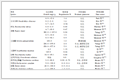
2 Results and discussion 2.1 Synthesis and analytical spectral dataThe physical and chemical data of the title compounds are shown in Table 1. The 1H NMR data of the title compounds are shown in Table 2.
|
Table 1 The physical and chemical data of title compounds 11a-11j |
|
|
Table 2 The 1H NMR data of title compounds 11a-11j |
In this synthesis route,the preparation of intermediate 5 was the key step for the synthesis of intermediate 7. It was prepared from intermediate 4 with the amino protected via a highly regio-selective Friedel-Crafts acylation reaction. Under absolutely anhydrous conditions,compound 5 was obtained with high yield and purity. Isomers of 5 were hardly observed.
Compound 6 was obtained from the hydrolyzation of compound 5 under heat and inorganic acid conditions. The reaction time and molar ratio of substrate were examined. The best result was obtained when compound 5 was reacted with 10 equiv.of H2SO4 in water (50%H2SO4),at 100 ℃ for 24 h.
The structure of all products 11 were confirmed by 1H NMR and MS. In 1H NMR spectra,all phenyl proton nuclei showed multiplet at δ 6.69-7.77. Each hydrogen atom on isoxazoline nuclei showed double peak or double-double peak,the chemical shifts of which were about δ 4.27-4.39. Coupling effect of the two hydrogen atoms or spatial structure effect may lead to the appearance of characteristic peak on the isoxazoline proton nuclei. And both of the two hydrogen atoms on the -N-O-CH2- group showed double peak,the chemical shifts of which were about δ 3.05-3.66. Coupling effect of the two hydrogen atoms in different chemical environments leads to the appearance of characteristic peak on the -N-O-CH2-group.
2.2 Biological activityAs shown in Table 3,all the compounds exihibit some fungicidal activity in vivo except compound 11a. Among them,11b containing substituent group R=4-Cl provided 90% relative control effect against P. cubensis,and 95% relative control effect against S.fuliginea at concentration of 200 mg/L. However,the fungicidal efficacies of all the compounds were lower than carbendazin. The compounds did not need to go through the secondary fungicidal screening.
The preliminary herbicidal screening in Table 4 showed that all the compounds exhibit good herbicidal activity at concentration of 200 mg/L. Among them,The inhibition rates of 11c containing substituent group R=2-Cl and 11j containing substituent group R=2,6-Cl2 were up to 80% against root and stem growth of all the target plants. Those two compounds exhibit excellent herbicidal activity which was as good as pyribambenz isopropyl.
|
|
Table 3 The fungicidal activity of title compounds 11a-11j |
|
|
Table 4 The herbicidal activity of title compounds 11a-11j |
However,the secondary herbicidal screening showed that 11c and 11j exhibit lower herbicidal activity against S. media compared to pyribambenz isopropyl. For example,the herbicidal efficacies of 11j against S. media was only 70% by postmergence foliar spray processing at 150 g/hm2,and the herbicidal efficacies of 11c against chickweed was only 75% by preemergence soil spray processing at the same dose.
The moderate bioactivity proved that the compounds were reasonably desinged. The relationship between structure and bioactivity was also studied.
3 ConclusionCarbendazim is a widely used,broad-spectrum benzimidazole fungicide and a metabolite of benomyl[1-2]. Oxime ether and isoxazoline moiety possess unique bioactivity. Thus,we introduced those two moiety into carbendazim,designed and synthesized a series of carbamates bearing methoxyimino-isoxazoline. All the structures of the compounds were verified by 1H NMR and MS. The bioassays indicated that the compounds exhibit good fungicidal and herbicidal activity,which proved that the compounds were reasonably desinged. The relationship between structure and bioactivity was also studied.
| [1] | Hampel H, Löcher F. History fungicide[C]. Proc Br Insectic Fungic Conf, 1973, 1, 127, 301. |
| [2] | Louis K H, Wilmington D. 2-Benzimidazolecarbamic acid alkyl esters as foliar fungicides: US 3657443[P]. 1972-04-18. |
| [3] | Krämer W, Schirmer U. Chapter 16. Fungicides acting on mitosis and cell division[M]//Modern Crop Protection Compounds[M]. Darmstadt: Wiley-VCH Verlag GmbH & Co. KGaA, 2007. |
| [4] | The Free Encyclopedia. Carbendazim[EB/OL]. http://en.wikipedia.org/wiki/Carbendazim.2015-07-07. |
| [5] | Song Bao'an, Liu Xinhua, Yang Song, et al. Recent advance in synthesis and biological activity of oxime derivatives [J]. Chin J Org Chem, 2005, 25(5): 507-525. (in Chinese) |
| [6] | Song Bao'an, Liu Xinhua, Yang Song, et al. Synthesis and anticancer activity of 2, 3, 4-trimethoxyacetophenoxime ester containing benzothiazole moiety [J]. Chin J Chem, 2005, 23(9): 1236-1240. |
| [7] | Krämer W, Schirmer U. Chapter 13. Fungicides Acting on Oxidative Phosphorylation[M]//Modern Crop Protection Compounds. Darmstadt: Wiley-VCH Verlag GmbH & Co. KGaA, 2007. |
| [8] | WANG T, Imerhasan M. Synthesis and application of isoxazolinium salts[J]. Chin J Org Chem, 2010, 30(12): 1831-1839. (in Chinese) |
| [9] | CHENG Chunsheng, Yu Ping, Li Zhinian, et al. 2-methyl-3-(4-methoxyphenyl)-5-(3-methoxyphenyl) isoxazoline and its bioactivity[J]. Chin J Org Chem, 2010, 30(6): 833-836. (in Chinese) |
| [10] | LIU Junli, Si Naiguo, Chen Liang, et al. Biological activity against tomato leaf mold and application of a novel fungicide, SYP-Z048 (Ш)[J]. Pesticides, 2004, 43(3): 103-105. (in Chinese) |
| [11] | Zhou Yinglei, Shen Songwei, Liu Fangming. Synthesis and configuration of novel isoxazole derivatives containing pyrazole moiety[J]. Chin J Org Chem, 2010, 30(9): 1342-1346. (in Chinese) |
| [12] | Ito A, Ohashi H, Magaribuchi K. Process for producing benzylamine derivative: US 7326813(B2)[P]. 2008-02-05. |
| [13] | Plattner J J, Fung A K L, Smital J R, et al. [[(Aminomethyl)aryl]oxy] acetic acid esters. A new class of high-ceiling diuretics. 2. Modifications of the oxyacetic side chain[J]. J Med Chem, 1984, 27(12): 1587-1596. |
| [14] | Liu Tianlin, Zhou Yibo. Studies on the synthesis of pyridazinone-aryl aldehyde (ketone) oxime ether derivatives[J]. Chin J Org Chem, 2000, 20(5): 758-763. (in Chinese) |
| [15] | Tang Wei, Xu Xiaoyan, Chen Jie, et al. Comparison of herbicidal activity among five herbicides under greenhouse and field conditions[J]. Weed Sci, 2014, 32(1): 107-110. (in Chinese) |
| [16] | Hu Weiqun, Zhu Weigang, Zhang Ruirui, et al. Biological activity of a novel quinoline compound ZJ5337[J]. Chin J Pestic Sci, 2014, 16(4): 414-419. (in Chinese) |