 2002, Vol. 38
文章信息
- Lu Xiaoning, Han Shuguang, Wu Yufei, Liu Qiming, He Yi
- 卢晓宁, 韩书广, 吴羽飞, 刘启明, 何毅
- LOW FORMALDEHYDE EMISSION PARTICLEBOARD AND MEDIUM DENSITY FIBERBOARD OF LOW MOLAR RATIO UF RESIN WITHOUT DEHYDRATION
- 用不脱水低摩尔脲醛树脂制造低游离甲醛刨花板与中密度纤维板
- Scientia Silvae Sinicae, 2002, 38(2): 108-112.
- 林业科学, 2002, 38(2): 108-112.
-
文章历史
Received date: 2001-07-06
-
作者相关文章


Urea formaldehyde resin has been widely used in particleboard (PB) and medium density fiberboard (MDF) manufacture in China.Low formaldehyde emission from the UF bonded panels is a selling point as most of them are the materials for furniture, floor, and interior decoration.European Standard E1 and E2 on low formaldehyde emission have been received in the market and the Chinese Standard GB-T11718 -1999 for MDF published in 2000, prescribed the permissible formaldehyde emission of less than 90mg·kg-1 and 90 mg·kg-1 to 400 mg·kg-1 for Grades A and B respectively, and the standard for particleboard is being discussed.Several methods have been developed for reducing the emission such as, low molar ratio of urea to formaldehyde, ammonia or polyphenol scavengers, melamine urea formaldehyde (MUF)copolymer, post treatment with ammonia, etc.Of formaldehyde scavengers, timely catching method is welcome.With the occurrence of formaldehyde escaped from resin and wood it can be caught by the scavenger during hot pressing.This kind of scavenger, named NLFS -1, is composed of polyphenol and ammonia (Lu et al., 1999), which has been used effectively to reduce formaldehyde emission by more than 50 % in PB bonded with higher molar ratio UF resin.
There are several methods to improve the performance of PB and MDF but post -treatment is considered as simple and low cost one.The results which are obtained for the curing of UF resin with solid of 65 %when studied on wood substrates by thermomechanical analysis (TMA)(Lu and Pizzi, 1998)have indicated that post -treatment and hot -stacking (postcuring)conditions capable of improving the mechanical performance of UF resin -bonded particleboard without any degradation should instead exist.Later, the results from experiment which after UF, with the solid of 65 %, resin -bonded particleboards were pressed they were post -treated (Lu and Pizzi, 1998)in a oven with different isothermal conditions that the properties of panels such as internal bond strength, thickness swelling, MOE, MOR were noticeably improved.
Facing to a manufacturer, how does he make wood based panels technology according to chinese panels situation because many UF resins without dehydration and with low molar ratio (F :U)are used to reduce cost? They would result in reducing production as pressing time prolongs if there isn' t suitable manufacturing technology, and even more serious if formaldehyde scavengers are added.The purposes of this paper are to how to make good particleboard and MDF with the UF resin with low molar ratio and without any dehydration and to realize the reaction process of adhesives and scavenger to select hot pressing conditions.
ExperimentalThere were two types of UF resins used.One was a particleboard adhesive type of U:F molar ratio =1:1.25, 52 % resin solid content, and 65 gel time at 100 ℃and 1 %NH4Cl and another a MDF commercial adhesive type of U:F molar ratio =1:1.15, 52 % resin solid content, and 100 ℃ gel time at 100 ℃ and 1 %NH4Cl.
Dynamic heat flux differential scanning calorimetry (DSC)was used to analyze the process of resin curing and polymer forming.Liquid resin was spread uniformly on a piece of glass and was dehydrated in a refrigerator at 10 ℃ for 24 hours till a thin sticky film was formed.Then 5 ~ 20 mg film sample was filled in a crucible and the crucible was inserted into measuring cell.There were two testing modes.One is in non -isothermal mode that the sample was tested between 20 ℃ and 250 ℃ at heating rate of 10 ℃·min-1 with DSC 200.Another was mixed with non -isothermal and isothermal mode that the sample was placed at ambient temperature in the DSC measuring cell and the system then heated at 20 ℃·min-1 until temperature of 105 ℃.After that the sample was kept in the cell at 105 ℃ for 10 min.
UF resin particleboard were made according to the following conditions :
D =0.65g·cm-3; glue content =12 %; the scavenger (NLFS -1)contents were respectively 0 %, 5 %, and 10 % on the basis of liquid adhesive; particle size =-25 ~ +100 mesh with MC 3 % and poplar species; the dimension of board = 400 mm ×400 mm ×14 mm; press platens temperature =190 ℃; pressing cycle =60/60/60 seconds at pressure of 3.0 MPa/1.2 MPa/0.5 MPa; the particleboard for isothermal treatment were put in an oven set at 80 ℃for 30 min while panel center temperature was cooled to 100 ℃out hot press; the panels were tested after 2 days conditioning at ambient temperature for internal bond (IB)strength and formaldehyde emission in boards with perforator method.
UF resin medium density fiberboard were made according to the following conditions besides same technological factors as for particleboard :
D =0.8 g·cm-3; fiber size = -28 ~ +150 mesh with MC 3 % and wood mixed species; the panels were tested only for formaldehyde emission in panels with perforator method.
Discussion DSC AnalysisThere were some different reacting caloric values between scavenge and none with adhesives, shown Fig. 1.Normally, the curing reaction of thermosets is strongly exothermic.There was a exothermic-peek at 95 ℃ in up-triangle line and UF resin without scavenger would cure.But the exothermic peek would delay to 100 ℃ and less caloric in solid up-triangle line was given off than one in up - triangle line. When adhesive was heated, some free formaldehyde would accelerate curing (Pizzi 1989).As scavenger, a few formaldehyde would react with ammonia or phenol and some copolymer would be formed with maximum endothermic peek (Zhang 2000) at 115 ℃.Contrarily, no such peek could be observed in up -triangle line except degrada Fig. 2 Reaction caloric at isothermal condition tion peek at 165 ℃.In the other words, the UF resin with scavenger would have a higher aging temperature due to polymer of ammonia, phenol, and formaldehyde.In particleboard manufacturing practice the temperature of panels center would be steadily 103 ℃~ 106 ℃ (Humphrey and Bolton, 1989; Lu and Pizzi, 1998)for a while which would be controlled in real pressing time.For that in the isothermal condition, which Maximum temperature was set 105 ℃ and kept 10 min, DSC experiment simulated the curing temperature in panel center was investigated and the result was shown that the temperature was increased to 107 ℃ from system temperature 105 ℃ at exothermic peek (Fig. 2).Therefore, the temperature in panel could meet its curing condition for UF resin with scavenger.

|
Fig.1 Comparing scavenge adhesive with no scavenge one

|

|
Fig.2 Reaction caloric at isothermal condition |
They would effect greatly their endothermic caloric though molar ratios wouldn' t change reacting trend of UF adhesive with scavenger (Fig. 3).Their endothermic caloric at molar ratios of 1:1.15, 1:1.20, and 1 :1.25 are respectively 59.4 J·g-1, 161.5 J·g-1, and 208.1 J·g-1.Higher molar ratio would result in higher free formaldehyde or formaldehyde emission.The results were shown that amount of free formaldehyde in UF resin could react with the scavenger and it' s reacting amount would depend on molar ratio or free formaldehyde.

|
Fig.3 Reaction caloric of adhesives at three kinds of molar ratios

|
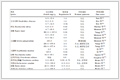
Three levels of scavenger of 0 %, 5 % and 10 %of were blended in UF resin and particleboards were pressed. It was marked that free formaldehyde could be absorbed by higher NLFS -1 scavenger and reduced by 80 % and 88 % on the levels of scavenger of 5 %and 10 %(Tab.1), which their relative reduction were higher than onewith higher molar ratio (U:F)=1:1.5 (Lu and Wan, 1999).But their IB values couldn' t be improved as higher molar ratio did because free formaldehyde left in the adhesives with low molar ratio was too low to increase network connect.
|

It is of interest to discuss the relation between IB value and formaldehyde emission (Tab.1)on post isothermal condition for low molar ratio, and not dehydrated UF bonded particleboard.Their IB values could be improved markedly (Lu and He, 2001)after the particleboards were post -isothermal -treated.Although IB value could be increased, formaldehyde emission would be increased somewhat.For example, IB value of panel with 5 %scavenger in UF resin could be gained to 0.96MPa from 0.55MPa, but formaldehyde emission value went up to 96 mg·kg-1 from 88 mg·kg-1 after post treatment.So did that of panel with 10 % scavenger.The results are explained that since the resin network does not noticeably degrade with post -curing, only the tightening of the network derived by further bridges formation by reaction within the network of the part of formaldehyde molecules released from methylene ether bridge decomposition though they are much low (Pizzi 1983)will be noticeable and the IB value will be improved with post isothermal treatment.The few remain, however, will result in a little increase of formaldehyde emission value as the scavenger has been used up before.
MDF experiments, an application of NLFS-1 scavengerAs the UF resin with NLFS -1 scavenger has longer pot life of more than 4 hours at ambient temperature, the scavenger could be mixed with MDF UF resin with low molar ratio of 1 :1.15 although there is some difference between MDF manufacturing technology and PB one.The results were shown (Item MDF1 and MDF2 in Tab.1)that formaldehyde emission could be reduced by 87 %.
ConclusionThe higher scavenger amount is there, the lower formaldehyde emission value in particleboard and medium density fiberboard panels with low molar ratio UF resins without dehydration could be obtained.NLFS -1 scavenger of 5 % is high capable of catching formaldehyde and the formaldehyde emission value can meet European Standard E1 or Chinese Standard GB-T11718 -1999 Grade A.The formaldehyde emission would be increased a little although the IB values could be improved well after post isothermal treatment on condition of 80 ℃ for 30min while the temperature in panel center was cooled to 100 ℃.
The reaction of the scavenger with formaldehyde could be measured with DSC technique.The analyses of DSC technique were shown that there were some different reacting caloric values between scavenger and none with UF adhesive, most of free formaldehyde in UF bonded panels could be reacted with the scavenger, and it' s reacting amount would depend on molar ratio or free formaldehyde.Of considerable importance is that the data from DSC analyses could be chosen as the reference of hot pressing technology.
Lu X, He Y and Zhou X.Post Isothermal Treatment on the Particleboards with not dehydrated Urea Formaldehyde Resin.China Wood Industry, in press, 2001
|
Zhang Meizhen. 2000. Research Methods for Polymers. Beijing: China Light Industry Press: 120-123.
|
Lu X, Wa nM. 1999. Research on Formaldehyde Scavenge for UF Resin. China Forest Products Industry, 26(2): 23-41. |
Lu X, Pizzi A. 1998. Curing Conditions Effects on the characters of Thermosetting Adhesives-bonded Wood Joints Part 1. Holz als Roh-und Werkstoff, 56(5): 339-346. DOI:10.1007/s001070050330 |
Lu X, Pizzi A. 1998. Hot postcuring improvement of UF particleboards and its temperature fore -casting model. Holz als Roh-und Werkstoff, 56(6): 393-401. DOI:10.1007/s001070050339 |
Humphrey P E, Bolton A J. 1989. The hot pressing of dry-formed wood based composites.Part 2:A simulation model for heat andmoisture transfer and typical results. Holzforsch, 43(3): 199-206. DOI:10.1515/hfsg.1989.43.3.199 |
Pizzi A.Aminoplastic Wood Adhesives, Chapter 2 in Wood Adhesives Chemistry and Technology, Marcel Dekker, New York, 1983
|