 2021, Vol. 64


2. 中国科学院大学地球与行星科学学院, 北京 100049
2. College of Earth and Planetary Sciences, University of Chinese Academy of Sciences, Beijing 100049, China
大陆地壳中,由相互交叉的两组断裂构成的共轭断层,是常见的一种断层分布形态.共轭断层这一种断层分布形态早就为中外许多地球科学家所注意与研究.例如,在研究自然界中韧性变形带的共轭性质时,郑亚东等(2007)、Zheng等(2011)详细研究了共轭断层这种断层分布形态.很多地震的主震、余震的震源机制与空间分布也显示出具有共轭破裂的特征.迄今已经有许多有关地震共轭破裂现象的工作(如张四昌,1991;满开言等,1993;陈金海和刘赛君,1995;张四昌和刁桂苓,1995;等).这些工作揭示了共轭破裂是一种普遍存在的破裂现象,总结了一些强震震例的共轭分布特征.Kelly等(1998)研究了石灰岩中共轭走滑断层的结构,并建立了断层的演化模型.谢新生和王维襄(2002)研究了地震共轭破裂角随地壳深度的变化,以及通过破裂角计算极限主应力的方法.除此之外,很多学者对共轭破裂产生的机制进行过探讨.王学滨(2004)针对简单的地震块体模型产生剪切共轭破裂的机制作了数值模拟.郭婷婷(2015)采用有限元模拟方法对共轭断层系统的孕震与发震机理进行了数值模拟与讨论分析.乔建永等(2019)提出了X型共轭剪切破裂—地震复合模型,马念杰等(2019)进一步研究了共轭剪切破裂地震发生的力学机理和演化过程.
尽管共轭破裂作为地震中的常见形态已经得到证实,但对于地震区域的破裂状况与地下介质特性之间的关联,迄今研究仍然甚少.在小样本的岩石破裂实验中,现已查明脆性破裂基本遵循库仑破坏准则,其共轭面夹角与材料的内摩擦系数之间存在简单的定量关系(Anderson, 1905).当将地震破裂整体作为研究对象时,共轭破裂角与破裂区域介质的内摩擦系数是否仍遵从上述关系,至今未见讨论.为此,本文收集具有共轭特征的地震数据,验证库仑破坏准则与破裂的安德逊理论在原地(in situ),即天然地震破裂情况下成立的可能性,并据此估算地壳的内摩擦系数.这一研究对于进一步理解地震破裂机制,增进对地壳的内摩擦特性的认知,具有理论和实际意义.
1 岩石的脆性破裂理论 1.1 库仑破坏准则与破裂的安德逊理论脆性物质在压应力下的剪切破坏通常用库仑破坏准则(又称为库仑—莫尔破坏准则或库仑—纳维准则)描述.处于高围压下,原先没有破裂的地下岩石要发生破裂,不但要克服阻碍其破裂的岩石的内聚强度(S),而且要克服妨碍其滑动的、与正应力(σn)成正比的摩擦阻抗(μσn),也就是当作用于某一个面上的剪切应力达到岩石的内聚强度(S)与摩擦阻抗(μσn)之和时,材料便沿该平面发生脆性破坏:

|
(1) |
式中,τ和σn分别为作用于该平面上的剪切应力和正应力,以压应力为正,μ为内摩擦系数.
通常用莫尔圆表示库仑破坏准则.设σ1>σ2>σ3依次为最大、中间、最小主压应力(图 1).图 1横坐标表示作用于岩石中某一平面的正应力σn,以压应力为正,纵坐标是作用于某一平面上的剪切应力τ,A点的坐标是((σ1+σ3)/2,0),莫尔圆的半径AP=(σ1-σ3)/2.当式(1)表示的斜率为tanϕ=μ,截距为S的直线(称作破裂线) BP与莫尔圆相切时发生剪切破裂,此时破裂面通过中间主压应力轴σ2,并与最大主压应力轴σ1成θ角.有两个可能的破裂面,它们均与σ1轴成θ的夹角,是一对共轭的平面(图 2).两个平面之间的角度2θ称作共轭角,其与内摩擦系数μ的关系为

|
(2) |

|
图 1 由莫尔圆表示的库仑破坏准则 Fig. 1 Coulomb failure criterion expressed by Mohr′s circle |

|
图 2 共轭角(2θ)与主(压)应力的关系 Fig. 2 Relationship between conjugate angle (2θ) and principal (compressive) stress |
安德逊(Anderson, 1905)提出,断层是脆性破裂的结果,并将库仑破坏准则运用于断层破裂问题.他指出,断层有可能形成一对共轭组合,断层面通过中间主应力轴σ2,与最大主压应力轴σ1成θ角,称为“破裂角”或“断层角”.对于三类主要的断层(正断层、逆断层、走滑断层),破裂面和应力轴的关系如图 3所示.

|
图 3 三类主要断层模式 (a) 正断层;(b) 逆断层;(c) 走滑断层. Fig. 3 Three main fault types (a) Normal fault; (b) Reverse fault; (c) Strike-slip fault. |
Yamakawa(1971)总结了岩石破裂三轴应力实验的一些重要结果(图 4),岩石样本破裂时释放的压力P的方向与σ1轴方向成45°-θ角,释放的张力T的方向与σ3轴方向同样成45°-θ角,破裂面与σ2轴平行.将这些结果运用于地震现象,考虑岩石中产生新的断层的情形,可知,对于两个可能的共轭断层面(图 5),其释放的压应力轴(即由震源机制解得到的P轴)与最大主压应力轴σ1成45°-θ角,释放的张应力轴(T轴)与最小主压应力轴σ3同样成45°-θ角(图 6).P轴和T轴反映的是地震前后震源区应力状态的变化,而非震源区构造应力本身.

|
图 4 岩石破裂三轴应力实验示意图 Fig. 4 The diagram of triaxial stress experiment of rock fracture |

|
图 5 两个可能的、共轭的断层面 Fig. 5 Two possible and conjugate fault planes |

|
图 6 地震发生时释放的应力的主轴与震源区构造应力的主轴之间的关系 Fig. 6 The relationship between the principal axis of the stress released during an earthquake and the principal axis of the tectonic stress in the focal zone |
自Anderson(1951)提出共轭断层概念以来,这种现象得到了大量的观测证据支持.例如,日本伊豆半岛的主要构造要素为共轭走滑断层系统(Somerville et al., 1987),中国华北地区存在一系列共轭状分布的地震条带(张四昌,1991),等等.
历史上发生的大地震也常出现共轭破裂现象,如1941年耿马—澜沧面波震级MS7.0地震、1966年邢台MS6.2地震、1975年辽宁海城MS7.3地震、1976年唐山MS7.8地震等,均表现出了明显的共轭破裂特征(张四昌,1991).分析共轭破裂地震的断层面特征,有助于在原地尺度(即天然地震尺度)上对Anderson断层理论进行验证,并通过估测破裂面与应力主轴的夹角,运用公式(2)可以估算地壳的内摩擦系数μ的数值.
2 历史地震分析 2.1 历史地震的共轭破裂特征Jaeger和Cook(1979)指出,岩石实验中,内摩擦系数μ的取值范围通常为0.5~1.0.对应于共轭破裂断层,其共轭角(2θ)为44°~64°.在实际发生的地震中,由于岩石存在各向异性与不均匀性,共轭角与摩擦系数可能会与理想状况有显著的差异,但Anderson(1951)与Kelly等(1998)指出,共轭角与摩擦系数的这些结果仍适用于累积位移较小的脆弱走滑断层.
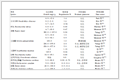
本文综合各方面的资料,列出从20世纪至今国内外具有明显共轭破裂特征的地震,并参考历史文献给出的余震震中分布图,标出共轭断层面的走向,通过估测破裂面的夹角,给出内摩擦系数μ的数值(表 1、表 2).
|
表 1 我国历史上共轭地震的夹角(2θ)与内摩擦系数(μ) Table 1 Conjugate angle (2θ) and internal friction coefficient (μ) of historical conjugate earthquakes in Chinese mainland |
|
|
表 2 国外历史上共轭地震的夹角(2θ)与内摩擦系数(μ) Table 2 Conjugate angle (2θ) and internal friction coefficient (μ) of abroad historical conjugate earthquakes |
图 7给出了所研究的24个国内外地震的震中位置与相应的地壳内摩擦系数的分布.由于很多地震发生的年代距今较为久远,资料精确度一般较低,由此计算得出的内摩擦系数仅是一个粗略的估计.但分析这些数据仍能得出结论:共轭角(2θ)的取值分布在45°~85°之间,优势分布区间在65°~75°左右.另外,发生在相近或同一地区不同年代的共轭破裂,其共轭角往往比较相近,例如云南施甸地区1991年地震序列的共轭角约为64°,2001年地震序列的共轭角约为58°;美国加州地区1979年Homestead Valley地震与1984年Round Valley地震的共轭角均约为73°.

|
图 7 地震震中位置与内摩擦系数分布图 Fig. 7 Distribution of earthquake epicentral location and internal friction coefficient |
表 2中,与其余走滑断层型地震不同,2016年8月24日发生在意大利中部的MW6.5地震是一次正断层地震,但同样表现出了明显的共轭破裂特征.这对于验证安德逊理论在三种不同类型地震断层上的成立是一个很好的例子.
2.2 2014年8月3日云南鲁甸MS6.5地震的共轭破裂特征作为举例,我们来分析2014年8月3日云南鲁甸MS6.5地震.北京时间2014年8月3日16时30分在云南省昭通市鲁甸县发生的MS6.5地震,余震分布复杂,展现出了共轭破裂的特征.重新定位的结果表明(图 8),余震在近南北向和近东西向均有比较明显的优势分布,总体呈现不完整的X形(L形)的特征(王未来等,2014;张广伟等,2014;房立华等,2014).

|
图 8 鲁甸地震重定位余震震中分布(房立华等,2014) Fig. 8 Relocated aftershock distribution of the Ludian earthquake (Fang et al., 2014) |
为了确定两个断层面的走向和倾角,采用如下方法:首先选取近东西向分支余震较为集中的部分,如图 9a所示,对矩形框内的余震分布进行拟合,得到近东西向断层的最佳拟合走向为91°或271°(拟合误差造成的变动范围为±1°).然后将余震分别投影到平行于走向的91°垂直剖面(图 9b)和正交于走向的181°垂直剖面上(图 9c).通过图 9c的拟合,得到断层面的最佳倾角为87°(拟合误差造成的变动范围为±1°),并判断出该分支余震所显示的断层面走向为271°±1°.对图 10a矩形框内的近南北向分支余震用同样的方法进行拟合(图 10),得到近南北向断层的最佳拟合走向为336°±1°,倾角为88°±1°.

|
图 9 (a) 鲁甸地震的近东西向分支余震分布,拟合得到的走向为91°或271°;(b) 余震投影到91°走向的垂直剖面上的分布;(c) 余震投影到181°走向的垂直剖面上估计发震断层倾角及走向,最佳拟合得到的倾角为87°,对应的走向为271° Fig. 9 (a) The distribution of aftershocks in near east-west branches of Ludian earthquake, and the fitted trend is 91° or 271°; (b) The distribution of aftershocks projected onto the vertical section of 91° strike; (c) Aftershocks are projected onto the vertical section of the 181° strike to estimate the dip and strike of the seismogenic fault. The best fit is 87°, and the corresponding strike is 271° |

|
图 10 (a) 鲁甸地震的近南北向分支余震分布,拟合得到的走向为156°或336°;(b) 余震投影到156°走向的垂直剖面上的分布;(c) 余震投影到246°走向的垂直剖面上估计发震断层倾角及走向,最佳拟合得到的倾角为88°,对应的走向为336° Fig. 10 (a) The distribution of aftershocks in near south-north branches of Ludian earthquake, and the fitted trend is 156° or 336°; (b) The distribution of aftershocks projected onto a vertical section of 156° strike; (c) Aftershocks are projected onto a vertical section with a 246° strike to estimate the dip and strike of the seismogenic fault. The best fit is 88°, and the corresponding strike is 336° |
我们通过计算法线的方式得到两个最佳拟合断层面之间的锐角夹角,即共轭角2θ,如图 8所示.经计算,2θ=65°(±2°).代入公式(2)可得,内摩擦系数μ=0.47(±0.05).
2.3 2011年3月10日云南盈江MS5.8地震的共轭破裂特征北京时间2011年3月10日中缅边境附近的云南省德宏傣族景颇族自治州盈江县发生的MS5.8地震,余震同样展现出了共轭破裂的特征.重新定位的结果表明(图 11),余震分布在两个方向上,分别为北东向和北西向,呈共轭条带状分布(陈佳等,2011;房立华等,2011).

|
图 11 盈江地震重定位余震震中分布(房立华等,2011) Fig. 11 Relocated aftershock distribution of the Yingjiang earthquake (Fang et al., 2011) |
采用与2.2节所述方法相同的步骤进行拟合,得到北东向断层的最佳拟合走向为250°±2°,倾角为88°±2°(图 12c),北西向断层的最佳拟合走向为148°±3°,倾角为87°±3°(图 13a),断层面共轭如图 11所示.同理计算可得,共轭角2θ=78°(±5°),内摩擦系数μ=0.21(±0.09).

|
图 12 (a) 盈江地震的北东向分支余震分布,拟合得到的走向为70°或250°;(b) 余震投影到250°走向的垂直剖面上的分布;(c) 余震投影到160°走向的垂直剖面上估计发震断层倾角及走向,最佳拟合得到的倾角为88°,对应的走向为250° Fig. 12 (a) The distribution of aftershocks in north-east branches of Yingjiang earthquake, and the fitted trend is 70° or 250°; (b) The distribution of aftershocks projected onto a vertical section of 250° strike; (c) Aftershocks are projected onto a vertical section with a 160° strike to estimate the dip and strike of the seismogenic fault. The best fit is 88°, and the corresponding strike is 250° |

|
图 13 (a) 盈江地震的北西向分支余震分布,拟合得到的走向为148°或328°;(b) 余震投影到148°走向的垂直剖面上的分布;(c) 余震投影到238°走向的垂直剖面上估计发震断层倾角及走向,最佳拟合得到的倾角为87°,对应的走向为148° Fig. 13 (a) The distribution of aftershocks in north-west branches of Yingjiang earthquake, and the fitted trend is 148° or 328°; (b) The distribution of aftershocks projected onto a vertical section of 148° strike; (c) Aftershocks are projected onto the vertical section of 238° strike to estimate the dip and strike of the seismogenic fault. The best fit is 87°, and the corresponding strike is 148° |
本文分析研究了国内12个、国外12个具有共轭破裂特征的地震序列,根据主余震震源分布资料估算了共轭破裂面的(锐)夹角,以2011年盈江MS5.8地震、2014年鲁甸MS6.5地震两次典型的共轭破裂地震为例,详细阐述了通过由余震的空间分布图像确定地壳内摩擦系数的方法,在余震重定位数据的基础上进行拟合,得到共轭面(锐)夹角数值,并根据库仑破坏准则给出的共轭角与内摩擦系数的关系,计算了地壳的内摩擦系数.本文的主要研究结论如下:
(1) 在国内外不同地区、不同年代的多次共轭破裂地震中,共轭角与内摩擦系数的分布表现出了较高的一致性,共轭角的优势分布在65°~75°,内摩擦系数优势分布在0.27~0.47.发生在同一或相近地区的地震,其共轭角与内摩擦系数在数值上也相近.迄今为止的相关工作中,介质的内摩擦系数绝大多数是岩石实验小样本的测定结果,而野外原地大样本(天然地震)的内摩擦系数仍没有直接的测定.本文将岩石实验结果向天然地震进行推广,表明了岩石的摩擦特性从实验室小样本到野外原地大样本均遵从库仑破坏准则与破裂的安德逊理论.
(2) 库仑破坏准则在天然地震上的应用不应只局限于走滑断层,倾滑断层(正断层或逆断层)类型的共轭破裂地震,其共轭角与内摩擦系数的关系与走滑断层型地震同样应遵从库仑破坏准则.由于倾滑断层区域,由地震定位获得的深度误差较大,故倾滑断层情形的例子较少,仍有待更多数据验证.
(3) 本项研究表明,由地震共轭角估算地壳内摩擦系数这一方法简单、直接,不失为一种很好的增进对地壳摩擦特性认识的手段.
致谢 余震重定位数据由房立华研究员提供,谨表谢忱.
Akoglu A M, Cakir Z, Meghraoui M, et al. 2006. The 1994-2004 Al Hoceima (Morocco) earthquake sequence: Conjugate fault ruptures deduced from InSAR. Earth and Planetary Science Letters, 252(3-4): 467-480. DOI:10.1016/j.epsl.2006.10.010 |
Amelung F, Bell J W. 2003. Interferometric synthetic aperture radar observations of the 1994 Double Spring Flat, Nevada, earthquake (M5. 9): Main shock accompanied by triggered slip on a conjugate fault.. Journal of Geophysical Research: Solid Earth, 108(B9): 2433. DOI:10.1029/2002JB001953 |
Anderson E M. 1905. The dynamics of faulting. Transactions of the Edinburgh Geological Society, 8(3): 387-402. DOI:10.1144/transed.8.3.387 |
Anderson E M. 1951. The Dynamics of Faulting and Dike Formation with Application to Britain.. 2nd ed.. Edinburgh: Oliver and Boyd..
|
Berryman K. 1992. Reconnaissance field investigation of the Landers earthquake (MS7.5) of June 28, 1992, San Bernadino county, California, USA. Bulletin of the New Zealand Society for Earthquake Engineering, 25(3): 230-241. DOI:10.5459/bnzsee.25.3.230-241 |
Chen J, Yang J, Ye B, et al. 2014. Relocation of foreshocks and aftershocks sequence of the 2011 Yingjiang MS5. 8 earthquake using double-difference location algorithm.. Recent Developments in World Seismology (in Chinese), 4(4): 6-10. |
Chen J H, Liu S J. 1995. Conjugate fracture features of continental intraplate earthquakes in eastern China. Translated World Seimology (in Chinese), 4(4): 39-45. |
Cheng S, Ren Z M. 1990a. Yanyuan MS6.7 earthquake on November 7, 1976 in Sichuan Province. Earthquake Cases in China (1976-1980) (in Chinese): 146-164. |
Cheng S, Ren Z M. 1990b. Songpan MS7.2 earthquake on August 16, 1976 in Sichuan Province.. Earthquake Cases in China (1976-1980) (in Chinese): 105-132. |
Diao G L, Zhang S C, Wang S J, et al. 1999. Three-dimensional characteristics of focal fault of 1995 MS=6. 5 Wuding earthquake occurring in Yunnan Province.. Acta Seismologica Sinica (in Chinese), 21(4): 361-366. |
Fang L H, Wu J P, Zhang T Z, et al. 2011. Relocation of mainshock and aftershocks of the 2011 Yingjiang MS5. 8 earthquake in Yunnan.. Acta Seismologica Sinica (in Chinese), 33(2): 262-267. |
Fang L H, Wu J P, Wang W L, et al. 2014. Relocation of the aftershock sequence of the MS6. 5 Ludian earthquake and its seismogenic structure.. Seismology and Geology (in Chinese), 36(4): 1173-1185. |
Guo T T, Xu X W, Xing H L, et al. 2015. Nonlinear finite-element simulation of conjugate faults system and associated earthquake swarm. Seismology and Geology (in Chinese), 37(2): 598-612. |
Hauksson E, Jones L M, Hutton K, et al. 1993. The 1992 landers earthquake sequence: seismological observations. Journal of Geophysical Research: Solid Earth, 98(B11): 19835-19858. DOI:10.1029/93JB02384 |
Hwang L J, Kanamori H. 1992. Rupture processes of the 1987-1988 Gulf of Alaska Earthquake Sequence. Journal of Geophysical Research: Solid Earth, 97(B13): 19881-19908. DOI:10.1029/92JB01817 |
Ichinose G A, Smith K D, Anderson J G. 1998. Moment tensor solutions of the 1994 to 1996 Double Spring Flat, Nevada, earthquake sequence and implications for local tectonic models. Bulletin of the Seismological Society of America, 88(6): 1363-1378. |
Jaeger J C, Cook N G W. 1979. Fundamentals of Rock Mechanics.. 3rd ed.. London: Methuen and Company, Ltd..
|
Kariche J, Meghraoui M, Timoulali Y, et al. 2018. The Al Hoceima earthquake sequence of 1994, 2004 and 2016:Stress transfer and poroelasticity in the Rif and Alboran Sea region. Geophysical Journal International, 212(1): 42-53. DOI:10.1093/gji/ggx385 |
Kelly P G, Sanderson D J, Peacock D C P. 1998. Linkage and evolution of conjugate strike-slip fault zones in limestones of Somerset and Northumbria. Journal of Structural Geology, 20(11): 1477-1493. DOI:10.1016/S0191-8141(98)00048-0 |
Lü J, Zheng Y, Ni S D, et al. 2008. Focal mechanisms and seismogenic structures of the MS5.7 and MS4.8 Jiujiang-Ruichang earthquakes of Nov. 26, 2005.. Chinese Journal of Geophysics (in Chinese), 51(1): 158-164. |
Li Y Q, Wang D, Xu S H, et al. 2019. Thrust and conjugate strike-slip faults in the 17 June 2018 MJMA6. 1 (MW5.5) Osaka, Japan, Earthquake Sequence.. Seismological Research Letters, 90(6): 2132-2141. DOI:10.1785/0220190122 |
Liu X, Zhao X Y. 2002. Shidian MS 5.2, 5.9 and 5.3 earthquakes on April 10, 12 and June 8, 2001 in Yunnan Province. Earthquake Cases in China (2000-2002) (in Chinese): 250-279. |
Long X F. 2000. Shidian MS5.0, 5.2 earthquakes on July 1 and 22, 1991 in Yunnan Province.. Earthquake Cases in China (1989-1991) (in Chinese). |
Ma N J, Ma J, Zhao Z Q, et al. 2019. Mechanical mechanism and evolution of X-shaped conjugate shear fractures-seism. Journal of China Coal Society (in Chinese), 44(6): 1647-1653. |
Man K Y, Zhang S C. 1993. Conjugate earthquake fracture and tectonics in the eastern part of north China. Northwestern Seismological Journal (in Chinese), 15(4): 61-68. |
Pananont P, Herman M W, Pornsopin P, et al. 2017. Seismotectonics of the 2014 Chiang Rai, Thailand, Earthquake Sequence. Journal of Geophysical Research: Solid Earth, 122(8): 6367-6388. DOI:10.1002/2017JB014085 |
Parameswaran R M, Thorbjarnardóttir B S, Stefánsson R, et al. 2020. Seismicity on conjugate faults in Ölfus, South Iceland: case study of the 1998 Hjalli-Ölfus earthquake. Journal of Geophysical Research: Solid Earth, 125(8): e2019JB019203. DOI:10.1029/2019JB019203 |
Porreca M, Minelli G, Ercoli M, et al. 2018. Seismic reflection profiles and subsurface geology of the area interested by the 2016-2017 earthquake sequence (Central Italy). Tectonics, 37(4): 1116-1137. DOI:10.1002/2017TC004915 |
Priestley K F, Smith K D, Cockerham R S. 1988. The 1984 Round Valley, California earthquake sequence. Geophysical Journal International, 95(2): 215-235. DOI:10.1111/j.1365-246X.1988.tb00464.x |
Qiao J Y, Ma N J, Ma J, et al. 2019. Conjugate shear fracture-seismic composite model based on structural stability of dynamic system. Journal of China Coal Society (in Chinese), 44(6): 1637-1646. |
Sibson R H, Ghisetti F C, Crookbain R A. 2012. Andersonian wrench faulting in a regional stress field during the 2010-2011 Canterbury, New Zealand, earthquake sequence. Geological Society, London, Special Publications, 367(1): 7-18. DOI:10.1144/SP367.2 |
Somerville P G, McLaren J P, LeFevre L V, et al. 1987. Comparison of source scaling relations of eastern and western North American earthquakes. Bulletin of the Seismological Society of America, 77(2): 322-346. DOI:10.1785/BSSA0770020322 |
Stein R S, Lisowski M. 1983. The 1979 homestead valley earthquake Sequence, California: Control of aftershocks and postseismic deformation. Journal of Geophysical Research: Solid Earth, 88(B8): 6477-6490. DOI:10.1029/JB088iB08p06477 |
Wang W L, Wu J P, Fang L H, et al. 2014. Double difference location of the Ludian MS6. 5 earthquake sequences in Yunnan province in 2014.. Chinese Journal of Geophysics (in Chinese), 57(9): 3042-3051. DOI:10.6038/cjg20140929 |
Wang X B, Zhao Y F, Dai S H, et al. 2004. Numerical simulation of conjugate shear fracture bands for seismic block model. Journal of Disaster Prevention and Mitigation Engineering (in Chinese), 24(2): 119-125. |
Wei Y L, Chen T C, Chen Y. 2001. Focal mechanism of Yajiang-Kangding Earthquake stress field. Earthquake Research in Sichuan (in Chinese), (4): 17-20. |
Xie X S, Wang W X. 2002. Seismic conjugate ruptures and limiting principal stresses accompanying variation of depths in the crust-Take 1975 Haicheng earthquake with M73 as an example.. Earthquake Research in China (in Chinese), 18(2): 166-174. |
Xie X S. 2002. 1976 Longling earthquakes conjugate ruptures and its limitation of principal stresses accompanying variation of depths in the crust. Crust Structure and Crust Stress Corpus (in Chinese), (14): 63-72. |
Xie X S. 2003. Variation of conjugate ruptures and limiting principal stresses with the crustal depths in the Yanyuan-Ninglang earthquake. Journal of Geomechanics (in Chinese), 9(2): 161-170. |
Yamakawa N. 1971. Stress fields in focal regions. Journal of Physics of the Earth, 19(4): 347-355. DOI:10.4294/jpe1952.19.347 |
Youngs R R. 2005. Living on an active earth: perspectives on earthquake science. Earthquake Spectra, 21(1): 281-282. DOI:10.1193/1.1856538 |
Zhang G W, Lei J S, Liang S S, et al. 2014. Relocations and focal mechanism solutions of the 3 August 2014 Ludian, Yunnan MS6. 5 earthquake sequence.. Chinese Journal of Geophysics (in Chinese), 57(9): 3018-3027. DOI:10.6038/cjg20140926 |
Zhang S C. 1985. Seismic pattern and conjugate earthquake preparation structure in North China. North China Earthquake Sciences (in Chinese), 3(2): 9-18. |
Zhang S C. 1991. Studies of conjugate seismotectonics of the continental earthquakes in China. Earthquake Research in China (in Chinese), 7(2): 71-78. |
Zhang S C, Wang S J, Diao G L, et al. 1994. The rupture characteristics of 1974 Yongshan-Daguan earthquake sequence. Chinese Journal of Geophysics (Acta Geophysica Sinica) (in Chinese), 37(S2): 170-176. |
Zhang S C, Diao G L. 1995. Conjugate seismotectonic zone in North China area. North China Earthquake Sciences (in Chinese), 13(4): 1-8. |
Zhang S C, Wang S J, Long X F, et al. 1995. Fracture feature of 1976 Yanyuan-Ninglang earthquake sequence. Earthquake (in Chinese), 4(3): 275-279. |
Zheng Y D, Wang T, Wang X S. 2007. Miraculous 109. 4°-the angle of conjugate deformation zones.. Chinese Journal of Geology (in Chinese), 42(1): 1-9. |
Zheng Y D, Zhang J J, Wang T. 2011. Puzzles and the maximum-effective-moment (MEM) criterion in structural geology. Journal of Structural Geology, 33(9): 1394-1405. |
陈佳, 杨军, 叶泵, 等. 2014. 2011年盈江MS5.8地震前震及余震序列双差定位研究. 国际地震动态, 4(4): 6-10. |
陈金海, 刘赛君. 1995. 中国东部大陆板内地震的共轭破裂特征. 世界地震译丛, 4(4): 39-45. |
程式, 任昭明. 1990a. 1976年11月7日四川省盐源6. 7级地震.. 中国震例(1976-1980): 146-164. |
程式, 任昭明. 1990b. 1976年8月16日四川省松潘7. 2级地震.. 中国震例(1976-1980): 105-132. |
刁桂苓, 张四昌, 王绍晋, 等. 1999. 1995年云南武定6. 5级地震震源断层的三维特征.. 地震学报, 21(4): 361-366. DOI:10.3321/j.issn:0253-3782.1999.04.004 |
房立华, 吴建平, 张天中, 等. 2011. 2011年云南盈江MS5. 8地震及其余震序列重定位.. 地震学报, 33(2): 262-267. DOI:10.3969/j.issn.0253-3782.2011.02.013 |
房立华, 吴建平, 王未来, 等. 2014. 云南鲁甸MS6. 5地震余震重定位及其发震构造.. 地震地质, 36(4): 1173-1185. DOI:10.3969/j.issn.0253-4967.2014.04.019 |
郭婷婷, 徐锡伟, 邢会林, 等. 2015. 共轭断层系统的非线性有限元模拟与震群模型讨论. 地震地质, 37(2): 598-612. DOI:10.3969/j.issn.0253-4967.2015.02.021 |
刘翔, 赵小艳. 2002. 2001年4月10日、12日和6月8日云南省施甸5.2, 5.9和5.3级地震. 中国震例(2000-2002): 250-279. |
龙晓帆. 2000. 1991年7月1日、22日云南省施甸5.0, 5.2级地震. 中国震例(1989-1991). |
卢守安. 1990. 1983年11月7日山东省菏泽5. 9级地震.. 中国震例(1981-1985): 133-156. |
吕坚, 郑勇, 倪四道, 等. 2008. 2005年11月26日九江-瑞昌MS5. 7、MS4.8地震的震源机制解与发震构造研究.. 地球物理学报, 51(1): 158-164. DOI:10.3321/j.issn:0001-5733.2008.01.020 |
马念杰, 马骥, 赵志强, 等. 2019. X型共轭剪切破裂——地震产生的力学机理及其演化规律. 煤炭学报, 44(6): 1647-1653. |
满开言, 张四昌. 1993. 华北东部地区的共轭地震破裂与地质构造. 西北地震学报, 15(4): 61-68. |
乔建永, 马念杰, 马骥, 等. 2019. 基于动力系统结构稳定性的共轭剪切破裂——地震复合模型. 煤炭学报, 44(6): 1637-1646. |
王未来, 吴建平, 房立华, 等. 2014. 2014年云南鲁甸MS6. 5地震序列的双差定位.. 地球物理学报, 57(9): 3042-3051. DOI:10.6038/cjg20140929 |
王学滨, 赵扬锋, 代树红, 等. 2004. 地震块体模型的共轭剪切破裂带数值模拟. 防灾减灾工程学报, 24(2): 119-125. |
魏亚玲, 陈天长, 陈银. 2001. 雅江地震的震源机制解和应力场. 四川地震, (4): 17-20. DOI:10.3969/j.issn.1001-8115.2001.04.003 |
谢新生, 王维襄. 2002. 地震共轭破裂及极限主应力随地壳深度的变化——以1975年海城7. 3级地震为例.. 中国地震, 18(2): 166-174. DOI:10.3969/j.issn.1001-4683.2002.02.006 |
谢新生. 2002. 1976年龙陵-潞西7.3、7.4级地震的共轭破裂及其极限主应力. 地壳构造与地壳应力文集, (14): 63-72. |
谢新生. 2003. 盐源-宁蒗地震共轭破裂及极限主应力随地壳深度变化. 地质力学学报, 9(2): 161-170. DOI:10.3969/j.issn.1006-6616.2003.02.009 |
张广伟, 雷建设, 梁姗姗, 等. 2014. 2014年8月3日云南鲁甸MS6. 5级地震序列重定位与震源机制研究.. 地球物理学报, 57(9): 3018-3027. DOI:10.6038/cjg20140926 |
张四昌. 1985. 华北地区的地震分布图象与共轭孕震构造. 华北地震科学, 3(2): 9-18. |
张四昌. 1991. 中国大陆共轭地震构造研究. 中国地震, 7(2): 71-78. |
张四昌, 王绍晋, 刁桂苓, 等. 1994. 1974年永善-大关地震序列的破裂特征. 地球物理学报, 37(S2): 170-176. |
张四昌, 刁桂苓. 1995. 华北地区的共轭地震构造带. 华北地震科学, 13(4): 1-8. |
张四昌, 王绍晋, 龙晓帆, 等. 1995. 1976年盐源-宁蒗地震序列的破裂特征. 地震, 4(3): 275-279. |
郑亚东, 王涛, 王新社. 2007. 神秘的109. 4°——共轭变形带的夹角.. 地质科学, 42(1): 1-9. |