


白云石[CaMg(CO3)2]自命名以来,其成因问题一直是沉积学界和石油地质学界争论的热点和难点。虽然现今海水对白云石过饱和,但未见等化学计量、有序白云石沉淀。近地表环境的实验模拟(1atm❶, 25℃)也难以直接沉淀出白云石[1]。前寒武纪白云石丰度较高,白云石成因类型多样,而全新世以来白云石却少见[2]。这是著名的“白云石问题”。
❶ 1atm=101325Pa。
新元古代,尤其是埃迪卡拉纪,发育大量纤维状白云石。埃迪卡拉纪海水具有半氧化—缺氧、高Mg/Ca比值、低硫酸根(SO42-)浓度和高碱度值等特征[3-5]。缺氧环境有利于硫酸盐还原菌活动,进而诱导白云石沉淀[6-8]。高Mg/Ca比值和高碱度可以提高海水中CaMg(CO3)2饱和度。这些因素可能促进埃迪卡拉纪白云石的发育。埃迪卡拉纪纤维状白云石的大量发育,是否与当时的古海洋性质有关,还是受其他因素制约?
埃迪卡拉纪纤维状白云石的成因类型一直是碳酸盐岩沉积与成岩研究中的热点问题。研究表明,部分类型纤维状白云石可能是由文石或高镁方解石交代形成,而另一部分纤维状白云石则可能直接从古流体中沉淀[3]。纤维状白云石通常形成于陆源物质输入受限、甚至可能受到大气水影响的海相沉积环境,其沉淀过程受陆源干扰相对较小[9]。海相碳酸盐岩及同沉积白云石胶结物能够较好地记录古海水信号,但在后期成岩作用过程中常经历不同程度的改造。相比之下,保留原始沉积结构的纤维状白云石可视为恢复古海水及海相孔隙水化学特征的重要载体[3, 9-11]。其地球化学特征为研究埃迪卡拉纪的海洋化学、沉积环境及微生物活动提供了关键证据。
中国埃迪卡拉纪纤维状白云石主要出现在扬子板块陡山沱组盖帽碳酸盐岩、扬子板块台地相灯影组(以四川盆地最为发育)及塔里木盆地奇格布拉克组。其中,陡山沱组盖帽碳酸盐岩的形成与“雪球地球”事件密切相关[12],纤维状白云石独特的地球化学特征使其成为恢复古海水信号、重建前寒武纪地质环境的重要载体,对该层位纤维状白云石的深入研究,有助于解析当时的沉积环境、成岩作用及全球气候变化的相互关系。四川盆地灯影组碳酸盐岩是重要的油气储层,已成为天然气勘探与开发的重要对象[13]。关于其纤维状白云石的类型、成因和地质意义研究程度较高。此外,塔里木盆地奇格布拉克组作为重要的储层之一,具有较高的油气勘探潜力。对奇格布拉克组纤维状白云石的形成机制及地球化学特征开展深入研究,有助于深化对前寒武纪末期沉积环境演化及成岩过程的认识。
为此,本文首先综述了国内外关于纤维状白云石成因类型及其判别依据的研究进展。随后,以中国扬子板块埃迪卡拉系陡山沱组、四川盆地灯影组及塔里木盆地奇格布拉克组为研究对象,系统分析纤维状白云石的分布特征、岩石学与地球化学属性,进一步探讨其成因类型。在此基础上,初步厘清控制纤维状白云石沉淀的关键因素,并评估其所反映的古环境意义。
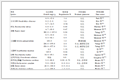
1 纤维状白云石成因类型及判别依据新元古代,尤其是埃迪卡拉纪时期,全球多个沉积盆地均有大量纤维状白云石的报道,显示出该时期独特的沉积—成岩背景。与之相比,自显生宙以来,纤维状白云石的形成与保存则明显罕见(表 1,图 1)。
|
表 1 埃迪卡拉纪—显生宙纤维状白云石和方解石的代表剖面/区域统计表 Table 1 Representative section/region of fibrous dolomite and calcite in the Ediacaran–Phanerozoic |

|
图 1 埃迪卡拉纪—显生宙纤维状白云石和方解石丰度统计图 Fig. 1 Abundance distribution of the Ediacaran–Phanerozoic fibrous dolomite and calcite 频数代表公开报道的频数/频率,其具体剖面/区域参考表 1。黑色曲线为海水Mg/Ca比值,埃迪卡拉纪与显生宙数据修改自文献[3, 5] |
纤维状白云石的成因类型可概括为原生与次生两大类。原生白云石指直接由流体沉淀形成的产物,而次生白云石则主要由文石或高镁方解石经成岩过程转化而成。在判别纤维状白云石成因类型时,需要综合多种地质学和地球化学特征,以提高判别的准确性。基于对澳大利亚成冰系礁相碳酸盐岩[3]、西伯利亚埃迪卡拉系碳酸盐台地[95]、四川盆地埃迪卡拉系灯影组[13, 92-93, 98-103]和拉伸系Beck Spring白云岩[104-105]研究的综合分析,系统总结了原生纤维状白云石与次生纤维状白云石在矿物岩石学、晶体光学及地球化学等方面的差异(表 2)。
|
|
表 2 纤维状白云石成因类型的判别依据汇总表 Table 2 Summary of distinguishment criteria for the genetic types of fibrous dolomite |
保存良好的生长环带是判别原生成因纤维状白云石的重要岩石学特征之一。该类环带在阴极发光观察下通常呈现出清晰的周期性生长结构(图 2),在扫描电镜下也可观察到结构连续、界限明确的环带状晶体生长纹理[10]。相比之下,次生成因的纤维状白云石在形成过程中通常经历了不同程度的重结晶或白云石化改造作用,难以保存清晰的环带特征,表现为斑杂状亮红色或亮红色阴极发光,甚至部分晶体顶部呈亮红色[3, 13, 105-106]。

|
图 2 澳大利亚成冰系礁相纤维状白云石单偏光(a)和阴极发光照片(b)[106] Fig. 2 Single polarization (a) and cathodoluminescence (b) photos of fibrous dolomite in Cryogenian reef complexes [106] |
纤维状白云石的结构形态也是区分成因类型的重要依据。次生成因的纤维状白云石因在一定程度上继承了文石母质或高镁方解石母质的特征,而常常展现出针状或葡萄状结构[107]。此外,具有方形终端结构的白云石晶体往往指示其为交代文石后的产物[88]。这些结构特征与原生白云石有所差异,后者通常具有更加规则、有序的纤维状结构。晶体光学特征是区分纤维状白云石成因类型的重要依据。原生成因纤维状白云石通常具有正延性光学特征,即其晶体C轴与主要生长方向的夹角较大;而交代成因的纤维状白云石则常表现为负延性光学性质,即其晶体C轴与主要生长方向之间的角度较小[3, 91, 95, 106]。
微量元素含量与白云石的成因类型密切相关。由于元素在文石、方解石和白云石中的分配系数不同,不同成因类型白云石的元素特征存在差异。特别是在成岩改造较弱的情况下,纤维状白云石的元素特征,能够指示其是否为原生沉积物[14, 23, 108]。受分配系数及微生物活动的影响,同样介质下形成的白云石较文石具有更高的Cu和Co含量[109-110]。相反,Ba和Sr会优先富集于文石,而白云石的元素含量相对较低[109, 111]。
2 埃迪卡拉纪纤维状白云石在中国的分布 2.1 四川盆地埃迪卡拉系灯影组埃迪卡拉系灯二段下部和灯四段发育大量的纤维状白云石,此类纤维状白云石广泛发育于扬子板块台地相,特别是四川盆地[13, 92-93, 98-103, 112]。根据岩石学和地球化学特征,四川盆地灯影组主要发育5种准同生期纤维状白云石。
(1)组构保留的、等厚的板状白云石(图 3a)。板状白云石在灯影组发育相对较少,主要以围绕颗粒的等厚环边产出。板状白云石晶体长约100μm,宽约30μm,且晶体边界较清晰。板状白云石具有均一消光及暗红色的阴极发光。白云石和方解石均是三方晶系,交代高镁方解石的纤维状白云石可保留柱状结构[113];而文石是斜方晶系,白云石交代文石过程会破坏沉积组构。因此等厚的板状白云石通常是交代高镁方解石母质的产物[107],如西班牙三叠系Muschelkalk群[113]。

|
图 3 四川盆地灯影组纤维状白云石显微照片及阴极发光照片[13] Fig. 3 Microscopic and cathodoluminescence photos of fibrous dolomites in Dengying Formation, Sichuan Basin [13] (a)等厚板状白云石(两条白色虚线之间)环绕在白云岩之上,后被束状—负延性白云石覆盖,磨溪9井,5440.13m;(b)束状—负延性白云石,具有葡萄状结构,磨溪9井,5757.38m;(c)束状—正延性白云石(白色虚线)被中晶白云石(红色三角形)切穿,磨溪9井,5457.76m;(d)图(c)的阴极发光照片;(e)放射状—正延性白云石的正交光照片,磨溪9井,5459.15m;(f)图(e)的阴极发光照片,指示放射状—正延性白云石的菱形生长环带 |
(2)束状—负延性白云石,生长于板状白云石之上或以第一期白云石壳的形式生长于白云岩围岩(微生物岩)之上,顶部被泥晶壳或内部沉积物覆盖。此类白云石的长度为1000~2000μm,宽可达10μm。束状—负延性白云石具有葡萄状形态(图 3b)和方形终端[88]。此类白云石具有负延性的光学特征、波状消光及斑杂状亮红色阴极发光。考虑到其典型的葡萄状结构和方形终端[114],认为其母质是文石。
(3)放射状—负延性白云石,通常直接沿着孔洞内壁生长,在手标本中呈灰黑色。此类白云石以等厚的外壳形式出现,由一层或多层纤维状快速生长的白云石组成。外壳厚度介于0.2~2.4mm,取决于其所含白云石层的数量。放射状—负延性白云石在正交光下为均一消光,在阴极发光下表现为暗红色微弱发光,部分晶体顶部呈亮红色。岩石学和晶体光学特征指示其母质为高镁方解石[115]。
(4)束状—正延性白云石,以垂直于白云岩围岩或层状裂缝充填物的形式展布(图 3c、d)。其沉淀于白云石基质或泥晶壳之上。这期等厚的白云石壳长度范围是400~1500μm,宽度可达30μm,终端以平缓的晶面结束。此类白云石晶体具有正延性的光学性质。束状白云石具有强烈的波状消光和暗红色的阴极发光。阴极发光下,可观察到保存良好的生长环带。生长环带较平滑,且平行于基底。
(5)放射状—正延性白云石,部分发育于束状—正延性白云石之上,部分则直接充填于围岩裂缝内。这期等厚白云石具有自形的结构特征,且长度范围是400~5000μm,宽度范围是20~800μm。单偏光下,可见富包裹体和贫包裹体的菱形生长环带,顶部被内部沉积物覆盖。此类白云石具有正延性的光学性质,均一消光或波状消光。阴极发光下,可观察到保存良好的暗红色—亮红色交替生长环带。阴极发光环带具有菱形形态,横向连续性好,厚度为10~30μm,近乎平行于基底沉积物(图 3e、f)。
束状—正延性白云石和放射状—正延性白云石具有保留良好的阴极发光环带及正延性光性特征,指示直接沉淀成因。相反,次生交代文石或高镁方解石过程,难以保存此类生长环带。扫描电镜显示束状—正延性白云石和放射状—正延性白云石表面发育微米级的球形白云石、铁白云石及含硫白云石[13]。此外,部分束状—正延性白云石内部可见黄铁矿颗粒,且黄铁矿核部发育白云石包裹体。
综上,等厚的板状白云石和放射状—负延性白云石均源于高镁方解石母质;束状—负延性白云石是交代文石后的产物;而束状—正延性白云石和放射状—正延性白云石则为直接沉淀形成。值得注意的是,U—Pb定年测定纤维状白云石的主要形成时间范围是572Ma±25Ma至530Ma±12Ma[116-120],与围岩发育时间一致。
2.2 扬子板块埃迪卡拉系陡山沱组盖帽碳酸盐岩扬子板块陡山沱组台地相(如九龙湾剖面和花鸡坡剖面)[15, 94]及斜坡相[11]发育纤维状白云石和纤维状方解石。其中,纤维状白云石主要分布在陡一段盖帽碳酸盐岩的下部,且进一步分为束状—负延性白云石和放射状—正延性白云石。
束状—负延性白云石主要形成于裂缝或孔隙中(图 4a),晶体呈葡萄状集合体,长度可达5000μm,宽度最大100μm,排列较为规则。表现出负延性的光学特征,并且在正交偏光显微镜下具有波状消光特征。阴极发光显示从暗红色到亮红色的渐变,且无生长环带(图 4a),指示次生交代成因。同时考虑到葡萄状胶结物为典型的文石母质形态,且重结晶过程中存在组构破坏现象[3, 94],因此,该类型白云石可能由文石通过交代作用形成。

|
图 4 扬子板块陡山沱组纤维状白云石薄片、扫描电镜和阴极发光照片 Fig. 4 Thin section, SEM and cathodoluminescence photos of fibrous dolomite in Doushantuo Formation in Yangtze Plate (a) 束状—负延性白云石,呈葡萄状形态,单偏光,右上角为同视域下的阴极发光照片,花鸡坡剖面;(b)放射状—正延性白云石,具有菱形终端,单偏光,九龙湾剖面[10];(c) 扫描电镜图像显示放射状—正延性白云石的生长带,红色虚线指示生长环带[10],花鸡坡剖面;(d、e) 单偏光和阴极发光图像显示放射状—正延性白云石的生长环带,花鸡坡剖面 |
放射状—正延性白云石通常生长在束状白云石之上,晶体呈放射状分布,单个晶体长度可达数毫米,宽度可达400μm,具有明显的等厚沉积特征(图 4b)。在光学显微镜下,表现为正延性光学性质。扫描电子显微镜观察显示该类白云石具有清晰的生长层理(图 4c),单偏光、阴极发光均呈现明暗交替的生长环带(图 4d、e)。这指示该类白云石为从古海洋或海相孔隙水中直接沉淀的白云石[10]。
2.3 塔里木盆地埃迪卡拉系奇格布拉克组塔里木盆地埃迪卡拉系奇格布拉克组顶部发育束状—负延性白云石和放射状—正延性白云石[32, 89-90, 121],主要形成时间是556Ma±17Ma至553Ma±20Ma[122-123]。束状—负延性白云石主要沿着孔洞内壁生长,其单个晶体长度在100~1000μm之间,宽度最大可达10μm,长宽比超过10∶1(图 5a)。该类白云石表现出典型的负延性光学特征,并具有斑驳的暗红色阴极发光,指示其可能源于文石或高镁方解石的次生交代作用。然而,因缺乏葡萄状结构,可排除文石母质的可能性,因而推断其应为高镁方解石经交代作用形成[32]。

|
图 5 塔里木盆地埃迪卡拉系奇格布拉克组白云石薄片及阴极发光显微照片[32] Fig. 5 Thin section and cathodoluminescence microscopic photos of fibrous dolomite in the Ediacaran Qigebulake Formation in Tarim Basin [32] (a) 阴极发光显微照片,束状—负延性白云石为斑驳的暗红色,右上角插图为该视图的单偏光照片,肖尔布拉克露头;(b) 白云岩围岩被束状—负延性白云石及放射状—正延性白云石覆盖,肖尔布拉克露头;(c) 白云岩被放射状—正延性白云石、内部白云石沉积物(蓝色三角形)及粗晶白云石覆盖,肖尔布拉克露头;(d) 阴极发光照片,展示放射状—正延性白云石的菱形生长分带(三角标示),肖尔布拉克露头 |
放射状—正延性白云石在塔里木盆地有两种形式:(1)生长于束状—负延性白云石之上(图 5b);(2)在孔洞或裂缝上直接沉淀形成等厚的白云石环边(图 5c)。晶体较自形,长度介于400~1500μm,宽度范围为20~200μm,长宽比在6∶1~10∶1之间。这种白云石通常形成放射状结构,最大厚度可达3mm。在光学显微镜下,表现为正延性光学性质。在正交偏光下表现为均一消光,阴极发光下呈现暗红色与亮红色交替分布的环带状发光结构(图 5d)。该类白云石表现出正延性光学性质并发育明显的生长环带,指示其为直接沉淀成因[32]。
3 纤维状白云石的成因机制和意义 3.1 纤维状白云石成因机制近年来,关于新元古代纤维状白云石的研究逐渐增多[3, 95, 104-106],并认为其形成受到多种环境因素的影响,包括缺氧的海水环境、低硫酸根浓度、高Mg/Ca比值及高碱度等条件的共同作用。这些因素有助于白云石的沉淀。然而,同期地层中也发现文石和高镁方解石母质的存在,表明白云石的沉淀机制可能并非单一过程,而是受多种物理化学条件及微生物活动的共同控制,成因机制更为复杂。深入探讨这些控制因素之间的相互作用,不仅有助于深化对新元古代海洋地球化学背景的理解,也为厘清白云石的成因机制及其在沉积环境中的指示意义提供了新的研究视角。
海水的Mg/Ca比值是控制CaCO3同质异像体的关键因素[124]。埃迪卡拉纪末期海水Mg/Ca比值的变化范围是4∶1~6∶1[125-127],近地表海水温度主要范围是20~25℃[128]。参考Mg/Ca比值和温度交会图[127],埃迪卡拉纪末期海洋有利于文石和高镁方解石的沉淀。这一推论与前寒武系大量出现的文石和高镁方解石母质现象相一致,进一步支持了海洋环境对碳酸盐矿物沉淀的控制作用。
值得注意的是,前人利用Phreeqc软件计算得出,埃迪卡拉纪海水中白云石的饱和指数为4.7,而同期海相孔隙水的饱和指数达5.1[32]。尽管古海水对白云石处于过饱和状态,受动力学条件的限制,白云石在近地表环境中的直接沉淀仍较为困难[129]。这可能是因为Mg2+与水分子间存在较强的键合能力,常温条件下Mg2+与水分子键合形成富水络合物,阻碍了Mg2+与CO32-的结合,使得白云石难以成核生长[130-131]。这表明,除热力学驱动外,动力学屏障也是限制白云石成核与生长的关键因素。因此亟须进一步探讨可能的促进机制,例如微生物介导过程、蒸发作用或局部微环境条件对纤维状白云石沉淀动力学的影响。
埃迪卡拉纪海洋环境的显著特征之一是区域性缺氧,其中海水表层通常处于半氧化—缺氧状态[132-134]。全球硫循环减缓,导致海水中硫酸根(SO42-)浓度(1~3mM)远低于现代水平(28mM)[135]。这种富H2S、低硫酸根的缺氧性水体环境有利于硫酸盐还原菌和甲烷氧化菌等异养微生物的活跃代谢,加速有机质降解和碳酸盐离子过饱和。
微生物硫酸盐还原作用在埃迪卡拉纪纤维状白云石的形成过程中发挥了重要作用。相关岩石学和地球化学证据包括:(1)氧化还原性敏感元素指示负延性白云石主要形成于近地表的半氧化海水环境,如四川盆地灯影组负延性白云石的Ce异常为0.70± 0.17[13]。相比之下,束状—正延性白云石和放射状—正延性白云石形成于缺氧的海相孔隙水环境,如扬子板块埃迪卡拉系盖帽碳酸盐岩和四川盆地灯影组正延性白云石Ce异常分别为1.00±0.48[10]和0.85± 0.23[13]至0.89±0.13[89],指示缺氧水体环境。(2)扫描电镜观察显示四川盆地灯影组纤维状白云石表面发育含铁或含硫的球形或哑铃状纳米级白云石及矿化的胞外聚合物[13, 98],是典型的硫酸盐还原菌活动产物。(3)四川盆地灯影组中,与纤维状白云石共生的黄铁矿颗粒具有“U”形分布的原位硫同位素特征:边缘硫同位素值高(δ34S: 24.7‰±5.6‰),而核部的硫同位素值相对较低(15.1‰±2.9‰)[13]。这与封闭环境下硫酸盐还原作用的动力学分馏有关,记录微生物硫酸盐还原过程[136]。这些证据共同指向微生物硫酸盐还原作用在埃迪卡拉纪纤维状白云石形成中的关键作用。微生物硫酸盐还原作用可通过多种机制克服白云石沉淀的动力学障碍,从而促进其沉淀,包括:(1)释放MgSO4中的Mg2+[137];(2)促进水和镁离子的脱离[7];(3)提高流体介质的碱度[137]。在微生物活动增强或白云石饱和度较高的条件下,更有利于纤维状白云石的成核与定向沉淀[138-140]。类似地,中新世纤维状白云石的形成同样与硫酸盐还原作用密切相关[141]。值得注意的是,本文认为仍需结合更多类似盆地的资料,进一步检验和论证微生物硫酸盐还原作用对纤维状白云石沉淀的促进机制。
强烈的蒸发作用也可能在扬子板块和塔里木盆地埃迪卡拉纪纤维状白云石及基质白云石的形成过程中发挥重要促进作用。该时期,两地区位于热带至低纬度,气候炎热干燥,蒸发强度高。在受限的台地环境或半封闭的海洋体系中,持续的蒸发作用可显著提升海水的Mg/Ca比值,从而降低白云石沉淀的动力学障碍,增强其沉淀潜力,进而有利于不同类型白云石的形成与发育[116]。埃迪卡拉纪海水普遍较高的碱度为碳酸盐矿物的沉淀提供了有利条件[88]。相较于海水,海相孔隙水虽在Mg2+和Ca2+浓度上有所降低,但其更高的碱度与升高的Mg/Ca比值可有效提高白云石的饱和度[142-143],从而进一步促进其沉淀。上述这些机制在埃迪卡拉纪海相孔隙水中协同降低白云石沉淀的动力学障碍,最终促成纤维状白云石的区域性乃至广泛分布[95, 104, 108]。
综合扬子板块与塔里木盆地的研究表明,埃迪卡拉纪末期纤维状白云石的形成受多种环境因素协同控制:埃迪卡拉纪海水具有高Mg/Ca比值、高碱度和低硫酸根浓度。这为碳酸盐矿物的直接沉淀创造了有利条件,并控制了基质的形成。相应地,早期纤维状胶结物主要沉淀于相对开放的沉积物—海水界面,其形成环境以半氧化—缺氧水体为特征,矿物组成为文石和高镁方解石(图 6a、b)。强烈的蒸发作用进一步提升了受限海域海水的Mg/Ca比值。随后,孔隙水体系中局部出现的缺氧,甚至硫化环境,为硫酸盐还原菌提供了适宜的生态位,其代谢过程不仅释放Mg2+、提升pH值与碱度,还有效克服了白云石沉淀的动力学障碍,进而促进了晚期海相孔隙水环境下原生成因纤维状白云石的成核与定向生长(图 6c)。这些因素在特定的沉积—成岩体系中共同作用,促成了埃迪卡拉纪纤维状白云石的区域性分布,也反映出当时古海洋环境的独特地球化学特征。

|
图 6 微生物礁相纤维状白云石胶结物充填过程示意图 Fig. 6 Schematic filling process of fibrous dolomite cement of biological reef facies (a)四川盆地灯影组;(b)九龙湾剖面陡山沱组盖帽碳酸盐岩;(c)四川盆地灯影组,塔里木盆地奇格布拉克组 |
古环境重建研究传统上依赖碳酸盐岩和页岩的全岩数据。这些岩性因其在沉积过程中对古气候、古水体条件及成岩作用的敏感响应,成为提取古环境信息的重要载体。相较之下,纤维状白云石具有以下显著优势:(1)部分类型白云石(如束状—正延性白云石和放射状—正延性白云石)直接沉淀自古海水或近地表孔隙水,尽可能避免陆源碎屑的污染;(2)具有相对稳定的热力学特性,能够较好地保存原始流体信号,是恢复古流体信息的理想载体。
基于地球化学参数,前人研究认为扬子板块陡一段台地相和斜坡相纤维状白云石分别记录了海水[10]和热液流体[11]的信号;四川盆地灯影组纤维状白云石记录的流体类型,包括:大气水[100, 102]、海水[13, 91-92, 144]和混合水[145];塔里木盆地奇格布拉克组纤维状白云石可能记录的流体类型,包括:海水[32]和大气水[89-90]。
相较于其他埃迪卡拉纪纤维状白云石,扬子板块陡一段的纤维状白云石具有偏负的碳同位素和氧同位素值(图 7),并富集锰元素和铁元素[10]。台地相和斜坡相纤维状白云石的碳同位素(δ13C)最低值分别达-6.4‰[146]和-7.0‰[11]。激光剥蚀—电感耦合等离子体质谱结果指示台地相束状—负延性白云石表现出典型的海水信号,即重稀土元素富集;而放射状—正延性白云石具有相对平坦的稀土元素配分特征[10]。受热液流体的影响,斜坡相纤维状白云石具有典型的中稀土元素富集特征[11]。这可能与冰期后的古海洋分层相关。

|
图 7 中国埃迪卡拉系白云岩围岩与纤维状白云石碳氧同位素交会图(数据来自文献[10-11, 13, 89, 94, 152]) Fig. 7 Cross plot of carbon and oxygen isotopes between dolomite host rock and fibrous dolomite in the Ediacaran in China (data from references [10-11, 13, 89, 94, 152]) |
四川盆地灯影组纤维状白云石的碳和氧同位素值(图 7)和锶同位素比值(87Sr/86Sr:0.7091± 0.0002)[13]与全球范围内的同期海相沉积岩一致[146-148]。值得注意的是,部分纤维状白云石的锶同位素比值较高[100, 102],可能与样品的钻取方法及是否经受重结晶作用相关。激光剥蚀—电感耦合等离子体质谱测试结果表明,束状—负延性白云石与束状(和放射状)—正延性白云石均具有典型的重稀土元素富集信号,而束状—负延性白云石的负Ce异常更显著。这可能与束状—负延性白云石形成于相对开放的半氧化古海水有关[13]。相比之下,灯影组白云岩全岩普遍表现出平坦或中稀土富集的稀土配分曲线特征,且Y/Ho比值接近球粒陨石[149-150]。这一方面可能与全岩样品处理过程中使用HF和HNO3等强酸有关[149-150];另一方面全岩可能受到淡水、碎屑矿物或成岩作用的影响[151]。此类样品是否真实记录了沉积流体信号,存在不确定性。因此,保存较好的四川盆地灯影组纤维状白云石更好地记录了同期海水(或是海相孔隙水),且高精度的单成分分析较传统的全岩分析更能准确地恢复古流体信号。
塔里木盆地齐格布拉克组纤维状白云石与四川盆地灯影组纤维状白云石及同期海相白云岩的碳、氧同位素范围一致(图 7),且其锶同位素比值(0.7093±0.0001[32]、0.7089~0.7094[89])与埃迪卡拉纪海相沉积岩类似[147-148]。值得注意的是,激光剥蚀—电感耦合等离子体质谱测试结果同样表明沿着纤维状白云石晶体的生长方向,稀土配分曲线特征由重稀土富集逐渐演化为平坦的稀土元素分布特征[32]。纤维状白云石负Ce异常为0.8±0.2,与四川盆地灯影组纤维状白云石的古流体信号类似。
因此,纤维状白云石凭借其独特的成因机制与较强的地球化学稳定性,在古环境重建研究中展现出重要的指示意义。不仅可有效指示古海水/流体的氧化还原状态、成分来源及时空演化,还可反映古海洋中的热液活动等关键环境过程。作为埃迪卡拉纪海洋—孔隙水体系演化的载体,纤维状白云石为深入解析前寒武纪海洋化学背景及其对早期生命演化的制约机制提供了可靠的地质记录与研究支撑。
3.3 中国埃迪卡拉纪纤维状白云石的油气地质意义四川盆地灯影组是重要的海相碳酸盐岩储层,其中纤维状白云石胶结物多充填于溶洞或层状裂缝。溶洞的形成多与近地表阶段的岩溶作用密切相关,该过程有利于次生孔隙的产生与碳酸盐岩储层的发育[153]。结果显示,以磨溪9井灯二段为例,5428.4~5457.8m井段发育大量纤维状白云石胶结物,其面孔率平均为4.7%(n=7),显著高于叠层石(2.3%)和泥晶云岩(1.5%)[154]。塔里木盆地埃迪卡拉系奇格布拉克组纤维状白云石部分充填溶洞,残留一定的储集空间[155]。虽然胶结作用在一定程度上降低了孔隙度,但这些胶结物在早成岩阶段即已发生白云石化,从而增强了岩石的抗压实能力。纤维状胶结物对孔洞具有一定的支撑作用,使得孔隙在后续埋藏过程中得以较好保存。类似现象在其他盆地也有报道:如二叠系美国Midland盆地台缘带虽然发育纤维状方解石胶结物,但储层物性较好[156];渐新世印度尼西亚Kutei盆地台缘带虽经历显著的碳酸盐矿物胶结作用,但受晚期酸性流体优先溶蚀的影响,孔隙度高于台内带[157]。相反,澳大利亚泥盆系Canning盆地由于大量方解石胶结且缺乏有效的晚期溶蚀改造,储层性能显著下降[158]。
4 结论(1)原生成因与次生成因纤维状白云石在岩石学、光学性质及地球化学参数等方面存在差异:前者通常呈现纤维状结构,具正延性光学特征,清晰的生长环带;后者则多表现为针状、葡萄状结构或终端呈方形,具负延性光学性质,且受重结晶作用影响,无生长环带。微量元素在识别白云石的成因类型中具有潜在指示意义。
(2)中国扬子板块埃迪卡拉系陡一段、埃迪卡拉系灯二段和灯四段及塔里木盆地埃迪卡拉系奇格布拉克组发育多种类型纤维状白云石,包括:板状白云石、束状—负延性白云石、放射状—负延性白云石、束状—正延性白云石和放射状—正延性白云石。前3者主要由近地表环境下白云石交代文石或高镁方解石,而后两者则为直接沉淀的原生白云石。
(3)埃迪卡拉纪末期纤维状白云石的形成受多重环境因素协同控制。高Mg/Ca比值、高碱度和低硫酸根浓度的海水背景,促使文石与高镁方解石母质类纤维状矿物沉淀。蒸发作用进一步提升Mg/Ca比值,缺氧环境下硫酸盐还原菌的代谢活动释放Mg2+、提高pH值与碱度,有效克服沉淀障碍,促进原生纤维状白云石的成核与生长。
(4)中国埃迪卡拉纪纤维状白云石主要记录了同期海水或海相孔隙水的信号,部分与热液流体相关。纤维状白云石独特的地球化学特征能够较为准确地记录古海洋环境的演化及关键的地球化学变化,为深入解析前寒武纪海洋化学背景及其对早期生命演化的制约机制提供了可靠的地质记录。
(5)纤维状胶结物虽降低孔隙度,但其支撑作用及晚期溶蚀改造有助于孔隙保存与改善储层性能。
| [1] |
Land L S. Failure to precipitate dolomite at 25℃ from dilute solution despite 1000-fold oversaturation after 32 years[J]. Aquatic Geochemistry, 1998, 4(3): 361-368. |
| [2] |
Warren J. Dolomite: occurrence, evolution and economically important associations[J]. Earth-Science Reviews, 2000, 52(1-3): 1-81. DOI:10.1016/S0012-8252(00)00022-2 |
| [3] |
Hood A V, Wallace M W. Neoproterozoic marine carbonates and their paleoceanographic significance[J]. Global and Planetary Change, 2018, 160: 28-45. DOI:10.1016/j.gloplacha.2017.11.006 |
| [4] |
Canfield D E, Farquhar J. Animal evolution, bioturbation, and the sulfate concentration of the oceans[J]. Proceedings of the National Academy of Sciences, 2009, 106(20): 8123-8127. DOI:10.1073/pnas.0902037106 |
| [5] |
Lowenstein T K, Timofeeff M N, Brennan S T, et al. Oscillations in Phanerozoic seawater chemistry: evidence from fluid inclusions[J]. Science, 2001, 294(5544): 1086-1088. DOI:10.1126/science.1064280 |
| [6] |
Meister P. Two opposing effects of sulfate reduction on carbonate precipitation in normal marine, hypersaline, and alkaline environments[J]. Geology, 2013, 41(4): 499-502. DOI:10.1130/G34185.1 |
| [7] |
由雪莲, 孙枢, 朱井泉, 等. 微生物白云岩模式研究进展[J]. 地学前缘, 2011, 18(4): 52-64. You Xuelian, Sun Shu, Zhu Jingquan, et al. Progress in the study of microbial dolomite model[J]. Earth Science Frontiers, 2011, 18(4): 52-64. |
| [8] |
Petrash D A, Bialik O M, Bontognali T R R, et al. Microbially catalyzed dolomite formation: from near-surface to burial[J]. Earth-Science Reviews, 2017, 171: 558-582. DOI:10.1016/j.earscirev.2017.06.015 |
| [9] |
Wallace M W, Shuster A, Greig A, et al. Oxygenation history of the Neoproterozoic to early Phanerozoic and the rise of land plants[J]. Earth and Planetary Science Letters, 2017, 466: 12-19. DOI:10.1016/j.epsl.2017.02.046 |
| [10] |
Hu Y, Cai C, Sun P, et al. Palaeo-environmental significance of fibrous carbonate cement in Marinoan cap carbonates[J]. Marine and Petroleum Geology, 2023, 106392. |
| [11] |
Zhao Y Y, Zhao M Y, Li S Z. Evidences of hydrothermal fluids recorded in microfacies of the Ediacaran cap dolostone: geochemical implications in South China[J]. Precambrian Research, 2018, 306: 1-21. DOI:10.1016/j.precamres.2017.12.028 |
| [12] |
王家生, 王舟, 胡军, 等. 华南新元古代"盖帽"碳酸盐岩中甲烷渗漏事件的综合识别特征[J]. 地球科学——中国地质大学学报, 2012, 37(增刊2): 14-22. Wang Jiasheng, Wang Zhou, Hu Jun, et al. Multiple proxies indicating methane seepage during the Neoproterozoic cap carbonate in South China[J]. Earth Science—Journal of China University of Geosciences, 2012, 37(S2): 14-22. |
| [13] |
Hu Y, Cai C, Liu D, et al. Formation, diagenesis and palaeoenvironmental significance of upper Ediacaran fibrous dolomite cements[J]. Sedimentology, 2020, 67(2): 1161-1187. DOI:10.1111/sed.12683 |
| [14] |
Álvaro J J, Debrenne F. The Great Atlasian Reef complex: an early Cambrian subtropical fringing belt that bordered West Gondwana[J]. Palaeogeography, Palaeoclimatology, Palaeoecology, 2010, 294(3-4): 120-132. DOI:10.1016/j.palaeo.2009.11.022 |
| [15] |
Mei M, Latif K, Mei C, et al. Thrombolitic clots dominated by filamentous cyanobacteria and crusts of radio-fibrous calcite in the Furongian Changshan Formation, North China[J]. Sedimentary Geology, 2020, 395: 105540. DOI:10.1016/j.sedgeo.2019.105540 |
| [16] |
Lee J H, Chen J, Woo J. The earliest Phanerozoic carbonate hardground (Cambrian Stage 5, Series 3): implications to the paleoseawater chemistry and early adaptation of hardground fauna[J]. Palaeogeography, Palaeoclimatology, Palaeoecology, 2015, 440: 172-179. DOI:10.1016/j.palaeo.2015.07.043 |
| [17] |
Wet C B, Frey H M, Gaswirth S B, et al. Origin of meter-scale submarine cavities and herringbone calcite cement in a Cambrian microbial reef, Ledger Formation (USA)[J]. Journal of Sedimentary Research, 2004, 74(6): 914-923. DOI:10.1306/040404740914 |
| [18] |
Whittaker S G, James N P, Kyser T K. Geochemistry of synsedimentary cements in Early Cambrian reefs[J]. Geochimica et Cosmochimica Acta, 1994, 58(24): 5567-5577. DOI:10.1016/0016-7037(94)90250-X |
| [19] |
James N P, Klappa C F. Petrogenesis of early Cambrian reef limestones, Labrador, Canada[J]. Journal of Sedimentary Research, 1983, 53(4): 1051-1096. |
| [20] |
Pratt B R. Deep-water Girvanella-Epiphyton reef on a mid-Cambrian continental slope, Rockslide Formation, Mackenzie Mountains, Northwest Territories[M]. Geldsetzer H H J, James N P, Tebbutt G E, Eds. Reefs: Canada and Adjacent Areas. Canadian Society of Petroleum Geologists Memoir 13, Calgary, Alberta, 1989: 161-164.
|
| [21] |
Pratt B R. Tepees in peritidal carbonates: origin via earthquake-induced deformation, with example from the Middle Cambrian of western Canada[J]. Sedimentary Geology, 2002, 153(3-4): 57-64. DOI:10.1016/S0037-0738(02)00318-4 |
| [22] |
James N P, Gravestock D I. Lower Cambrian shelf and shelf margin buildups, Flinders ranges, South Australia[J]. Sedimentology, 1990, 37(3): 455-480. DOI:10.1111/j.1365-3091.1990.tb00147.x |
| [23] |
Clarke J D A. An Early Cambrian carbonate platform near Wilkawillina Gorge, South Australia[J]. Australian Journal of Earth Sciences, 1990, 37(4): 471-483. DOI:10.1080/08120099008727946 |
| [24] |
Kim J C, Lee Y I. Marine diagenesis of Lower Ordovician carbonate sediments (Dumugol Formation), Korea: cementation in a calcite sea[J]. Sedimentary Geology, 1996, 105(3-4): 241-257. DOI:10.1016/0037-0738(95)00141-7 |
| [25] |
Kim Y, Lee Y I. Radiaxial fibrous calcites as low-magnesian calcite cement precipitated in a marine-meteoric mixing zone[J]. Sedimentology, 2003, 50(4): 731-742. DOI:10.1046/j.1365-3091.2003.00573.x |
| [26] |
Brett C E, Brookfield M E. Morphology, faunas and genesis of Ordovician hardgrounds from southern Ontario, Canada[J]. Palaeogeography, Palaeoclimatology, Palaeoecology, 1984, 46(4): 233-290. DOI:10.1016/0031-0182(84)90001-4 |
| [27] |
Kröger B, Ebbestad J O R, Lehnert O. Accretionary mechanisms and temporal sequence of formation of the Boda Limestone mud-mounds (Upper Ordovician), Siljan District, Sweden[J]. Journal of Sedimentary Research, 2016, 86(4): 363-379. DOI:10.2110/jsr.2016.12 |
| [28] |
Tobin K J, Walker K R. Ordovician low-to intermediate-Mg calcite marine cements from Sweden: marine alteration and implications for oxygen isotopes in Ordovician seawater[J]. Sedimentology, 1996, 43(4): 719-735. DOI:10.1111/j.1365-3091.1996.tb02022.x |
| [29] |
Möller N K, Kvingan K. The genesis of nodular limestones in the Ordovician and Silurian of the Oslo Region (Norway)[J]. Sedimentology, 1988, 35(3): 405-420. DOI:10.1111/j.1365-3091.1988.tb00994.x |
| [30] |
Tobin K J, Walker K R, Steinhauff D M, et al. Fibrous calcite from the Ordovician of Tennessee: preservation of marine oxygen isotopic composition and its implications[J]. Sedimentology, 1996, 43(2): 235-251. DOI:10.1046/j.1365-3091.1996.d01-2.x |
| [31] |
Lee J H, Lee D J. Mid-Late Ordovician tetradiid-calcimicrobial-cement reef: a new, peculiar reef-building consortium recording global cooling[J]. Global and Planetary Change, 2021, 200: 103462. DOI:10.1016/j.gloplacha.2021.103462 |
| [32] |
Hu Y, Cai C, Li Y, et al. Upper Ediacaran fibrous dolomite versus Ordovician fibrous calcite cement: origin and significance as a paleoenvironmental archive[J]. Chemical Geology, 2022, 609: 121065. DOI:10.1016/j.chemgeo.2022.121065 |
| [33] |
Noble J P A. The Late Silurian LaPlante Reefs of northern New Brunswick, Canada[C]. Cspg Special Publications, 1988: 344-349.
|
| [34] |
Neuser R D, Richter D K. Non-marine radiaxial fibrous calcites: examples of speleothems proved by electron backscatter diffraction[J]. Sedimentary Geology, 2007, 194(3-4): 149-154. DOI:10.1016/j.sedgeo.2006.05.015 |
| [35] |
Kendall A C. Fascicular-optic calcite; a replacement of bundled acicular carbonate cements[J]. Journal of Sedimentary Research, 1977, 47(3): 1056-1062. |
| [36] |
Krebs W. Early void-filling cementation in Devonian fore-reef limestones (Germany)[J]. Sedimentology, 1969, 12(3-4): 279-299. DOI:10.1111/j.1365-3091.1969.tb00879.x |
| [37] |
Kendall A C, Tucker M E. Radiaxial fibrous calcite as a replacement after syn-sedimentary cement[J]. Nature Physical Science, 1971, 232(29): 62-63. DOI:10.1038/physci232062a0 |
| [38] |
Kendall A C. Radiaxial fibrous calcite: a reappraisal[J]. Carbonate Cements, 1985, 1: 59-77. |
| [39] |
Dickson J A D. Crystal growth diagrams as an aid to interpreting the fabrics of calcite aggregates[J]. Journal of Sedimentary Research, 1993, 63(1): 1-17. |
| [40] |
Lindholm R C. Fabric and chemistry of pore filling calcite in septarian veins; models for limestone cementation[J]. Journal of Sedimentary Research, 1974, 44(2): 428-440. |
| [41] |
Carpenter S J, Lohmann K C, Holden P, et al. δ18O values, 87Sr/86Sr and Sr/Mg ratios of Late Devonian abiotic marine calcite: implications for the composition of ancient seawater[J]. Geochimica et Cosmochimica Acta, 1991, 55(7): 1943-1959. |
| [42] |
MacKenzie W S. Fibrous calcite, a Middle Devonian geologic marker, with stratigraphic significance, District of Mackenzie, Northwest Territories[J]. Canadian Journal of Earth Sciences, 1972, 9(11): 1431-1440. DOI:10.1139/e72-127 |
| [43] |
Cavalazzi B, Barbieri R, Ori G G. Chemosynthetic microbialites in the Devonian carbonate mounds of Hamar Laghdad (Anti-Atlas, Morocco)[J]. Sedimentary Geology, 2007, 200(1-2): 73-88. DOI:10.1016/j.sedgeo.2007.03.002 |
| [44] |
Denayer J. From mud to limestone: birth and growth of a giant reef in the Eifelian (Middle Devonian) of Belgium[J]. Palaeogeography, Palaeoclimatology, Palaeoecology, 2023, 627: 111748. DOI:10.1016/j.palaeo.2023.111748 |
| [45] |
Antoshkina A I. Calcite microspherulites as a reflection of the relationship between abiotic processes and biological mechanisms[C]// International Symposium Biogenic-abiogenic interactions in natural and anthropogenic systems. Cham: Springer International Publishing, 2022: 167-182.
|
| [46] |
Hurley N F, Lohmann K C. Diagenesis of Devonian reefal carbonates in the Oscar Range, Canning Basin, Western Australia[J]. Journal of Sedimentary Research, 1989, 59(1): 127-146. |
| [47] |
Van der Kooij B, Immenhauser A, Steuber T, et al. Controlling factors of volumetrically important marine carbonate cementation in deep slope settings[J]. Sedimentology, 2010, 57(6): 1491-1525. DOI:10.1111/j.1365-3091.2010.01153.x |
| [48] |
Chenrai P, Assawincharoenkij T, Warren J, et al. The occurrence of bedding-parallel fibrous calcite veins in permian siliciclastic and carbonate rocks in Central Thailand[J]. Frontiers in Earth Science, 2022, 9: 781782. DOI:10.3389/feart.2021.781782 |
| [49] |
Davies G R, Nassichuk W W. Submarine cements and fabrics in Carboniferous to Lower Permian, reefal shelf margin and slope carbonates, northwestern Ellesmere Island, Canadian Arctic Archipelago[J]. Bulletin of the Geological Survey of Canada, 1990, 399: 1-77. |
| [50] |
Kendall A C, Tucker M E. Radiaxial fibrous calcite: a replacement after acicular carbonate[J]. Sedimentology, 1973, 20(3): 365-389. DOI:10.1111/j.1365-3091.1973.tb01616.x |
| [51] |
Kirkham A, Tucker M E. Thrombolites, spherulites and fibrous crusts (Holkerian, Purbeckian, Aptian): context, fabrics and origins[J]. Sedimentary Geology, 2018, 374: 69-84. DOI:10.1016/j.sedgeo.2018.07.002 |
| [52] |
Wright V P. The significance of needle-fibre calcite in a Lower Carboniferous palaeosol[J]. Geological Journal, 1984, 19(1): 23-32. DOI:10.1002/gj.3350190103 |
| [53] |
Mazzullo S J, Cys J M. Marine aragonite sea-floor growths and cements in Permian phylloid algal mounds, Sacramento Mountains, New Mexico[J]. Journal of Sedimentary Research, 1979, 49(3): 917-936. |
| [54] |
Stanton Jr R J, Pray L C. Skeletal-carbonate Neptunian dikes of the Capitan reef: Permian, Guadalupe Mountains, Texas, USA[J]. Journal of Sedimentary Research, 2004, 74(6): 805-816. DOI:10.1306/042704740805 |
| [55] |
Vennin E. Coelobiontic communities in neptunian fissures of synsedimentary tectonic origin in Permian reef, southern Urals, Russia[J]. Geological Society, London, Special Publications, 2007, 275: 191-204. |
| [56] |
Rahnis M A, Kirkland B L. Distribution, petrography and geochemical characterization of radiaxial calcite and associated diagenetic events in the Capitan Formation, west Texas and New Mexico[J]. USGS Professional Paper, 1999, 65: 176-189. |
| [57] |
Kershaw S, Guo L. Beef and cone-in-cone calcite fibrous cements associated with the end-Permian and end-Triassic mass extinctions: reassessment of processes of formation[J]. Journal of Palaeogeography, 2016, 5(1): 28-42. DOI:10.1016/j.jop.2015.11.003 |
| [58] |
Halley R B, Scholle P A. Radiaxial fibrous calcite as early-burial, open-system cement: isotopic evidence from Permian of China[J]. AAPG Bulletin, 1985, 69(2): 261-261. |
| [59] |
Liu H, Rigby J K. Diagenesis of the Upper Permian Jiantianba Reef, West Hubei, China[J]. Journal of Sedimentary Research, 1992, 62(3): 367-381. |
| [60] |
Satterley A K, Marshall J D, Fairchild I J. Diagenesis of an Upper Triassic reef complex, Wilde Kirche, Northern Calcareous Alps, Austria[J]. Sedimentology, 1994, 41(5): 935-950. DOI:10.1111/j.1365-3091.1994.tb01433.x |
| [61] |
Christ N, Immenhauser A, Amour F, et al. Triassic Latemar cycle tops—Subaerial exposure of platform carbonates under tropical arid climate[J]. Sedimentary Geology, 2012, 265: 1-29. |
| [62] |
Russo F, Mastandrea A, Stefani M, et al. Carbonate facies dominated by syndepositional cements: a key component of Middle Triassic platforms. The Marmolada case history (Dolomites, Italy)[J]. Facies, 2000, 42(1): 211-226. DOI:10.1007/BF02562573 |
| [63] |
Al-Aasm I S, Coniglio M, Desrochers A. Formation of complex fibrous calcite veins in Upper Triassic strata of Wrangellia Terrain, British Columbia, Canada[J]. Sedimentary Geology, 1995, 100(1-4): 83-95. DOI:10.1016/0037-0738(95)00104-2 |
| [64] |
Liu G, Liu X, Ma X, et al. Genesis of fibrous calcite in the Chang 7 Member of the Yanchang Formation, Ordos Basin, China[J]. Acta Geologica Sinica (English Edition), 2023, 97(5): 1490-1502. DOI:10.1111/1755-6724.15079 |
| [65] |
Wang G, Hao F, Chang X, et al. Quantitative analyses of porosity evolution in tight grainstones: a case study of the Triassic Feixianguan formation in the Jiannan gas field, Sichuan Basin, China[J]. Marine and Petroleum Geology, 2017, 86: 259-267. DOI:10.1016/j.marpetgeo.2017.05.021 |
| [66] |
Payne J L, Lehrmann D J, Christensen S, et al. Environmental and biological controls on the initiation and growth of a Middle Triassic (Anisian) reef complex on the Great Bank of Guizhou, Guizhou Province, China[J]. Palaios, 2006, 21(4): 325-343. DOI:10.2110/palo.2005.P05-58e |
| [67] |
Hips K. Sedimentary aspects of the onset of Middle Triassic continental rifting in the western end of Neotethys; inferences from the Silica and Torna Nappes, NE Hungary: a review[J]. Facies, 2022, 68(3): 8. DOI:10.1007/s10347-022-00646-3 |
| [68] |
Aubrecht R, Józsa Š, PlaŠienka D, et al. Mid-Cretaceous turnover in the Oravic segment of the Pieniny Klippen Belt (Western and Eastern Carpathians): new data and synthesis[J]. Cretaceous Research, 2022, 140: 105323. DOI:10.1016/j.cretres.2022.105323 |
| [69] |
Purser B H. Syn-sedimentary marine lithification of Middle Jurassic limestones in the Paris Basin[J]. Sedimentology, 1969, 12(3-4): 205-230. DOI:10.1111/j.1365-3091.1969.tb00875.x |
| [70] |
Gray A F, Adams A E. Sheet voids and radiaxial fibrous calcite cement fills from Upper Jurassic beachrock, Calcaires Blancs de Provence, southeast France[J]. Carbonates and Evaporites, 1995, 10(2): 252-260. DOI:10.1007/BF03175410 |
| [71] |
Wilkinson B H, Smith A L, Lohmann K C. Sparry calcite marine cement in Upper Jurassic limestones of southeastern Wyoming[M]. Schneidermann N, Harris P M, Eds. Carbonate Cements. Society economic Paleontologists and Mineralogists, 1985: 169-184.
|
| [72] |
Aissaoui D M, Purser B H. Nature and origins of internal sediments in Jurassic limestones of Burgundy (France) and Fnoud (Algeria)[J]. Sedimentology, 1983, 30(2): 273-283. DOI:10.1111/j.1365-3091.1983.tb00670.x |
| [73] |
Wilson R C L. Diagenetic carbonate fabric variations in Jurassic limestones of southern England[J]. Proceedings of the Geologists'Association, 1967, 78(4): 535-554. DOI:10.1016/S0016-7878(68)80002-1 |
| [74] |
Reinhold C. Ancient helictites and the formation of vadose crystal silt in Upper Jurassic carbonates (Southern Germany)[J]. Journal of Sedimentary Research, 1998, 68(3): 378-390. DOI:10.2110/jsr.68.378 |
| [75] |
Koch R, Ogorelec B. Biogenic constituents, cement types, and sedimentary fabrics: their interrelations in Lower Cretaceous (Valanginian to Hauterivian) peritidal carbonate sediments (Trnovo, NW Slovenia)[J]. Sediments and Environmental Geochemistry, 1990, 95-123. |
| [76] |
Wilson P A, Dickson A D. Radiaxial calcite: alteration product of and petrographic proxy for magnesian calcite marine cement[J]. Geology, 1996, 24(10): 945-948. DOI:10.1130/0091-7613(1996)024<0945:RCAPOA>2.3.CO;2 |
| [77] |
Nehza O, Woo K S. The effect of subaerial exposure on the morphology and microstructure of stromatolites in the Cretaceous Sinyangdong Formation, Gyeongsang Supergroup, Korea[J]. Sedimentology, 2006, 53(5): 1121-1133. DOI:10.1111/j.1365-3091.2006.00804.x |
| [78] |
Immenhauser A, Van Der Kooij B, Van Vliet A, et al. An ocean-facing Aptian-Albian carbonate margin, Oman[J]. Sedimentology, 2001, 48(6): 1187-1207. DOI:10.1046/j.1365-3091.2001.00416.x |
| [79] |
Scheffler F, Immenhauser A, Pourteau A, et al. A lost Tethyan evaporitic basin: evidence from a Cretaceous hemipelagic meta-selenite-red chert association in the Eastern Mediterranean realm[J]. Sedimentology, 2019, 66(7): 2627-2660. DOI:10.1111/sed.12606 |
| [80] |
Woo K S, Anderson T F, Sandberg P A. Diagenesis of skeletal and nonskeletal components of mid-Cretaceous limestones[J]. Journal of Sedimentary Research, 1993, 63(1): 18-32. |
| [81] |
Carvalho A M A, Hamon Y, De Souza Jr O G, et al. Facies and diagenesis distribution in an Aptian pre-salt carbonate reservoir of the Santos Basin, offshore Brazil: a comprehensive quantitative approach[J]. Marine and Petroleum Geology, 2022, 141: 105708. DOI:10.1016/j.marpetgeo.2022.105708 |
| [82] |
Aubrecht R, Schlögl J, Krobicki M I C H A Ł, et al. Middle Jurassic stromatactis mud-mounds in the Pieniny Klippen Belt (Carpathians): a possible clue to the origin of stromatactis[J]. Sedimentary Geology, 2009, 213(3-4): 97-112. DOI:10.1016/j.sedgeo.2008.11.007 |
| [83] |
Aissaoui D M. Magnesian calcite cements and their diagenesis: dissolution and dolomitization, Mururoa Atoll[J]. Sedimentology, 1988, 35(5): 821-841. DOI:10.1111/j.1365-3091.1988.tb01253.x |
| [84] |
Saller A H. Radiaxial calcite in lower Miocene strata, subsurface Enewetak Atoll[J]. Journal of Sedimentary Research, 1986, 56(6): 743-762. |
| [85] |
Nicolaides S, Wallace M W. Submarine cementation and subaerial exposure in Oligo-Miocene temperate carbonates, Torquay Basin, Australia[J]. Journal of Sedimentary Research, 1997, 67(3): 397-410. |
| [86] |
Lu Y, Mihailova B, Malcherek T, et al. Role of bottom water chemistry in the formation of fibrous magnesium calcite at methane seeps in the Black Sea[J]. Sedimentology, 2024, 71(4): 1193-1213. DOI:10.1111/sed.13170 |
| [87] |
Richter D K, Riechelmann D F C. Late Pleistocene cryogenic calcite spherolites from the Malachitdom Cave (NE Rhenish Slate Mountains, Germany): origin, unusual internal structure and stable CO isotope composition[J]. International Journal of Speleology, 2008, 37(2): 119-129. DOI:10.5038/1827-806X.37.2.5 |
| [88] |
Assereto R, Folk R L. Diagenetic fabrics of aragonite, calcite, and dolomite in an ancient peritidal-spelean environment; Triassic Calcare rosso, Lombardia, Italy[J]. Journal of Sedimentary Research, 1980, 50(2): 371-394. |
| [89] |
钱一雄, 何治亮, 李慧莉, 等. 塔里木盆地北部上震旦统葡萄状白云岩的发现及成因探讨[J]. 古地理学报, 2017, 19(2): 197-210. Qian Yixiong, He Zhiliang, Li Huili, et al. Discovery and discussion on origin of botryoidal dolostone in the Upper Sinian in north Tarim Basin[J]. Journal of Palaeogeography, 2017, 19(2): 197-210. |
| [90] |
Tang P, Chen D, Wang Y, et al. Diagenesis of microbialite-dominated carbonates in the Upper Ediacaran Qigebrak Formation, NW Tarim Basin, China: implications for reservoir development[J]. Marine and Petroleum Geology, 2022, 136: 105476. DOI:10.1016/j.marpetgeo.2021.105476 |
| [91] |
Ding Y, Chen D, Zhou X, et al. Cavity-filling dolomite speleothems and submarine cements in the Ediacaran Dengying microbialites, South China: responses to high-frequency sea-level fluctuations in an"aragonite-dolomite sea"[J]. Sedimentology, 2019, 66(6): 2511-2537. DOI:10.1111/sed.12605 |
| [92] |
Cui H, Xiao S, Cai Y, et al. Sedimentology and chemostratigraphy of the terminal Ediacaran Dengying Formation at the Gaojiashan section, South China[J]. Geological Magazine, 2019, 156(11): 1924-1948. DOI:10.1017/S0016756819000293 |
| [93] |
Wang J, He Z, Zhu D, et al. Petrological and geochemical characteristics of the botryoidal dolomite of Dengying Formation in the Yangtze Craton, South China: constraints on terminal Ediacaran"dolomite seas"[J]. Sedimentary Geology, 2020, 406: 1-17. |
| [94] |
Jiang G, Kennedy M J, Christie-Blick N, et al. Stratigraphy, sedimentary structures, and textures of the late Neoproterozoic Doushantuo cap carbonate in South China[J]. Journal of Sedimentary Research, 2006, 76(7): 978-995. DOI:10.2110/jsr.2006.086 |
| [95] |
Wood R A, Zhuravlev A Y, Sukhov S S, et al. Demise of Ediacaran dolomitic seas marks widespread biomineralization on the Siberian Platform[J]. Geology, 2017, 45(1): 27-30. DOI:10.1130/G38367.1 |
| [96] |
Kennedy M J. Stratigraphy, sedimentology, and isotopic geochemistry of Australian Neoproterozoic postglacial cap dolostones; deglaciation, delta 13C excursions, and carbonate precipitation[J]. Journal of Sedimentary Research, 1996, 66(6): 1050-1064. DOI:10.2110/jsr.66.1050 |
| [97] |
Richter D K, Heinrich F, Geske A, et al. First description of Phanerozoic radiaxial fibrous dolomite[J]. Sedimentary Geology, 2014, 304(1): 1-10. |
| [98] |
林孝先, 彭军, 闫建平, 等. 四川盆地震旦系灯影组葡萄状白云岩成因讨论[J]. 古地理学报, 2015, 17(6): 755-770. Lin Xiaoxian, Peng Jun, Yan Jianping, et al. A discussion about origin of botryoidal dolostone of the Sinian Dengying Formation in Sichuan Basin[J]. Journal of Palaeogeography, 2015, 17(6): 755-770. |
| [99] |
李文奇, 刘汇川, 李平平, 等. 四川灯影组白云石化流体多样化特征及白云岩差异性成因[J]. 地球科学, 2023, 48(9): 3360-3377. Li Wenqi, Liu Huichuan, Li Pingping, et al. Diverse fluids in dolomitization and petrogenesis of the Dengying Formation dolomite in the Sichuan Basin, SW China[J]. Earth Science, 2023, 48(9): 3360-3377. |
| [100] |
施泽进, 梁平, 王勇, 等. 川东南地区灯影组葡萄石地球化学特征及成因分析[J]. 岩石学报, 2011, 27(8): 2263-2271. Shi Zejin, Liang Ping, Wang Yong, et al. Geochemical characteristics and genesis of grapestone in Sinian Dengying Formation in south-eastern Sichuan Basin[J]. Acta Petrologica Sinica, 2011, 27(8): 2263-2271. |
| [101] |
Hu A, Shen A, Wang Y, et al. The geochemical characteristics and origin analysis of the botryoidal dolomite in the Upper Sinian Dengying Formation in the Sichuan Basin, China[J]. Journal of Natural Gas Geoscience, 2019, 4(2): 93-100. DOI:10.1016/j.jnggs.2019.04.002 |
| [102] |
钱一雄, 冯菊芳, 何治亮, 等. 从岩石学及微区同位素探讨四川盆地灯影组皮壳—葡萄状白云石成因[J]. 石油与天然气地质, 2017, 38(4): 665-676. Qian Yixiong, Feng Jufang, He Zhiliang, et al. Applications of petrography and isotope analysis of micro-drill samples to the study of genesis of grape-like dolomite of the Dengying Formation in the Sichuan Basin[J]. Oil & Gas Geology, 2017, 38(4): 665-676. |
| [103] |
Zhai X, Luo P, Gu Z, et al. Microbial mineralization of botryoidal laminations in the Upper Ediacaran dolostones, western Yangtze Platform, SW China[J]. Journal of Asian Earth Sciences, 2020, 195: 104334. DOI:10.1016/j.jseaes.2020.104334 |
| [104] |
Shuster A M, Wallace M W, Hood A V, et al. The tonian beck spring dolomite: marine dolomitization in a shallow, anoxic sea[J]. Sedimentary Geology, 2018, 368: 83-104. DOI:10.1016/j.sedgeo.2018.03.003 |
| [105] |
Tucker M E. Precambrian dolomites: petrographic and isotopic evidence that they differ from Phanerozoic dolomites[J]. Geology, 1982, 10: 7-12. |
| [106] |
Hood A V, Wallace M W, Drysdale R N. Neoproterozoic aragonite-dolomite seas? Widespread marine dolomite precipitation in Cryogenian reef complexes[J]. Geology, 2011, 39(9): 871-874. DOI:10.1130/G32119.1 |
| [107] |
Christ N, Immenhauser A, Wood R A, et al. Petrography and environmental controls on the formation of Phanerozoic marine carbonate hardgrounds[J]. Earth-Science Reviews, 2015, 151: 176-226. DOI:10.1016/j.earscirev.2015.10.002 |
| [108] |
Hood A V, Wallace M W. Extreme ocean anoxia during the Late Cryogenian recorded in reefal carbonates of Southern Australia[J]. Precambrian Research, 2015, 261: 96-111. DOI:10.1016/j.precamres.2015.02.008 |
| [109] |
Veizer J. Trace elements and isotopes in sedimentary carbonates[J]. Reviews in Mineralogy and Geochemistry, 1983, 11(1): 265-299. |
| [110] |
Swart P K. The geochemistry of carbonate diagenesis: the past, present and future[J]. Sedimentology, 2015, 62(5): 1233-1304. DOI:10.1111/sed.12205 |
| [111] |
Wassenburg J A, Scholz D, Jochum K P, et al. Determination of aragonite trace element distribution coefficients from speleothem calcite-aragonite transitions[J]. Geochimica et Cosmochimica Acta, 2016, 190: 347-367. DOI:10.1016/j.gca.2016.06.036 |
| [112] |
罗青云, 王剑, 杜秋定, 等. 川北地区灯影组四段白云岩成岩演化对优质储层的控制作用[J]. 沉积学报, 2024, 42(6): 2174-2190. Luo Qingyun, Wang Jian, Du Qiuding, et al. Controls on the high-quality dolomite reservoir of the 4th member of Denying Formation related to the diagenetic evolution, northern Sichuan Basin[J]. Acta Sedimentologica Sinica, 2024, 42(6): 2174-2190. |
| [113] |
Tucker M, Marshall J. Diagenesis and geochemistry of Upper Muschelkalk (Triassic) buildups and associated facies in Catalonia (NE Spain): a paper dedicated to Francesc Calvet[J]. Geologica Acta, 2004, 2(4): 257-269. |
| [114] |
Tucker M E, Wright V P. Carbonate sedimentology [M]. New York: John Wiley & Sons, 2009.
|
| [115] |
Zhao D, Tan X, Hu G, et al. Characteristics and primary mineralogy of fibrous marine dolomite cements in the end-Ediacaran Dengying Formation, South China: implications for aragonite-dolomite seas[J]. Palaeogeography, Palaeoclimatology, Palaeoecology, 2021, 581: 110635. DOI:10.1016/j.palaeo.2021.110635 |
| [116] |
Jiang L, Shen A, Wang Z, et al. U-Pb geochronology and clumped isotope thermometry study of Neoproterozoic dolomites from China[J]. Sedimentology, 2022, 69(7): 2925-2945. DOI:10.1111/sed.13026 |
| [117] |
Liu E, Yan D, Zhao J X, et al. Spatial U-Pb age distribution in botryoidal dolomite in the terminal Ediacaran Dengying Formation, South China: constraints on"dolomite seas"and formation process[J]. Precambrian Research, 2025, 417: 107636. DOI:10.1016/j.precamres.2024.107636 |
| [118] |
胡安平, 沈安江, 陈亚娜, 等. 基于U-Pb同位素年龄和团簇同位素(Δ47)温度约束的四川盆地震旦系灯影组构造—埋藏史重建[J]. 石油实验地质, 2021, 43(5): 896-905. Hu Anping, Shen Anjiang, Chen Yana, et al. Reconstruction of tectonic-burial evolution history of Sinian Dengying Formation in Sichuan Basin based on the constraints of in-situ laser ablation U-Pb date and clumped isotopic thermometer (Δ47)[J]. Petroleum Geology & Experiment, 2021, 43(5): 896-905. |
| [119] |
倪智勇, 赵建新, 俸月星, 等. 川中地区震旦系"葡萄花边"白云岩的形成时代与成因[J]. 岩石学报, 2024, 40(1): 282-294. Ni Zhiyong, Zhao Jianxin, Feng Yuexing, et al. Age and origin of Sinian grape-lace shaped dolostone in central Sichuan Basin[J]. Acta Petrologica Sinica, 2024, 40(1): 282-294. |
| [120] |
Su A, Chen H, Feng Y X, et al. In situ U-Pb dating and geochemical characterization of multi-stage dolomite cementation in the Ediacaran Dengying Formation, Central Sichuan Basin, China: constraints on diagenetic, hydrothermal and paleo-oil filling events[J]. Precambrian Research, 2022, 368: 106481. DOI:10.1016/j.precamres.2021.106481 |
| [121] |
陈旭东, 许启鲁, 郝芳, 等. 塔里木盆地塔北地区上震旦统奇格布拉克组白云岩储层形成与成岩演化[J]. 中国科学: 地球科学, 2023, 53: 2348-2369. Chen Xudong, Xu Qilu, Hao Fang, et al. Dolomite reservoir formation and diagenesis evolution of the Upper Ediacaran Qigebrak Formation in the Tabei area, Tarim Basin[J]. Scientia Sinica Terrae, 2023, 53: 2348-2369. |
| [122] |
杨翰轩, 胡安平, 郑剑锋, 等. 面扫描和定年技术在古老碳酸盐岩储集层研究中的应用[J]. 石油勘探与开发, 2020, 47(5): 935-946. Yang Hanxuan, Hu Anping, Zheng Jianfeng, et al. Application of mapping and dating techniques in the study of ancient carbonate reservoirs: a case study of Sinian Qigebrak Formation in northwestern Tarim Basin, NW China[J]. Petroleum Exploration and Development, 2020, 47(5): 935-946. |
| [123] |
沈安江, 胡安平, 郑剑锋, 等. 基于U-Pb同位素年龄和团簇同位素(Δ47)温度约束的构造—埋藏史重建: 以塔里木盆地阿克苏地区震旦系奇格布拉克组为例[J]. 海相油气地质, 2021, 26(3): 1-11. Shen Anjiang, Hu Anping, Zheng Jianfeng, et al. Reconstruction of tectonic-burial evolution based on the constraints of laser in situ U-Pb date and clumped isotopic temperature: a case study from Sinian Qigebulak Formation in Akesu area, Tarim Basin[J]. Marine Origin Petroleum Geology, 2021, 26(3): 1-11. |
| [124] |
Balthasar U, Cusack M. Aragonite-calcite seas: quantifying the gray area[J]. Geology, 2015, 43(2): 99-102. DOI:10.1130/G36293.1 |
| [125] |
Zhang P, Huang K J, Luo M, et al. Constraining the terminal Ediacaran seawater chemistry by Mg isotopes in dolostones from the Yangtze Platform, South China[J]. Precambrian Research, 2022, 377: 106700. DOI:10.1016/j.precamres.2022.106700 |
| [126] |
Xiong Y, Wood R, Pichevin L. The record of sea water chemistry evolution during the Ediacaran—Cambrian from early marine cements[J]. The Depositional Record, 2023, 9(3): 508-525. DOI:10.1002/dep2.211 |
| [127] |
Porter S M. Calcite and aragonite seas and the de novo acquisition of carbonate skeletons[J]. Geobiology, 2010, 8(4): 256-277. DOI:10.1111/j.1472-4669.2010.00246.x |
| [128] |
Meng F, Ni P, Schiffbauer J D, et al. Ediacaran seawater temperature: evidence from inclusions of Sinian halite[J]. Precambrian Research, 2011, 184(1-4): 63-69. DOI:10.1016/j.precamres.2010.10.004 |
| [129] |
Spence G H, Le Heron D P, Fairchild I J. Sedimentological perspectives on climatic, atmospheric and environmental change in the Neoproterozoic Era[J]. Sedimentology, 2016, 63(2): 253-306. DOI:10.1111/sed.12261 |
| [130] |
赵东方, 谭秀成, 罗冰, 等. 微生物诱导白云石沉淀研究进展及面临的挑战[J]. 沉积学报, 2022, 40(2): 335-349. Zhao Dongfang, Tan Xiucheng, Luo Bing, et al. A review of microbial dolomite: advances and challenges[J]. Acta Sedimentologica Sinica, 2022, 40(2): 335-349. |
| [131] |
Zhang F, Xu H, Konishi H, et al. Dissolved sulfide-catalyzed precipitation of disordered dolomite: implications for the formation mechanism of sedimentary dolomite[J]. Geochimica et Cosmochimica Acta, 2012, 97: 148-165. DOI:10.1016/j.gca.2012.09.008 |
| [132] |
Lyons T W, Reinhard C T, Planavsky N J. The rise of oxygen in Earth's early ocean and atmosphere[J]. Nature, 2014, 506(7488): 307-315. DOI:10.1038/nature13068 |
| [133] |
赵坤, 满玲, 贺然, 等. 川东北地区晚埃迪卡拉纪灯影期海水氧化还原环境重建[J]. 沉积学报, 2023, 41(1): 183-195. Zhao Kun, Man Ling, He Ran, et al. Redox conditions of the late Ediacaran Dengying period in northeastern Sichuan, China[J]. Acta Sedimentologica Sinica, 2023, 41(1): 183-195. |
| [134] |
Li C, Love G D, Lyons T W, et al. A stratified redox model for the Ediacaran ocean[J]. Science, 2010, 328(5974): 80-83. DOI:10.1126/science.1182369 |
| [135] |
Halverson G P, Hurtgen M T. Ediacaran growth of the marine sulfate reservoir[J]. Earth and Planetary Science Letters, 2007, 263(1-2): 32-44. DOI:10.1016/j.epsl.2007.08.022 |
| [136] |
Coleman M L, Raiswell R. Carbon, oxygen and sulphur isotope variations in concretions from the Upper Lias of N.E. England[J]. Geochimica et Cosmochimica Acta, 1981, 45: 329-340. DOI:10.1016/0016-7037(81)90243-X |
| [137] |
Vasconcelos C, McKenzie J A. Microbial mediation of modern dolomite precipitation and diagenesis under anoxic conditions (Lagoa Vermelha, Rio de Janeiro, Brazil)[J]. Journal of Sedimentary Research, 1997, 67: 378-390. |
| [138] |
Gránásy L, Pusztai T, Tegze G, et al. Growth and form of spherulites[J]. Physical Review E, 2005, 72(1): 011605. DOI:10.1103/PhysRevE.72.011605 |
| [139] |
Liu D, Chen T, Dai Z, et al. A non-classical crystallization mechanism of microbially-induced disordered dolomite[J]. Geochimica et Cosmochimica Acta, 2024, 381: 198-209. DOI:10.1016/j.gca.2024.05.005 |
| [140] |
Warthmann R, Van Lith Y, Vasconcelos C, et al. Bacterially induced dolomite precipitation in anoxic culture experiments[J]. Geology, 2000, 28(12): 1091-1094. DOI:10.1130/0091-7613(2000)28<1091:BIDPIA>2.0.CO;2 |
| [141] |
Lu Y, Paulmann C, Mihailova B, et al. Fibrous dolomite formation at a Miocene methane seep may reflect Neoproterozoic aragonite-dolomite sea conditions[J]. Communications Earth & Environment, 2023, 4(1): 346. |
| [142] |
Ye H, Yang T, Zhu G R, et al. Pore water geochemistry in shallow sediments from the northeastern continental slope of the South China Sea[J]. Marine and Petroleum Geology, 2016, 75: 68-82. DOI:10.1016/j.marpetgeo.2016.03.010 |
| [143] |
Gieskes J M, Elderfield H, Lawrence J R, et al. Geochemistry of interstitial waters and sediments, Leg 64, Gulf of California[J]. Initial Reports of the Deep Sea Drilling Project, 1982, 64: 675-694. |
| [144] |
牟传龙, 王秀平, 梁薇, 等. 上扬子区灯影组白云岩葡萄体特征及成因初探: 以南江杨坝地区灯影组一段为例[J]. 沉积学报, 2015, 33(6): 1097-1110. Mu Chuanlong, Wang Xiuping, Liang Wei, et al. Characteristics and genesis of grape-like stone of dolomite in Sinian Dengying Formation in Yangtze Region: a case from the first section of Dengying Formation in Yangba, Nanjiang, Sichuan Province[J]. Acta Sedimentologica Sinica, 2015, 33(6): 1097-1110. |
| [145] |
向芳, 陈洪德, 张锦泉. 资阳地区震旦系灯影组白云岩中葡萄花边的成因研究[J]. 矿物岩石, 1998, 18: 136-138. Xiang Fang, Chen Hongde, Zhang Jinquan. Studying on the origin of botryoidal lace in dolomitite of Dengying Formation, Sinian from Ziyang Sichuan[J]. Journal of Mineralogy and Petrology, 1998, 18: 136-138. |
| [146] |
Zhou C, Bao H, Peng Y, et al. Timing the deposition of 17O-depleted barite at the aftermath of Nantuo glacial meltdown in South China[J]. Geology, 2010, 38(10): 903-906. DOI:10.1130/G31224.1 |
| [147] |
Wood R, Bowyer F, Penny A, et al. Did anoxia terminate Ediacaran benthic communities? Evidence from early diagenesis[J]. Precambrian Research, 2018, 313: 134-147. DOI:10.1016/j.precamres.2018.05.011 |
| [148] |
Li D, Ling H F, Shields-Zhou G A, et al. Carbon and strontium isotope evolution of seawater across the Ediacaran—Cambrian transition: evidence from the Xiaotan section, NE Yunnan, South China[J]. Precambrian Research, 2013, 225: 128-147. DOI:10.1016/j.precamres.2012.01.002 |
| [149] |
Liu Q, Zhu D, Jin Z, et al. Coupled alteration of hydrothermal fluids and thermal sulfate reduction (TSR) in ancient dolomite reservoirs: an example from Sinian Dengying Formation in Sichuan Basin, southern China[J]. Precambrian Research, 2016, 285: 39-57. DOI:10.1016/j.precamres.2016.09.006 |
| [150] |
Gao P, Liu G, Jia C, et al. Redox variations and organic matter accumulation on the Yangtze carbonate platform during Late Ediacaran—Early Cambrian: constraints from petrology and geochemistry[J]. Palaeogeography, Palaeoclimatology, Palaeoecology, 2016, 450: 91-110. DOI:10.1016/j.palaeo.2016.02.058 |
| [151] |
Della Porta G, Webb G E, McDonald I. REE patterns of microbial carbonate and cements from Sinemurian (Lower Jurassic) siliceous sponge mounds (Djebel Bou Dahar, High Atlas, Morocco)[J]. Chemical Geology, 2015, 400: 65-86. DOI:10.1016/j.chemgeo.2015.02.010 |
| [152] |
Wu H P, Jiang S Y, Palmer M R, et al. Positive cerium anomaly in the Doushantuo cap carbonates from the Yangtze platform, South China: implications for intermediate water column manganous conditions in the aftermath of the Marinoan glaciation[J]. Precambrian Research, 2019, 320: 93-110. DOI:10.1016/j.precamres.2018.10.019 |
| [153] |
梁锋, 谭兵, 王立恩, 等. 川中古隆起蓬莱气区上震旦统灯影组二段白云岩储集层特征及优质储层形成主控因素[J]. 天然气地球科学, 2024, 35(10): 1816-1832. Liang Feng, Tan Bing, Wang Li'en, et al. Characteristics and main controlling factors of dolomite reservoir in the second member of Upper Sinian Dengying Formation, Penglai gas area, Central Sichuan Paleo-uplift[J]. Natural Gas Geoscience, 2024, 35(10): 1816-1832. |
| [154] |
Hu Y, Cai C, Li Y, et al. Sedimentary and diagenetic archive of a deeply buried, upper Ediacaran microbialite reservoir, southwestern China[J]. AAPG Bulletin, 2023, 107(3): 387-412. DOI:10.1306/08232221122 |
| [155] |
Zhao D, Ni C, Li S, et al. Dolomitization history and fluid evolution of end-ediacaran multi-phase dolomites from the near-surface to deep burial depths in the Tarim Craton, northwestern China[J]. Marine and Petroleum Geology, 2024, 168: 106929. DOI:10.1016/j.marpetgeo.2024.106929 |
| [156] |
Mazzullo S J. Dolomitization of periplatform carbonates (Lower Permian, Leonardian), Midland Basin, Texas[J]. Carbonates and Evaporites, 1994, 9(1): 95-112. DOI:10.1007/BF03175189 |
| [157] |
Saller A H, Vijaya S. Depositional and diagenetic history of the Kerendan carbonate platform, Oligocene, central Kalimantan, Indonesia[J]. Journal of Petroleum Geology, 2002, 25(2): 123-149. DOI:10.1111/j.1747-5457.2002.tb00001.x |
| [158] |
Wallace M W, Kerans C, Playford P E, et al. Burial diagenesis in the Upper Devonian reef complexes of the Geikie Gorge region, Canning Basin, Western Australia[J]. AAPG Bulletin, 1991, 75(6): 1018-1038. |