 2026, Vol. 56


2. 中国海洋大学海水养殖教育部工程研究中心,山东 青岛 266003;
3. 青岛七彩种业科技有限公司,山东 青岛 266621
墨瑞鳕(Maccullochella peelii)隶属鲈形目(Perciforme)真鲈科(Percichthyidae)麦鳕鲈属(Maccullochella),其野生种群仅分布于澳大利亚东南部的墨瑞达令河流域[1]。作为澳大利亚的标志性鱼类,墨瑞鳕兼具重要的经济、生态和文化价值,被澳大利亚视为重要本土鱼类资源[2-3]。该鱼属暖水性鱼类,耐受水温范围为5~35 ℃,最适生长温度为18~28 ℃,性成熟需4~6 a。此外,墨瑞鳕适合高密度养殖、能够驯化并摄食人工饲料,尤其适合封闭式工业化循环水养殖[4]。中国内地自2001年引进墨瑞鳕以来,经过近二十年的技术研究,在人工繁育、苗种培育及饲料营养等方面已取得显著进展[3, 5-6]。墨瑞鳕肉质优良、营养丰富,深受国内市场青睐,具备广阔的养殖前景和经济潜力[5-6]。目前,墨瑞鳕已成为中国水产养殖业的一个重要新兴品种,山东、江苏、浙江和福建等地已建立起了一定规模的养殖与繁育基地[7]。特别是山东地区已发展成为国内规模较大养殖区,据企业资料显示,该地区拥有世界上规模最大的墨瑞鳕选育亲鱼群体,其数量约7 200余尾,年可生产鱼苗约2 000万尾,商品鱼约500 t[8]。然而,随着养殖规模不断扩大、人工繁殖世代累积以及亲本来源相对有限,近交风险和遗传多样性流失的风险也随之增加。
微卫星(Microsatellites)又称简单重复序列(Simple sequence repeats, SSR),由于其高度变异性和共显性遗传特征,已成为水产遗传学研究中的重要工具,被广泛应用于遗传结构分析、亲子鉴定、遗传连锁图谱构建、数量性状位点定位以及分子标记辅助选择育种等研究[9-10]。然而,传统微卫星标记的开发方法存在通量低、成本高且效率有限等问题。值得注意的是,新一代测序(Next generation sequencing, NGS)技术的快速发展,为高通量、低成本且高效率地开发大量微卫星标记提供了强有力的技术支撑,能够为单一物种提供数量更为充足、重复序列更长且特异性更强的分子标记[11-12]。在众多基于NGS平台的简化基因组测序策略中,限制性位点相关DNA测序(Restriction-site associated DNA sequencing, RAD-seq)因其能够显著降低复杂基因组测序成本,并可高效获取丰富的基因组遗传变异信息,已成为开发SSR分子标记的高效手段之一[13]。
近年来,基于RAD-seq开发SSR标记的方法已在多种鱼类中成功应用,如圆尾斗鱼(Macropodus ocellatus)[14]、星斑六线鱼(Hexagrammos otakii)[15]、蒙古红鲌(Chanodichthys mongolicus)[16]、白鱎(Hemiculter leucisculus)[17]和长身高原鳅(Triplophysa tenuis)[18]等。相比之下,早期关于墨瑞鳕SSR位点的开发主要依赖于生物素富集法[19]、SSR探针文库筛选[20]以及近缘物种引物扩增[21]等传统策略。尽管这些研究获得了部分可用标记,但其标记数量有限,多态性水平较低,难以支撑系统性的遗传育种研究[21-23]。因此,为防止该物种的种质资源退化,推动墨瑞鳕种质资源的可持续开发利用与定向遗传改良,亟需开发更多具有高多态性和良好通用性的SSR标记,以建立稳定可靠的分子标记体系。
本研究采用RAD-seq开发墨瑞鳕的高多态性SSR标记,并对其多态性信息含量、等位基因数等关键特征进行了评估。研究结果将为墨瑞鳕种质资源鉴定、亲本选配及分子标记辅助育种提供有价值的分子工具。
1 材料与方法 1.1 实验材料与DNA提取本研究所用44尾墨瑞鳕样品来自山东省青岛市七彩种业科技有限公司的同一人工养殖群体。所用样本平均体长为(4.47±0.54) cm,平均体重为(1.03±0.45) g。由于样本处于幼鱼阶段,性别尚未分化,未进行性别鉴定。剪取适量尾鳍组织,经清洗后置于含无水乙醇(≥99.5%,v/v)的1.5 mL离心管中,于-80℃保存备用。使用细胞/组织基因组DNA提取试剂盒(诺唯赞,南京)提取基因组DNA,通过1%琼脂糖凝胶电泳检测DNA完整性后,使用NanoDrop 2000(Thermo Fisher Scientific,USA)检测浓度与纯度,根据电泳条带的清晰度及核酸检测仪光密度(Optical density,OD)值判断提取的DNA是否符合后续实验要求。
1.2 RAD文库构建、SSR搜索及引物设计文库构建与测序由北京诺禾致源科技股份有限公司完成。将检测合格的DNA样品通过酶切、随机打断,经末端修复、加A尾、加测序接头、纯化、PCR扩增等步骤完成整个文库制备。构建好的文库在Illumina HiSeq测序平台进行双末端测序。所得序列经数据质控、序列聚类、局部组装得到墨瑞鳕基因组序列信息进行后续分析。利用MISA软件[26]识别基因组中的微卫星序列。筛选标准如下:SSR重复单元长度为2~6 bp,序列的最小长度为12 bp,上、下游序列各保留100 bp,两个SSR的最小距离为12 bp。针对筛选出的微卫星位点,使用Primer Premier 5.0软件设计引物。SSR引物筛选标准如下:扩增片段长度均不小于110 bp,二核苷酸重复次数不少于8次,三核苷酸及其他类型重复次数不少于6次。引物合成由生工生物工程(上海)股份有限公司青岛分部完成。
1.3 SSR引物最适退火温度的筛选设置12个温度梯度(50.0、50.5、51.2、52.3、53.6、54.9、56.0、57.5、58.8、59.8、60.5、61.0 ℃)对每对引物进行温度梯度PCR扩增。PCR反应体系总体积为50 μL,包含10×PCR缓冲液5 μL、脱氧核苷三磷酸混合液4 μL、引物各1 μL、Taq DNA聚合酶0.2 μL、模板DNA约50~100 ng,余量以无菌水补足。PCR扩增程序如下:95 ℃预变性3 min;94 ℃变性30 s、退火30 s、72 ℃延伸30 s,共31个循环;最后在72 ℃延伸5 min。PCR扩增产物经1%琼脂糖凝胶电泳检测,筛选出能稳定扩增条带亮、杂带少的引物,并确定每对引物的最适退火温度。
1.4 引物筛选与多态性检测引物筛选与多态性检测共分三步进行。首先,以8个墨瑞鳕样本的基因组DNA为模板进行PCR扩增。扩增产物通过8%非变性聚丙烯酰胺凝胶电泳(Polyacrylamide gel electrophoresis, PAGE)及硝酸银染色观察条带的波动情况,进行多态性SSR序列引物的初筛。然后,再利用12个样本的基因组DNA进行进一步筛选。最后,将经过两次筛选的SSR引物以24个样本的基因组DNA为模板进行验证。PCR反应体系与1.3节相同,扩增条件采用温度梯度PCR确定的各微卫星引物最适退火温度。PCR产物经8%非变性聚丙烯酰胺凝胶电泳检测,电泳结束后进行银染处理,染色10 min后用蒸馏水清洗2次,随后在显色液中浸泡至条带清晰,使用凝胶成像系统拍照保存。最后,根据电泳条带的波动情况,对引物的多态性进行验证并开展后续分析。
1.5 数据分析基于24尾墨瑞鳕个体的基因组DNA,对筛选出的SSR位点进行多态性评估。扩增片段大小以20 bp DNA ladder marker为参照进行确定。使用GenAlEx 6.5软件分析各位点的等位基因数(Na)、有效等位基因数(Ne)、期望杂合度(He)、观测杂合度(Ho)和“哈迪-温伯格”平衡(Hardy-Weinberg equilibrium, HWE)检验。使用Cervus ver.3.0.7软件分析各位点的多态性信息含量(Polymorphism information content, PIC)。
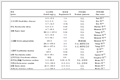
2 结果 2.1 测序数据质量评估及组装RAD-seq高通量测序共获得raw reads 2.76 GB,经质控过滤后获得clean reads 2.59 GB。测序数据的平均GC含量为40.11%,质量评估指标Q20与Q30分别达到97.79%和93.44%,RAD-Tag捕获率为99.58%。共获得237 132条序列,总长度为64 806 388 bp。在这些序列中共检测到3 598个完整的SSR位点,总长度为61 164 bp,平均长度为16.70 bp,占总序列长度的0.09%。详细结果见表 1。
|
表 1 墨瑞鳕简化基因组中SSR位点检测结果 Table 1 Identification of SSR loci in the simplified genome of Murray cod |
墨瑞鳕简化基因组中SSR位点类型较为丰富。按重复单位类型划分,二核苷酸重复(di-)位点数量最多,为2 018个,占总数的56.09%;三核苷酸重复(tri-)位点有1 169个,占总数的32.49%;四核苷酸重复(tetra-)位点有331个,占总数的9.20%;五核苷酸重复(penta-)位点有72个,占总数的2.00%。六核苷酸重复(hexa-)位点最少,仅8个,占总数的0.22%(见图 1)。共检测到236种不同重复类型,主要重复基序如图 2所示。在二核苷酸重复中,AC和TG型占比最高,分别为21.41%和21.01%;其次是GT和CA型,分别为17.01%和15.21%;GC型比例最低,为0.595%。三核苷酸重复以TTA(6.33%)、AAT(5.73%)、ATT(4.88%)和GAC(3.51%)为主。四核苷酸重复中TTTA(4.53%)、AAAT(3.93%)、ATGG(3.93%)和TCCA(2.42%)最为丰富。五核苷酸重复中TTAGG占比最高(19.15%),其次为GCTAA、TGAAT和TGCCT,分别占10.64%、8.51%和8.51%。六核苷酸重复数量较少且分布分散,无显著优势基序。

|
(di-: 二核苷酸重复;tri-: 三核苷酸重复;tetra-: 四核苷酸重复; penta-: 五核苷酸重复; hexa-: 六核苷酸重复。di-: di-nucleotide repeats; tri-: tri-nucleotide repeats; tetra-: tetra-nucleotide repeats; penta-: penta-nucleotide repeats; hexa-: hexa-nucleotide repeats.) 图 1 墨瑞鳕基因组微卫星各重复类型占比 Fig. 1 Distribution of SSRs repeat types in genomes of Murray cod |

|
(A: 二核苷酸重复中优势重复基元占比,主要包括AC、TG、GT和CA;B: 三核苷酸重复中优势重复基元占比,主要包括TTA、AAT、ATT和GAC;C: 四核苷酸重复中优势重复基元占比,主要包括TTTA、AAAT、ATGG和TCCA; D: 五核苷酸重复中优势重复基元占比,主要包括TTAGG、GCTAA、TGAAT和TGCCT。A: proportion of the dominant repeat motif in di-nucleotide repeats, mainly including AC, TG, GT, and CA; B: proportion of the dominant repeat motif in tri-nucleotide repeats, mainly including TTA, AAT, ATT, and GAC; C: proportion of the dominant repeat motif in tetra-nucleotide repeats, mainly including TTTA, AAAT, ATGG, and TCCA; D: proportion of the dominant repeat motif in penta-nucleotide repeats, mainly including TTAGG, GCTAA, TGAAT, and TGCCT.) 图 2 各重复类型优势重复基元及其比例 Fig. 2 Dominant repeat motifs and their proportions for each repeat type |
基于RAD文库构建及SSR位点的查找与筛选,本研究从3 598对SSR引物中筛选并合成了75对引物用于后续分析。通过PCR扩增效果验证,共筛选得到71对特异性较强且扩增稳定的引物,并确定了各引物的最适退火温度。随后,分别以8、12和24个不同个体的DNA为模板对上述引物进行PCR扩增,通过电泳条带的多态性表现,最终筛选获得19个具有较高多态性的微卫星位点。图 3展示了部分引物的电泳结果。19对引物在24个墨瑞鳕样本中的多态性参数结果如表 2所示。19个SSR位点的等位基因数(Na)介于9~14之间(平均值11.58),有效等位基因数(Ne)介于5.111~11.805之间(平均值8.415),观测杂合度(Ho)与期望杂合度(He)范围分别为0.273~0.833(平均值0.554)与0.804~0.915(平均值0.877)。19个位点的多态性信息含量介于0.782~0.909之间(平均值0.864)。此外,共有16个标记等位基因频率符合“哈迪-温伯格”平衡。

|
(A: MuC21扩增产物的聚丙烯酰胺凝胶电泳图;B: MuCHH扩增产物的聚丙烯酰胺凝胶电泳图。最右侧泳道为20 bp DNA ladder marker,用于指示DNA片段的分子量大小。A: Polyacrylamide gel electrophoresis (PAGE) of the PCR amplification products of MuC21; B: Polyacrylamide gel electrophoresis (PAGE) of the PCR amplification products of MuCHH. The rightmost lane represents a 20 bp DNA ladder marker, which was used to indicate the molecular size of the DNA fragments.) 图 3 部分多态性SSR引物在24个墨瑞鳕个体中的电泳结果 Fig. 3 Electrophoretic profiles of selected polymorphic SSR markers in 24 Murray cod individuals |
|
|
表 2 19个微卫星位点信息及多态性指标 Table 2 Characteristics and polymorphic indices of 19 microsatellite loci |
微卫星分子标记是渔业与水产养殖中遗传种群分析、亲缘关系鉴定及分子标记辅助育种等研究的重要工具[9]。近年来,基于简化基因组测序的策略已成为开发此类标记常用且高效的方法[24-26]。本研究首次采用高通量测序技术构建墨瑞鳕简化基因组文库,并对其SSR分布特征进行分析。结果表明,在所检测到的SSR类型中,二核苷酸重复最为丰富,其次为三核苷酸重复。这与小黄鱼(Larimichthys polyactis)[27]、裂腹鱼类(Schizothoracinae)[28]、淡水蚌(Lamellidens marginalis)[26]以及日本竹荚鱼(Trachurus japonicus)[29]的研究结果一致。然而,在大多数脊椎动物中,四核苷酸重复类型的比例通常高于三核苷酸重复[30]。然而在本研究中,墨瑞鳕基因组中四核苷酸重复的比例却低于三核苷酸重复,这一分布特征在花鲈(Lateolabrax maculatus)[31]和梭鲈(Sander lucioperca)[32]中曾被报道。这一结果可能与测序策略、物种特异性、复制滑移效率以及CpG甲基化等表观遗传调控机制有关[33-34]。
在已报道的SSR重复类型中,AC、AAT、AGAT和AAAAT分别是最常见的二、三、四、五核苷酸重复基序[27, 35]。本研究中墨瑞鳕基因组的SSR分布基本与上述规律一致,其中二核苷酸重复以AC、TG和GT为主,三核苷酸重复则主要为TTA、AAT和ATT。先前研究表明SSR重复基序具有偏好性,通常倾向于AX或AXX形式(X代表任意碱基),这一趋势已在多项研究中得到验证[36-38]。值得注意的是,本研究发现GC类型在墨瑞鳕二核苷酸重复类型中占比最低。已有研究指出,较低的GC含量是维持基因组热力学稳定性的必要条件之一,而GC型重复序列主要来源于复制、修复或重组过程中DNA链滑移导致的错配[39-40]。因此,本研究推测墨瑞鳕基因组可能具备较强的结构稳定性,从而导致GC型SSR重复频率明显偏低。在五核苷酸重复方面,本研究中最主要的基序类型为TTAGG和GCTAA,这一特征与花鲈(L. maculatus)的研究结果相似[31]。Jiang等[30]在对30种鱼类的SSR分布进行比较后发现,虽然五核苷酸中最丰富的类型通常为A/T偏好型(如AAAAT、AAAAC和AAAAG),但某些C/G偏好型五核苷酸重复在真骨鱼类(Euteleostei)中的部分物种中表现出明显的种属偏好。因此,本研究推测TTAGG和GCTAA在五核苷酸重复中的高比例可能并非偶然,而是反映了硬骨鱼类中较为普遍的基序偏好趋势。
遗传多样性是评估鱼类种质资源状况的重要依据,不仅与群体的抗病能力和育种潜力密切相关,也直接影响繁育策略的制定及养殖管理的科学性[9, 31]。因此,为更准确评估墨瑞鳕群体的遗传多样性,本研究采用等位基因数、杂合度、多态性信息含量以及“哈迪-温伯格”平衡检验(HWE)等常用遗传参数进行评估[41]。结果显示,本研究新开发的19个SSR标记均表现出高多态性,仅有3个位点显著偏离HWE,其余16个位点均符合HWE。19个位点的平均等位基因数(Na)和有效等位基因数(Ne)分别为11.58和8.415,均高于既往报道[19, 21]。与此前基于传统方法开发的墨瑞鳕SSR标记相比,本研究所得新位点多态性更高。值得注意的是,杂合度是衡量群体遗传多样性的重要指标之一[42]。本研究中,19个SSR位点的观测杂合度(Ho)和期望杂合度(He)分别介于0.273~0.833和0.804~0.915之间,平均值分别为0.554和0.877,提示所研究的墨瑞鳕人工养殖群体内仍具备较丰富的遗传变异。然而整体上观测杂合度平均值(Ho=0.554)低于期望杂合度平均值(He=0.877),可能反映该群体存在一定程度的近缘交配或亚群体结构,导致群体中杂合子频率降低。此外,当PIC>0.5时,该位点通常被认为是高度多态性位点[43]。本研究所有位点的PIC值均大于0.5,且平均PIC值达到0.864,进一步说明这些SSR标记具有较高的多态性检出能力。需要指出的是,本研究所使用的24个墨瑞鳕样品均来自同一养殖群体,因此所评估的遗传多样性主要反映该群体内部水平,尚不能全面代表天然种群中的遗传结构特征。同时,鉴于墨瑞鳕引入我国后尚未全面开展养殖苗种与亲本资源的规范化管理,我国现有墨瑞鳕亲本群体的遗传背景仍不够清晰,这在一定程度上增加了繁殖过程中发生近亲交配的风险,进而可能导致苗种质量下降。因此, 本研究结果仍可为我国墨瑞鳕群体的遗传学研究和种质资源评价提供有价值的基础数据。未来研究将通过引入不同来源的群体样品,以获得更具代表性的遗传多样性评估结果。
4 结语本研究系统解析了墨瑞鳕的微卫星位点特征,并成功开发出19个具有高多态性的微卫星标记。可为墨瑞鳕的群体遗传学研究和选择育种提供重要的分子工具,同时也将有助于制定遗传保护与管理策略,从而有望推动我国墨瑞鳕养殖产业的长期健康发展。
| [1] |
Growns I, Ryder D, Frost L. The basal food sources for Murray cod (Maccullochella peelii) in wetland mesocosms[J]. Journal of Freshwater Ecology, 2020, 35(1): 235-254. DOI:10.1080/02705060.2020.1779140 (  0) 0) |
| [2] |
Koehn J D, Todd C R. Balancing conservation and recreational fishery objectives for a threatened fish species, the Murray cod, Maccullochella peelii[J]. Fisheries Management and Ecology, 2012, 19(5): 410-425. DOI:10.1111/j.1365-2400.2012.00856.x ( 0) |
| [3] |
Liu M, Yuan S, Zhao Z, et al. Non-programmable cryopreservation of sperm from industrial-farmed Murray cod (Maccullochella peelii)[J]. Aquaculture, 2021, 541: 736811. DOI:10.1016/j.aquaculture.2021.736811 ( 0) |
| [4] |
刘明, 刘朋超, 刘岩, 等. 墨瑞鳕生物学特性与人工养殖研究进展[J]. 海洋湖沼通报, 2025, 47(5): 224-230. Liu M, Liu P C, Liu Y, et al. Breeding status and research progresses of Murray cod[J]. Transactions of Oceanology and Limnology, 2025, 47(5): 224-230. ( 0) |
| [5] |
Di Z, Li K, Li T, et al. Effects of light intensity and photoperiod on the growth performance of juvenile Murray cods (Maccullochella peelii) in recirculating aquaculture system (RAS)[J]. Aquaculture and Fisheries, 2023, 8(3): 274-279. DOI:10.1016/j.aaf.2021.12.009 ( 0) |
| [6] |
Song D, Peng D, Zhu X, et al. Investigating skeletal deformities in Murray cod (Maccullochella peelii): A comprehensive study combining transcriptomics and histology[J]. Aquaculture International, 2024, 32(4): 4819-4839. DOI:10.1007/s10499-024-01403-9 ( 0) |
| [7] |
赵悦, 孙大川, 刘文畅, 等. 低盐度对澳洲龙纹斑生长、血液及非特异性免疫酶的影响[J]. 上海海洋大学学报, 2021, 30(3): 435-441. Zhao Y, Sun D C, Liu W C, et al. Effects of low salinity on the growth, blood and non-specific immune enzymes of Maccullochella peelii peelii[J]. Journal of Shanghai Ocean University, 2021, 30(3): 435-441. ( 0) |
| [8] |
宫庆礼, 刘岩, 刘明, 等. 墨瑞鳕规模化全人工繁育技术及工业化高密度循环水养殖技术[R]. 青岛: 青岛七彩种业科技有限公司, 2023. Gong Q L, Liu Y, Liu M, et al. Full-Scale Artificial Seed Production Technology and Industrial High-Density Recirculating Aquaculture System for Murray Cod (Maccullochella peelii)[R]. Qingdao: Qingdao Qicai Seed Technology Co., Ltd., 2023. ( 0) |
| [9] |
Wenne R. Microsatellites as molecular markers with applications in exploitation and conservation of aquatic animal populations[J]. Genes, 2023, 14(4): 808. DOI:10.3390/genes14040808 ( 0) |
| [10] |
Liu X, Tang X, Chen M, et al. Development and application of molecular markers in fisheries, aquaculture, and industry of representative temperate and tropical sea cucumbers: A review[J]. Frontiers in Marine Science, 2024, 11: 1423096. DOI:10.3389/fmars.2024.1423096 ( 0) |
| [11] |
Marudamuthu B, Sharma T, Purru S, et al. Next-generation sequencing technology: A boon to agriculture[J]. Genetic Resources and Crop Evolution, 2023, 70(2): 353-372. DOI:10.1007/s10722-022-01512-5 ( 0) |
| [12] |
Mandlik J S, Patil A S, Singh S. Next-generation sequencing (NGS): Platforms and applications[J]. Journal of Pharmacy and Bioallied Sciences, 2024, 16(Suppl 1): 41-45. ( 0) |
| [13] |
He J C, Li S Y, He W Z, et al. Application of restriction site-associated DNA sequencing (RAD-seq) for copy number variation and triploidy detection in human[J]. Cytogenetic and Genome Research, 2021, 161(8-9): 406-413. DOI:10.1159/000518930 ( 0) |
| [14] |
Liu H, Zhang Q, Sun C, et al. Development and characterization of 12 microsatellite markers for the roundtail paradisefish (Macropodus ocellatus) using RAD sequencing[J]. Journal of Applied Ichthyology, 2020, 36(2): 243-245. DOI:10.1111/jai.14003 ( 0) |
| [15] |
Shen Z, Wang B, Hu F, et al. Isolation and characterization of microsatellite loci in Hexagrammos otakii based on 2b-RAD method[J]. Journal of Applied Ichthyology, 2020, 36(1): 55-61. DOI:10.1111/jai.13988 ( 0) |
| [16] |
Liu K, Feng X Y, Ma H J, et al. Development and characterization of 13 microsatellite markers of Chanodichthys mongolicus (Cypriniformes: Cyprinidae) by RAD-seq[J]. Journal of Applied Ichthyology, 2021, 37(6): 975-979. DOI:10.1111/jai.14253 ( 0) |
| [17] |
Sun S, Hu Z, Lu Z, et al. Genetic diversity and population structure of Hemiculter leucisculus (Basilesky, 1855) in Xinjiang Tarim River[J]. Genes, 2022, 13(10): 1790. DOI:10.3390/genes13101790 ( 0) |
| [18] |
Wu W, Qiu J, Lin Y, et al. Analysis of genetic diversity among three Triplophysa tenuis populations by RAD-seq[J]. Frontiers in Molecular Biosciences, 2024, 11: 1373754. DOI:10.3389/fmolb.2024.1373754 ( 0) |
| [19] |
Rourke M, Nheu J, Mountford H, et al. Isolation and characterization of 102 new microsatellite loci in Murray cod, Maccullochella peelii peelii (Percichthyidae), and assessment of cross-amplification in 13 Australian native and six introduced freshwater species[J]. Molecular Ecology Notes, 2007, 7(6): 1258-1264. DOI:10.1111/j.1471-8286.2007.01849.x ( 0) |
| [20] |
Loughnan S R, Baranski M D, Robinson N A, et al. Microsatellite loci for studies of wild and hatchery Australian Murray cod Maccullochella peelii peelii (Percichthyidae)[J]. Molecular Ecology Notes, 2004, 4(3): 382-384. DOI:10.1111/j.1471-8286.2004.00660.x ( 0) |
| [21] |
Nock C J, Baverstock P R. Polymorphic microsatellite loci for species of Australian freshwater cod, Maccullochella[J]. Conservation Genetics, 2008, 9(5): 1353-1356. DOI:10.1007/s10592-007-9488-7 ( 0) |
| [22] |
Rourke M L, McPartlan H C, Ingram B A, et al. Polygamy and low effective population size in a captive Murray cod (Maccullochella peelii peelii) population: Genetic implications for wild restocking programs[J]. Marine and Freshwater Research, 2009, 60(8): 873-883. DOI:10.1071/MF08218 ( 0) |
| [23] |
Rourke M L, McPartlan H C, Ingram B A, et al. Biogeography and life history ameliorate the potentially negative genetic effects of stocking on Murray cod (Maccullochella peelii peelii)[J]. Marine and Freshwater Research, 2010, 61(8): 918-927. DOI:10.1071/MF10037 ( 0) |
| [24] |
Hu Y, Liu X, Yang J, et al. Development of 17 Novel cross-species microsatellite markers for Dabry′s sturgeon (Acipenser dabryanus) from Chinese sturgeon (Acipenser sinensis) via next-generation sequencing[J]. Pakistan Journal of Zoology, 2019, 51(6): 1-4. ( 0) |
| [25] |
Wang L, Yu H, Li Q. Identification and characterization of 23 microsatellite loci for Chlorostoma rustica based on RAD-seq[J]. Journal of Genetics, 2018, 97(S1): 61-65. DOI:10.1007/s12041-018-0935-7 ( 0) |
| [26] |
Varshney S, Sagwekar M, Pavan-Kumar A, et al. Development and characterisation of novel polymorphic microsatellite loci in the freshwater mussel Lamellidens marginalis(Lamarck, 1819) using next generation sequencing[J]. Molluscan Research, 2020, 40(4): 308-312. DOI:10.1080/13235818.2020.1799147 ( 0) |
| [27] |
Zheng J, Song C, Gao T, et al. Profile and development of microsatellite markers for the small yellow croaker Larimichthys polyactis based on high-throughput sequencing technology[J]. Regional Studies in Marine Science, 2020, 38: 101370. DOI:10.1016/j.rsma.2020.101370 ( 0) |
| [28] |
Li X, Tang Y, Zhang R, et al. Characterization and development of SSR markers of schizothoracine fish (Cypriniformes: Cyprinidae) based on SLAF-seq technique[J]. Journal of Applied Ichthyology, 2020, 36(4): 519-527. DOI:10.1111/jai.14032 ( 0) |
| [29] |
Niu S, Zhai Y, Wu R, et al. Development and characterization of 33 polymorphic microsatellite markers in Trachurus japonicus by SLAF-seq technology[J]. Journal of Applied Ichthyology, 2021, 37(2): 308-313. DOI:10.1111/jai.14158 ( 0) |
| [30] |
Jiang Q, Li Q, Yu H, et al. Genome-wide Analysis of simple sequence repeats in marine animals—a comparative approach[J]. Marine Biotechnology, 2014, 16(5): 604-619. DOI:10.1007/s10126-014-9580-1 ( 0) |
| [31] |
Sigang F, Hao H, Yong L, et al. Genome-wide identification of microsatellite and development of polymorphic SSR markers for spotted sea bass (Lateolabrax maculatus)[J]. Aquaculture Reports, 2021, 20: 100677. DOI:10.1016/j.aqrep.2021.100677 ( 0) |
| [32] |
Lu C, Sun Z, Xu P, et al. Novel microsatellites reveal wild populations genetic variance in pike-perch (Sander lucioperca) in China[J]. Aquaculture Reports, 2022, 23: 101031. DOI:10.1016/j.aqrep.2022.101031 ( 0) |
| [33] |
Katti M V, Ranjekar P K, Gupta V S. Differential distribution of simple sequence repeats in eukaryotic genome sequences[J]. Molecular Biology and Evolution, 2001, 18(7): 1161-1167. DOI:10.1093/oxfordjournals.molbev.a003903 ( 0) |
| [34] |
Lei Y, Zhou Y, Price M, et al. Genome-wide characterization of microsatellite DNA in fishes: Survey and analysis of their abundance and frequency in genome-specific regions[J]. BMC Genomics, 2021, 22(1): 421. DOI:10.1186/s12864-021-07752-6 ( 0) |
| [35] |
Tóth G, Gáspári Z, Jurka J. Microsatellites in different eukaryotic genomes: Survey and analysis[J]. Genome Research, 2000, 10(7): 967-981. DOI:10.1101/gr.10.7.967 ( 0) |
| [36] |
管奥, 毋玉婷, 陈宇, 等. 曼氏无针乌贼转录组微卫星特征分析[J]. 渔业科学进展, 2018, 39(3): 144-151. Guan A, Wu Y T, Chen Y, et al. Deep sequence-based transcriptome analysis of microsatellites in the cuttlefish (Sepiella japonica)[J]. Progress in Fishery Sciences, 2018, 39(3): 144-151. ( 0) |
| [37] |
王耀嵘, 杨尉, 任席林, 等. 金钱鱼基因组微卫星分布特征分析及多态性标记开发[J]. 广东海洋大学学报, 2020, 40(4): 7-14. Wang Y R, Yang W, Ren X L, et al. Distribution patterns of microsatellites and development of polymorphic markers from Scatophagus argus genome[J]. Journal of Guangdong Ocean University, 2020, 40(4): 7-14. ( 0) |
| [38] |
徐杰杰, 郑翔, 张鑫宇, 等. 4种河鲀全基因组微卫星分布特征分析[J]. 基因组学与应用生物学, 2021, 40(4): 1441-1451. Xu J J, Zhen X, Zhang X Y, et al. Analysis of distribution characteristics of microsatellites in four genomes of puffer fish[J]. Genomics and Applied Biology, 2021, 40(4): 1441-1451. ( 0) |
| [39] |
Liu Y, Liang N, Xian Q, et al. GC heterogeneity reveals sequence-structures evolution of angiosperm ITS2[J]. BMC Plant Biology, 2023, 23(1): 608. DOI:10.1186/s12870-023-04634-9 ( 0) |
| [40] |
Tanudisastro H A, Deveson I W, Dashnow H, et al. Sequencing and characterizing short tandem repeats in the human genome[J]. Nature Reviews Genetics, 2024, 25(7): 460-475. DOI:10.1038/s41576-024-00692-3 ( 0) |
| [41] |
Molnár T, Benedek I, Kovács B, et al. Genetic consequences of pond production of a pikeperch (Sander lucioperca L.) stock with natural origin: The effects of changed selection pressure and reduced population size[J]. PeerJ, 2020, 8: e8745. DOI:10.7717/peerj.8745 ( 0) |
| [42] |
孔啸兰, 李敏, 陈作志, 等. 基于RAD-seq技术的长体圆鲹二、三核苷酸重复微卫星标记开发与评价[J]. 南方水产科学, 2019, 15(3): 97-103. Kong X L, Li M, Chen Z Z, et al. Development and evaluation of di-/tri-nucleotide-repeated microsatellites by RAD-seq in Decapterus macrosoma[J]. South China Fisheries Science, 2019, 15(3): 97-103. ( 0) |
| [43] |
Roy P, Sogir S B, Basak T. On the polymorphism information content (PIC)—a practical application for the DNA sequencing data[J]. European Journal of Medical and Health Research, 2023(1): 21-29. ( 0) |
2. Engineering Research Center of Mariculture, Ministry of Education, Ocean University of China, Qingdao 266003, China;
3. Qingdao Seven Colour Seed Aqua-Tech Company Limited, Qingdao 266621, China