 2026, Vol. 56


2. 中国海洋大学环境科学与工程学院,山东 青岛 266100
有机磷酸酯(Organophosphorus esters,OPEs)是一类磷酸酯类合成衍生物,因其具有良好阻燃性能,常作为阻燃剂被用于家具、电子产品、润滑剂和油漆在内的多种产品中[1]。根据OPEs中取代基的不同,可大致将其分为烷基磷酸酯、芳基磷酸酯和氯代烷基磷酸酯[2]。2013年以来,含卤阻燃剂多溴联苯醚在全球范围内被逐步禁用[3],而有机磷酸酯阻燃剂(Organophosphorus flame retardants,OPFRs)因具有低腐蚀、易代谢和抑烟效果好等特点得到广泛应用[4]。据报道,从2014年到2020年,中国OPFRs年产量从14.15万t激增至29.42万t,预计2027年的产量将达到50万t[5-6]。
磷酸三(2-氯丙基)酯(Tris(2-chloroethyl)phosphate,TCPP)是一种典型的氯代OPFRs,主要用作床垫、汽车座椅和家用软家具等物品中柔性聚氨酯泡沫的阻燃剂[7]。TCPP通常不与产品基质发生化学结合,因此在生产、使用和处置过程中容易通过磨损、浸出等方式释放到周围环境中[8]。目前,已在湖泊、海洋、沉积物、土壤、灰尘和大气等环境介质中检测到TCPP的存在,而且其在河流、海洋中的检出浓度高于其他OPFRs[9]。作为全球最重要的水生生态系统,海洋是TCPP重要的汇之一。美国加利福尼亚近岸表层海水中检测到TCPP的均值浓度为410 ng/L,部分海域的最高浓度可达3.10 μg/L[10]。日本大阪北港海水中检出的TCPP最高浓度达48.20 μg/L[11]。此外,在海洋鱼类和贻贝中经常检测到TCPP,表明其在水生食物网中存在生物累积及生物放大的潜力[12-13]。因此,TCPP在水环境中的存在对水生生物生存和人类健康构成严重威胁。目前,有关TCPP对海洋生物的毒性效应已有相关报道。例如,TCPP能引起紫贻贝(Mytilus galloprovincialis)细胞内活性氧含量显著增加,且高浓度TCPP造成贻贝血细胞的凋亡和氧化应激反应;溶酶菌基因表达水平显著下调则表明TCPP能够抑制贻贝的免疫功能,影响免疫系统发育[14]。岩鱼许氏平鲉(Sebastes schlegeli)暴露于含TCPP的海水15 d后,体内与神经发育相关的多种蛋白质(磷脂酰肌醇结合网格蛋白组装蛋白和二氢嘧啶酶样9等)的表达均受到显著抑制,引起神经毒性及发育障碍[15]。
自然衰减是一种利用自然过程降低污染物浓度、毒性和迁移性的环境修复技术,主要通过物理、化学和生物作用实现污染物的消减[16]。自然衰减的快慢决定着污染物对水生生物危害的持久性;自然衰减的产物毒性高低则决定着这种修复技术的生态可行性[17]。但是,目前尚未见到有关TCPP在海水中自然衰减的任何报道。为此,本研究拟采用微宇宙装置模拟海洋自然环境条件进行海水中TCPP的自然衰减试验,通过反应动力学分析确定其半衰期,比较水解、光解和生物降解作用的相对贡献,根据中间产物种类推测TCPP衰减机制和评价自然衰减的生态风险。研究结果将为认识TCPP在海水中的环境行为及评价氯代OPFRs的生态风险提供科学依据。
1 材料与方法 1.1 材料TCPP标准品(纯度98%)购自上海麦克林生化科技有限公司;甲醇、乙腈、甲酸及乙酸乙酯(色谱纯)购自天津科密欧化学试剂有限公司;氯化汞、磷酸二氢钾、钼酸铵、酒石酸锑钾和抗坏血酸(分析纯)均购自上海国药集团化学试剂有限公司;硫酸(优级纯)购自西陇科学股份有限公司。
海水取自青岛沙子口海域(pH=8.1、盐度30),使用100目筛网进行过滤,以去除水中大颗粒物质。
1.2 方法 1.2.1 TCPP自然衰减试验TCPP自然衰减试验在微宇宙装置中进行,该装置主要由圆柱体玻璃缸、长弧氙灯、小型空调、空气泵等组成(见图 1)。将3只玻璃缸(装有100 μg/L TCPP的天然海水10 L)置于微宇宙装置的中部,顶部盖有透光性较好的亚克力材质有机玻璃板,以防止缸内水分蒸发。长弧氙灯(BXU999型,广州星创电子有限公司,波长范围在290~800 nm)用于模拟太阳光,位于玻璃缸上方,与缸顶部相距40 cm(水体表面接收到的光强为200 μmol/(m2·s));小型空调用于调节系统内的温度以模拟一定海域的环境温度。试验期间,通过微宇宙装置模拟青岛胶州湾的海洋环境条件,即:温度15 ℃;盐度30;风速:5 m/s;光暗周期14 h∶10 h[18]。由于TCPP不具有挥发性(25 ℃下的饱和蒸汽压为2.53×10⁻⁴ Pa[19]),因此,只需考虑生物降解、光解和水解对TCPP在海水中自然衰减的影响。

|
图 1 微宇宙装置示意图 Fig. 1 Schematic diagram of microcosm device |
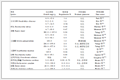
试验设置3个处理,编号分别为PHB、PH和H,分别对应不同作用方式的组合,即:光解+水解+生物降解、光解+水解和水解。其中,PH、H处理中各加入200 mg/L HgCl2,以消除微生物作用[20],且H处理的玻璃缸用铝箔包裹,防止其中的TCPP发生光解(见表 1)。在上述模拟条件下连续培养90 d, 在试验开始以及培养10、20、30、40、60和90 d后,各取3份5 mL水样测定其中的TCPP剩余浓度。另外,试验开始和结束后,从PHB处理中分别移取100 mL水样3份,用于中间产物鉴定以及pH、活性磷酸盐浓度测定。
|
表 1 3个处理中TCPP的降解方式组合 Table 1 TCPP degradation mode combination in three treatments |
样品前处理参照于晓龙[21]的方法:向5 mL水样中加入等体积乙酸乙酯,涡旋振荡萃取3 min,重复3次,将有机相合并,用氮吹仪吹干,加入5 mL甲醇复溶,涡旋混匀后,经0.22 μm有机滤膜过滤,取1 mL于进样瓶中。使用超高效液相色谱仪串联三重四极杆质谱仪(LC/MS,1290-Ⅱ/6470,美国Agilent公司)对TCPP进行测定,色谱柱型号为Zorbax Eclipse Plus C18(150 mm×2.1 mm×5 μm)。液相色谱参数:柱温40 ℃,进样体积1 μL,流速0.3 mL/min。流动相条件:乙腈(A)∶0.1%甲酸溶液(B)=70∶30(V/V)。质谱采用多反应监测模式(MRM)以正离子模式测定目标物,定量离子对为m/z 327>98.9,定性离子对为m/z 327>174.9。以目标化合物浓度为横坐标,峰面积为纵坐标,绘制标准曲线,计算TCPP浓度。按式(1)计算TCPP去除率:
| $ \eta=[(C_{0}-C_\mathrm{t})/C_{0}]\times100\% 。$ | (1) |
式中:η为TCPP去除率(%); t为衰减时间(d); Ct为t时刻海水中剩余TCPP浓度(μg/L); C0为海水中初始TCPP浓度(μg/L)。
TCPP标准曲线方程为Y=2 758X+9 857.9(R2=0.998 9);3个加标水平(30、50和70 μg/L)的回收率为92.51%~104.20%,相对标准偏差为0.37%~1.73%;海水样品检出限(LOD,3倍信噪比)为2.26 μg/L。表明该方法测定海水中TCPP具有良好的精密度和准确度。
1.2.3 光解、水解及生物降解对TCPP总衰减量的贡献利用差减法分别计算各个时刻光解(见式(2))和生物降解(见式(3))单独作用时TCPP的衰减量,进而确定每种作用引起的衰减量占总衰减量的比例随衰减时间的变化。该方法已被广泛用于探究光解、生物降解、水解以及挥发等过程对水体中有机污染物自然衰减的相对贡献[17, 22-23]。
| $ \Delta_{\mathrm{P}}=\Delta_{\mathrm{PH}}-\Delta_{\mathrm{H}}, $ | (2) |
| $ \Delta_{\mathrm{B}}=\Delta_{\mathrm{PHB}}-\Delta_{\mathrm{PH}} 。$ | (3) |
式中:ΔPHB、ΔPH、ΔH分别为PHB、PH以及H处理中TCPP浓度的衰减量(μg/L);ΔP、ΔB分别为光解和生物降解引起的TCPP浓度衰减量(μg/L)。
1.2.4 衰减动力学对于每个处理中TCPP剩余浓度随时间的变化数据,分别采用零级(见式(4))、一级(见式(6))方程[24]进行拟合,根据拟合优度,确定最适于表征TCPP自然衰减过程的动力学模型,并计算相应的半衰期(见式(5)和式(7))。对于每种作用(光解、水解、生物降解)单独存在时TCPP剩余浓度随时间变化也采用上述方程进行拟合。
| $ C_t=C_0-k_0 t, $ | (4) |
| $ t_{1 / 2}=C_0 / 2 k_0, $ | (5) |
| $ \ln C_t-\ln C_0=-k_1 t, $ | (6) |
| $ t_{1 / 2}=\ln 2 / k_1。$ | (7) |
式中:t为衰减时间(d);Ct为t刻TCPP浓度(μg/L);C0为TCPP初始浓度(μg/L);k0为零级反应的衰减速率常数(μg/(L·d));k1为一级反应的衰减速率常数(d-1);t1/2为半衰期(d)。
1.2.5 衰减产物鉴定在PHB组运行0、90 d后,采集海水样品,采用1.2.2节方法进行前处理。采用超高效液相色谱(UPLC,Ultimate 3000,Thermo Fisher,USA)-四级杆飞行时间质谱(Q-TOF,MaXis,Bruker,USA)鉴定衰减产物。液相色谱分离采用二元流动相:A相为乙腈,B相为0.1%甲酸溶液,流速为0.3 mL/min。进样量为10 μL,洗脱模式为梯度洗脱:0 min 10%A+90%B,30 min 90%A+10%B,35 min 90%A+10%B,35.1 min 10%A+90%B,40 min 10%A+90%B。质谱分析采用电喷雾电离(ESI)源在正离子模式下进行,扫描范围为m/z 50~1 000,喷雾电压5.5 kV,离子源温度550 ℃,气帘气压207 kPa,雾化气压276 kPa。
1.2.6 磷酸盐浓度测定对于PHB组试验前后的海水样品,根据《海洋监测规范(GB 17378.4—2007)》[25],分别采用pH计法和磷钼蓝分光光度法测定pH值和活性磷酸盐浓度。
1.2.7 衰减产物毒性评价利用ECOSAR软件(v2.0)预测TCPP及其衰减产物对3类水生生物(鱼、溞和绿藻)的急性和慢性毒性,并参照《全球化学品统一分类和标签制度》[26]评估毒性等级。
1.3 数据处理所有试验均设3次重复,结果以平均数±标准差(mean±SD)表示。使用Origin 2021绘制相关图形。采用IBM SPSS Statistics 24软件进行数据统计分析,通过独立样本t检验判断各组间的差异显著性,统计显著性水平为P < 0.05。
2 结果与讨论 2.1 3种处理中TCPP的衰减及动力学分析图 2显示了3个处理组中的TCPP衰减曲线。PHB组的TCPP衰减最快,90 d后残余浓度为75.10 μg/L(即:去除率为24.90%),这是光解、水解和生物降解三者共同作用的结果。PH组与PHB组的TCPP衰减趋势相似,但是,由于缺少生物降解作用,光解和水解的联合作用下TCPP在90 d内的去除率为17.90%(残余浓度为82.10 μg/L),且衰减速率始终低于同期的PHB组。H组中,TCPP只能进行水解反应,因此其浓度降解十分缓慢,试验结束时残余浓度为95.74 μg/L,去除率仅有4.26%。

|
图 2 3种处理中TCPP自然衰减趋势及其去除率 Fig. 2 Natural attenuation trend and removal rate of TCPP in three treatments |
由表 2可见,与零级动力学方程相比,采用一级动力学方程对3个处理的TCPP衰减数据进行拟合,所得到的拟合优度(R2)均较高,因此认为,3个处理中的TCPP自然衰减过程均适于采用一级动力学方程描述。由此得到处理组PHB、PH、H的衰减速率常数(k)依次为0.003 0、0.002 1和0.000 5 d-1;半衰期(t1/2)分别为231.05、330.07和1 386.30 d。这表明光解、水解和生物降解的共同作用最有利于TCPP的衰减。半衰期常被用于评估污染物在各种环境介质中的持久性。根据联合国环境规划署《斯德哥尔摩公约》[27]提出的持久性有机污染物筛选标准(化学品在水中的t1/2大于2个月),TCPP应被归类为持久性有机污染物,因此,今后应对其在海洋中的环境行为和生态效应进行更为深入的研究。
|
|
表 2 3种处理的TCPP降解动力学参数 Table 2 Degradation kinetic parameters of TCPP in three treatments |
衰减试验期间,光解对TCPP去除的贡献程度始终最大,其次为生物降解,而水解的贡献率最小(见图 3)。试验结束时,三者单独存在下的TCPP去除率分别为13.64%、7.00%和4.26%。动力学方程拟合结果同样表明(见表 3),光解、生物降解和水解对TCPP的去除均遵循一级动力学方程(R2>0.96),其中,光解、生物降解对应的k值分别为0.001 5和0.000 8 d-1,t1/2值分别为462.10和866.43 d。水解对应的k值和t1/2(即:0.000 5 d-1和1 386.30 d)与表 2中H处理的相应值相等。

|
图 3 光解、水解、生物降解对TCPP衰减的相对贡献 Fig. 3 Relative contributions of photolysis, hydrolysis, and biodegradation to TCPP attenuation |
|
|
表 3 光解、水解、生物降解单独存在时的TCPP降解动力学参数 Table 3 Kinetic parameters of TCPP degradation in the presence of photolysis, hydrolysis, and biodegradation separately |
有机污染物的光降解分为直接光解和间接光解,前者是指有机物分子直接吸收光子能量转变为激发态,并引起自身结构的改变;后者是指水体中的光敏剂吸收太阳光获得能量产生自由基,而后自由基与有机污染物发生反应导致其降解。虽然光解作用是TCPP在海水中自然衰减的主要驱动力,但是这种降解不太可能以直接光解的方式进行,因为TCPP分子中的侧链烷基缺乏发色基团,没有紫外吸收峰。而自由基介导的间接光解就成为TCPP光降解的主要方式[28-29]。海水中存在多种有机光敏剂(如:溶解性有机物(Dissolved organic matter,DOM))和无机光敏剂(如:NO3-、NO2-),它们吸收280~400 nm间的紫外光(UV)后均可产生羟基自由基(·OH)、单线态氧(1O2)及超氧阴离子自由基(·O2-)等活性氧[30-31],攻击TCPP中的磷酯键并使其断裂。海水的理化性质(盐度和pH等)对这些活性氧的产生有较大影响。有研究表明,与淡水相比,在海水的离子强度下,DOM的三重激发态3DOM*(产生·OH和1O2的重要前体物)衰变速率降低,使其稳态浓度增加约1倍[32]。pH值也是影响DOM光化学性质的重要因素。Gao等[33]发现pH变化对DOM光吸收能力有显著影响,pH=9.0时的吸收能力大约是pH=5.0时的4.5倍。另有研究报道[34],3DOM*在pH=9.0时的产率显著高于pH=4.0和7.0时的相应值。这意味着海水的较高pH和盐度有利于DOM的光化学转化和自由基生成,从而能使TCPP发生一定程度的间接光解。相反,超纯水中这些光敏剂含量极低,即使在光照下也难以发生间接光解。Regnery等[35]的研究可以证明这一点:TCPP在超纯水中自然光解15 d后,浓度无显著变化,而海水中的光解能够去除少量TCPP,20 d后去除率为5.25%,90 d后达到13.64%。Li等[36]基于UV/H2O2降解实验计算得到温度25 ℃时水溶液中(pH=5.5)TCPP与·OH的反应速率常数(kOH)为4.32×10⁸ mol-1·L·s-1。Mopper等[37]实测得到阳光照射的沿海表层水中·OH的稳态浓度(cOH)为12×10-18 mol·L-1。根据这些文献报道的kOH、cOH数值,可推算出TCPP在海水中间接光解的t1/2为1 539.35 d。虽然本研究所用海水性质(pH=8.1、温度15 ℃)与上述计算kOH时的实验条件不同,但有研究表明,温度、pH对UV/H2O2体系中TCPP降解效果的影响并不明显(说明kOH变化不大)[38-39]。与上述计算结果相比,本研究中TCPP的光解速度较快(t1/2为462.10 d),这主要归因于上述文献[36]没有考虑海水中其它自由基对TCPP转化的影响。海水中的DOM等光敏剂吸收光能后不仅产生·OH,还能形成1O2、·O2-等。其中,1O2在天然海水中的稳态浓度(约10-15~10-12 mol·L-1[40])比·OH高3~6个数量级。Cristale等[28]研究发现,1O2对TCPP等OPFRs的自然转化也具有重要贡献。
海水中有机污染物的生物降解是土著微生物(细菌、真菌、放线菌及微藻等)对其代谢转化的过程。本研究发现,海水中天然生物对TCPP的降解速度较为缓慢(t1/2=866.43 d),这可能有多方面原因,但是海水中缺少有效降解TCPP的微生物种类可能是主要限制因素。很多采用膜-生物反应器(MBR)、厌氧-缺氧-好氧法(A2/O)、厌氧-好氧-曝气生物滤池(A/O-BAF)等生物处理工艺的研究发现,氯代OPFRs(包括TCPP)比烷基OPFRs、芳基OPFRs更难被生物降解[41-42]。与此相应的是,目前文献报道的能够降解芳基OPFRs的微生物种类较多,包括食吡啶红球菌(Rhodococcus pyridinivorans YC-MTN)[43]、洋葱伯克霍尔德菌(Burkholderia cepacia ZY1)[44]、土地鞘氨醇盒菌(Sphingopyxis terrae ZY2)[44]、拟无枝酸菌(Amycolatopsis ZY3)[44]、红球菌(Rhodococcus sp.YC-JH2)[45]、鞘氨醇盒菌(Sphingopyxis sp.YC-JH3)[45]等。然而,能够降解TCPP的微生物仅有拟无枝酸菌(Amycolatopsis sp. FT-1)[9]、雷氏普罗威登斯菌(Providencia rettgeri)[42]等少数种类,均分离自受污染的沉积物。这意味着天然水体中TCPP降解菌的种类不多。相较于光催化降解,生物修复技术对环境友好,在适宜条件下能够将TCPP降解为CO2等小分子物质,不会产生二次污染,同时具有高效且成本低的优点。因此,作为生物修复技术的一种重要手段,生物强化(即投加高效降解TCPP的微生物)可能是促进海水中TCPP去除的有效方法。
水解是指有机化合物的某些官能团与水发生反应, 通过断裂化学键分解为较简单物质的过程。TCPP发生水解的方式较单一,主要涉及酯键断裂。本研究中,海水中TCPP单独通过水解而降解的速度很慢,主要是因为天然海水的pH值(本研究为8.1)不适合水解反应发生。Su等[46]研究发现,在pH=13的溶液中,TCPP水解迅速(t1/2为11 d),而在pH=7、9、11溶液中水解35 d后浓度无显著降低(P>0.05)。另有研究提出[47],TCPP在pH=6的溶液中水解t1/2长达1 600 a,由此可见,TCPP的酯键断裂对pH具有显著依赖性,即:强碱性环境有利于水解进行,而在其它pH下则较难发生水解。
2.3 产物鉴定及降解路径推导采用UPLC-Q-TOF-MS/MS测定TCPP自然衰减前后的海水样品(见图 4),与衰减前的海水样品相比,衰减90 d后的海水样品中出现2种中间产物。TCPP和2种中间产物的高分辨率的质荷比(m/z)分别为327.009 1、251.000 1和174.992 1(见表 4),由此确定2种产物的分子式分别为C6H13Cl2PO4(磷酸二(2-氯丙基)酯(Bis(2-chloropropyl)phosphate,BCPP))和C3H8ClPO4(磷酸单(2-氯丙基)酯(Mono(2-chloropropyl)phosphate,MCPP))。二者分别为TCPP衰减形成的二酯和单酯产物。TCPP的分子中含有三个氯丙基(2-Cl-CH(CH3)-)取代基,位于磷酸酯的三个酯基位置。有研究认为,OPFRs的降解机制通常包括脱烷基化、羟基化、脱氯等[48],相应的,磷酸酯键、—CH3和C—Cl键可能是受到攻击的主要位点[49]。从本研究鉴定出的中间产物看,TCPP自然衰减主要是脱氯代烷基所致。此外,海水样品中磷酸盐浓度由TCPP自然衰减前7.33 μg/L升至9.20 μg/L(P<0.05)(见图 5),表明H3PO4也是TCPP降解的产物之一。需要说明的是,海水pH值从自然衰减前的8.1降为7.2(见图 5),这似乎也能支持TCPP降解为H3PO4的判断。但是,产物H3PO4的生成并非这种酸化(pH值降低0.9)的主要原因。文献报道,近岸海水的缓冲容量(使1 L海水pH变化1个单位所需加入的酸或碱的物质量)约为0.1~0.36 mmol/L[50-53]。本研究中,TCPP经过90 d自然衰减后,实测体系中磷酸盐浓度的增加值为1.87 μg/L(即0.02 μmol/L)。假定这些新增磷酸盐是由TCPP自然衰减后生成的H3PO4完全电离所致(实际上不可能,因为磷酸溶液在pH=8左右主要以HPO42-形态存在),生成的H+数量为0.06 μmol/L。按上述海水缓冲容量估算,这些H+引起海水pH值的降低微乎其微(不足0.001)。因此推测,自然衰减体系中pH值降低的主要原因可能是天然海水中微生物的作用,即:它们代谢TCPP及其降解产物(氯丙烷)生成的CO2溶入海水中,进而生成H2CO3并解离出H+。

|
图 4 海水中TCPP自然衰减前后的总离子流图 Fig. 4 Total ion chromatogram before and after natural attenuation of TCPP in seawater |
|
|
表 4 TCPP及降解产物的高分辨质谱数据 Table 4 High-resolution mass spectrometry data of TCPP and its degradation products |

|
图 5 TCPP衰减前后磷酸盐浓度及pH变化 Fig. 5 Changes in phosphate concentration and pH before and after TCPP attenuation |
根据产物鉴定结果,提出TCPP在海水中的自然衰减路径如下(见图 6):TCPP分子中的一个磷酸酯键发生断裂,脱除一个氯丙基,生成BCPP;随后,第二个磷酸酯键断裂并脱除相应的氯丙基,生成MCPP;当第三个磷酸酯键断裂后,即生成H3PO4。这种以脱氯代烷基为主导的降解路径与前人报道的光催化及生物降解体系中的TCPP转化途径一致。例如,有关TCPP高级氧化降解的研究表明,·OH可直接攻击TCPP的中心P原子而使磷酸三酯发生脱烷基作用,依次生成相应的磷酸二酯、单酯及H3PO4等产物[54-56]。

|
图 6 TCPP在海水中的降解路径 Fig. 6 The proposed degradation pathway of TCPP in seawater |
为明确TCPP衰减过程是否生成毒性高于母体化合物的产物,利用ECOSAR软件评估了TCPP和3种转化产物对鱼类、藻类和溞类的急性和慢性毒性,并根据《全球化学品统一分类和标签制度》提出的毒性分类标准进行评价。该标准将污染物对水生生物的急/慢性毒性划分为4个等级:半数致死浓度(LC50)/半数效应浓度(EC50)/慢性毒性值(Chv)>100 mg/L,无毒;10<LC50/EC50/Chv≤100 mg/L,低毒;1<LC50/EC50/Chv≤10 mg/L,高毒;LC50/EC50/Chv≤1 mg/L,极高毒。
结果表明,3种转化产物对水生生物的急/慢性毒性水平均低于母体化合物。例如,TCPP对鱼、绿藻以及溞的急性毒性皆处于低毒水平,而BCPP、MCPP以及H3PO4对上述生物均表现为无毒(见图 7(a))。就慢性毒性而言,TCPP对3类水生生物表现为高毒,而3种转化产物表现为低毒或无毒(见图 7(b))。而且,每种产物对水生生物的急性、慢性毒性均比母体化合物低1~3个数量级。这表明,虽然TCPP自然衰减的速度较慢,但是所形成的产物毒性大大降低,不会对海洋生态系统造成较大危害。此外,TCPP自然衰减引起海水中磷酸盐浓度有所增加,但是实测的磷酸盐浓度(9.20 μg/L)仍符合《海水水质标准(GB3097—1997)》[57]一类标准(活性磷酸盐≤15 μg/L)要求。因此,TCPP自然衰减对海洋环境生态没有明显不利影响。但是,需要指出的是,当某些海域中存在高浓度TCPP时,仅通过自然衰减很难将其浓度快速降低至安全水平,这种情况下有必要采用生物强化方法加快其去除。

|
图 7 基于ECOSAR程序预测的TCPP及其降解产物生物急性毒性(a)和慢性毒性(b) Fig. 7 Prediction of acute toxicity (a) and chronic toxicity (b) of TCPP and its degradation products using ECOSAR program |
(1) TCPP在海水中的自然衰减非常缓慢,衰减速率常数为0.003 0 d-1,半衰期为231.05 d。光解是自然衰减的主要驱动力,而生物降解和水解对TCPP衰减的贡献较小。
(2) 光解、生物降解、水解作用单独存在时,TCPP的衰减过程均符合一级反应动力学。
(3) TCPP在海水中自然衰减形成3种产物,即:BCPP、MCPP和H3PO4。氯化烷基的脱除是TCPP的主要转化方式。
(4) 各种产物的急性、慢性毒性均显著低于母体化合物,表明TCPP在海水中的自然衰减过程伴随着生物毒性的降低。但是, 在TCPP高污染海域需进行生物修复以加快其去除。
| [1] |
Marklund A, Andersson B, Haglund P. Screening of organophosphate compounds and their distribution in various indoor environments[J]. Chemosphere, 2003, 53(9): 1137-1146. DOI:10.1016/S0045-6535(03)00666-0 (  0) 0) |
| [2] |
Veen I V D, Boer J D. Phosphorus flame retardants: Properties, production, environmental occurrence, toxicity and analysis[J]. Chemosphere, 2012, 88(10): 1119-1153. DOI:10.1016/j.chemosphere.2012.03.067 ( 0) |
| [3] |
Stapleton H M, Sharma S, Getzinger G, et al. Novel and high volume use flame retardants in US couches reflective of the 2005 penta BDE phase out[J]. Environmental Science & Technology, 2012, 46(24): 13432-13439. ( 0) |
| [4] |
汪国威. 有机磷酸酯阻燃剂在鱼体内的富集、分布和代谢及其机制[D]. 南京: 南京大学, 2017. Wang G W. Enrichment, Distribution, Metabolism and Mechanism of Organic Phosphate Flame Retardants in Fish[D]. Nanjing: Nanjing University, 2017. ( 0) |
| [5] |
华经情报网. 2020年中国磷系阻燃剂产业市场现状分析[EB/OL]. (2021-08-20)[2025-07-09]. https://www.huaon.com/channel/trend/741225.html. Huajing Intelligence Network. Analysis of the current market situation of China's phosphorus based flame retardant industry in 2020[EB/OL]. (2021-08-20)[2025-07-09]. https://www.huaon.com/channel/trend/741225.html. ( 0) |
| [6] |
王皓. 典型有机磷酸酯类阻燃剂全生命周期环境影响评估[D]. 北京: 北京交通大学, 2024. Wang H. Environmental Impact Assessment of the Whole Life Cycle of Typical Organophosphate Flame Retardants[D]. Beijing: Beijing Jiaotong University, 2024. ( 0) |
| [7] |
Plaisance H, Raffy G, Le Bot B, et al. Characteristics of Tris(chloropropyl)phosphate (TCPP) emission from upholstered furniture in offices and consequence on indoor air quality[J]. Building and Environment, 2022, 219: 109156. DOI:10.1016/j.buildenv.2022.109156 ( 0) |
| [8] |
Shi Y, Gao L, Li W, et al. Occurrence, distribution and seasonal variation of organophosphate flame retardants and plasticizers in urban surface water in Beijing, China[J]. Environmental Pollution, 2016, 209: 1-10. ( 0) |
| [9] |
Feng M, Xie Y, Mao W, et al. Efficient biodegradation of tris-(2-chloroisopropyl) phosphate by a novel strain Amycolatopsis sp. FT-1: Process optimization, mechanism studies and toxicity changes[J]. Journal of Hazardous Materials, 2023, 443: 130149. DOI:10.1016/j.jhazmat.2022.130149 ( 0) |
| [10] |
Alvarez D A, Maruya K A, Dodder N G, et al. Occurrence of contaminants of emerging concern along the California coast (2009-10) using passive sampling devices[J]. Marine Pollution Bulletin, 2014, 81(2): 347-354. DOI:10.1016/j.marpolbul.2013.04.022 ( 0) |
| [11] |
Kawagoshi Y, Fukunaga I, Itoh H. Distribution of organophosphoric acid triesters between water and sediment at a sea-based solid waste disposal site[J]. Journal of Material Cycles and Waste Management, 1999, 1: 53-61. ( 0) |
| [12] |
Choi W, Lee S, Lee H K, et al. Organophosphate flame retardants and plasticizers in sediment and bivalves along the Korean coast: Occurrence, geographical distribution, and a potential for bioaccumulation[J]. Marine Pollution Bulletin, 2020, 156: 111275. DOI:10.1016/j.marpolbul.2020.111275 ( 0) |
| [13] |
Wang W, Qing X, Wang J, et al. Bioaccumulation and potential risk of organophosphate flame retardants in coral reef fish from the Nansha Islands, South China Sea[J]. Chemosphere, 2022, 287: 132125. DOI:10.1016/j.chemosphere.2021.132125 ( 0) |
| [14] |
Wu H, Zhong M, Lu Z, et al. Biological effects of tris (1-chloro-2-propyl) phosphate (TCPP) on immunity in mussel Mytilus galloprovincialis[J]. Environmental Toxicology and Pharmacology, 2018, 61: 102-106. DOI:10.1016/j.etap.2018.05.022 ( 0) |
| [15] |
Ji C, Lu Z, Xu L, et al. Global responses to tris(1-chloro-2-propyl) phosphate (TCPP) in rockfish Sebastes schlegeli using integrated proteomic and metabolomic approach[J]. Science of the Total Environment, 2020, 724: 138307. DOI:10.1016/j.scitotenv.2020.138307 ( 0) |
| [16] |
Freitas J G, Rivett M O, Roche R S, et al. Heterogeneous hyporheic zone dechlorination of a TCE groundwater plume discharging to an urban river reach[J]. Science of the Total Environment, 2015, 505: 236-252. DOI:10.1016/j.scitotenv.2014.09.083 ( 0) |
| [17] |
Shao S, Wu J, Meng F, et al. Natural attenuation of sulfometuron-methyl in seawater: Kinetics, intermediates, toxicity change and ecological risk assessment[J]. Journal of Environmental Management, 2022, 313: 114980. DOI:10.1016/j.jenvman.2022.114980 ( 0) |
| [18] |
赵增霞, 孙晓霞, 赵永芳, 等. 2006—2010年胶州湾水文和化学环境因子监测数据集[J]. 中国科学数据(中英文网络版), 2020, 5(2): 83-90. Zhao Z X, Sun X X, Zhao Y F, et al. Monitoring dataset of hydrological and chemical environmental factors in Jiaozhou Bay from 2006 to 2010[J]. Chinese Scientific Data (Online Version in Chinese and English), 2020, 5(2): 83-90. ( 0) |
| [19] |
孙敦宇, 杨绍贵, 向伟铭, 等. 有机磷酸酯阻燃剂降解方法的研究进展[J]. 环境化学, 2021, 40(2): 474-486. Sun D Y, Yang S G, Xiang W M, et al. Research progress on degradation methods of organic phosphate flame retardants[J]. Environmental Chemistry, 2021, 40(2): 474-486. ( 0) |
| [20] |
Li D, Wu J, Liu J, et al. Natural attenuation characteristics and comprehensive toxicity changes of C9 aromatics under simulated marine conditions[J]. Journal of Environmental Sciences, 2021, 109: 26-35. DOI:10.1016/j.jes.2021.02.029 ( 0) |
| [21] |
于晓龙. 三-(2-氯异丙基)磷酸酯的紫外驱动高级氧化降解机制及其降解产物毒性研究[D]. 广州: 华南理工大学, 2019. Yu X L. UV Driven Advanced Oxidative Degradation Mechanism and Toxicity of Degradation Products of Tri-(2-chloroisopropyl) Phosphate[D]. Guangzhou: South China University of Technology, 2019. ( 0) |
| [22] |
周睿, 赵勇胜, 任何军, 等. BTEX在地下环境中的自然降解[J]. 环境科学, 2019, 30(9): 2804-2808. Zhou R, Zhao Y S, Ren H J, et al. Natural degradation of BTEX in the subsurface environment[J]. Environmental Science, 2019, 30(9): 2804-2808. ( 0) |
| [23] |
Duan W, Meng F, Peng X, et al. Kinetic analysis and degradation mechanism for natural attenuation of xylenes under simulated marine conditions[J]. Ecotoxicology and Environmental Safety, 2019, 168: 443-449. DOI:10.1016/j.ecoenv.2018.10.103 ( 0) |
| [24] |
Jayanthi A, Sivagnanam S. Biodegradation of chlorpyrifos and its hydrolysis product 3, 5, 6-trichloro-2-pyridinol using a novel bacterium Ochrobactrum sp. JAS2: A proposal of its metabolic pathway[J]. Pesticide Biochemistry and Physiology, 2016, 126: 13-21. DOI:10.1016/j.pestbp.2015.07.001 ( 0) |
| [25] |
国家海洋环境监测中心. 海洋监测规范第4部分: 海水分析GB 17378.4—2007[S]. 北京: 中国标准出版社, 2008. National Marine Environmental Monitoring Center of China. The specification for marine monitoring Part 4: Seawater analysis GB 17378.4—2007[S]. Beijing: Standards Press of China, 2008. ( 0) |
| [26] |
Winder C, Azzi R, Wagner D. The development of the globally harmonized system (GHS) of classification and labelling of hazardous chemicals[J]. Journal of Hazardous Materials, 2005, 125(1-3): 29-44. DOI:10.1016/j.jhazmat.2005.05.035 ( 0) |
| [27] |
生态环境部对外合作与交流中心. 关于持久性有机污染物的斯德哥尔摩公约-文本-2017年版[EB/OL]. (2017-07-31)[2025-08-24]. http://www.china-pops.org/gyjc/gyjs/202007/t20200707_103354.htm. Foreign Environmental Cooperation Center of the Ministry of Ecology and Environment. Stockholm convention on persistent organic pollutants-text-2017 edition[EB/OL]. (2017-07-31)[2025-08-24]. http://www.china-pops.org/gyjc/gyjs/202007/t20200707_103354.htm. ( 0) |
| [28] |
Cristale J, Dantas R F, De Luca A, et al. Role of oxygen and DOM in sunlight induced photodegradation of organophosphorous flame retardants in river water[J]. Journal of Hazardous Materials, 2017, 323: 242-249. DOI:10.1016/j.jhazmat.2016.05.019 ( 0) |
| [29] |
吴星悦, 孙敦宇, 季秋忆, 等. 氯代有机磷酸酯阻燃剂的去除技术研究进展[J]. 环境化学, 2022, 41(3): 1022-1034. Wu X Y, Sun D Y, Ji Q Y, et al. Research progress on removal technology of chlorinated organic phosphate flame retardants[J]. Environmental Chemistry, 2022, 41(3): 1022-1034. ( 0) |
| [30] |
Garbin J R, Débora M B P, Simões M L, et al. Influence of humic substances on the photolysis of aqueous pesticide residues[J]. Chemosphere, 2007, 66(9): 1692-1698. DOI:10.1016/j.chemosphere.2006.07.017 ( 0) |
| [31] |
Nélieu S, Shankar L M V, Kerhoas L, et al. Phototransformation of monuron induced by nitrate and nitrite ions in water: Contribution of photonitration[J]. Journal of Photochemistry and Photobiology A: Chemistry, 2008, 193(1): 1-9. ( 0) |
| [32] |
Parker K M, Pignatello J J, Mitch W A. Influence of ionic strength on triplet-state natural organic matter loss by energy transfer and electron transfer pathways[J]. Environmental Science & Technology, 2013, 47(19): 10987-10994. ( 0) |
| [33] |
Gao Y, Yan M, Korshin G V. Effects of ionic strength on the chromophores of dissolved organic matter[J]. Environmental Science & Technology, 2015, 49(10): 5905-5912. ( 0) |
| [34] |
马哲, 王杰琼, 陈景文, 等. pH对不同来源溶解性有机质光致生成活性物种量子产率的影响[J]. 环境化学, 2017, 36(9): 1889-1895. Ma Z, Wang J Q, Chen J W, et al. Effects of pH on the quantum yields of photo-induced reactive species from dissolved organic matter of different sources[J]. Environmental Chemistry, 2017, 36(9): 1889-1895. ( 0) |
| [35] |
Regnery J, Puettmann W. Occurrence and fate of organophosphorus flame retardants and plasticizers in urban and remote surface waters in Germany[J]. Water Research, 2010, 44(14): 4097-4104. DOI:10.1016/j.watres.2010.05.024 ( 0) |
| [36] |
Li C, Wei G, Chen J, et al. Aqueous ·OH radical reaction rate constants for organophosphorus flame retardants and plasticizers: Experimental and modeling studies[J]. Environmental Science & Technology, 2018, 52(5): 2790-2799. ( 0) |
| [37] |
Mopper K, Zhou X L. Hydroxyl radical photoproduction in the sea and its potential impact on marine processes[J]. Science, 1990, 250(4981): 661-664. DOI:10.1126/science.250.4981.661 ( 0) |
| [38] |
Yu X, Yin H, Peng H, et al. Degradation mechanism, intermediates and toxicology assessment of tris-(2-chloroisopropyl) phosphate using ultraviolet activated hydrogen peroxide[J]. Chemosphere, 2020, 241: 124991. DOI:10.1016/j.chemosphere.2019.124991 ( 0) |
| [39] |
刘杨先, 张军. UV/H2O2高级氧化工艺反应机理与影响因素最新研究进展[J]. 化学工业与工程技术, 2011, 32(3): 18-24. Liu Y X, Zhang J. Latest research progress on reaction mechanism and influencing factors of UV/H2O2 advanced oxidation process[J]. Journal of Chemical Industry and Engineering Technology, 2011, 32(3): 18-24. ( 0) |
| [40] |
Schwarzenbach R P, Gschwend P M, Imboden D. Environmental Organic Chemistry, Second Edition[M]. New York: John Wiley & Sons, Incorporated, 2003.
( 0) |
| [41] |
Qi C D, Yu G, Zhong M M, et al. Organophosphate flame retardants in leachates from six municipal landfills across China[J]. Chemosphere, 2019, 218: 836-844. DOI:10.1016/j.chemosphere.2018.11.150 ( 0) |
| [42] |
Ye J, Tang S, Qiu R, et al. Biodegradation pathway and mechanism of tri (2-chloropropyl) phosphate by Providencia rettgeri[J]. Journal of Environmental Sciences, 2024, 144: 26-34. ( 0) |
| [43] |
Long Y, Wang J, New M T, et al. Biodegradation of aryl-organophosphate flame retardants by Rhodococcus pyridinivorans YC-MTN: Performance, pathway and potential in environmental remediation[J]. International Biodeterioration & Biodegradation, 2024, 190: 105772. ( 0) |
| [44] |
Yu Y, Huang W, Tang S, et al. Degradation mechanisms of isodecyl diphenyl phosphate (IDDP) and bis-(2-ethylhexyl)-phenyl phosphate (BEHPP) using a novel microbially-enriched culture[J]. Journal of Hazardous Materials, 2025, 494: 138453. ( 0) |
| [45] |
Wang J, Khokhar I, Ren C, et al. Characterization and 16S metagenomic analysis of organophosphorus flame retardants degrading consortia[J]. Journal of Hazardous Materials, 2019, 380: 120881. ( 0) |
| [46] |
Su G Y, Letcher R J, Yu H X. Organophosphate flame retardants and plasticizers in aqueous solution: pH-dependent hydrolysis, kinetics, and pathways[J]. Environmental Science & Technology, 2016, 50(15): 8103-8111. ( 0) |
| [47] |
Fang Y D, Kim E, Strathmann T J. Mineral-and base-catalyzed hydrolysis of organophosphate flame retardants: Potential major fate-controlling sink in soil and aquatic environments[J]. Environmental Science & Technology, 2018, 52(4): 1997-2006. ( 0) |
| [48] |
Hou R, Liu C, Gao X, et al. Accumulation and distribution of organophosphate flame retardants (PFRs) and their di-alkyl phosphates (DAPs) metabolites in different freshwater fish from locations around Beijing, China[J]. Environmental Pollution, 2017, 229: 548-556. ( 0) |
| [49] |
Yu X, Yin H, Ye J S, et al. Degradation of tris-(2-chloroisopropyl) phosphate via UV/TiO2 photocatalysis: Kinetic, pathway, and security risk assessment of degradation intermediates using proteomic analyses[J]. Chemical Engineering Journal, 2019, 374: 263-273. ( 0) |
| [50] |
Zhao Y, Liu J, Uthaipan K, et al. Dynamics of inorganic carbon and pH in a large subtropical continental shelf system: Interaction between eutrophication, hypoxia, and ocean acidification[J]. Limnology and Oceanography, 2020, 65: 1359-1379. ( 0) |
| [51] |
Liu Q, Wang J, Miao Y, et al. Mechanisms controlling acidification resilience in the Yangtze River estuary: An index from buffering capacity[J]. Marine Chemistry, 2024, 263: 104400. ( 0) |
| [52] |
臧维玲, 江敏, 戴习林, 等. 杭州湾漕泾沿岸水化学状况[J]. 上海水产大学学报, 2000, 9(3): 200-203. Zang W L, Jiang M, Dai X L, et al. Hydrochemical conditions of the coastal area along Caojing in Hangzhou Bay[J]. Journal of Shanghai Ocean University, 2000, 9(3): 200-203. ( 0) |
| [53] |
Ingrosso G, Giani M, Comici C, et al. Drivers of the carbonate system seasonal variations in a Mediterranean gulf[J]. Estuarine, Coastal and Shelf Science, 2016, 168: 58-70. ( 0) |
| [54] |
He H, Ji Q, Gao Z, et al. Degradation of tri(2-chloroisopropyl) phosphate by the UV/H2O2 system: Kinetics, mechanisms and toxicity evaluation[J]. Chemosphere, 2019, 236: 124388. ( 0) |
| [55] |
Yu X, Yin H, Peng H, et al. Oxidation degradation of tris-(2-chloroisopropyl) phosphate by ultraviolet driven sulfate radical: Mechanisms and toxicology assessment of degradation intermediates using flow cytometry analyses[J]. Science of the Total Environment, 2019, 687: 732-740. ( 0) |
| [56] |
Antonopoulou M, Karagianni P, Konstantinou I K. Kinetic and mechanistic study of photocatalytic degradation of flame retardant Tris (1-chloro-2-propyl) phosphate (TCPP)[J]. Applied Catalysis B-Environmental, 2016, 192: 152-160. ( 0) |
| [57] |
国家环境保护局. 海水水质标准GB 3097—1997[S]. 北京: 中国标准出版社, 1997. National Environmental Protection Agency of China. Standard for Seawater Quality GB 3097—1997[S]. Beijing: Standards Press of China, 1997. ( 0) |
2. College of Environmental Science and Engineering, Ocean University of China, Qingdao 266100, China