 2026, Vol. 56


2. 青岛海洋科技中心海洋生态与环境科学功能实验室, 山东 青岛 266237;
3. 中国海洋大学海洋生物多样性与进化研究所, 山东 青岛 266003
趋化性(Chemotaxis)是指细胞根据特定物质的浓度梯度进行定向运动的现象,该过程中能够吸引细胞靠近的物质被称为趋化剂(Chemoattractant)。约一半已知的细菌和古菌具趋化性[1],它们借此来感知和响应周围环境中的物质[2-3],并在宿主定殖、生物被膜形成及营养物质摄取过程中发挥重要作用,从而增强微生物种群在生存和生长中的竞争优势[3-4]。环境中多种物质,如氨基酸、脂肪酸、芳香烃、无机离子和多糖等,都能作为趋化剂吸引微生物[5-6]。
近年来,微生物对二甲基巯基丙酸内盐(Dimethylsulfoniopropionate, DMSP)的趋化作用受到广泛关注[7-10]。DMSP被认为是海洋生态系统中一种重要的化学信号分子[7-10],也是一种广泛存在于海洋环境中的生源含硫化合物,年产量高达109 t,约占全球海洋初级生产力的1%~10%[11]。它由浮游植物、大型藻类、珊瑚和海洋微生物合成,在全球碳、硫循环中扮演关键角色[12]。其降解产物二甲基硫(Dimethyl sulfide, DMS)作为冷室气体,能影响云凝结核的形成,从而参与气候变化调控[12]。DMSP可以作为多种海洋微生物的趋化剂[7, 9],不仅影响DMSP的利用和冷室气体的产生,还在介导微生物与其他生物(如藻类、珊瑚等)间的相互作用中也发挥着重要作用[13-15]。本文基于近年来DMSP趋化微生物的研究进展,系统探讨其类群组成及在藻-菌、珊瑚-菌互作中的生态功能和DMSP代谢潜力,分析了其趋化性信号传导机制与DMSP裂解途径的潜在关系,并评估了相关研究技术的优势与局限性,旨在阐明DMSP趋化微生物的生态贡献与关键机制,凸显DMSP趋化性在海洋环境中的重要性。
1 海洋微生物对DMSP的趋化响应在微观尺度下,DMSP在海洋中的分布呈现明显的空间异质性。研究表明,开阔大洋表层海水中的DMSP浓度通常在“nmol/L”级别,如黄海表层水中DMSP浓度为7.02~22.98 nmol/L[16],东印度洋表层水DMSP浓度为(17.2±18.64) nmol/L[17]。然而,海洋中DMSP生产者(主要为藻类和珊瑚)体内或其周围通常具有极高的DMSP浓度,例如卡氏膜球藻(Hymenomonas carterae)胞内DMSP浓度为120 mmol/L[18],甲藻(Dinoflagellates)胞内DMSP通常较高,其部分物种在特定条件下的DMSP可达640 mmol/L[19]。在许多珊瑚物种的黏液中DMSP浓度为1~62 μmol/L,远高于周围海水中的DMSP浓度(6~11 nmol/L)[14]。这些DMSP合成生物通过牧食作用、衰老和病毒裂解等过程,将高浓度的DMSP释放到周围的海水中[20],形成“DMSP热点”区域。因此,目前针对微生物趋化DMSP的相关研究多集中于藻类和珊瑚相关的微生物类群,本文将分别针对藻际细菌和珊瑚共生细菌的DMSP趋化性研究进展(见图 1)进行具体阐述,并探讨这些细菌类群的DMSP趋化能力与DMSP代谢能力之间的关系。

|
图 1 藻类与珊瑚相关微生物类群的DMSP趋化性 Fig. 1 DMSP chemotaxis of algae and coral-related microorganisms |
海洋藻类是海洋初级生产者和DMSP的重要合成者[21]。在藻际微环境中,存在着复杂的藻-菌间的物质交换和信号交流,而DMSP是藻-菌互作的关键调节因子之一(见图 1)[22]。隶属于α-变形菌纲的玫瑰杆菌类群(Roseobacter clade)作为藻际微生物的优势类群,广泛分布于海洋中且与浮游植物关系密切[23]。其中,庞氏鲁杰氏菌(Ruegeria pomeroyi)TM1040是研究玫瑰杆菌与海洋浮游植物间相互作用分子机制的模型微生物[24],该菌能通过脱甲基途径降解DMSP,进而生成巯基丙酸甲酯(3-methylmercaptopropionate, MMPA)[25]。Miller等[26]发现,该菌对甲藻匀浆物质具强烈的趋化性,DMSP是介导该菌对甲藻趋化性的关键物质,同时该菌对DMSP的趋化作用是其与甲藻建立共生关系的重要机制。亚硫酸盐杆菌(Sulfitobacter sp.)是另一种重要的玫瑰杆菌[27],分离自赫氏艾密里藻(Emiliani huxleyi)藻华,其中亚硫酸盐杆菌D7具有杀藻能力[8]。Barak-Gavish等[8]发现,亚硫酸盐杆菌D7通过趋化DMSP来定位能够合成DMSP的赫氏艾密里藻,且能够降解DMSP,从而产生甲硫醇(Methanethiol, MeSH)。DMSP合成能力越强的赫氏艾密里藻株越容易受到D7菌株的感染。此外,添加外源DMSP能显著提高该菌株对赫氏艾密里藻的毒力[8]。该研究结果[8]表明,DMSP介导的趋化性以及细菌致病性可能是控制藻华发生和衰退的重要因素。
DMSP介导的微生物趋化作用在建立其与大型藻类共生关系中也发挥重要作用。易变石莼(Ulva mutabilis)的形态发生主要依赖微生物诱导,玫瑰变色菌(Roseovarius sp. MS2)和栖海杆菌(Maribacter sp. MS6)是促进其发育和形态发生的关键微生物[28]。Kessler等[22]发现,玫瑰变色菌MS2能够对DMSP产生趋化响应,且该菌株能够迅速将DMSP降解为MeSH和DMS。易变石莼通过释放DMSP吸引玫瑰变色菌MS2,进而促进藻体发育和形态发生[22]。微生物通过趋化DMSP来定位宿主藻类并实现感染或促进共生的机制,在调控海洋藻类群落的动态方面发挥着关键作用。Clerc等[29]通过模拟计算表明,在模拟的海洋环境中,非运动细菌在平均每天只会遇到0.01个藻细胞,而具有趋化性的细菌平均每天能遇到250个藻细胞[29]。因此,DMSP趋化性能够协助DMSP微生物快速聚集到DMSP热点区域,从而高效获取DMSP,并促进冷室气体DMS的释放,并对海洋气候及碳硫循环产生影响。
1.2 珊瑚共生细菌对DMSP趋化响应运动性和趋化性被认为是珊瑚礁区域微生物的重要特征,珊瑚礁附近海水中趋化性、运动性相关基因具较高丰度[30]。珊瑚相关优势类群大多具运动能力,如内生单胞菌属(Endozoicomonas)、假单胞菌属(Pseudomonas)、弧菌属(Vibrio)和交替单胞菌属(Alteromonas)等[30-31]。DMSP是珊瑚虫及其共生的虫黄藻(Symbiodinium)和部分微生物的重要代谢产物[32],在珊瑚周围形成DMSP热点区域,其DMSP浓度比周围海水高出2~4个数量级[33],且珊瑚附近的DMSP降解菌的丰度与DMSP浓度正相关[34]。
目前研究已发现许多珊瑚共生微生物具有DMSP趋化性。Tout等[14]通过原位趋化性检测(In-situ chemotaxis assay, ISCA)技术对细枝鹿角珊瑚(Pocillopora damicornis)和矛枝轴孔珊瑚(Acropora aspera)表面的微生物群落进行了DMSP趋化性测定,结果显示,与普通表层海水微生物相比,珊瑚礁附近的微生物对DMSP具有强烈的趋化反应(见图 1),涉及的微生物类群包括红细菌科(Rhodobacteraceae)、丛毛单胞菌科(Comamonadaceae)、黄杆菌科(Flavobacteriaceae)、假单胞菌科(Pseudomonadaceae)、鞘氨醇单胞菌科(Sphingomonadaceae)以及希瓦氏菌科(Shewanellaceae)。这表明DMSP作为一种化学信号可能在调控珊瑚微生物群落方面发挥着重要作用。Garren等[35]发现:对珊瑚具毒性的溶珊瑚弧菌(Vibrio coralliilyticus BAA-450)对DMSP表现出显著的趋化性,其趋化强度与整个黏液引发的趋化反应相当;在热应激的珊瑚碎片中,DMSP浓度增加了5倍,该菌的趋化反应也相应增强,这表明该菌对珊瑚的趋化作用可能主要由DMSP诱发。该发现揭示了DMSP在珊瑚-病原菌相互作用中的重要作用,尤其是在珊瑚面临环境应激(如温度升高)时,DMSP的浓度变化可能加剧病原菌的感染风险。在珊瑚生态系统中,DMSP尽管可能吸引某些病原微生物,但同时富集众多有益微生物,这些有益微生物通过各种机制使珊瑚受益,并可能通过形成竞争性的微生物防御屏障来抑制病原菌的生长,从而有助于维持珊瑚健康[36-37]。因此,DMSP介导的趋化作用可能在不同层面上调节珊瑚-微生物共生关系,在维持珊瑚礁健康和稳定性方面具有重要作用。
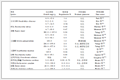
2 DMSP趋化微生物类群DMSP趋化性研究始于1996年,Zimmer-Faust等[15]借助计算机辅助视频运动技术来观察微毛细血管趋化检测系统中DMSP裂解产DMS的粪产碱菌(Alcaligenes faecalis)M3A对DMSP的趋化性,进而发现该菌对DMSP具趋化性,同时此过程能被DMSP裂解酶促进。该研究表明,微生物对DMSP的趋化过程可能影响DMS的产生,并在海洋溶解有机物的降解与海洋-大气间的生物地球化学硫循环中发挥潜在作用。之后,陆续有研究发现更多能趋化DMSP的微生物,涵盖了细菌[13]、真核浮游微藻[26]和原生动物[38]。目前,已有研究通过实验鉴定出14种具有DMSP趋化性的微生物,其中7株为细菌;通过ISCA技术发现了8个科的细菌对DMSP具趋化性,其中黄杆菌科、红细菌科、假单胞菌科和盐单胞菌科微生物具有降解DMSP的潜力。本文对目前已报道的具有DMSP趋化性的微生物进行了归纳与总结(见表 1)。
|
表 1 目前已报道的对DMSP具趋化性的微生物 Table 1 Microorganisms that have been reported to be chemotactic towards DMSP |
现有研究表明,对DMSP具趋化性的微生物主要集中在特定的生态位,如与浮游藻类和珊瑚共生或附生的微生物群体,且经过实验表征的DMSP趋化细菌数量很少,这在一定程度上限制了对海洋微生物DMSP趋化机制与作用的进一步了解。此外,微生物在更广泛海洋环境中的DMSP趋化作用仍存在研究空白,如近岸、远洋海水及沉积物和极端海洋生境。
3 海洋微生物DMSP趋化性的分子机制微生物趋化DMSP涉及复杂的胞内分子信号传导通路。趋化系统是原核生物中极为复杂的信号转导系统之一,虽然其核心组分在遗传上高度保守[1, 40-41],但不同细菌的趋化系统组成仍存在差异。目前,对趋化转导系统通路的表征及趋化导航作用的研究大多基于大肠杆菌(Escherichia coli),而研究表明,多数海洋微生物具独特的运动模式和分子机制,且这些机制仍待揭示。
目前已知的细菌趋化系统信号转导过程(见图 2)通常如下:膜受体甲基化趋化蛋白(Methyl-accepting chemotaxis proteins, MCPs)负责感受外界刺激,并通过支架蛋白(Scaffold protein)CheW/V与组氨酸激酶CheA相连;MCPs结合外界信号分子后,调控CheA的活性,进而将信号向下游的响应调节因子CheY传递,CheA与CheY共同构成双组分信号转导系统(Two-component signal transduction system,TCS)[42];被CheA磷酸化的CheY(CheY-P)通过鞭毛蛋白FliM与鞭毛-马达复合体相互作用,调控细菌的运动方向。此外,CheR和CheB蛋白通过参与MCPs的甲基化状态变化来调整微生物对化学信号的敏感性,使其能响应新的环境变化[43-45]。因此,解析海洋微生物对于DMSP趋化性的关键在于鉴定介导DMSP趋化性的MCPs。

|
(P:磷酸基团Phosphate group;—CH3:甲基Methyl group.) 图 2 细菌趋化系统信号转导过程 Fig. 2 Signal transduction process of the bacterial chemotaxis system |
目前已知趋化细菌平均拥有14种MCPs[46],且其种类数在不同物种间差异悬殊,各趋化菌种MCPs种类数介于1~90种[47-48],例如庞氏鲁杰氏菌TM1040具有的MCPs可能超过20个[26]。然而,现有研究发现的MCPs大多是识别氨基酸和糖类等物质[49]。目前尚未发现特异性感知DMSP的MCPs [50]。MCPs在确定触发微生物趋化运动的阈值中起着关键作用[51],不同物种对DMSP浓度的敏感性和触发阈值存在显著差异[52]。例如,粪产碱菌M3A的趋化反应可以被10和100 nmol/L的DMSP浓度触发[15];在500 μmol/L DMSP浓度下,游海假交替单胞菌ATCC-700530和庞氏鲁杰氏菌TM1040均表现出趋化性,但在20 μmol/L DMSP浓度下,游海假交替单胞菌ATCC-700530的趋化性消失,而庞氏鲁杰氏菌TM1040仍存在趋化反应[13]。然而,在高浓度DMSP条件下,微生物的趋化性和运动会被显著抑制。Vila-Costa等[53]在百慕大群岛所在的大西洋站位表层海水中加入过量的DMSP并孵育30 min,然后对其进行宏转录组分析发现,细胞运动相关的基因表达显著下调。该现象与Miller等[26]大量添加外源DMSP会降低庞氏鲁杰氏菌TM1040对DMSP的趋化性的观察结果一致。这种高浓度DMSP抑制现象可能是由于化学感受器达到了饱和状态,大量的DMSP掩盖了浮游植物细胞周围的微尺度DMSP浓度梯度,从而降低了趋化性[13, 29]。此外,有研究表明,微生物的趋化性可能更依赖于感知浓度的变化,而非绝对浓度,例如当趋化微生物接近化学诱导物时,其MCP被激活的频率以及信号转导蛋白CheY的磷酸化频率显著增加[54-55]。
DMSP裂解通路可能参与调控微生物趋化性反应。粪产碱菌M3A通过DddY进行DMSP裂解[56],其对DMSP的趋化反应,可能依赖DMSP裂解酶进行调控:与没有诱导DMSP裂解酶表达的菌株相比,诱导表达DMSP裂解酶的菌株表现出更强烈的趋化性[15]。Chiou等[31]发现,露丝盖兹内生杆菌(Endozoicomonas ruthgatesiae)8E通过DddD代谢DMSP,且在代谢DMSP的同时,趋化性相关基因表达会上调,并推测DMSP代谢通路可能与趋化通路耦联。然而,并非所有的DMSP降解类群都趋化DMSP,如SAR11基因组中缺乏编码鞭毛和趋化系统相关基因[17, 57-58]。某些不能降解DMSP的微生物却表现出对DMSP的趋化性,如溶珊瑚弧菌BAA-450[35],这表明该菌仅将DMSP作为信号分子来定位富营养微环境(珊瑚黏液),而非直接将其作为营养物质[35]。此外,Clerc等[5]发现,DMSP在增强微生物对其他营养物质的趋化敏感性中发挥了重要作用,该过程可能涉及S-腺苷甲硫氨酸(S-adenosylmethionine,SAM)的甲基转移途径。
4 海洋微生物趋化性研究方法目前,常用于研究微生物DMSP趋化性的方法主要包括微毛细管法(Capillary assays)和近年来广泛应用的微流控技术(Microfluidic technology)。微毛细管法是经典的趋化性定量检测方法(见图 3A),其操作方式如下:在微生物培养液中插入含有DMSP溶液的毛细管,借助计算机辅助视频运动分析,利用流式细胞仪对微生物丰度定量,并结合荧光显微技术来分析微生物在毛细管内的聚集情况,从而定量衡量微生物的趋化性。此方法已被用于实验室中鉴定亚硫酸盐杆菌D7、庞氏鲁杰氏菌TM1040、玫瑰变色菌MS2和粪产碱菌M3A的分离株对DMSP的趋化性[8]。通常采用趋化指数(Chemotaxis index)Ic来衡量微生物趋化反应的强度[59],其计算式如下:
| $ I_{\mathrm{c}}=\frac{N_{\mathrm{t}}}{N_{\mathrm{c}}}。$ | (1) |

|
(A. 微毛细管法Capillary assay;B. 微流控检测法[13]Microfluidic system[13];C.原位趋化性检测技术[59]In-situ chemotaxis assay[59].) 图 3 检测微生物对DMSP趋化性常用方法 Fig. 3 Common methods for detecting bacterial chemotaxis to DMSP |
式中:Nt为实验组(加入DMSP的组别)中受测微生物的数量;Nc为对照组(不加入DMSP的组别)中微生物受测的数量。当Ic>1时,该微生物对DMSP具有趋化性,Ic越大, 该微生物对DMSP的趋化性越强;当Ic < 1时,该微生物对DMSP不产生趋化响应;当Ic < 1时,该微生物对DMSP具驱斥性。
然而,微毛细管法主要适用于实验室条件,难以实现高通量筛选和原位观测。近年来,微流控技术作为趋化性研究的重要突破点,它为精确控制化学梯度和实时动态观察提供了可能。Seymour等[13]设计了一个双入口单通道微流控芯片(见图 3B),其中一个入口通入趋化剂,另一个入口通入菌液。待液流稳定后,关闭注射器泵。由于通道内液体为层流状态,注射器泵关闭后,液体流动立即停止,进入静态扩散阶段。在这种条件下,细菌会在趋化作用的驱动下进行横向运动[13]。基于该方法,研究发现了游海假交替单胞菌ATCC-700530[13]、溶珊瑚弧菌BAA-450[13]和团聚玫瑰色菌(Roseibium aggregatum)PO1[35]对DMSP的趋化反应。与微毛细管法不同,微流控技术能够提供更高的实验精度和动态观测,但其仍然局限在实验室环境中,难以揭示未培养微生物的趋化性。
针对该问题,Lambert等[59]基于微流控技术开发了原位趋化性检测(In-situ chemotaxis assay, ISCA)技术(见图 3C)。该技术(装置)由一系列微孔组成,通过端口连接到外部溶液,微孔中充满了趋化剂,趋化剂从端口扩散到周围的溶液中,形成化学扩散羽流,趋化微生物可通过端口游入微孔。该方法绕过了微生物难以培养或未培养的问题,实现了在原位状态下对微生物的趋化性表征。该技术已成功揭示了珊瑚相关细菌对DMSP具有强趋化性[14]以及DMSP能够增强微生物对多糖的趋化反应[5]。
微流控技术的优势不仅体现在其精准的控制和动态观察能力上,还在于其具备数据整合和高通量筛选能力。例如,结合单细胞测序技术,可以在单菌水平上解析趋化行为与基因功能的关联,为揭示DMSP趋化的分子机制提供了新的视角。然而,该技术仍面临高成本和操作复杂的挑战,其在海洋环境中的广泛应用仍待进一步发展。
5 总结与展望微生物对DMSP趋化性运动的研究不仅能加深对DMSP在全球碳硫循环中作用的认识,也为探讨藻-菌及珊瑚-菌共生机制提供新的理论框架。趋化微生物通过快速感知化学梯度并移动至富营养微环境,这展现了其在生态位适应与生态平衡维持中的重要作用。此外,趋化机制的深入解析,特别是与DMSP裂解途径的关联研究,为揭示趋化性与生物地球化学功能之间的耦合关系奠定了基础。
目前关于DMSP趋化性微生物仍存在许多研究空白。首先,DMSP趋化性研究仍集中在有限的物种和生态位上,未来需要进一步拓展对不同生态环境中DMSP趋化性微生物分布与特性的探索。其次,微生物感知DMSP的具体方式及其后续信号转导的分子机制尚不明确,特别是如何通过特异性MCPs受体识别DMSP仍有待深入解析。此外,现有研究尚未充分结合原位观测与高通量组学技术,难以系统评估DMSP趋化微生物在DMSP消费者群落中的占比,以及趋化类群在DMSP降解过程中的具体贡献。未来可以结合原位化学探针技术、高分辨率单细胞成像、宏基因组和宏转录组等手段,深入解析DMSP趋化性微生物的种群特征、代谢潜力及其在海洋生态系统中的动态变化。同时,可通过稳定同位素示踪(如13C-DMSP)、生态网络分析及功能性筛选实验,量化趋化类群与非趋化类群在DMSP降解途径中的代谢通量差异。最后,通过构建模型来模拟DMSP趋化性微生物在不同海洋环境条件下的行为,并结合实验验证其对局部碳硫循环过程的调控作用,从而全面揭示趋化微生物在全球碳硫循环中的关键功能。
| [1] |
Gumerov V M, Ortega D R, Adebali O, et al. MiST 3.0:An updated microbial signal transduction database with an emphasis on chemosensory systems[J]. Nucleic Acids Research, 2020, 48(1): 459-464. (  0) 0) |
| [2] |
Cremer J, Honda T, Tang Y, et al. Chemotaxis as a navigation strategy to boost range expansion[J]. Nature, 2019, 575(7784): 658-663. DOI:10.1038/s41586-019-1733-y ( 0) |
| [3] |
Keegstra J M, Carrara F, Stocker R. The ecological roles of bacterial chemotaxis[J]. Nature Reviews Microbiology, 2022, 20(8): 491-504. DOI:10.1038/s41579-022-00709-w ( 0) |
| [4] |
Colin R, Ni B, Laganenka L, et al. Multiple functions of flagellar motility and chemotaxis in bacterial physiology[J]. FEMS Microbiology Reviews, 2021, 45(6): fuab038. DOI:10.1093/femsre/fuab038 ( 0) |
| [5] |
Clerc E E, Raina J B, Keegstra J M, et al. Strong chemotaxis by marine bacteria towards polysaccharides is enhanced by the abundant organosulfur compound DMSP[J]. Nature Communications, 2023, 14(1): 8080. DOI:10.1038/s41467-023-43143-z ( 0) |
| [6] |
Matilla M A, Krell T. Bacterial amino acid chemotaxis: A widespread strategy with multiple physiological and ecological roles[J]. Journal of Bacteriology, 2024, 206(10): e00300-24. ( 0) |
| [7] |
Barak-Gavish N, Dassa B, Kuhlisch C, et al. Bacterial lifestyle switch in response to algal metabolites[J]. Elife, 2023, 12: e84400. DOI:10.7554/eLife.84400 ( 0) |
| [8] |
Barak-Gavish N, Frada M J, Ku C, et al. Bacterial virulence against an oceanic bloom-forming phytoplankter is mediated by algal DMSP[J]. Science Advances, 2018, 4(10): eaau5716. DOI:10.1126/sciadv.aau5716 ( 0) |
| [9] |
Shemi A, Alcolombri U, Schatz D, et al. Dimethyl sulfide mediates microbial predator-prey interactions between zooplankton and algae in the ocean[J]. Nature Microbiology, 2021, 6(11): 1357-1366. DOI:10.1038/s41564-021-00971-3 ( 0) |
| [10] |
Teng Z J, Wang P, Chen X L, et al. Acrylate protects a marine bacterium from grazing by a ciliate predator[J]. Nature Microbiology, 2021, 6(11): 1351-1356. DOI:10.1038/s41564-021-00981-1 ( 0) |
| [11] |
Kiene R P, Linn L J, Bruton J A. New and important roles for DMSP in marine microbial communities[J]. Journal of Sea Research, 2000, 43(3-4): 209-224. DOI:10.1016/S1385-1101(00)00023-X ( 0) |
| [12] |
张晓华, 刘骥, 柳敬丽, 等. DMSP的生物合成与裂解及其在硫循环中的作用[J]. 中国科学基金, 2018, 32(5): 471-478. Zhang X H, Liu J, Liu J L, et al. Biosynthesis and cleavage of DMSP and their roles in global sulfur cyele[J]. Bulletin of National Natural Science Foundation of China, 2018, 32(5): 471-478. ( 0) |
| [13] |
Seymour J R, Simó R, Ahmed T, et al. Chemoattraction to dimethylsulfoniopropionate throughout the marine microbial food web[J]. Science, 2010, 329(5989): 342-345. DOI:10.1126/science.1188418 ( 0) |
| [14] |
Tout J, Jeffries T C, Petrou K, et al. Chemotaxis by natural populations of coral reef bacteria[J]. The ISME Journal, 2015, 9(8): 1764-1777. DOI:10.1038/ismej.2014.261 ( 0) |
| [15] |
Zimmer-Faust R K, de Souza M P, Yoch D C. Bacterial chemotaxis and its potential role in marine dimethylsulfide production and biogeochemical sulfur cycling[J]. Limnology and Oceanography, 1996, 41(6): 1330-1334. DOI:10.4319/lo.1996.41.6.1330 ( 0) |
| [16] |
Yang G P, Jing W W, Li L, et al. Distribution of dimethylsulfide and dimethylsulfoniopropionate in the surface microlayer and subsurface water of the Yellow Sea, China during spring[J]. Journal of Marine Systems, 2006, 62(1-2): 22-34. DOI:10.1016/j.jmarsys.2006.04.003 ( 0) |
| [17] |
O'Brien J, Focardi A, Deschaseaux E S, et al. Microbial dimethylsulfoniopropionate(DMSP) cycling in the ultraoligotrophic eastern Indian Ocean[J]. Deep Sea Research Part Ⅱ: Topical Studies in Oceanography, 2022, 206: 105195. DOI:10.1016/j.dsr2.2022.105195 ( 0) |
| [18] |
Vairavamurthy A, Andreae M, Iverson R L. Biosynthesis of dimethylsulfide and dimethylpropiothetin by Hymenomonas carterae in relation to sulfur source and salinity variations[J]. Limnology and Oceanography, 1985, 30(1): 59-70. DOI:10.4319/lo.1985.30.1.0059 ( 0) |
| [19] |
Belviso S, Kim S K, Rassoulzadegan F, et al. Production of dimethylsulfonium propionate (DMSP) and dimethylsulfide (DMS) by a microbial food web[J]. Limnology and Oceanography, 1990, 35(8): 1810-1821. DOI:10.4319/lo.1990.35.8.1810 ( 0) |
| [20] |
Yoch D C. Dimethylsulfoniopropionate: Its sources, role in the marine food web, and biological degradation to dimethylsulfide[J]. Applied and Environmental Microbiology, 2002, 68(12): 5804-5815. DOI:10.1128/AEM.68.12.5804-5815.2002 ( 0) |
| [21] |
Ishida Y, Kadota H. Production of dimethyl sulfide from unicellular algae[J]. Bulletin of the Japanese Society for the Science of Fish, 1967, 33: 782-787. DOI:10.2331/suisan.33.782 ( 0) |
| [22] |
Kessler R W, Weiss A, Kuegler S, et al. Macroalgal-bacterial interactions: Role of dimethylsulfoniopropionate in microbial gardening by Ulva (Chlorophyta)[J]. Molecular Ecology, 2018, 27(8): 1808-1819. DOI:10.1111/mec.14472 ( 0) |
| [23] |
Zubkov M V, Fuchs B M, Archer S D, et al. Linking the composition of bacterioplankton to rapid turnover of dissolved dimethylsulphoniopropionate in an algal bloom in the North Sea[J]. Environmental Microbiology, 2001, 3(5): 304-311. DOI:10.1046/j.1462-2920.2001.00196.x ( 0) |
| [24] |
Sule P, Belas R. A novel inducer of Roseobacter motility is also a disruptor of algal symbiosis[J]. Journal of Bacteriology, 2013, 195(4): 637-646. DOI:10.1128/JB.01777-12 ( 0) |
| [25] |
Miller T R, Belas R. Dimethylsulfoniopropionate metabolism by Pfiesteria-associated Roseobacter spp[J]. Applied and Environmental Microbiology, 2004, 70(6): 3383-3391. DOI:10.1128/AEM.70.6.3383-3391.2004 ( 0) |
| [26] |
Miller T R, Hnilicka K, Dziedzic A, et al. Chemotaxis of Silicibacter sp. strain TM1040 toward dinoflagellate products[J]. Applied and Environmental Microbiology, 2004, 70(8): 4692-4701. DOI:10.1128/AEM.70.8.4692-4701.2004 ( 0) |
| [27] |
Prabagaran S R, Manorama R, Delille D, et al. Predominance of Roseobacter, Sulfitobacter, Glaciecola and Psychrobacter in seawater collected off Ushuaia, Argentina, Sub-Antarctica[J]. FEMS Microbiology Ecology, 2007, 59(2): 342-355. DOI:10.1111/j.1574-6941.2006.00213.x ( 0) |
| [28] |
Grueneberg J, Engelen A H, Costa R, et al. Macroalgal morphogenesis induced by waterborne compounds and bacteria in coastal seawater[J]. PLoS One, 2016, 11(1): e0146307. DOI:10.1371/journal.pone.0146307 ( 0) |
| [29] |
Clerc E E, Raina J B, Peaudecerf F J, et al. Survival in a Sea of Gradients: Bacterial and Archaeal Foraging in a Heterogeneous Ocean[M]//Stal L J, Cretoiu M S. The Marine Microbiome. Cham: Springer, 2022: 47-102.
( 0) |
| [30] |
Tout J, Jeffries T C, Webster N S, et al. Variability in microbial community composition and function between different niches within a coral reef[J]. Microbial Ecology, 2014, 67: 540-552. DOI:10.1007/s00248-013-0362-5 ( 0) |
| [31] |
Chiou Y J, Chan Y F, Yu S P, et al. Similar but different: Characterization of dddD gene-mediated DMSP metabolism among coral-associated Endozoicomonas[J]. Science Advances, 2023, 9(47): eadk1910. DOI:10.1126/sciadv.adk1910 ( 0) |
| [32] |
唐小玉, 张颖, 张文谦, 等. 珊瑚共附生DMSP降解菌的分离及其多样性分析[J]. 海洋学报, 2021, 43(6): 108-117. Tang X, Zhang Y, Zhang W, et al. Isolation and diversity analysis of coral-associated DMSP degrading bacteria[J]. Haiyang Xuebao, 2021, 43(6): 108-117. ( 0) |
| [33] |
Broadbent A D, Jones G B. DMS and DMSP in mucus ropes, coral mucus, surface films and sediment pore waters from coral reefs in the Great Barrier Reef[J]. Marine and Freshwater Research, 2004, 55(8): 849-855. DOI:10.1071/MF04114 ( 0) |
| [34] |
Frade P, Schwaninger V, Glasl B, et al. Dimethylsulfoniopropionate in corals and its interrelations with bacterial assemblages in coral surface mucus[J]. Environmental Chemistry, 2015, 13(2): 252-265. ( 0) |
| [35] |
Garren M, Son K, Raina J B, et al. A bacterial pathogen uses dimethylsulfoniopropionate as a cue to target heat-stressed corals[J]. The ISME Journal, 2014, 8(5): 999-1007. DOI:10.1038/ismej.2013.210 ( 0) |
| [36] |
Rosenberg E, Koren O, Reshef L, et al. The role of microorganisms in coral health, disease and evolution[J]. Nature Reviews Microbiology, 2007, 5(5): 355-362. DOI:10.1038/nrmicro1635 ( 0) |
| [37] |
Vanwonterghem I, Webster N S. Coral reef microorganisms in a changing climate[J]. Iscience, 2020, 23(4): 100972. DOI:10.1016/j.isci.2020.100972 ( 0) |
| [38] |
Güell-Bujons Q, Zanoli M, Tuval I, et al. Distinctive chemotactic responses of three marine herbivore protists to DMSP and related compounds[J]. The ISME Journal, 2024, 18(1): wrae130. DOI:10.1093/ismejo/wrae130 ( 0) |
| [39] |
陈敏纯. 血红哈卡藻藻际微生物群落及藻际细菌Labrenzia sp. PO1的研究[D]. 深圳: 深圳大学, 2018. Chen M. Research of Microbial Community of Akashiwo sanguinea and Phycosphere Bacteria Labrenzia sp. PO1[D]. Shenzhen: Shenzhen University, 2018. ( 0) |
| [40] |
Baker M D, Wolanin P M, Stock J B. Signal transduction in bacterial chemotaxis[J]. Bioessays, 2006, 28(1): 9-22. DOI:10.1002/bies.20343 ( 0) |
| [41] |
Tindall M J, Gaffney E A, Maini P K, et al. Theoretical insights into bacterial chemotaxis[J]. Wiley Interdisciplinary Reviews: Systems Biology and Medicine, 2012, 4(3): 247-259. DOI:10.1002/wsbm.1168 ( 0) |
| [42] |
Zschiedrich C P, Keidel V, Szurmant H. Molecular mechanisms of two-component signal transduction[J]. Journal of Molecular Biology, 2016, 428(19): 3752-3775. DOI:10.1016/j.jmb.2016.08.003 ( 0) |
| [43] |
ejková J, Holler S, Nguyenová T Q, et al. Chemotaxis and chemokinesis of living and non-living objects[M]//Adamatzky A. Advances in Unconventional Computing: Volume 2: Prototypes, Models and Algorithms. Cham: Springer, 2017: 245-260.
( 0) |
| [44] |
Liu Z, Klominek J. Chemotaxis and chemokinesis of malignant mesothelioma cells to multiple growth factors[J]. Anticancer Research, 2004, 24(3A): 1625-1630. ( 0) |
| [45] |
Stephens B B, Loar S N, Alexandre G. Role of CheB and CheR in the complex chemotactic and aerotactic pathway of Azospirillum brasilense[J]. Journal of Bacteriology, 2006, 188(13): 4759-4768. DOI:10.1128/JB.00267-06 ( 0) |
| [46] |
Lacal J, García-Fontana C, Muñoz-Martínez F, et al. Sensing of environmental signals: Classification of chemoreceptors according to the size of their ligand binding regions[J]. Environmental Microbiology, 2010, 12(11): 2873-2884. DOI:10.1111/j.1462-2920.2010.02325.x ( 0) |
| [47] |
Alexandre G, Greer-Phillips S, Zhulin I B. Ecological role of energy taxis in microorganisms[J]. FEMS Microbiology Reviews, 2004, 28(1): 113-126. DOI:10.1016/j.femsre.2003.10.003 ( 0) |
| [48] |
Salah Ud-Din A I M, Roujeinikova A. Methyl-accepting chemotaxis proteins: A core sensing element in prokaryotes and archaea[J]. Cellular and Molecular Life Sciences, 2017, 74: 3293-3303. DOI:10.1007/s00018-017-2514-0 ( 0) |
| [49] |
Grebe T W, Stock J. Bacterial chemotaxis: The five sensors of a bacterium[J]. Current Biology, 1998, 8(5): 154-157. DOI:10.1016/S0960-9822(98)00098-0 ( 0) |
| [50] |
Li C Y, Cao H Y, Curson A R, et al. Dimethylsulfoniopropionate and its catabolites are important chemical signals mediating marine microbial interactions[J]. Trends in Microbiology, 2023, 31(10): 992-994. DOI:10.1016/j.tim.2023.07.004 ( 0) |
| [51] |
Mesibov R, Ordal G W, Adler J. The range of attractant concentrations for bacterial chemotaxis and the threshold and size of response over this range: Weber law and related phenomena[J]. The Journal of General Physiology, 1973, 62(2): 203-223. DOI:10.1085/jgp.62.2.203 ( 0) |
| [52] |
Breckels M N, Boakes D E, Codling E A, et al. Modelling the concentration of exuded dimethylsulphoniopropionate(DMSP) in the boundary layer surrounding phytoplankton cells[J]. Journal of Plankton Research, 2010, 32(2): 253-257. DOI:10.1093/plankt/fbp116 ( 0) |
| [53] |
Vila-Costa M, Rinta-Kanto J M, Sun S, et al. Transcriptomic analysis of a marine bacterial community enriched with dimethylsulfoniopropionate[J]. The ISME Journal, 2010, 4(11): 1410-1420. DOI:10.1038/ismej.2010.62 ( 0) |
| [54] |
Bren A, Eisenbach M. How signals are heard during bacterial chemotaxis: Protein-protein interactions in sensory signal propagation[J]. Journal of Bacteriology, 2000, 182(24): 6865-6873. DOI:10.1128/JB.182.24.6865-6873.2000 ( 0) |
| [55] |
Xu Q, Ali S, Afzal M, et al. Advancements in bacterial chemotaxis: Utilizing the navigational intelligence of bacteria and its practical applications[J]. Science of the Total Environment, 2024, 172967. ( 0) |
| [56] |
Curson A R, Sullivan M J, Todd J D, et al. DddY, a periplasmic dimethylsulfoniopropionate lyase found in taxonomically diverse species of Proteobacteria[J]. The ISME Journal, 2011, 5(7): 1191-1200. DOI:10.1038/ismej.2010.203 ( 0) |
| [57] |
Tripp H J, Kitner J B, Schwalbach M S, et al. SAR11 marine bacteria require exogenous reduced sulphur for growth[J]. Nature, 2008, 452(7188): 741-744. DOI:10.1038/nature06776 ( 0) |
| [58] |
Williams T J, Joux F, Lauro F M, et al. Physiology of marine oligotrophic ultramicrobacteria[M]// Antranikian G, Bull A T, Robb F T, et al. Extremophiles Handbook. Cham: Springer, 2011.
( 0) |
| [59] |
Lambert B S, Raina J B, Fernandez V I, et al. A microfluidics-based in situ chemotaxis assay to study the behaviour of aquatic microbial communities[J]. Nature Microbiology, 2017, 2(10): 1344-1349. DOI:10.1038/s41564-017-0010-9 ( 0) |
2. Laboratory for Marine Ecology and Environmental Science, Qingdao Marine Science and Technology Center, Qingdao 266237, China;
3. Institute of Evolution and Marine Biodiversity, Ocean University of China, Qingdao 266003, China