 2026, Vol. 56


2. 青岛海洋科技中心 海洋生态与环境科学功能实验室, 山东 青岛 266237;
3. 中国海洋大学 化学化工学院, 山东 青岛 266100
一氧化碳(CO)是一种重要的痕量还原性气体,因其能够影响大气对流层中羟基自由基的浓度,被视为一种间接温室气体[1]。在自然环境中,一氧化碳的浓度较低,例如大气中的全球平均浓度约为92 ppb,而海水中的浓度范围为2~15 nmol·L-1[2]。海洋不仅是大气CO的重要自然来源,也是CO参与全球碳循环和气候调节的关键介质。
CO是有机化合物不完全降解产生的碳氧小分子化合物。在海水中,CO的主要来源包括有机质的光化学降解和热化学降解,以及浮游植物的产生[3-6]。这些产生的CO可以作为能量来源,迅速被微生物消耗,以支持其生存[7-9]。海洋沉积物中普遍含有腐殖酸等有机质,因此CO在缺氧的沉积环境中可能广泛分布。基于分子生物学技术,在海洋沉积物中检测到了调控微生物CO代谢的关键基因[10],这为CO在海洋沉积物中的微生物代谢提供了有力证据。
CO可通过抑制金属酶中断电子传递链,对微生物产生毒性作用。然而,仍有许多微生物能够利用CO作为能量来源和碳源[11]。作为原始大气的重要成分之一,CO可能作为碳源促进了早期生命的起源[12-13]。CO可作为电子供体,参与多种发酵途径,包括产氢、产乙酸和产甲烷等,同时也可参与还原外源电子受体的厌氧呼吸过程,如硫酸盐还原和金属还原等[14-16]。因此,CO作为一种广泛分布的碳源,可能是海洋沉积物微生物代谢的潜在底物,并在碳循环和能量代谢中发挥作用。
尽管已有研究从基因组学角度推测海洋沉积物中普遍存在着能够代谢CO的微生物,但目前关于CO代谢的研究主要集中在微生物的分离与鉴定[17-18],而沉积物中CO的原位分布特征及代谢过程研究相对较少[19-21]。因此,本研究以黄河三角洲及胶州湾滨海湿地沉积物为研究对象,开展了CO浓度及其他地球化学参数的分布调查,并结合实验室沉积物培养实验,旨在探究海洋沉积物中CO的微生物代谢过程及其影响因素,从而进一步完善对海洋沉积物中CO生物地球化学循环的认识。
1 材料与方法 1.1 研究区域及样品采集沉积物样品分别于2023年11月和2024年3月采集于黄河三角洲滨海湿地(119°13.5′E,37°43.1′N)和胶州湾大沽河口潮间带(120°7.8′E,36°10.1′N),如图 1所示,取样点根据有无植被覆盖分为黄河三角洲滨海湿地芦苇区(A)和光滩区(B),胶州湾大沽河口潮间带盐地碱蓬区(C)和光滩区(D),共四个站位。每个站位利用聚氯乙烯管(直径7 cm)取30 cm或50 cm沉积物插管柱,以5 cm为间隔进行分层处理。每个站位同时取两根平行柱,分别用于孔隙水样品和固相样品采集。

|
图 1 沉积物采样站位 Fig. 1 Location of sediment sampling stations |
用于分析溶解有机碳(Dissolved organic carbon,DOC)、溶解无机碳(Dissolved inorganic carbon,DIC)和硫酸盐的沉积物孔隙水样品使用Rhizon采样器抽取[22]。收集到的孔隙水样品随后被分装至22 mL玻璃西林瓶或10 mL离心管(聚丙烯,Biosharp)。用于采集固相样品的沉积物按一定间隔分层后,使用3 mL切端注射器采集样品。对于H2样品,取3 mL沉积物至22 mL玻璃西林瓶中,用高纯氮气(N2,99.999%)置换顶空,4 ℃培养7天后测定; 对于甲烷样品,取3 mL沉积物至预先装有3 mL NaOH(2 mol·L-1)的22 mL玻璃西林瓶中,使用涡旋混匀仪摇匀后测定。其余沉积物样品转移至无菌玻璃瓶密封,通过氮气吹扫顶空以保持无氧状态,在4 ℃条件下保存,用于后续的沉积物培养实验。
1.2 沉积物孔隙水CO浓度的测定沉积物孔隙水CO浓度测定采用提取法[21, 23]。取3 mL沉积物至22 mL玻璃西林瓶中,加入Milli-Q水至无顶空状态后使用灰色丁基橡胶塞密封。置换5 mL N2顶空,使用涡旋混匀仪充分混合泥浆,将样品置于避光环境中。平衡2 h后,抽取1 mL顶空气体,采用配备有还原化合物光度检测器的还原性气体色谱仪(Peak Performer 1,Peak Laboratories)进行测定。
沉积物空隙水中的CO浓度[CO]EXT(nmol·L-1)通过以下公式计算:
| $ [C O]_{\mathrm{g}}=\chi_{\mathrm{CO}} \times P \times \mathrm{R}^{-1} \times T^{-1} 。$ | (1) |
式中:χCO为气相色谱测定的顶空CO浓度(ppbv); P是玻璃西林瓶中顶空气体压力(1 atm); R是通用气体常数; T是以开尔文(K)为单位的温度。当瓶内体系达到平衡时,液体中溶解的CO浓度[CO]aq为:
| $ [C O]_{\mathrm{aq}}=\beta \times[C O]_{\mathrm{g}} \text { 。} $ | (2) |
其中,β是根据盐度和温度校正的溶解度常数[24]。对于提取法,通过质量平衡计算在沉积物孔隙水中的CO浓度[CO]EXT:
| $ [C O]_{\mathrm{EXT}}=\left([C O]_{\mathrm{g}} \times V_{\mathrm{g}}+[C O]_{\mathrm{aq}} \times V_{\mathrm{aq}}\right) \times V_{\mathrm{sed}}^{-1} \times \phi^{-1} 。$ | (3) |
式中:Vg是玻璃西林瓶中气体体积; Vaq是玻璃西林瓶中液体体积,包括孔隙水和添加的Milli-Q水; Vsed是沉积物样品体积; Φ是沉积物孔隙度。
在样品测定前,以浓度为10 ppmv的CO标准气体为基础,使用N2进行梯度稀释,进而绘制标准曲线(1~10 ppmv),其呈现出良好的线性(R2=0.999 3)。该方法具有较低的检出限(LoDm=28 nmol·L-1),相对标准偏差小于4%(1 ppmv)。
1.3 沉积物其它地球化学参数的测定沉积物孔隙水甲烷浓度的测定采用配备有HP-POLT Q毛细管柱(30 m×0.32 mm×20 μm,Agilent)和火焰离子化检测器(Flame ionization detector,FID)的气相色谱仪(GC8890,Agilent)。沉积物孔隙水H2浓度采用配备有还原化合物光度检测器的Peak Performer 1还原性气体色谱仪(Peak Performer 1,Peak Laboratories)进行测定[25]。H2样品测定完毕后,将沉积物样品进行冷冻干燥处理,研磨过筛(100目)酸熏后,使用总有机碳分析仪(TOC-L SSM-5000A,Shimadzu)测定总有机碳(Total organic carbon,TOC)。DOC浓度采用总有机碳分析仪(TOC-L CPH,Shimadzu)进行测定。孔隙水DIC浓度使用高精度碳同位素分析仪(G2201-i,Picarro)进行测定。孔隙水硫酸盐的浓度通过配有色谱柱(A7,Metrohm)和保护柱(61011030,Metrohm)的离子色谱仪(940 Professional IC,Metrohm)进行测定。
1.4 沉积物培养实验为探究沉积物中CO的微生物代谢过程及影响因素,本文以胶州湾D站位表层沉积物为实验对象,开展了沉积物培养实验。
在好氧环境(如海水和土壤)中,CO作为微生物能量代谢的重要能量来源已被广泛报道[8, 26]; 而在厌氧环境中,由于CO2/CO(E0=-520 mV)具有较低的氧化还原电位,使得涉及CO的代谢反应在微生物能量代谢中展现出显著优势[27]。基于此,向培养体系中分别添加了10 mmol·L-1硝酸盐、30 mmol·L-1钼酸钠和30 mmol·L-1 2-溴乙基磺酸钠(2-bromoethanesulfo-nic acid,BES),作为电子受体和硫酸盐还原与甲烷生成过程的特异性抑制剂[28-29],同时设置不添加任何底物的对照组,以探究沉积物中CO潜在的消耗途径。
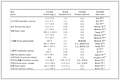
研究发现,土壤CO通量受温度和湿度等环境因素的影响[30]。滨海湿地沉积物作为典型的动态环境,其温度、含水率和盐度等理化性质易受气候、潮汐和河流等多种因素的共同调控,进而对微生物代谢活性产生显著影响。因此,通过设计不同培养条件下的沉积物培养实验[20, 31-32],系统分析了温度、含水率和盐度对CO微生物代谢过程的影响机制(见表 1)。
|
表 1 环境因素培养实验条件设置 Table 1 Experimental conditions for cultivation under environmental factors |
本实验采用优化后的基础矿物培养基配方配制人工海水用于沉积物培养[33],通过调节氯化钠的比例来控制培养基的盐度。底物添加、温度和含水率实验在厌氧手套箱内将培养基与沉积物按4∶1(体积∶质量)比例混合制成泥浆,取约60 mL泥浆分装于120 mL玻璃培养瓶中,经滤灭菌后添加不同底物。使用蓝色丁基橡胶塞密封压盖,并以高纯N2吹扫培养瓶顶空以建立厌氧环境。含水率实验在超净工作台内进行,按照培养基与沉积物比值为0、10%、35%、60%、160%和360%混合培养基与沉积物,制备具有不同含水率的样品,密封压盖后顶空为空气条件。为确保实验在无菌环境进行,厌氧手套箱和超净工作台均经过紫外照射灭菌处理,培养实验用品及灭活对照组均采用高温高压灭菌法进行处理。在培养体系的顶空中均加入最终浓度约为100 ppmv的CO作为补充。每组实验设置三个平行样品,在室温或不同温度培养箱(温度实验)中避光培养,并定期测定真空气体参数变化。通过培养初期CO浓度随时间变化的线性回归分析计算CO消耗速率。
1.5 数据处理研究区域的站位分布图采用Ocean Data View软件进行绘制。实验结果图表的绘制使用OriginPro 2024软件完成,相关性分析通过SPSS 25.0软件进行。
2 结果与讨论 2.1 沉积物CO及其它地球化学参数分析黄河三角洲A(S=9.2)和B(S=29.8)站位分别位于芦苇区和光滩区,沉积物短柱全长30 cm (见图 2A和2B)。A站位沉积物孔隙水中的CO浓度表现出随深度增加的趋势,范围为369.4~540.3 nmol·L-1; 而在B站位中,CO浓度相对较低,范围为86.2~324.0 nmol·L-1,浓度最高出现在表层2.5 cm,随深度逐渐减小。胶州湾C和D站位分别位于大沽河口沿岸的盐地碱蓬区和光滩区,沉积物短柱长度为50 cm(见图 2C和2D)。C站位沉积物孔隙水中的CO浓度自表层2.5 cm处的122.4 nmol·L-1下降至12.5 cm处的58.5 nmol·L-1,随后逐渐上升至深层280.5 nmol·L-1; 而D站位CO浓度自表层2.5 cm处的99.1 nmol·L-1增加至12.5 cm处的281.9 nmol·L-1,深层浓度保持相对稳定。在四个研究站位中,位于黄河三角洲芦苇区的A站位沉积物孔隙水中CO浓度最高。由于黄河口采样时为11月,正值芦苇生长进入落叶期,根系和凋落物为沉积物提供了额外的碳源,促进了CO的积累。此外,CO作为植物中普遍存在的气态信号分子,在植物响应盐度胁迫时发挥积极作用[34-35]。盐度胁迫能够引起植物根系释放CO,从而增强其耐盐性,这可能是A站位CO浓度积累的原因之一[36]。而D站位的盐地碱蓬植物尚处于萌发期,因此对沉积物理化性质的影响较小。

|
图 2 黄河三角洲(A和B)和胶州湾(C和D)沉积物CO垂直分布 Fig. 2 Vertical distribution of CO in sediments from the Yellow River Delta (A and B) and Jiaozhou Bay (C and D) |
本研究调查的滨海湿地沉积物孔隙水CO浓度略高于孟倪等人报道的春季胶州湾沉积物(48.6~189.9 nmol·L-1)[21],这一差异可能与采样深度和站位的不同有关。此外,本研究结果也略高于海草床沉积物(17~51 nmol·L-1)[19],但明显低于热液流体(5 μmol·L-1)与含天然气水合物沉积物(83 μmol·L-1)[10, 37]。在通气良好的土壤中,CO的产生主要来源于腐殖酸及其他有机质的热解,受温度和有机质含量的控制[38]; 而在缺氧环境下,如淹水的稻田土壤,CO则作为有机质微生物降解的中间产物产生[39]。由于黄河带入大量泥沙,黄河口附近海域的水体浑浊度较高,海水浑浊度较高,抑制了海水中CO的光生成,导致海水CO浓度较低,仅为0.09~0.20 nmol·L-1[40]。因此,沉积物中的CO可以向海水或直接向大气进行扩散。
H2和CO类似,是能够支持微生物生长的痕量还原性气体[41]。在四个站位中,H2浓度较低,范围为0.2~3.0 nmol·L-1(见图 3)。在缺氧环境中,H2主要通过微生物发酵过程产生,并迅速被产甲烷菌、硫酸盐还原菌等微生物利用,其在环境中的浓度由微生物的产生与消耗过程共同控制[42]。在A、B和C站位,硫酸盐浓度垂直变化较小,平均浓度分别为4.8、12.8和31.7 mmol·L-1,甲烷平均浓度分别11.2、12.0和4.4 μmol·L-1; 而D站位硫酸盐浓度随深度略微下降,从28.9 mmol·L-1下降至25.5 mmol·L-1,同时甲烷浓度随深度逐渐增加,范围为3.7~12.3 μmol·L-1。硫酸盐作为沉积物中参与有机质厌氧氧化的主要电子受体[43],其浓度与CO之间呈显著负相关(n=28,r=-0.54,p < 0.05,见图 4),这表明沉积物中CO浓度可能受到硫酸盐还原过程的影响。

|
图 3 黄河三角洲(A和B)和胶州湾(C和D) 沉积物地球化学参数垂直分布 Fig. 3 Vertical distribution of geochemical parameters in sediments from the Yellow River Delta (A and B) and Jiaozhou Bay (C and D) |

|
( 星号表示显著性水平,:p < 0.05,:p < 0.01,:p < 0.001;Asterisk denotes significance level, : p < 0.05, : p < 0.01, : p < 0.001。r斯皮尔曼相关系数Spearman’s rank correlation coefficient. ) 图 4 滨海湿地沉积物CO和其它地球化学参数的Spearman相关分析 Fig. 4 Spearman's correlation analysis between carbon monoxide concentrations and other geochemical parameters in coastal wetland sediments |
在A站位,DIC含量随深度增加,范围为10.7~14.2 mmol·L-1,而TOC含量随深度减小,从0.44%下降至0.14%;B站位DIC范围为8.2~12.3 mmol·L-1,TOC含量比较稳定,平均为0.15%;在C站位,DIC含量从表层3.3 nmol·L-1,增至6.4 mmol·L-1,δ13C-DIC则随深度逐渐转负,从-1.8‰降至-10.4‰,DOC浓度变化较小,平均为3.3 mmol·L-1; 同样的,D站位DIC随深度逐渐增加,范围为4.4~12.8 mmol·L-1,δ13C-DIC从-1.4‰下降至-7.6‰,DOC浓度随深度略微升高,变化范围为3.7~6.7 mmol·L-1。DIC作为有机质降解的最终产物,普遍随沉积物深度逐渐增加,体现了有机质在随深度发生持续的降解; 但在B站位,由于受到植物根系的扰动,DIC呈现出不规律的变化趋势[44]。同时,CO浓度与DIC(n = 28,r = 0.59,p < 0.05)和δ13C-DIC(n=16,r=-0.57,p < 0.05)之间存在显著相关性(见图 4),表明了有机质降解驱动的早期成岩过程是CO积累的关键因素。
2.2 CO在沉积物中的潜在代谢途径为了确定海洋沉积物中与CO厌氧消耗相关的微生物代谢过程,进行了添加电子受体与抑制剂的沉积物培养实验,对照组中的CO被迅速利用,而添加电子受体与抑制剂则在一定程度上削弱了CO的消耗(见图 5)。在培养的12 d内,对照组顶空CO迅速减少95.6%,CO浓度由添加的103 ppmv下降至4.5 ppmv,消耗速率为5.0 μmol·g-1·d-1,其间H2最高积累到13.4 ppmv。相较之下,灭活对照组CO浓度仅减少了11.0%,表明培养实验中的CO减少主要是由微生物代谢过程消耗。

|
图 5 电子受体与抑制剂添加沉积物培养期间顶空CO(A)和H2(B)浓度变化 Fig. 5 Headspace CO (A) and H2 (B) concentrations during sediments incubation amended with electron acceptors and inhibitors |
BES的添加对CO厌氧消耗影响较小,顶空CO浓度下降至8.1 ppmv,H2最大浓度为12.2 ppmv,这一现象与美国缅因州Lowes Cove盐沼沉积物实验结果类似[45]。据报道,目前仅分离出三株产甲烷菌能够以CO作为唯一碳源生长并产生甲烷,分别为Methanobacterium thermoautotrophicus,Methanosarcina barkeri和Methanosarcina acetivorans[14, 46-47]。由于CO并非常规的产甲烷底物,因此产甲烷过程对CO消耗贡献相对较小。
基于现有的基因组分析发现,大多数硫酸盐还原菌都含有编码一氧化碳脱氢酶的基因,具有氧化CO的潜力[48],因此硫酸盐还原菌可能是沉积物中CO消耗的重要参与者。在培养实验中,当添加钼酸钠抑制硫酸盐还原过程后,CO浓度仅下降至36.7 ppmv,与对照组相比,CO消耗减少了33.3%,并且H2浓度逐渐积累至36.2 ppmv。在盐沼沉积物中添加钼酸钠同样抑制了50%的CO消耗[45],然而钼酸钠对淡水沉积物CO消耗影响很小[49]。在淡水体系中,由于硫酸盐浓度远远低于海洋沉积物,硫酸盐还原过程不能作为CO消耗的主要途径,因此CO可能被产乙酸等其他微生物过程利用[50-51]。
作为海洋沉积物中常见的电子受体,硝酸盐并不能作为电子受体参与到CO厌氧氧化,甚至对CO厌氧氧化产生了一定的抑制作用,仅有51%的CO被消耗,并且H2浓度始终低于1 ppmv。在河口和温泉沉积物的宏基因组分析表明,Hadesarchaea具备厌氧氧化CO的能力,并且可能与异化硝酸盐还原为氨过程(Dissimilatory nitrate reduction to ammonium,DNRA)耦合,通过这一途径在地下环境中获取能量[52]。但硝酸盐通常对硫酸盐还原菌、产甲烷古菌和产乙酸菌具有抑制作用[53-55],从而影响沉积物中微生物对CO的代谢。此外,硝酸盐还原过程中产生的N2O会使一氧化碳脱氢酶失活,从而抑制CO的利用[56]。并且,在产乙酸菌Clostridium thermoautotrophicum和Clostridium thermoaceticum的纯培养实验中发现,硝酸盐会阻断C1化合物(CO、甲酸和甲醇等)的利用,使它们丧失伍德-永达尔(Wood-Ljungdahl)途径的自养碳固定能力,从而进一步抑制CO的消耗[54]。尽管某些具有钼依赖型一氧化碳脱氢酶的好氧CO氧化细菌能够在厌氧条件下利用硝酸盐作为电子受体氧化CO[57],但在本实验中并未观察到这一现象。因此,本实验认为硝酸盐不能作为海洋沉积物中CO厌氧氧化的电子受体。
2.3 影响沉积物CO微生物代谢的环境因素为了探究环境因素对CO微生物代谢的影响,在不同条件下进行了沉积物培养实验,实验结果发现温度、含水率和盐度都产生了不同程度的影响(见图 6)。

|
( 虚线为灭活对照组。Dashed line respresents the inactivated control group. ) 图 6 不同环境因素培养期间顶空CO(A、B和C)浓度变化及CO消耗速率(D) Fig. 6 Headspace CO concentrations (A, B, and C) and CO uptake rates (D) during incubation under different environmental factors |
在陆地生态系统中,厌氧CO代谢活性已在好氧、微氧及缺氧的土壤和沉积物中得到广泛发现,且嗜温和嗜热微生物的CO代谢过程在地热与非地热环境中普遍存在[58]。为探究温度对盐沼沉积物中CO微生物代谢过程的影响,本文设置了4、18、25、30、37和55 ℃的温度梯度进行培养实验。结果表明,CO消耗速率随温度变化显著(见图 6A)。在4~37 ℃的温度范围内,随着温度升高,CO消耗速率呈现上升趋势,从0.8 μmol·g-1·d-1增加至10.5 μmol·g-1·d-1; 在55 ℃时,尽管CO消耗速率降至8.4 μmol·g-1·d-1,但依然维持较高的CO代谢活性。同时,温度升高导致了CO消耗的平衡阈值浓度的降低。在低于24 ℃时,平衡阈值浓度高于5 ppmv; 而在30 ℃以上时,平衡阈值浓度降至小于2 ppmv,这表明在中温条件下更有利于微生物代谢CO。与本实验结果一致,在沼泽、湖泊沉积物及淹没稻田土壤等典型缺氧环境中,同样观察到在中温条件下比高温条件具有更快的CO消耗速率,表明普遍缺氧的环境可能更有利于嗜温微生物的CO代谢过程[20]。
滨海湿地生态系统位于海洋与陆地的交界处,表层沉积物受到潮汐的周期性淹没影响,沉积物含水率随之变化。为探究沉积物含水率对盐沼沉积物中CO微生物代谢过程的影响,模拟了落潮暴露于空气和涨潮被海水覆盖的情境,设置了含水率分别为40%、45%、56%、63%、77%和87%的培养实验。结果表明,沉积物含水率对CO的消耗具有显著影响(见图 6B)。在含水率40%~63%范围内,随着含水率的升高,CO消耗速率逐渐增加,从2.5 μmol·g-1·d-1上升至10.7 μmol·g-1·d-1; 但当含水率进一步升高至87%时,CO消耗速率下降至4.5 μmol·g-1·d-1。随着海水淹没,沉积物的含水率升高,孔隙被海水填充,阻碍了与大气之间的气体交换,形成相对厌氧的环境,这对微生物的厌氧CO消耗产生了积极影响。同时,含水率也影响着沉积物中有机碳的可利用性,提高了微生物活性和生长速度[59],从而加速了CO代谢。然而,当含水率超过77%时,泥浆静置后形成一定厚度的水层,隔绝空气的同时,也减缓了沉积物与顶空中CO的气体交换,导致CO消耗速率下降。此外,有研究表明,土壤气体扩散效率随着水分增加而降低[64],因此土壤湿度的升高会导致CO吸收的减少。
盐沼沉积物孔隙水的盐度受降水、河流输入和蒸发等过程的影响而发生变化。为探究盐度对盐沼沉积物中CO微生物代谢过程的影响,本研究设置了15、25、35和45的盐度梯度进行培养实验。结果表明,与温度和含水率相比,盐度变化对CO消耗速率的影响相对较小(见图 6C)。在海水盐度下,CO消耗速率为5.1 μmol·g-1·d-1; 当盐度降至25和15时,CO消耗速率分别降至4.1和3.3 μmol·g-1·d-1; 当盐度为45时,CO消耗速率仅降至4.7 μmol·g-1·d-1。总体来看,相对于温度和含水率,微生物CO代谢对盐度的变化具有较强的适应力。已有研究发现,能够代谢CO的微生物广泛存在于从低盐到高盐的环境中,例如淡水湖泊分离出的Thermincola carboxydiphila gen. nov., sp. nov.,可以厌氧氧化CO并产生等摩尔量的H2[60]; 从盐滩分离出的极端嗜盐广古菌Haloarcula sp. PCN7和Halobaculum sp. WSA2可以将CO氧化与高氯酸盐还原偶联[61]; 从盐湖和苏打盐湖中分离出的Halanaeroarchaeum sp. HSR-CO和Halalkaliarchaeum sp. AArc-CO发现了极端嗜盐古菌中以CO作为电子供体的硫呼吸途径[62]。
3 结语本文通过对黄河三角洲及胶州湾滨海湿地沉积物进行系统调查,结合地球化学参数分析及沉积物培养实验,研究了滨海湿地沉积物中CO的原位分布特征、微生物代谢途径及影响素。研究结果表明,黄河三角洲与胶州湾滨海湿地沉积物孔隙水CO浓度范围分别为86.2~540.3和58.5~281.9 nmol·L-1,其分布主要受有机质降解和硫酸盐还原等生物地球化学过程的控制。培养实验表明,沉积物中广泛分布的CO可以被硫酸盐还原菌等微生物快速利用。此外,产甲烷过程对CO代谢的贡献相对较小,而硝酸盐对CO的厌氧消耗表现出一定的抑制作用。沉积物中CO的微生物代谢速率受环境因素的影响。微生物CO代谢在4~55 ℃的温度范围内均可发生,在37 ℃时CO的消耗速率达到最大值; 沉积物含水率通过影响气液交换过程进而调控CO的消耗速率; 在15~45的盐度范围内,CO消耗速率的变化相对较小。本研究为深入理解海洋环境中CO的生物地球化学循环提供了新的科学依据。
致谢: 感谢中国海洋大学吴柄政、管文嘉、陈钊和罗方淇对样品采集与测定提供的帮助。
| [1] |
Thompson A M. The oxidizing capacity of the earth's atmosphere: Probable past and future changes[J]. Science, 1992, 256(5060): 1157-1165. DOI:10.1126/science.256.5060.1157 (  0) 0) |
| [2] |
Moran M A, Miller W L. Resourceful heterotrophs make the most of light in the coastal ocean[J]. Nature Reviews Microbiology, 2007, 5(10): 792-800. DOI:10.1038/nrmicro1746 ( 0) |
| [3] |
Conrad R, Seiler W. Utilization of traces of carbon monoxide by aerobic oligotrophic microorganisms in ocean, lake and soil[J]. Archives of Microbiology, 1982, 132(1): 41-46. DOI:10.1007/BF00690815 ( 0) |
| [4] |
Johnson J E, Bates T S. Sources and sinks of carbon monoxide in the mixed layer of the tropical South Pacific Ocean[J]. Global Biogeochemical Cycles, 1996, 10(2): 347-359. DOI:10.1029/96GB00366 ( 0) |
| [5] |
Miller W L, Moran M A. Interaction of photochemical and microbial processes in the degradation of refractory dissolved organic matter from a coastal marine environment[J]. Limnology and Oceanography, 1997, 42(6): 1317-1324. DOI:10.4319/lo.1997.42.6.1317 ( 0) |
| [6] |
Gros V, Peeken I, Bluhm K, et al. Carbon monoxide emissions by phytoplankton: Evidence from laboratory experiments[J]. Environmental Chemistry, 2009, 6(5): 369-379. DOI:10.1071/EN09020 ( 0) |
| [7] |
Zafiriou O C, Andrews S S, Wang W. Concordant estimates of oceanic carbon monoxide source and sink processes in the Pacific yield a balanced global "blue-water" CO budget[J]. Global Biogeochemical Cycles, 2003, 17(1): 1015. ( 0) |
| [8] |
Greening C, Grinter R. Microbial oxidation of atmospheric trace gases[J]. Nature Reviews Microbiology, 2022, 20(9): 513-528. DOI:10.1038/s41579-022-00724-x ( 0) |
| [9] |
Lappan R, Shelley G, Islam Z F, et al. Molecular hydrogen in seawater supports growth of diverse marine bacteria[J]. Nature Microbiology, 2023, 8: 581-595. DOI:10.1038/s41564-023-01322-0 ( 0) |
| [10] |
Cho H, Hyun J H, You O R, et al. Microbial community structure associated with biogeochemical processes in the Sulfate-Methane Transition Zone (SMTZ) of gas-hydrate-bearing sediment of the Ulleung Basin, East Sea[J]. Geomicrobiology Journal, 2017, 34(3): 207-219. DOI:10.1080/01490451.2016.1159767 ( 0) |
| [11] |
Techtmann S M, Colman A S, Robb F T. 'That which does not kill us only makes us stronger': The role of carbon monoxide in thermophilic microbial consortia[J]. Environmental Microbiology, 2009, 11(5): 1027-1037. DOI:10.1111/j.1462-2920.2009.01865.x ( 0) |
| [12] |
Huber C, Wächtershäuser G. Activated acetic acid by carbon fixation on (Fe, Ni)S under primordial conditions[J]. Science, 1997, 276(5310): 245-247. DOI:10.1126/science.276.5310.245 ( 0) |
| [13] |
Martin W, Russell M J. On the origin of biochemistry at an alkaline hydrothermal vent[J]. Philosophical Transactions of the Royal Society of London. Series B, Biological Sciences, 2007, 362(1486): 1887-1925. DOI:10.1098/rstb.2006.1881 ( 0) |
| [14] |
Daniels L, Fuchs G, Thauer R K, et al. Carbon monoxide oxidation by methanogenic bacteria[J]. Journal of Bacteriology, 1977, 132(1): 118-126. DOI:10.1128/jb.132.1.118-126.1977 ( 0) |
| [15] |
Parshina S N, Kijlstra S, Henstra A M, et al. Carbon monoxide conversion by thermophilic sulfate-reducing bacteria in pure culture and in co-culture with Carboxydothermus hydrogenoformans[J]. Applied Microbiology and Biotechnology, 2005, 68(3): 390-396. DOI:10.1007/s00253-004-1878-x ( 0) |
| [16] |
Slobodkin A I, Sokolova T G, Lysenko A M, et al. Reclassification of Thermoterrabacterium ferrireducens as Carboxydothermus ferrireducens comb. nov., and emended description of the genus Carboxydothermus[J]. International Journal of Systematic and Evolutionary Microbiology, 2006, 56(10): 2349-2351. DOI:10.1099/ijs.0.64503-0 ( 0) |
| [17] |
Omae K, Fukuyama Y, Yasuda H, et al. Diversity and distribution of thermophilic hydrogenogenic carboxydotrophs revealed by microbial community analysis in sediments from multiple hydrothermal environments in Japan[J]. Archives of Microbiology, 2019, 201(7): 969-982. DOI:10.1007/s00203-019-01661-9 ( 0) |
| [18] |
Yoneda Y, Kano S I, Yoshida T, et al. Detection of anaerobic carbon monoxide-oxidizing thermophiles in hydrothermal environments[J]. FEMS Microbiology Ecology, 2015, 91(9): fiv093. DOI:10.1093/femsec/fiv093 ( 0) |
| [19] |
Kleiner M, Wentrup C, Holler T, et al. Use of carbon monoxide and hydrogen by a bacteria-animal symbiosis from seagrass sediments[J]. Environmental Microbiology, 2015, 17: 5023-5035. DOI:10.1111/1462-2920.12912 ( 0) |
| [20] |
DePoy A N, King G M. Putative nickel-dependent anaerobic carbon monoxide uptake occurs commonly in soils and sediments at ambient temperature and might contribute to atmospheric and sub-atmospheric carbon monoxide uptake during anoxic conditions[J]. Frontiers in Microbiology, 2022, 13: 736189. DOI:10.3389/fmicb.2022.736189 ( 0) |
| [21] |
孟倪, 关宇飞, 陈思阳, 等. 胶州湾沉积物中一氧化碳的微生物产生及消耗研究[J]. 中国海洋大学学报(自然科学版), 2024, 54(5): 83-90. Meng N, Guan F Y, Chen S Y, et al. Microbial production and consumption of carbon monoxide in sediments of Jiaozhou Bay[J]. Periodical of Ocean University of China, 2024, 54(5): 83-90. DOI:10.16441/j.cnki.hdxb.20230061 ( 0) |
| [22] |
Zhuang G C, Elling F J, Nigro L M, et al. Multiple evidence for methylotrophic methanogenesis as the dominant methanogenic pathway in hypersaline sediments from the Orca Basin, Gulf of Mexico[J]. Geochimica et Cosmochimica Acta, 2016, 187: 1-20. ( 0) |
| [23] |
Teske A, Lizarralde D, Höfig T W, et al. Expedition 385 methods[R]. College Station, TX: International Ocean Discovery Program, 2021: 385.
( 0) |
| [24] |
Crozier T E, Yamamoto S. Solubility of hydrogen in water, sea water, and sodium chloride solutions[J]. Journal of Chemical & Engineering Data, 1974, 19(3): 242-244. ( 0) |
| [25] |
Lin Y S, Heuer V B, Goldhammer T, et al. Towards constraining H2 concentration in subseafloor sediment: A proposal for combined analysis by two distinct approaches[J]. Geochimica et Cosmochimica Acta, 2012, 77: 186-201. DOI:10.1016/j.gca.2011.11.008 ( 0) |
| [26] |
Cordero P R F, Bayly K, Leung P M, et al. Atmospheric carbon monoxide oxidation is a widespread mechanism supporting microbial survival[J]. The ISME Journal, 2019, 13: 2868-2881. DOI:10.1038/s41396-019-0479-8 ( 0) |
| [27] |
Diender M, Stams A J M, Sousa D Z. Pathways and bioenergetics of anaerobic carbon monoxide fermentation[J]. Frontiers in Microbiology, 2015, 6: 1275. ( 0) |
| [28] |
Oremland R S, Taylor B F. Sulfate reduction and methanogenesis in marine sediments[J]. Geochimica et Cosmochimica Acta, 1978, 42(2): 209-214. DOI:10.1016/0016-7037(78)90133-3 ( 0) |
| [29] |
Nollet L, Demeyer D, Verstraete W. Effect of 2-bromoethanesulfonic acid and Peptostreptococcus productus ATCC 35244 addition on stimulation of reductive acetogenesis in the ruminal ecosystem by selective inhibition of methanogenesis[J]. Applied and Environmental Microbiology, 1997, 63(1): 194-200. DOI:10.1128/aem.63.1.194-200.1997 ( 0) |
| [30] |
Liu L, Zhuang Q, Zhu Q, et al. Global soil consumption of atmospheric carbon monoxide: An analysis using a process-based biogeochemistry model[J]. Atmospheric Chemistry and Physics, 2018, 18(11): 7913-7931. DOI:10.5194/acp-18-7913-2018 ( 0) |
| [31] |
陆小兰, 张聪, 杨桂朋, 等. 胶州湾海水中一氧化碳光致生成影响因素的研究[J]. 海洋学报(中文版), 2012, 34(4): 77-83. Lu Xiaolan, Zhang Cong, Yang Guipeng, et al. Studies of influencing factors on photoproduction of carbon monoxide in sea water of the Jiaozhou Bay[J]. Haiyang Xuebao, 2012, 34(4): 77-83. ( 0) |
| [32] |
Xian X, Pang M, Zhang J, et al. Assessing the effect of potential water and salt intrusion on coastal wetland soil quality: Simulation study[J]. Journal of Soils and Sediments, 2019, 19(5): 2251-2264. DOI:10.1007/s11368-018-02225-y ( 0) |
| [33] |
Laso-Pérez R, Krukenberg V, Musat F, et al. Establishing anaerobic hydrocarbon-degrading enrichment cultures of microorganisms under strictly anoxic conditions[J]. Nature Protocols, 2018, 13(6): 1310-1330. DOI:10.1038/nprot.2018.030 ( 0) |
| [34] |
Tarr M A, Miller W L, Zepp R G. Direct carbon monoxide photoproduction from plant matter[J]. Journal of Geophysical Research: Atmospheres, 1995, 100(D6): 11403-11413. DOI:10.1029/94JD03324 ( 0) |
| [35] |
Jin Q, Cui W, Xie Y, et al. Carbon Monoxide: A Ubiquitous Gaseous Signaling Molecule in Plants[M]. Gasotransmitters in Plants: The Rise of a New Paradigm in Cell Signaling. Cham: Springer, 2016: 3-19.
( 0) |
| [36] |
Xie Y, Ling T, Han Y, et al. Carbon monoxide enhances salt tolerance by nitric oxide-mediated maintenance of ion homeostasis and up-regulation of antioxidant defence in wheat seedling roots[J]. Plant, Cell & Environment, 2008, 31(12): 1864-1881. ( 0) |
| [37] |
Charlou J L, Donval J P, Fouquet Y, et al. Geochemistry of high H2 and CH4 vent fluids issuing from ultramafic rocks at the Rainbow hydrothermal field (36°14'N, MAR)[J]. Chemical Geology, 2002, 191(4): 345-359. DOI:10.1016/S0009-2541(02)00134-1 ( 0) |
| [38] |
Conrad R, Seiler W. Characteristics of abiological carbon monoxide formation from soil organic matter, humic acids, and phenolic compounds[J]. Environmental Science & Technology, 1985, 19(12): 1165-1169. ( 0) |
| [39] |
Conrad R, Schütz H, Seiler W. Emission of carbon monoxide from submerged rice fields into the atmosphere[J]. Atmospheric Environment, 1988, 22(4): 821-823. DOI:10.1016/0004-6981(88)90021-2 ( 0) |
| [40] |
Zhao B Z, Yang G P, Xie H, et al. Distribution, flux and photoproduction of carbon monoxide in the Bohai and Yellow Seas[J]. Marine Chemistry, 2015, 168: 104-113. DOI:10.1016/j.marchem.2014.11.006 ( 0) |
| [41] |
Leung P M, Grinter R, Tudor-Matthew E, et al. Trace gas oxidation sustains energy needs of a thermophilic archaeon at suboptimal temperatures[J]. Nature Communications, 2024, 15: 3219. DOI:10.1038/s41467-024-47324-2 ( 0) |
| [42] |
Conrad R. Soil microorganisms as controllers of atmospheric trace gases (H2, CO, CH4, OCS, N2O, and NO)[J]. Microbiological Reviews, 1996, 60(4): 609-640. DOI:10.1128/mr.60.4.609-640.1996 ( 0) |
| [43] |
董宏坤, 万世明, 刘喜停. 海洋沉积物早期成岩作用研究进展[J]. 沉积学报, 2022, 40(5): 1172-1187. Dong H K, Wan S M, Liu X T. Research progress on geochemical behavior of minerals and elementsin early diagenesis of marine sediments[J]. Acta Sedimentologica Sinica, 2022, 40(5): 1172-1187. ( 0) |
| [44] |
Delgard M L, Deflandre B, Kochoni E, et al. Biogeochemistry of dissolved inorganic carbon and nutrients in seagrass (Zostera noltei) sediments at high and low biomass[J]. Estuarine, Coastal and Shelf Science, 2016, 179: 12-22. DOI:10.1016/j.ecss.2016.01.012 ( 0) |
| [45] |
King G M. Microbial carbon monoxide consumption in salt marsh sediments: Benthic marine CO consumption[J]. FEMS Microbiology Ecology, 2007, 59(1): 2-9. DOI:10.1111/j.1574-6941.2006.00215.x ( 0) |
| [46] |
O'Brien J M, Wolkin R H, Moench T T, et al. Association of hydrogen metabolism with unitrophic or mixotrophic growth of Methanosarcina barkeri on carbon monoxide[J]. Journal of Bacteriology, 1984, 158(1): 373-375. DOI:10.1128/jb.158.1.373-375.1984 ( 0) |
| [47] |
Rother M, Metcalf W W. Anaerobic growth of Methanosarcina acetivorans C2A on carbon monoxide: An unusual way of life for a methanogenic archaeon[J]. Proceedings of the National Academy of Sciences, 2004, 101(48): 16929-16934. DOI:10.1073/pnas.0407486101 ( 0) |
| [48] |
Parshina S N, Sipma J, Henstra A M, et al. Carbon monoxide as an electron donor for the biological reduction of sulphate[J]. International Journal of Microbiology, 2010, 2010: 319527. ( 0) |
| [49] |
Rich J J, King G M. Carbon monoxide consumption and production by wetland peats[J]. FEMS Microbiology Ecology, 1999, 28: 215-224. DOI:10.1111/j.1574-6941.1999.tb00577.x ( 0) |
| [50] |
Küsel K, Drake H L. Effects of environmental parameters on the formation and turnover of acetate by forest soils[J]. Applied and Environmental Microbiology, 1995, 61(10): 3667-3675. DOI:10.1128/aem.61.10.3667-3675.1995 ( 0) |
| [51] |
Wagner C, Griesshammer A, Drake H L. Acetogenic capacities and the anaerobic turnover of carbon in a kansas prairie soil[J]. Applied and Environmental Microbiology, 1996, 62(2): 494-500. DOI:10.1128/aem.62.2.494-500.1996 ( 0) |
| [52] |
Baker B J, Saw J H, Lind A E, et al. Genomic inference of the metabolism of cosmopolitan subsurface Archaea, Hadesarchaea[J]. Nature Microbiology, 2016, 1(3): 16002. DOI:10.1038/nmicrobiol.2016.2 ( 0) |
| [53] |
Jones G A. Dissimilatory metabolism of nitrate by the rumen microbiota[J]. Canadian Journal of Microbiology, 1972, 18(12): 1783-1787. DOI:10.1139/m72-279 ( 0) |
| [54] |
Fröstl J M, Seifritz C, Drake H L. Effect of nitrate on the autotrophic metabolism of the acetogens Clostridium thermoautotrophicum and Clostridium thermoaceticum[J]. Journal of Bacteriology, 1996, 178(15): 4597-4603. DOI:10.1128/jb.178.15.4597-4603.1996 ( 0) |
| [55] |
Jenneman G E, McInerney M J, Knapp R M. Effect of nitrate on biogenic sulfide production[J]. Applied and Environmental Microbiology, 1986, 51(6): 1205-1211. DOI:10.1128/aem.51.6.1205-1211.1986 ( 0) |
| [56] |
Lu W P, Ragsdale S W. Reductive activation of the coenzyme A/acetyl-CoA isotopic exchange reaction catalyzed by carbon monoxide dehydrogenase from Clostridium thermoaceticum and its inhibition by nitrous oxide and carbon monoxide[J]. Journal of Biological Chemistry, 1991, 266(6): 3554-3564. DOI:10.1016/S0021-9258(19)67831-2 ( 0) |
| [57] |
King G M. Nitrate-dependent anaerobic carbon monoxide oxidation by aerobic CO-oxidizing bacteria: Nitrate-dependent CO oxidation[J]. FEMS Microbiology Ecology, 2006, 56(1): 1-7. ( 0) |
| [58] |
DePoy A, King G. Distribution and diversity of anaerobic thermophiles and putative anaerobic nickel-dependent carbon monoxide-oxidizing thermophiles in mesothermal soils and sediments[J]. Frontiers in Microbiology, 2023, 13: 1096186. DOI:10.3389/fmicb.2022.1096186 ( 0) |
| [59] |
Qin H, Xing X, Tang Y, et al. Soil moisture and activity of nitrite- and nitrous oxide-reducing microbes enhanced nitrous oxide emissions in fallow paddy soils[J]. Biology and Fertility of Soils, 2020, 56(1): 53-67. DOI:10.1007/s00374-019-01403-5 ( 0) |
| [60] |
Sokolova T G, Kostrikina N A, Chernyh N A, et al. Thermincola carboxydiphila gen. nov., sp. nov., a novel anaerobic, carboxydotrophic, hydrogenogenic bacterium from a hot spring of the Lake Baikal area[J]. International Journal of Systematic and Evolutionary Microbiology, 2005, 55(5): 2069-2073. DOI:10.1099/ijs.0.63299-0 ( 0) |
| [61] |
Myers M R, King G M. Perchlorate-coupled carbon monoxide (CO) oxidation: Evidence for a plausible microbe-mediated reaction in martian brines[J]. Frontiers in Microbiology, 2017, 8: 2571. DOI:10.3389/fmicb.2017.02571 ( 0) |
| [62] |
Sorokin D Y, Merkel A Y, Messina E, et al. Anaerobic carboxydotrophy in sulfur-respiring haloarchaea from hypersaline lakes[J]. The ISME Journal, 2022, 16(6): 1534-1546. DOI:10.1038/s41396-022-01206-x ( 0) |
2. Laboratory for Marine Ecology and Environmental Science, Qingdao Marine Science and Technology Center, Qingdao 266100, China;
3. College of Chemistry and Chemical Engineering, Ocean University of China, Qingdao 266100, China