 2025, Vol. 55


2. 海水养殖教育部重点实验室(中国海洋大学),山东 青岛 266003;
3. 中国海洋大学海水养殖教育部工程研究中心,山东 青岛 266003
近年来,由于水产饲料优质蛋白源短缺,水产养殖生产中常通过提高饲料脂肪比例达到节约蛋白质的效果[1]。然而,饲料中脂质含量过高可能造成养殖鱼类肝脏中脂质沉积过多、脂质代谢紊乱,导致脂肪肝病频繁发生,生长性能减缓,进而对水产养殖业以及消费市场造成较大的负面影响[2]。已有研究表明,饲料中脂肪含量的增加可导致多种鱼类发生脂肪肝,例如,大黄鱼(Larimichthys crocea)[3]、草鱼(Ctenopharyngodon idellus)[4]等。因此,探寻能够有效改善鱼类饲料脂质利用的途径尤为重要。
众所周知,脂肪酶(Lipase)是脂肪代谢必需的酶,可催化甘油三酯水解为甘油和游离脂肪酸,存在于动物、植物和微生物组织中[5]。有研究表明,在饲料中外源添加脂肪酶可降低黄颡鱼(Pelteobagrus fulvidraco)血清甘油三酯、低密度脂蛋白和总胆固醇含量[6],同时也可改善草鱼(Ctenopharyngodon idella)生长性能、肠道功能、抗氧化和抗病能力[7]。另一方面,肠道微生物可通过分泌多种酶和不同代谢物来促进营养物质的吸收,提高饲料转化率和利用率,进而增强宿主生长性能和健康状态[8-9]。有报道显示,假单胞菌(Pseudomona spp.)、芽孢杆菌(Bacillus spp.)等菌属可产生较多脂肪酶[10],而水产动物肠道菌群也可通过产生脂肪酶调控宿主体内脂质代谢[10]。
益生菌是指在适当剂量下有益于宿主健康的活体微生物,目前已作为饲料添加剂广泛应用于畜牧业和水产养殖中[11]。其中枯草芽孢杆菌(Bacillus subtilis)是水产养殖中应用最广泛的益生菌之一,不仅可以改善水生动物生长性能和肠道菌群的组成、提高免疫和抗病能力[12],而且已被证明可以调节水产动物脂质代谢,减少肝脏脂质沉积[13]。例如,Zhao等发现在高脂饲料中添加一定浓度的枯草芽孢杆菌可以通过抑制脂质合成和促进脂肪酸β氧化降低草鱼肝脏脂质含量,同时缓解血脂异常,防止草鱼高脂肪饮食引起的肝脏氧化损伤[14]。Wang等研究结果显示,在高脂饲料中添加枯草芽孢杆菌HGcc-1的发酵物可以缓解斑马鱼(Danio rerio)脂质沉积并提高其抗氧化能力[15]。
本研究从鱼体肠道内筛选出一株高产脂肪酶的枯草芽孢杆菌C1,通过分析该菌株生物学特征、体内和体外益生特性,探究其是否具有应用到水产养殖中的益生潜力,研究结果可为枯草芽孢杆菌C1作为水产饲料益生菌添加剂的应用提供参考。
1 材料和方法 1.1 产脂肪酶菌株的分离从山东日照获得体质量为(500.0±5.0) g的健康大菱鲆(Scophthalmus maximus),该鱼在生长过程中食用商业饲料。分离大菱鲆肠道,在无菌磷酸盐缓冲液(PBS)中匀浆后进行梯度稀释,取100 μL匀浆液涂布于含有吐温80的LB琼脂平板(HB0129,中国海博)。在28.5 ℃恒温培养箱培养24 h,挑取有沉淀圈的单菌落。
1.2 菌株基因序列分析采用16S rRNA序列的常用引物27F(5′-AGAGTTTGATCCTGGCTCAG-3′)和1492R(5′-CTACGGCTACCTTGTTACGA-3′)对纯化培养后的分离菌株进行PCR扩增。反应程序为:94 ℃预变性5 min,94 ℃变性30 s,51 ℃复性30 s,72 ℃延伸1.5 min,35个循环,72 ℃延伸5 min。PCR扩增产物经琼脂凝胶电泳检测合格后,由上海生工生物工程技术服务有限公司进行测序。鉴定得到一株枯草芽孢杆菌(Bacillus subtilis),命名为枯草芽孢杆菌C1。同时将测序结果在NCBI-Blast上进行比对(https://blast.ncbi.nlm.nih.gov/Blast.cgi),通过MEGA7.0.14软件构件系统发育树。
1.3 油脂分解能力检测 1.3.1 在吐温80或鱼油琼脂平板上沉淀圈或水解圈的测定参考李唯一等[16]和乔汉桢等[17]方法并改进。将枯草芽孢杆菌C1(Bacillus subtilis C1)在28.5 ℃过夜培养后,分别取100 μL菌液置于含有吐温80或鱼油的直径为7 mm的琼脂平板的孔中,28.5 ℃培养3 d,分别测量沉淀圈和水解圈的直径,并计算沉淀圈或水解圈与孔径直径的比值。
1.3.2 脂肪酶活力的测定以对硝基苯酚棕榈酸酯(pNPP)为底物,利用脂肪酶促其水解生成对硝基苯酚(pNP)的反应原理,检测发酵上清液中脂肪酶的活性[18]。将分离菌株按1%的接种量接种在液体培养基中,在28.5 ℃、180 r/min条件下培养48 h,将菌体培养液按照12 000 r/min,离心2 min,取上清为粗酶液。配制6 mmol/L pNP,使用50 mmol/L Tris-HCL (pH=8.0)缓冲液稀释至不同浓度后加入10%三氯乙酸,测定410 nm光吸收值,绘制对硝基苯酚标准曲线。
将50 mmol/L Tris-HCL (pH=8.0)与溶解于异丙醇的p-NPP溶液混匀,37 ℃水浴保温5 min,加入待检测的粗酶液,水浴中准确反应10 min后,加入10%三氯乙酸,混匀,分光光度计测定酶催化产生的对硝基苯酚在410 nm处吸收值,计算其脂肪酶活力。脂肪酶活力单位(U)定义为:在以上条件下,每分钟释放1 μmol pNP所需要的酶量为1 U。酶活计算公式:A=([At-A0]×K+C0)×V1/(V2×t)。式中:A为样品酶活(U/mL);At为反应后样品酶液的吸光度OD值;A0为空白吸光度OD值;K为对硝基酚标准曲线的斜率;C为对硝基酚标准曲线的截距;V1为反应液的体积(mL);V2为酶液的体积/mL;t为反应时间(min)。
1.3.3 菌株对橄榄油的降解率参照秦华明油脂含量测定方法[19],分别配制不同浓度的橄榄油溶液(0、0.2、0.4、0.6、0.8、1.0、1.2、1.4和1.6 mg/mL),以石油醚溶液作为空白组,分别测量以上不同浓度的橄榄油溶液在OD300的吸光度,并绘制橄榄油标准曲线。按照1%接种量将分离菌株接种在含有橄榄油的液体培养基中,培养48 h后,8 000 r/min离心10 min,取上清液于分液漏斗中,弃去沉淀。以培养基作为对照,经过离心、萃取、测吸光值,计算剩余油脂的浓度,计算得到油脂降解率。由此可得到油脂降解率的公式为P=(C-Ctest)/C×100%。式中:P为油脂降解率;C为初始油脂浓度;Ctest为剩余油脂浓度。
1.4 枯草芽孢杆菌C1形态学观察将枯草芽孢杆菌C1接种到LB液体培养基后,在28.5 ℃培养12 h,取适量菌液稀释后在显微镜下(NIKON,日本)观察菌株形态。用革兰氏染色试剂盒(HB8278,中国海博)对分离的菌株进行染色、观察。
1.5 枯草芽孢杆菌C1对碳源的利用将枯草芽孢杆菌C1在28.5 ℃培养12 h,使用细菌生理生化鉴定试剂盒(杭州滨和,中国)对菌株进行鉴定,测定20种碳源(甘露糖、半乳糖、葡萄糖、果糖、蔗糖、麦芽糖、海藻糖、糊精、甘露醇、淀粉、阿拉伯糖、苦杏仁苷、棉子糖、鼠李糖、乳糖、纤维二糖、木糖、水杨苷、山梨醇、葡萄糖酸盐),每种设定3个平行,菌株培养基作为空白对照,在28.5 ℃恒温培养箱中过夜培养后观察结果并记录。
1.6 枯草芽孢杆菌C1安全性检测 1.6.1 溶血性在血平皿平板(3400071,中国海博)上对枯草芽孢杆菌C1进行平板划线,28.5 ℃过夜培养,观察菌落周围是否有溶血环。
1.6.2 枯草芽孢杆菌C1对斑马鱼存活率的影响将三日龄斑马鱼仔鱼均匀放入含有8 mL胚胎培养液的六孔板中,加入终浓度为105、106、107 CFU/mL的枯草芽孢杆菌C1水浴3 d,观察并统计死亡率,每组设置3个平行。
1.6.3 抗生素敏感性采用纸片扩散法(K-B法)测定枯草芽孢杆菌C1对卡那霉素、链霉素、氨苄西林、多粘菌素B、氯霉素、庆大霉素、四环素、青霉素G、头孢噻肟、克拉霉素、左氧氟沙星、万古霉素12种不同抗生素的敏感性。28.5 ℃培养12 h后,观察有无抑菌圈,并记录其直径。根据生产厂家的说明书(滨和,中国杭州),测量抑制圈直径并对照其规定的范围,以此判断菌株对药物的敏感性。
1.7 枯草芽孢杆菌C1耐受性实验 1.7.1 耐酸性实验人工胃液的制备参考Manhar等[20]和刘树彬等[21]的实验方法并改进。配制不同pH的人工胃液,在无菌磷酸盐缓冲液(PBS)中加入NaCl(0.5%)、胃蛋白酶(0.3 mg/mL)并用1 mol/L HCl分别调整pH至2.0和3.0,然后将两种pH的人工胃液分别过0.22 μm滤膜除菌。将28.5 ℃过夜培养的菌液,3 000 r/min离心15 min,PBS洗涤2次后用2种pH的人工胃液重悬细菌沉淀,28.5 ℃培养,分别在0、2、4、8和24 h各取出100 μL梯度稀释,进行平板活菌计数,并计算待测菌的存活率。
1.7.2 耐碱性实验人工肠液的制备方法参考Manhar等[20]和刘树彬等[21]的实验方法并改进。在PBS中加入胰蛋白酶(0.1 mg/mL)和牛胆盐(0.3%),用1 mol/L NaOH将pH分别调至6.8和8.0,分别过0.22 μm滤膜除菌,即得不同pH的人工肠液。将28.5 ℃过夜培养的菌液,3 000 r/min离心15 min,用PBS洗涤2次,分别用2种pH的人工肠液重悬细菌沉淀于28.5 ℃培养,分别在0,2,4,8和24 h各取100 μL梯度稀释并进行平板活菌计数,计算待测菌的存活率。
1.7.3 耐热性实验将枯草芽孢杆菌C1在28.5 ℃培养3 d后分别在70、80和90 ℃下处理10 min,进行平板计数,统计热灭活后菌株的存活率。
1.8 体外抑菌性实验中将迟缓爱德华菌(Edwardsiella tarda ET883)、鳗弧菌(Vibrio anguillarum DSM 21597)、金黄色葡萄球菌(Staphylococcus aureus DSM 20231)、柠檬酸杆菌(Citrobacter portucalensis A60)、a肠杆菌(Enterobacter asburiae JCM 6051)、大肠杆菌(Escherichia coli MC1061、MG1655)、副溶血性弧菌(Vibrio parahaemolyticus 2013V-1244)和溶藻弧菌(Vibrio alginolyticus 2014V-1011)作为指示菌。枯草芽孢杆菌C1于28.5 ℃过夜培养(2×10⁸ CFU/mL), 分别将100 μL PBS重悬液以及离心去除菌体的上清液置于预先涂有相应指示菌的孔直径为7 mm的LB琼脂平板中,PBS作为阴性对照,平板孵育过夜。观察菌落周围是否有抑菌圈并测量其直径,根据抑菌圈直径的大小判断菌株的抑菌能力。
1.9 黏附能力检测 1.9.1 自凝集能力检测黏附能力的检测均参照刘树彬等[21]实验方法并改进。将培养后的待测菌液3 000 r/min离心15 min,PBS清洗2次并重悬混匀,室温孵育,分别在0、2、4、6、8、10和24 h时吸取上层液体各1 mL,测量菌株在600 nm波长时的吸光值。自凝集百分率=1-(At/A0)×100%。式中:At为对应时间的吸光值; A0为0 h的吸光值。
1.9.2 生物被膜形成能力检测将待测菌液浓度调整为108 CFU/mL后用PBS按照1∶50接种于10 mL的LB液体培养基中混匀,于96孔板中每孔加入200 μL,每株菌设置5个重复,培养基作为空白对照(ODC),在28.5 ℃静置培养3 d。弃去菌液,PBS清洗2次。每孔加入1%结晶紫200 μL染色20 min,用去离子水洗脱未结合染料,自然晾干。每孔添加200 μL无水乙醇,静置15 min,测定菌株的OD570。依据各菌株生物被膜形成的量即OD570值按以下标准将其生物被膜形成能力分为四个等级[22]:OD570≤ODC者为不具有生物被膜形成能力,ODC<OD570≤2ODC者为生物被膜形成能力弱,2ODC<OD570≤4ODC者为生物被膜形成能力中等,4ODC<OD570者为生物被膜形成能力较强。
1.9.3 细胞表面疏水活性检测将过夜培养的待测菌液3 000 r/min离心15 min,PBS清洗2次将菌体沉淀重悬于PBS中,检测其OD600值为A0。然后分别将等体积的菌悬液和有机溶剂(二甲苯、乙酸乙酯)混匀,涡轮振荡2 min,室温静置1 h,待水相和液相分离后吸取水相测量OD600下的吸光值为A1。计算得到待测菌株的细胞表面疏水百分率。疏水率=(1-A1/A0)×100%。
1.10 代谢物检测枯草芽孢杆菌C1培养过夜后转接到新鲜液体培养基中培养,分别在0、6、12和24 h取1 mL菌液在12 000 r/min离心15 min,收集上清液。通过高效液相色谱法(HPLC)(岛津公司,日本)检测乳酸、乙酸、柠檬酸、苹果酸的含量。
1.11 数据分析采用GraphPad Prism 8.0对实验数据进行统计分析,使用单因素方差分析(one/two-way ANOVA)处理数据,若p<0.05表示处理组间存在差异显著,实验数据均用平均值±标准误(Mean±SEM)表示。
2 实验结果 2.1 枯草芽孢杆菌C1的油脂分解能力将分离所得枯草芽孢杆菌C1接种于含有吐温80的琼脂平板上,培养后可观察到沉淀圈,测量并计算沉淀圈直径和孔径直径比为4.10±0.36(见表 1)。与此相似,在含有鱼油的琼脂平板上,也可观察到水解圈且直径比为2.10±0.17(见表 1)。此外,将该菌株在含橄榄油的液体培养基中培养48 h,结果表明,枯草芽孢杆菌C1具有橄榄油降解能力,降解率为(45.15±6.34)%(见表 1)。根据对硝基苯酚法测定粗酶液脂肪酶活力,枯草芽孢杆菌C1脂肪酶活力为(20.47±2.70) U/mL。同时,我们用相同的方法筛选到另一株产脂肪酶的假交替单胞菌C2,将其作为对照菌株进行同样的检测,结果显示该菌株的橄榄油降解率和脂肪酶活力分别为(27.31±0.20)%和(7.24±0.38) U/mL(见表 1),均显著低于枯草芽孢杆菌C1。综上所述,枯草芽孢杆菌C1表现出较强的脂质代谢能力(见表 1)。
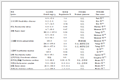
|
表 1 不同菌株的油脂分解能力 Table 1 The ability of different strains to decompose lipids |
通过进一步观测发现,枯草芽孢杆菌C1呈现长杆状形态(见图 1(A));革兰氏染色结果表明该菌株为革兰氏阳性菌(见图 1(B))。该菌株16 SrRNA基因序列比对结果显示与枯草芽孢杆菌序列相似性达到99%,通过Mega构建系统发育树(见图 1(C)),表明该菌株与枯草芽孢杆菌(Bacillus subtilis)的亲缘关系最近,将其命名为枯草芽孢杆菌C1(Bacillus subtilis C1)。此外,在28.5 ℃培养条件下,该菌株指数生长期为6~10 h,12 h后生长趋于稳定(见图 1(D))。生理生化实验结果表明,枯草芽孢杆菌C1可以利用甘露糖、阿拉伯糖、葡萄糖、果糖、蔗糖、麦芽糖、纤维二糖、海藻糖、木糖、水杨苷、甘露醇、淀粉等作为碳源(见表 2)。

|
( (A)使用显微镜(NIKON,日本)在10倍目镜和100倍物镜下对枯草芽孢杆菌C1进行可视化观察。(B)使用显微镜(OLYMPUS,BX43,日本)在10倍目镜和100倍物镜下观察枯草芽孢杆菌C1的革兰氏染色结果。(C)枯草芽孢杆菌C1的系统发育树。(D)枯草芽孢杆菌C1的生长曲线(n=3)。(A) Morphology of B. subtilis C1 was observed using the microscope (NIKON, Japan) under 10× eyepiece and 100× objective. (B) The Gram staining results of B. subtilis C1 were observed using the microscope (OLYMPUS, BX43, Japan) under 10× eyepiece and 100× objective. (C) Phylogenetic tree of B. subtilis C1. (D) The growth curve of B. subtilis C1 (n=3). ) 图 1 枯草芽孢杆菌C1的分离鉴定 Fig. 1 Isolation and identification of B. subtilis C1 |
|
|
表 2 枯草芽孢杆菌C1对不同碳源的利用能力 Table 2 Utilization ability of different carbon sources by B. subtilis C1 |
在血平板上未观察到溶血环,故该菌株无溶血现象(见图 2(A))。此外,3日龄斑马鱼仔鱼用不同浓度(105、106和107 CFU/mL)的枯草芽孢杆菌C1水浴3 d,结果显示,不同浓度枯草芽孢杆菌C1对斑马鱼仔鱼存活率无显著影响(见图 2(B))。药物敏感性实验结果发现,枯草芽孢杆菌C1对卡那霉素((19.33±0.33) mm)、链霉素((18.5±0.29) mm)、氨苄西林((21.17±0.17) mm)、多粘菌素B((13.33±0.33) mm)、氯霉素((24.67±0.33) mm)、庆大霉素((23.33±0.88) mm)、四环素((40.67±1.76) mm)、头孢噻肟((15.5±0.29) mm)、克拉霉素((25±0.58) mm)、左氟沙星((19.67±0.33) mm)、万古霉素((19.67±0.33) mm)敏感,仅对青霉素G((21.33±0.33) mm)中度敏感(见图 2(C))。

|
( (A)溶血性实验。在血平皿平板上对枯草芽孢杆菌C1进行平板划线,28.5 ℃过夜培养,观察菌落周围是否有溶血环。(B)使用不同浓度(105、106和107 CFU/mL)的枯草芽孢杆菌C1水浴3日龄(3 dpf)斑马鱼仔鱼3 d,统计存活率(n=3次重复/组,20尾仔鱼/重复)。(C)通过纸片扩散法药敏实验检测枯草芽孢杆菌C1对12种抗生素的敏感性(n=3); S表示该菌对抗生素敏感,I表示中等敏感。(A) Hemolytic activity test. B. subtilis C1 was spread on the blood plate, cultured overnight at 28.5 ℃, and observe whether there is a hemolytic zone around the colonies. (B) Zebrafish larvae (3 dpf) were immersed in the water with B. subtilis C1 at different concentrations (105, 106, 107 CFU/mL), and the survival rate was recorded after 3 days (n=3 replicates/group, 20 larvae/replicate). (C) Antibiotic sensitivity of B. subtilis C1 against 12 different antibiotics was detected through the disc-diffusion method (n=3); S: susceptible to the antibiotics; I: intermediate degree of susceptibility to the antibiotics. ) 图 2 枯草芽孢杆菌C1安全性检测 Fig. 2 The safety tests of B. subtilis C1 |
在人工胃液的环境下,枯草芽孢杆菌C1在pH=2时无法存活;在pH=3时,培养2 h后活菌数量相较培养前明显减少,2 h后趋于稳定(见图 3(A))。在人工肠液的环境下,枯草芽孢杆菌C1在两种不同pH下,2 h后活菌数量明显减少并趋于稳定(见图 3(B))。菌株耐热性检测结果表明,枯草芽孢杆菌C1在70 ℃处理后存活率约50%,80 ℃处理后存活率约20%,90 ℃处理后存活率不足5%(见图 3(C))。

|
( (A)枯草芽孢杆菌C1(1×10⁸ CFU/mL)在不同时间点对人工胃液(pH=2.0或3.0)的耐受能力(n=3)。(B)枯草芽孢杆菌C1在不同时间点对人工肠液(pH=6.8或8.0)的耐受能力(n=3),****: p<0.000 1。(C)在70、80和90 ℃下处理菌株10 min后统计枯草芽孢杆菌C1存活率(n=3),****:p<0.000 1。(A) The tolerance of B. subtilis C1 (1×10⁸ CFU/mL) to artificial gastric fluid (pH=2.0 or 3.0) at different time points. (B) The tolerance of B. subtilis C1 (1×10⁸ CFU/mL) to artificial intestinal fluid (pH=6.8 or 8.0) at different time points (n=3). ****: p < 0.000 1. (C) The survival rate of B. subtilis C1 was counted after the treatment at 70 ℃, 80 ℃ or 90 ℃ for 10 min (n=3), ****: p < 0.000 1. ) 图 3 枯草芽孢杆菌C1耐酸、耐碱、耐热性检测 Fig. 3 The tests on the resistance of B. subtilis C1 to acid, alkali and heat |
检测枯草芽孢杆菌C1对10种常见鱼类病原菌的体外抑菌能力。结果显示,枯草芽孢杆菌C1的菌体PBS重悬液对两种大肠杆菌(Escherichia coli MC1061、MG1655)有抑菌作用,抑菌圈直径约为(21.67±0.67) mm,但去除菌体的上清液并未观察到该现象(见表 3)。
|
|
表 3 枯草芽孢杆菌C1及培养上清液对10种病原菌的抑菌能力 Table 3 The antibacterial activity of B. subtilis C1 or the bacterial culture supernatants against 10 pathogenic bacteria |
对枯草芽孢杆菌C1黏附能力的检测结果表明,该菌自凝集能力较高,在24 h达到了近80%(见图 4(A)),而枯草芽孢杆菌C1的OD570的值为2ODC<OD570≤4ODC,表明该菌株的生物被膜形成能力中等(见图 4(B))。细胞表面疏水性检测结果显示,枯草芽孢杆菌C1对乙酸乙酯的疏水性为23.53%,但未检测到对二甲苯的疏水性(见图 4(C))。

|
( (A)自凝集能力,计算枯草芽孢杆菌C1在不同时间点的自凝集能力(n=3)。(B)生物被膜形成能力,在OD570处检测枯草芽孢杆菌C1培养3 d后的生物被膜形成能力,**: p<0.01。(C)细胞疏水性,以二甲苯和乙酸乙酯有机溶剂检测枯草芽孢杆菌C1的细胞疏水性(n=3)。(A) Self-aggregation assay. Calculation of the self-agglutination capacity of B. subtilis C1 at different time points (n=3). (B) Biofilm-forming ability assay. After 3 days of culture, the biofilm-formation ability of B. subtilis C1 was detected at OD570 (n=3), **: p < 0.01. (C) Cell hydrophobicity assay. The hydrophobic activity of B. subtilis C1 was tested with two organic solvents, i.e. xylene and ethyl acetate (n=3). ) 图 4 枯草芽孢杆菌C1黏附能力检测 Fig. 4 The tests on adhesive abilities of B. subtilis C1 |
利用HPLC检测枯草芽孢杆菌C1上清液中几种重要有机酸的含量,包括乳酸、乙酸、苹果酸和柠檬酸等。实验结果显示,在培养12 h后,该菌株产生了大量乙酸,而其他代谢产物如乳酸、苹果酸和柠檬酸的浓度并未发生变化(见图 5(A)、5(B))。

|
( 在枯草芽孢杆菌C1不同培养时间点(6、12和24 h)取上清液,利用HPLC检测其中乳酸和乙酸(A)的含量,以及柠檬酸和苹果酸(B)的含量(n=3~4)。*: p<0.05,***: p<0.001,****: p<0.000 1。The contents of lactic acid and acetic acid (A), and the contents of citric acid and malic acid (B) in the supernatant of B. subtilis C1 at different culture time points (6, 12 and 24 h) were detected by HPLC (n=3~4). *: p < 0.05, ***: p < 0.001, ****: p < 0.000 1. ) 图 5 枯草芽孢杆菌C1的代谢产物 Fig. 5 The metabolites of B. subtilis C1 |
随着我国水产养殖业的迅速发展,鱼类脂肪肝病在诸多养殖鱼类中频繁发生,而摄食高水平脂质饲料是导致鱼体脂质沉积的主要因素之一[23]。许多研究表明,高脂饲料中添加合适的益生菌是促进水产动物脂质代谢利用的有效途径之一[10]。由于物种和环境等因素的影响,大菱鲆与大黄鱼[24]、欧洲鲈(Dicentrarchus labrax)[25]等鱼种相比脂肪肝发生率较低。本研究选用健康大菱鲆可能有助于筛选到具有降脂作用的益生菌。在本研究中,我们筛选到可能具有油脂分解能力的枯草芽孢杆菌C1,通过分析分离菌株的鱼油和橄榄油分解能力以及产脂肪酶能力等,发现枯草芽孢杆菌C1的橄榄油降解效率约为42%,而利用p-NPP法测定的脂肪酶活性为(20.47±2.70) U/mL,均显著高于假交替单胞菌C2。张晶晶等[26]在其研究中从被油脂污染的土样中分离到3株芽孢杆菌编号为9、G4、A9,用同样方法测得其脂肪酶活力分别为18.07、9.73和33.36 U/mL。杜文勇等[27]从海捕野生许氏平鲉(Sebastes schlegelii)、大泷六线鱼(Hexagrammos otakii)消化道内壁黏膜分离并筛选出的枯草芽孢杆菌TS2和TH8同样具有产脂肪酶能力,在脂肪酶筛选平板上的结果显示,产酶水解圈直径与菌落直径比分别为2.27±0.13和2.06±0.19。相较而言,本研究所分离枯草芽孢杆菌C1具有较强产脂肪酶能力以及分解油源的能力。
在后续实验中我们继续评估了枯草芽孢杆菌C1的安全性。实验结果证实,该菌株非溶血,且对卡那霉素、链霉素、庆大霉素、左氟沙星等12种抗生素均敏感。因斑马鱼(Danio rerio)具有繁殖快、周期短、操作简便等优点已成为宿主-微生物互作研究中最常见的脊椎动物模型之一[28]。我们在斑马鱼3日龄仔鱼培养水体中添加不同浓度的枯草芽孢杆菌C1,并未影响斑马鱼仔鱼存活率,进一步验证枯草芽孢杆菌C1的安全性。同时,在饲料中添加益生菌时,为了确保有足够的活菌到达并定植在养殖动物肠道内生长,需要检测菌株对胃液和肠液的耐受性以及黏附能力。实验结果显示,枯草芽孢杆菌C1在pH为3.0的人工胃液中培养2 h后仍有47.1%的存活率,但对pH为6.8或8.0的人工肠液表现出较弱的耐受性。之前有研究报道,从洛氏鱥(Rhynchocypris lagowskii)肠道中分离得到的枯草芽孢杆菌LSG2-1对胃液的耐受能力较差,对肠液有一定的耐受能力[29]。另一方面,细菌黏附性主要评价指标包括自凝集能力、细胞表面疏水活性以及形成生物表面膜能力等[22]。本研究通过检测枯草芽孢杆菌C1的这三个指标发现,该菌24 h后的自凝集率达到80%以上,且具有中等生物成膜能力。此外,益生菌在投入生产和使用前需要经过加工和储存,加工过程中的高温高压蒸汽条件会对益生菌生物造成一定的损害,导致益生菌制剂受损[29]。因此,我们对枯草芽孢杆菌C1的耐热性进行了测试,结果表明,枯草芽孢杆菌C1在70 ℃处理后存活率可高达50%。枯草芽孢杆菌C1之所以耐高温可能由于其内生孢子,已有研究发现,孢子除了能抵抗紫外线(UV)辐射、化学物质(如过氧化物和次氯酸盐)、极端高温和其他压力外,还具有新陈代谢休眠和部分脱水的特性,这很可能使它们能在无营养和恶劣的环境中存活[30]。
因此,根据对枯草芽孢杆菌C1的油脂分解能力、安全性、耐受性等不同方面的检测评估,该菌株可作为水产饲料益生菌添加剂的候选菌株,用于调控水产养殖动物的脂质代谢。值得注意的是,本研究结果表明枯草芽孢杆菌C1可代谢产生乙酸。大量研究结果表明,乙酸是动物肠道最丰富的短链脂肪酸(SCFAs)之一,在维持机体能量稳态以及肠道健康方面发挥重要作用[31]。乙酸可以作为调节肝细胞脂质代谢基因表达的信号分子,同时作为棕榈酸和硬脂酸合成的前体,可促进肝脏脂肪酸代谢[32]。先前的一项研究表明,乙酸可激活AMPKα,进而上调小鼠肝脏中脂质氧化基因的表达,从而减少小鼠体内脂肪堆积[33]。此外,有报道显示,鲸杆菌(Cetobacterium sp.)作为鱼类肠道中一种重要的土著菌,乙酸是其主要代谢产物之一[34]。相关研究表明,在高脂饲料(HFD)中添加索氏鲸杆菌(Cetobacterium somerae)和乳酸乳球菌(Lactococcus lactis)的培养上清混合液喂食斑马鱼,改善了鱼体脂质代谢紊乱[35]。因此,枯草芽孢杆菌C1可能通过其代谢产物乙酸影响养殖动物的脂质代谢,但仍需更充分的实验证据进一步证实。
除此之外,益生菌可以产生对宿主肠道致病菌具有杀菌活性的效应物,抑制病原体的体内增殖[36]。现有研究表明,枯草芽孢杆菌具有一定的抗菌活性。例如,枯草芽孢杆菌RT-BS07对温和气单胞菌(Aeromonas sobria)、杀鲑气单胞菌(Aeromonas salmonicida)、鲁氏耶尔森氏菌(Yersinia ruckeri)等具有抗菌活性[37];刘晓燕等[38]观察到枯草芽孢杆菌WH1对金黄色葡萄球菌(Staphylococcus aureus)、副溶血性弧菌(Vibrio parahaemolyticus)有抑菌作用。但是本研究结果显示,在针对10种常见病原菌的拮抗检测中,枯草芽孢杆菌C1仅对两种大肠杆菌(Escherichia coli MC1061、MG1655)显示较强的体外抑菌效果。
4 结语本研究从鱼类肠道中分离出一株安全性高、具有一定耐酸耐碱耐热性的枯草芽孢杆菌C1,且该菌株具有较高的黏附性,研究证明枯草芽孢杆菌C1具有益生菌潜力。另一方面,该菌株具有较高产脂肪酶和分解油源的能力,且能够产生乙酸,因此可作为水产饲料微生态制剂,用于调控水产养殖动物脂质代谢。然而,该菌株对水产养殖动物脂代谢的实际调控效果还有待进一步验证。
| [1] |
Guo J L, Zhou Y L, Zhao H, et al. Effect of dietary lipid level on growth, lipid metabolism and oxidative status of largemouth bass, Micropterus salmoides[J]. Aquaculture, 2019, 506: 394-400. DOI:10.1016/j.aquaculture.2019.04.007 (  0) 0) |
| [2] |
Shi Y, Zhong L, Zhong H, et al. Taurine supplements in high-fat diets improve survival of juvenile Monopterus albus by reducing lipid deposition and intestinal damage[J]. Aquaculture, 2022, 547: 737431. DOI:10.1016/j.aquaculture.2021.737431 ( 0) |
| [3] |
He Y, Tang Y, Xu N, et al. Effects of supplemental phytosterol on growth performance, body composition, serum biochemical indexes and lipid metabolism of juvenile large yellow croaker (Larimichthys crocea) fed with high lipid diet[J]. Aquaculture, 2022, 551: 737899. DOI:10.1016/j.aquaculture.2022.737899 ( 0) |
| [4] |
Sun J, Wu W Y, Xu X X, et al. DGAT1 protects against lipid induced-hepatic lipotoxicity in grass carp (Ctenopharyngodon idellus)[J]. Aquaculture, 2021, 534: 736328. DOI:10.1016/j.aquaculture.2020.736328 ( 0) |
| [5] |
Ali S, Khan S A, Hamayun M, et al. The recent advances in the utility of microbial lipases: A review[J]. Microorganisms, 2023, 11(2): 510. DOI:10.3390/microorganisms11020510 ( 0) |
| [6] |
谷金皇, 杨毅, 冷向军, 等. 添加外源脂肪酶对瓦氏黄颡鱼的生长, 消化酶及血清生化指标的影响[J]. 上海海洋大学学报, 2010, 19(6): 798-804. Gu J H, Yang Y, Leng X J, et al. Effect of adding lipase in diet on growth performance, digestive enzyme and serum biochemical indexes of Pseudobagru vachelli[J]. Journal of Shanghai Ocean University, 2010, 19(6): 798-804. ( 0) |
| [7] |
Liu S, Feng L, Jiang W D, et al. Impact of exogenous lipase supplementation on growth, intestinal function, mucosal immune and physical barrier, and related signaling molecules mRNA expression of young grass carp (Ctenopharyngodon idella)[J]. Fish & Shellfish Immunology, 2016(55): 88-105. ( 0) |
| [8] |
Zhao J, Ling Y H, Zhang R Z, et al. Effects of dietary supplementation of probiotics on growth, immune responses, and gut microbiome of the abalone Haliotis diversicolor[J]. Aquaculture, 2018, 493: 289-295. DOI:10.1016/j.aquaculture.2018.05.011 ( 0) |
| [9] |
张美玲, 单承杰, 杜震宇. 益生菌与鱼类肠道健康研究进展[J]. 水产学报, 2021, 45(1): 147-157. Zhang M L, Shan C J, Du Z Y, et al. Research advances on probiotics and fish gut health[J]. Journal of Fisheries of China, 2021, 45(1): 147-157. ( 0) |
| [10] |
Wu S G, Pan M J, Zan Z Y, et al. Regulation of lipid metabolism by gut microbiota in aquatic animals[J]. Reviews in Aquaculture, 2023, 16(1): 34-46. ( 0) |
| [11] |
Sanders M E, Merenstein D, Merrifield C A, et al. Probiotics for human use[J]. Nutrition Bulletin, 2018, 43(3): 212-225. DOI:10.1111/nbu.12334 ( 0) |
| [12] |
Nayak S K. Multifaceted applications of probiotic Bacillus species in aquaculture with special reference to Bacillus subtilis[J]. Reviews in Aquaculture, 2020, 13(2): 862-906. ( 0) |
| [13] |
Shi F, Zi Y J, Lu Z J, et al. Bacillus subtilis H2 modulates immune response, fat metabolism and bacterial flora in the gut of grass carp (Ctenopharyngodon idellus)[J]. Fish & Shellfish Immunology, 2020, 106: 8-20. ( 0) |
| [14] |
Zhao H, Luo Y E, Zhang Y A, et al. Effects of Bacillus subtilis on hepatic lipid metabolism and oxidative stress response in grass carp (Ctenopharyngodon idellus) fed a high-fat diet[J]. Marine Life Science & Technology, 2020, 2: 50-59. ( 0) |
| [15] |
Wang A R, Meng D L, Hao Q, et al. Effect of supplementation of solid-state fermentation product of Bacillus subtilis HGcc-1 to high-fat diet on growth, hepatic lipid metabolism, epidermal mucus, gut and liver health and gut microbiota of zebrafish[J]. Aquaculture, 2022, 560: 738542. ( 0) |
| [16] |
李唯一. 产低温脂肪酶菌株筛选、发酵条件优化及其酶学性质研究[D]. 哈尔滨: 东北林业大学, 2021. Li W Y. Screening of Low Temperature Lipase Producing Strain, Optimization of Fermentation Conditions and Study on Enzymatic Properties[D]. Haerbin: Northeast Forestry University, 2021. ( 0) |
| [17] |
乔汉桢. 脂肪酶产生菌的筛选、基因克隆、密码子优化及其高效表达[D]. 广州: 华南农业大学, 2017. Qiao H Z. Screening of Lipase Producing Fungus, Gene Cloning, Codon Optimization and Expression in Pichia pastoris[D]. Guangzhou: South China Agricultural University, 2017. ( 0) |
| [18] |
何夙旭. 水产适用脂肪酶菌株的筛选、基因克隆及性质研究[D]. 北京: 中国农业科学院, 2012. He S X. Screening of Lipase Producing Strains for Aquatic Animals and Clonging of Lipase Genes and its Enzyme Charactritics[D]. Beijing: Chinese Academy of Agricultural Sciences, 2012. ( 0) |
| [19] |
秦华明. 高效油脂降解菌的筛选及其对油脂废水的强化处理研究[D]. 广州: 华南理工大学, 2003. Qin H M. Screening High Effective Oil Degradation Strain and Its Bioaugmentation of Oil Wastewater Treatment[D]. Guangzhou: South China University of Technology, 2003. ( 0) |
| [20] |
Manhar A K, Saikia D, Bashir Y, et al. In vitro evaluation of celluloytic Bacillus amyloliquefaciens AMS1 isolated from traditional fermented soybean (Churpi) as an animal probiotic[J]. Research in Veterinary Science, 2015, 99: 149-156. DOI:10.1016/j.rvsc.2015.01.008 ( 0) |
| [21] |
刘树彬. 卵形鲳鲹肠道益生菌的筛选及益生作用研究[D]. 海口: 海南大学, 2018. Liu S B. Identification and Probiotic Role Research of Probiotic from the Gut of Golden Pompano, Trachinotus ovatus[D]. Haikou: Hainan University, 2018. ( 0) |
| [22] |
龚虹, 王海霞, 马征途, 等. 乳酸菌粘附力与生物膜, 疏水性和自凝集特性的研究[J]. 中国微生态学杂志, 2016, 28(9): 1026-1028. Gong H, Wang H X, Ma Z T, et al. Biofilm hydrophobicity and auto-agglutination properties of five Lactobacillus strains[J]. Chinese Journal of Microecology, 2016, 28(9): 1026-1028. ( 0) |
| [23] |
杜震宇. 养殖鱼类脂肪肝成因及相关思考[J]. 水产学报, 2014, 38(9): 1628-1638. Du Z Y. Causes of fatty liver in farmed fish: A review and new perspectives[J]. Journal of Fisheries of China, 2014, 38(9): 1628-1638. ( 0) |
| [24] |
曾端, 麦康森, 艾庆辉. 脂肪肝病变大黄鱼肝脏脂肪酸组成、代谢酶活性及抗氧化能力的研究[J]. 中国海洋大学学报(自然科学版), 2008(4): 542-546. Zeng D, Mai K S, Ai Q H. Effects of fatty liver syndrome on liver lipid composition metabolism related enzymes and antioxidase in large yellow croaker, Pseudosciaena crocea[J]. Periodical of Ocean University of China, 2008(4): 542-546. DOI:10.16441/j.cnki.hdxb.2008.04.005 ( 0) |
| [25] |
Spisni E, Tugnoli M, Ponticelli A, et al. Hepatic steatosis in artificially fed marine teleosts[J]. Journal of Fish Diseases, 1998, 21(3): 177-184. ( 0) |
| [26] |
张晶晶, 刘金峰, 牟伯中, 等. 产脂肪酶菌株筛选及柠檬酸杆菌产酶条件优化[J]. 微生物学杂志, 2015, 35(2): 85-89. Zhang J J, Liu J F, Mou B Z, et al. Screening of lipase-producing bacteria and conditions optimization of lipase production byCitrobacter sp[J]. Journal of Microbiology, 2015, 35(2): 85-89. ( 0) |
| [27] |
杜文勇. 海水鱼源益生菌的筛选及其对同源宿主生长、酶活力和肠道菌群的影响[D]. 上海: 上海海洋大学, 2022. Du W Y. Screening of Marine Fish-Derived Probiotics and Effects of the Probiotics on Homologous Host Growth, Enzyme Activity and Gut Microbiota[D]. Shanghai: Shanghai Ocean Unversity, 2022. ( 0) |
| [28] |
Flores E M, Nguyen A T, Odem M A, et al. The zebrafish as a model for gastrointestinal tract-microbe interactions[J]. Cellular Microbiology, 2019, 22(3): e13152. ( 0) |
| [29] |
吴振超. 洛氏鱥肠道产酶益生菌的筛选及其粘附特性分析[D]. 长春: 吉林农业大学, 2020. Wu Z C. Screening and Adhesion Characteristics Analysis of Enzyme Producing Probiotics from Intestine of Rhynchocypris lagowskii[D]. Changchun: Jilin Agricultural University, 2020. ( 0) |
| [30] |
Mckenney P T, Driks A, Eichenberger P. The Bacillus subtilis endospore: Assembly and functions of the multilayered coat[J]. Nature Reviews Microbiology, 2012, 11(1): 33-44. ( 0) |
| [31] |
Tran N T, Li Z Z, Wang S Q, et al. Progress and perspectives of shortain fatty acids in aquaculture[J]. Reviews in Aquaculture, 2020, 12(1): 283-289. ( 0) |
| [32] |
Kindt A, Liebisch G, Clavel T, et al. The gut microbiota promotes hepatic fatty acid desaturation and elongation in mice[J]. Nature Communications, 2018, 9(1): 3760. ( 0) |
| [33] |
Sabater A G, Ribot J, Priego T, et al. Consumption of a mango fruit powder protects mice from high-fat induced insulin resistance and hepatic fat accumulation[J]. Cell Physiol Biochem, 2017, 42(2): 564-578. ( 0) |
| [34] |
Liao X M, Lan Y W, Wang W T, et al. Vitamin D influences gut microbiota and acetate production in zebrafish (Danio rerio) to promote intestinal immunity against invading pathogens[J]. Gut Microbes, 2023, 15(1): 2187575. ( 0) |
| [35] |
Li S H, Yang H W, Jin Y, et al. Dietary cultured supernatant mixture of Cetobacterium somerae and Lactococcus lactis improved liver and gut health, and gut microbiota homeostasis of zebrafish fed with high-fat diet[J]. Fish & Shellfish Immunology, 2023, 142: 109139. ( 0) |
| [36] |
Martínez Cruz P, Ibáez A L, Monroy Hermosillo O A, et al. Use of probiotics in aquaculture[J]. Isrn Microbiology, 2012, 2012: 916845. ( 0) |
| [37] |
樊丹, 邓福容, 李绍戊, 等. 一株虹鳟源枯草芽孢杆菌的分离鉴定及生物学特性研究[J]. 中国海洋大学学报(自然科学版), 2022, 52(2): 41-49. Fan D, Deng F R, Li S W, et al. Isoaltion, identification and biological characterization of Bacillus subtilis strain from rainbow trout (Oncorhynchus mykiss)[J]. Periodical of Ocean University of China, 2022, 52(2): 41-49. ( 0) |
| [38] |
刘晓燕, 王玲玲, 栾会妮, 等. 一株枯草芽孢杆菌的分离鉴定、生物学特性及其对水质净化的作用[J]. 微生物学通报, 2021, 48(2): 449-461. Liu X Y, Wang L L, Luan H N, et al. Isolation and identification of a Bacillus subtilis strain for water purification[J]. Microbiology China, 2021, 48(2): 449-461. ( 0) |
2. Key Laboratory of Mariculture (Ocean University of China), Ministry of Education, Qingdao 266003, China;
3. Engineering Research Center of Mariculture of Ministry of Education, Ocean University of China, Qingdao 266003, China