 2025, Vol. 55


2. 青岛海洋科技中心海洋生态与环境科学功能实验室,山东 青岛 266237;
3. 崂山实验室,山东 青岛 266237
养殖海湾是典型的近海生态系统,具有较强的碳汇潜力[1-3]。在养殖海湾,如桑沟湾,浮游植物作为海洋生态系统的主要初级生产者,可向沉积物中输入约26%的有机质,表明浮游植物对于调节碳汇过程至关重要[4]。有机碳的埋藏还与浮游植物群落结构密切相关。例如,当硅藻在群落中占主导地位时,浮游植物产生的有机碳更易被输出,从而沉降埋藏[5-7]。因此,研究近海养殖生态系统中浮游植物的生产力和群落结构演变,是深入理解海洋生态系统结构和功能变化及其碳汇潜力的基础。
桑沟湾是我国北方重要的海水养殖基地,养殖模式对浮游植物丰度和群落结构具有显著影响[8-9]。20世纪50年代末,桑沟湾开始了海带养殖[10]。自20世纪70年代起,贻贝养殖开始兴起,1980年代进入了大规模栉孔扇贝养殖阶段,1990年代牡蛎养殖逐渐崭露头角[11]。目前,养殖面积占据了整个海湾,并形成不同的养殖模式。海带的单一养殖主要集中在海湾口外侧,而双壳类的养殖主要分布在海湾的西部,海带与双壳类的综合养殖主要分布在中部区域[9-10, 12]。研究表明,桑沟湾的养殖模式显著影响浮游植物的多样性和丰度[13-20]。然而,大多数集中在不同季节[15, 19-20]和区域[13-14, 16-18]的短期调查,不同养殖模式下浮游植物生产力和群落结构长期演变的研究亟待展开。
本研究通过分析桑沟湾不同养殖模式区域四个站位柱状沉积物中的总有机碳含量、类脂生物标志物含量及比值,探究浮游植物生产力和群落结构的演变特征。甾醇等类脂生物标志物具有来源明确和化学性质稳定的特点,可有效重建浮游植物生产力和群落结构的长期演变[21-23]。本研究选取菜子甾醇表征硅藻,甲藻甾醇表征甲藻,两种甾醇之和表征浮游植物总生产力。同时,本文集成了桑沟湾长期观测的营养盐、温度和降水量等历史数据,以期厘清桑沟湾不同养殖模式下浮游植物生产力和群落结构的演变特征及其影响因素。
1 材料和方法 1.1 研究区域桑沟湾是位于中国山东半岛东部的一个半封闭海湾(见图 1(a))。海湾总面积为144 km2,平均水深为7.5 m,通过一条宽11.5 km的通道与黄海相连[24-25]。湾内地势平坦,有沽河、桑沟河、崖头河、十里河等几条河流入湾[26]。桑沟湾有从湾口北部向湾内流入、南部向湾外流出的逆时针环流[27-28]。湾内由于陆源输入、养殖物种排泄、水动力较弱和滞留时间较长,导致营养盐浓度较高[12, 14, 25, 29],而湾外水动力较强,使得水体中的营养盐浓度相对较低[30]。同时,桑沟湾的养殖设备,导致湾内海水与外海水的交换显著减弱[31-32]。目前,桑沟湾的浮游植物以硅藻和甲藻为主,其中硅藻占主导[15, 18-19, 33]。桑沟湾主要养殖品种包括扇贝、牡蛎和海带,通过筏架和延绳的方式进行单一养殖或综合养殖[34-35]。发展到现在已经形成贝类-贝藻-藻类的养殖模式。

|
( 本图修改自Jiang[26]和Li[12]。This figure is modified from Jiang[26] and Li[12]. ) 图 1 桑沟湾的地理位置(a)及采样站位(b) Fig. 1 Location of Sanggou Bay (a) and sampling stations (b) |
2022年8月16—22日搭载鲁荣渔养67822、鲁荣渔养65580、荣宁钓0088和鲁荣鱼钓80099,进行了采样。使用箱式采样器在B2站位(122.51°E,37.08°N)、C2站位(122.50°E,37.06°N)、B4站位(122.56°E,37.09°N)和A6站位(122.64°E,37.12°N)用PVC管各采集了1根柱状沉积物(长度分别为18、16、25和17 cm)(见图 1(b))。其中,B2、C2位于贝类养殖区,B4位于贝藻综合养殖区,A6位于湾外非养殖区。取样后立即密封以保持沉积物的原始状态,置于4 ℃冷库保存。24 h内用不锈钢环刀以1 cm的间隔分样,共得到75个样品(其中A6站位的14~16 cm作为1个样品处理)。所有样品用封口袋密封后于-20 ℃条件下保存。
1.3 样品测定 1.3.1 总有机碳的测定使用CHN元素分析仪(Thermo Flash 2000)对总有机碳(TOC)进行测定。使用乙酰苯胺(TOC=(71.10±0.23)%(质量百分比))作为标准品校准仪器,低有机碳土(TOC=(1.61±0.09)%(质量百分比))作为重复样验证仪器,确保仪器处于稳定状态。将冷冻干燥后的沉积物样品研磨均匀,取约1 g样品滴加4 mol/L盐酸以去除无机碳。随后,使用超纯水多次冲洗样品至中性,55 ℃干燥24 h后,再次研磨均匀,样品置于锡杯中上机测定。测定的标准误差为0.02%(n=6)。
1.3.2 类脂生物标志物的测定生物标志物的萃取和测定方法参照Schubert等[21]和Xing等[22]。样品冷冻干燥后研磨成粉末,取约5 g加入二氯甲烷:甲醇(体积比=3∶1)混合溶液和n-C19醇内标,重复震荡、超声4次,收集上清液,氮气吹干(水浴<40 ℃)得到总有机质。然后加入6%的氢氧化钾-甲醇溶液进行碱水解后,用正己烷萃取4次得到中性组分。将得到的中性组分通过硅胶柱进行层析分离,用二氯甲烷∶甲醇(体积比=95∶5)萃取得到极性组分,吹干后用BSTFA在70 ℃下衍生化处理2 h,待冷却至室温后上机测试分析。
使用气相色谱仪(GC, Agilent 6890N)对生物标志物进行定性和定量分析。色谱柱为Agilent HP-1(50 m × 0.32 mm × 0.17 μm),不分流方式进样,载气为氢气(流速为1.3 mL/min)。进样口的温度为300 ℃,FID检测器的温度为300 ℃。首先对B4站位的样品进行分析,分离效果较为理想。B4站位样品的升温程序如下:初始温度为80 ℃,保持1 min;然后以25 ℃/min升温至200 ℃,再以4 ℃/min升温至250 ℃;随后以1.7 ℃/min升温至300 ℃并保持15 min;最后以5 ℃/min升温至315 ℃并保持5 min。由于B2、C2和A6站位样品中杂质含量较高,原升温程序生成的杂质峰对后续样品的目标峰产生了干扰,因此对升温程序进行了相应调整,以改善分离效果。调整后的B2、C2和A6站位样品升温程序如下:初始温度为80 ℃,保持1 min;接着以25 ℃/min升温至200 ℃,再以4 ℃/min升温至250 ℃;随后以1.7 ℃/min升温至300 ℃并保持15 min;然后以5 ℃/min升温至315 ℃并保持6 min;最后以2 ℃/min升温至320 ℃并保持4 min。
1.4 数据分析为消除生产力变化、沉积速率及降解速率等对类脂生物标志物含量的影响,本文对沉积物中的生物标志物与总有机碳进行了归一化处理[36-37]。
本文使用文献中的平均沉积速率对沉积层年代进行初步估算。以往的研究也使用这一方法估算沉积层年代,如在北部湾海域[38]、雅浦海沟[39]、黄海和东海海域[40]。B2和C2站位使用S3站位(约为122.50°E,37.08°N)的沉积速率2.08 cm/a[28]。桑沟湾的湾内水流速度低于湾外[30]、水动力较弱[29],贝类排泄作用造成的沉积效果大于大型藻类碎屑沉积[34],所以贝类养殖区的沉积速率较高。因此,在贝类养殖区选择了B2和C2两根沉积柱进行对比分析。这两个站位的沉积柱状样反映了近10年(B2站位2012—2022年,C2站位2014—2022年)的沉积情况。B4站位位于海湾口的中部,其沉积速率范围为0.593~0.726 cm/a[27]。参考刘赛[27]的研究,本文使用S4站位(约为122.56°E,37.08°N)的沉积速率0.66 cm/a,反映了该区域近38年(1984—2022年)的沉积历史。A6站位位于桑沟湾湾外偏北,其沉积速率范围约为0.15~0.726 cm/a[28]。取两者的平均值0.423 cm/a,反映了A6站位近40年(1981—2022年)的沉积变化[28]。S3沉积柱结果显示[28],2010年后总有机碳(TOC)和海源有机碳含量呈上升趋势。同样,本文中基于2.08 cm/a沉积速率推算的B2沉积柱TOC和总甾醇碳归一化含量(ΣPB/TOC,指示浮游植物总生产力)在2010年后也呈上升趋势。C2站位ΣPB/TOC的变化趋势也与B2站位一致,这进一步印证了我们推算的年代框架的合理性。S4沉积柱结果显示[27],1985—2015年TOC和海源有机碳呈先升高后降低的趋势。本文中基于0.66 cm/a沉积速率推算的B4沉积柱TOC和ΣPB/TOC在1984—2022年也呈先升后降的趋势。此外,对靠近桑沟湾湾外的W01站位(约为123°E,37°N)研究发现,2010年前生物硅含量变化稳定,这与0.423 cm/a沉积速率推算的A6站位2010年前菜子甾醇碳归一化含量(B/TOC,指示硅藻生产力)变化趋势相似[40]。综上所述,通过对比B2、C2、B4和A6站位与参考沉积速率站位相关数据的变化趋势,我们认为本文采用沉积速率推算的年代框架具有较高的可靠性。
荣成市的贝藻养殖产量数据来源于威海市海洋发展局。桑沟湾的贝藻养殖产量约占荣成市贝藻养殖产量的41.2%[42],以此估算桑沟湾贝藻养殖产量。
采用斯皮尔曼相关性分析探究B4站位的生物标志物浓度与营养盐(浓度和比值)之间的相关性[20, 43-48]。由于B2和C2站位数据量较少,A6站位未收集到系统的营养盐数据,本文仅对B4站位数据进行相关性分析。采用曼-惠特尼U检验(Mann-Whitney U test)分析四个站位总甾醇含量(其中B2和C2站位含量以平均值计算)的差异。使用IBM SPSS 27软件进行统计分析。本研究中所有统计分析的显著性水平为p<0.05。
2 结果 2.1 贝类养殖区B2、C2站位柱状沉积物中总有机碳和生物标志物的变化在B2站位,TOC含量为0.34%~0.61%(平均值为0.45%),总甾醇的碳归一化含量(ΣPB/TOC)为24.84~157.84 μg/g(平均值为54.75 μg/g),菜子甾醇和甲藻甾醇的碳归一化含量(B/TOC和D/TOC,指示硅藻和甲藻生产力)分别为9.51~115.21和15.33~42.63 μg/g(平均值分别为29.84和24.62 μg/g),菜子甾醇与甲藻甾醇比值(B/D,指示硅藻-甲藻群落结构)为0.53~2.70(平均值为1.05)(见图 2a—e)。所有参数均从18 cm沉积层至表层呈逐渐上升的趋势。

|
图 2 桑沟湾B2(a—e)、C2(f—j)、B4(k—o)和A6(p—t)站位沉积柱状样中TOC含量(a, f, k, p)、ΣPB/TOC含量(b, g, l, q)、B/TOC含量(c, h, m, r)、D/TOC含量(d, i, n, s)和B/D(e, j, o, t)随深度的变化 Fig. 2 Depth distribution of total organic carbon contents (a, f, k, p), carbon-normalized contents of the sum of brassicasterol and dinosterol (b, g, l, q), carbon-normalized contents of brassicasterol (c, h, m, r), carbon-normalized contents of dinosterol (d, i, n, s), and the ratio of brassicasterol to dinosterol (e, j, o, t) at stations B2 (a—e), C2 (f—j), B4 (k—o) and A6 (p—t) in Sanggou Bay |
在C2站位,TOC含量为0.35%~0.58%(平均值为0.45%),从16 cm沉积层至表层呈波动型下降趋势(见图 2f)。ΣPB/TOC含量为18.82~126.05 μg/g(平均值为50.55 μg/g),B/TOC和D/TOC含量分别为6.59~85.51和12.24~41.04 μg/g(平均值分别为27.57和22.98 μg/g),B/D为0.53~2.11(平均值为1.06)(见图 2g—j)。所有参数均从16 cm沉积层至表层呈逐渐上升的趋势。
2.2 贝藻综合养殖区B4站位柱状沉积物中总有机碳和生物标志物的变化在B4站位,TOC含量为0.14%~0.52%(平均值为0.27%),从25 cm沉积层至8 cm沉积层逐渐下降,随后至表层逐渐上升(见图 2k)。ΣPB/TOC含量为48.34~325.46 μg/g(平均值为105.36 μg/g),从25 cm沉积层至8 cm沉积层呈上升趋势且在11 cm沉积层出现峰值,随后至表层呈下降趋势(见图 2l)。B/TOC和D/TOC的含量分别为14.99~125.78和33.05~199.68 μg/g(平均值分别为39.0和66.36 μg/g),其变化趋势与ΣPB/TOC含量变化趋势一致(见图 2m, n)。B/D为0.27~1.06(平均值为0.58),从25 cm沉积层至15 cm沉积层略微下降,随后至表层逐渐上升(见图 2o)。
2.3 湾外非养殖区A6站位柱状沉积物中总有机碳和生物标志物的变化在A6站位,TOC含量为0.28%~0.54%(平均值为0.40%),从17 cm沉积层至表层逐渐下降(见图 2p)。ΣPB/TOC含量为16.42~190.95 μg/g(平均值为48.69 μg/g),B/TOC和D/TOC的含量分别为6.20~121.96和10.22~76.63 μg/g(平均值分别为22.0和26.68 μg/g),B/D为0.47~1.77(平均值为0.71),这四个参数在17 cm沉积层至5 cm沉积层变化不大,但在5 cm沉积层至表层呈升高趋势(见图 2q—t)。
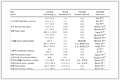
3 讨论 3.1 桑沟湾浮游植物生产力的长期变化特征和影响因素在贝类养殖区,两个站位浮游植物生产力(ΣPB/TOC)均呈上升趋势(B2站位从18 cm沉积层至表层(约2012—2022年);C2站位从16 cm沉积层至表层(约2014—2022年))(见图 2b, g)。这一结果与白怀宇等[49]在桑沟湾贝类养殖区的研究结果一致,即2010年后海源有机碳含量明显增加。贝类养殖区为靠近岸区域,该区域因受河流和地下水营养物质输入(DIN、DIP和DSi占总输入含量的比值为64.87%,37.04%和87.56%)的影响,营养盐较为丰富,从而维持了较高的浮游植物生产力[12, 50]。此外,贝类养殖也会加快氮和磷在水体中的流动和循环,往往会局部增加水柱中的营养浓度,并刺激浮游植物的初级生产[12, 14-15, 18-19, 51]。研究表明在桑沟湾[25, 52]、纽芬兰海湾[53],贝类养殖是养殖海湾氮磷输入的主要来源之一。近十年桑沟湾的贝类养殖产量明显增大,2020年贝类产量(10.89万t)是2010年产量的1.8倍(见表 1)。有研究指出,每年每克贻贝可产生1.76 g粪便,其中含氮0.001 7 g、磷0.000 26 g,且牡蛎、扇贝与贻贝的排泄率基本相近[54-55]。这表明,2010年后双壳类养殖规模的增大加快了水体中的氮磷营养盐的循环,潜在导致浮游植物生产力升高。因此,在陆源输入和贝类养殖规模增大的共同作用下,B2和C2站位浮游植物生产力呈现升高的趋势。
|
表 1 桑沟湾贝类和大型藻类养殖规模的长期变化 Table 1 Long-term changes in the scale of shellfish and kelp farming in Sanggou Bay |
在贝藻综合养殖区(B4站位),浮游植物生产力从25 cm沉积层至8 cm沉积层(约1984—2010年)呈先上升的趋势,然后至表层(约2010—2022年)呈下降趋势(见图 2l)。这与Wang等[56]在胶州湾的研究趋势相似,即自1980年后浮游植物的生产力不断上升,到2010年达到最大值,这主要与胶州湾营养物质的增加有关。同样,本研究也发现,ΣPB/TOC与DIN浓度呈显著正相关(r = 0.733,p = 0.025)(见表 2)。1980年以来,桑沟湾的年均DIN呈升高的趋势,但在2010年后有略微下降的趋势(见表 3)。因此,B4站位浮游植物受到桑沟湾中DIN浓度的影响,对应于沉积柱状样中ΣPB/TOC含量呈先增大后降低的趋势。此外,在贝藻综合养殖模式中,大型藻类可以吸收贝类代谢释放的营养盐,这有效降低了水体中的营养盐浓度,从而减少富营养化风险[49, 58-59]。近十年,桑沟湾的大型藻类产量持续上升,2020年大型藻类产量(23.6万t)是2010年产量的1.4倍(见表 1)。因此,相比贝类养殖区(B2和C2站位),贝藻综合养殖区(B4站位)中大型藻类对营养盐的利用,在一定程度上减弱了2010年后贝类养殖规模增大引起的营养盐浓度增大。进入20世纪90年代,由于国内外水产品市场需求的增长,桑沟湾的水产养殖规模显著扩大[28]。然而,由于养殖规模超过了海湾的承载能力,且管理缺乏科学性,栉孔扇贝频繁出现死亡现象。2003年桑沟湾爆发大规模贝类死亡[57],降低了浮游植物的摄食压力,这可能解释了B4站位(11 cm,约2005年)沉积物中浮游植物生产力出现峰值的现象。随后,对贝类养殖空间的科学调整可能导致死亡事件后浮游植物的生产力显著降低。此外,桑沟湾的沉积速率受养殖活动影响,并非恒定不变[41],这可能导致了年代推算中时间尺度的偏移,即文献报道的贝类死亡事件年份(2003年)与本论文发现的浮游植物生产力峰值出现年份(2005年)的偏差。然而,目前尚缺少桑沟湾详细的沉积速率时间变化数据,未来研究可根据沉积速率的变化进一步确定其对生产力演变规律的潜在影响。综上,DIN浓度的先升后降变化,以及贝藻综合养殖模式的实施,共同导致了B4站位浮游植物生产力的先上升后下降趋势。
|
|
表 2 桑沟湾B4站位ΣPB/TOC与营养盐浓度和比值的斯皮尔曼相关性分析 Table 2 Spearman's correlation analysis of the relationship between ΣPB/TOC and nutrient concentrations (and ratios) at station B4 in Sanggou Bay |
|
|
表 3 桑沟湾营养盐浓度和比值以及温度年平均值的长期观测数据 Table 3 Long-term observations of the annual mean values of nutrient concentrations and ratios, temperature in Sanggou Bay |
湾外非养殖区(A6站位)浮游植物生产力从17 cm沉积层至5 cm沉积层(约1981—2010年)基本稳定不变,然后至表层(约2010—2022年)呈上升趋势(见图 2q)。这与栾青杉等[60]在1985至2015年对北黄海浮游植物网采调查的结果一致。该研究表明,2005年之前北黄海浮游植物的总丰度较低,而2005—2015年间的平均丰度较1985—2000年增加了7.3倍。研究发现,北黄海浮游植物生产力受硝酸盐、铵盐和磷酸盐共同的影响[61],1990—2000年夏季的DIN变化不大,但2013年的DIN比2006年增大了约1.78倍[62]。上述研究表明,营养物质的增加是促使A6站位2010年后浮游植物生产力上升的主要原因之一。近年来,桑沟湾的沿海养殖范围已扩展至锋面区,即,桑沟湾与北黄海因温盐存在显著差异而形成的边界区域[63]。高密度的悬浮水产养殖显著影响了水动力格局,加剧了锋面区的逆时针环流,其强度超过无养殖条件下顺时针翻转的跨锋面环流[31]。He等[31]基于Finite-Volume Community Ocean模型模拟以及桑沟湾2011—2017年海带养殖成熟期的洋流剖面数据,发现过度悬浮养殖导致锋面区的水流交换明显减弱,约60%的高营养底层海水被阻挡,无法进入湾内。A6站位靠近锋面区域[31],因此来自黄海冷水团提供的较高营养盐进一步促进了浮游植物生产力的增加。综上,DIN的增加以及水动力格局的变化,共同导致了A6站位浮游植物生产力从5 cm沉积层至表层呈升高趋势。
总之,四个站位近几十年浮游植物生产力都有所增加,主要是受控于营养盐,尤其是DIN的影响。本研究进一步从长时间尺度上对比不同区域浮游植物生产力的变化。结果显示,近40年浮游植物生产力:贝藻综合养殖区显著高于湾外非养殖区(p<0.05)(见图 3(a));近10年:贝藻综合养殖区显著高于贝类养殖区(p<0.05)(见图 3(b))。上述结果与现代过程的观测结果一致。例如,2009—2010年贝藻综合养殖区浮游植物丰度通常高于贝类养殖区[18];2015年春季贝藻综合养殖区的浮游植物丰度也高于贝类养殖区[8]。刘赛等[28]研究发现1960年后随着养殖规模和密度的增大,贝藻综合养殖区的海源有机碳的埋藏通量呈显著增加趋。不同区域生产力的差异可能源于营养盐浓度的不同及贝类摄食的影响。湾外非养殖区的浮游植物生产力受到较低营养盐供给的限制,其生产力显著低于湾内养殖区[9, 14, 64]。此外,贝类对浮游植物的摄食可能会影响浮游植物的生物量[17]。然而在贝藻综合养殖区,海带碎屑为贝类提供了主要食物来源(约占14.1%~42.8%),有效减轻了贝类对浮游植物的直接摄食压力[59]。

|
( 字母a和b表示不同组间存在显著差异(曼-惠特尼U检验,p<0.05)。The letters a and b denote significant differences between groups (Mann-Whitney U test, p < 0.05). ) 图 3 桑沟湾不同养殖区域近40年(a)、近10年(b)ΣPB/TOC箱式图 Fig. 3 The box plots of carbon-normalizedcontents of the sum of brassicasterol and dinosterol (ΣPB/TOC) during the last 40 years (a) and 10 years (b) in different areas of Sanggou Bay |
桑沟湾内养殖区域(B2、C2和B4站位)的硅藻-甲藻群落结构(硅藻/甲藻,B/D)发生了明显变化,整体上呈现上升趋势(见图 2e, j, o),这种变化与许多其他生态系统中的观察结果一致。例如,1980—2000年胶州湾硅藻/甲藻呈上升趋势[56];1940—2010年闽浙沿岸上升流区域的硅藻/甲藻也呈上升趋势[23]。影响这种变化的因素包括营养盐结构和温度等[23, 56, 65]。本文重点围绕营养盐结构、温度、双壳类摄食等对浮游植物群落结构的潜在影响展开讨论。进入21世纪,桑沟湾的年均氮磷比值(N/P)呈下降的趋势,从2003年的53.5降低到2010年的39.54,2014年又降低到了23.62 μmol/L [20, 45, 47]。N/P的持续降低有助于增加硅藻对总生产力的贡献[23, 56]。年均硅氮比值(Si/N)从2003年的0.26上升到2010年的0.52 μmol/L,并在2011至2013年期间持续增加[25, 45, 47]。由于硅酸盐是桑沟湾的春季限制性营养盐[12, 66],所以提高Si/N也有利于硅藻的生长。桑沟湾的优势硅藻具槽帕拉藻(Paralia sulcata)是一种底栖链状硅藻,偏好低光照和高营养盐的水环境,具备利用多种磷源营养盐的能力,溶解有机磷(DOP)相比DIP更能促进其生长[67-68]。自2010年以来,威海沿岸的DOP含量显著增加,这有利于硅藻的生长[69]。此外,气温和降水等自然因素也可以通过影响海水表层温度和盐度对浮游植物群落结构的演变产生影响[56]。1994—2017年,桑沟湾的年均温度降低了约2.06 ℃,在低温下甲藻的生长速度和代谢活动都会受到抑制,而硅藻的代谢受到的影响相对较小,所以硅藻比甲藻更具有竞争力[20, 46, 70]。双壳类对浮游植物的摄食有选择性。例如:养殖物种栉孔扇贝更倾向于摄食富含脂肪酸且体型较小的甲藻,而对长链的硅藻的摄食选择性相对较低[71-72]。研究还表示,扇贝排泄物中的多种氨基酸被证明对浮游植物的生长速率有影响,在浓度较高时对骨条藻(桑沟湾另一种优势硅藻)的生长具有促进作用,但对原甲藻的影响不明显[73-74]。综上,在N/P降低、Si/N升高、DOP升高、温度降低和养殖活动的共同作用下,B2、C2和B4站位的硅藻/甲藻整体上呈上升趋势。
湾外非养殖区(A6站位)硅藻/甲藻从17 cm沉积层至5 cm沉积层(1981—2010年)基本保持稳定,从5 cm沉积层至表层(约2010—2022年)呈上升趋势(见图 2t)。这与郭术津等[67]在北黄海的研究结果相似,即,1980—2011年的北黄海浮游植物群落结构相对稳定。然而,栾青杉等[60]发现,2005—2015年北黄海大范围区域内的甲藻与硅藻丰度比值较1985—2000年增加了2.33倍。这与本研究中2010年后硅藻/甲藻的升高趋势相反,这一差异可能是因为A6站位靠近桑沟湾,因此受湾内环境的影响较大。Li等[75]的研究也证实了这一可能,2011—2014年桑沟湾N/P和DOP平均值在不同采样地点(桑沟湾养殖区和非养殖区)无显著差异。此外,黄海沿岸经常出现的湍流和锋面可能对浮游植物群落结构产生重要影响[76]。研究表明,湍流对硅藻和甲藻有不同的影响。甲藻因其依赖两个简单鞭毛游动,易受湍流干扰[77];硅藻因为硅化细胞壁在湍流中具有显著的生存优势[78]。He等[31]的粒子跟踪实验表明,2011—2017年由于悬浮水产养殖,锋面区的水流交换明显减弱,约有23.9%、27.4%和24.0%的DIN、DIP和DSi滞留于底层水体。A6站位靠近锋面区域,这显著促进了硅藻的生长。因此,营养盐和水动力的变化为硅藻的生长尤其是具槽帕拉藻提供了有利条件,促使A6站位从5 cm沉积层至表层的硅藻/甲藻呈现上升趋势。
总之,四个站位的硅藻/甲藻整体上呈现升高趋势,这主要受N/P降低、Si/N升高、DOP升高、温度降低、养殖活动以及水动力变化的耦合作用。这表明经过多年的养殖,桑沟湾硅藻/甲藻有所升高。此外,湾内B2、C2站位的硅藻/甲藻平均值显著高于湾口B4、湾外A6站位,Li等[12]的研究发现桑沟湾的河流和地下水输入的DSi占总输入的11.2%~87.6%,且在贝类养殖区的滞留时间较长[34],故这一差别可能受DSi的影响。当浮游植物群落以硅藻为主时,其沉降速率高于以甲藻为优势种的浮游植物群落[79],这意味着桑沟湾浮游植物固定的碳更容易输送到海底。
4 结论本文基于生物标志物含量和比值的变化探究了近几十年桑沟湾不同养殖区浮游植物生产力和群落结构的演变。主要有以下结论:
(1) 贝类养殖区(B2站位(18 cm沉积层至表层)和C2站位(16 cm沉积层至表层))的浮游植物生产力呈上升趋势,可能与陆源输入和贝类养殖规模增大(加快DIN的循环)有关。
(2) 贝藻综合养殖区(B4站位从25 cm沉积层至表层)的浮游植物生产力呈先升后降的趋势,这受DIN浓度的先升后降变化的显著影响(p<0.05),以及贝藻综合养殖模式的调控作用。
(3) 湾外非养殖区(A6站位从17 cm沉积层至5 cm沉积层)的浮游植物生产力较低,与以往北黄海的观测结果一致;而在5 cm沉积层至表层,生产力呈上升趋势,推测与DIN的增加以及水动力改变有关。
(4) 桑沟湾的硅藻/甲藻整体上呈上升趋势,这一趋势可能受N/P降低、Si/N升高、DOP升高、温度降低、养殖活动以及水动力的耦合影响。
研究表明,人类活动(陆源输入和养殖)和自然变化(温度和水动力)共同影响了浮游植物生产力与群落结构。基于长时间尺度的分析,桑沟湾不同区域的浮游植物生产力存在显著区域差异:近40年贝藻综合养殖区显著高于湾外非养殖区(p<0.05);近10年贝藻综合养殖区显著高于贝类养殖(p<0.05)。上述结果表明,贝藻综合养殖区域具有较高的海源有机碳碳汇潜力。多营养层次养殖模式可以通过物种间相互作用,充分发挥各养殖物种的碳汇能力[80-82]。因此,未来可以继续推广多营养层次养殖模式,不仅有助于实现增汇,还能提高养殖产量和经济效益。
致谢: 感谢“2022年桑沟湾夏季航次”全体人员在航次期间的帮助,感谢海洋有机地球化学实验室的刘美玉对于TOC样品测定工作的帮助,感谢张传莉、赵苗苗和刘雪的讨论与提供的建议。
| [1] |
Boyd C E, D'abramo L R, Glencross B D, et al. Achieving sustainable aquaculture: Historical and current perspectives and future needs and challenges[J]. Journal of the World Aquaculture Society, 2020, 51(3): 578-633. DOI:10.1111/jwas.12714 (  0) 0) |
| [2] |
Ross F W R, Boyd P W, Filbee-Dexter K, et al. Potential role of seaweeds in climate change mitigation[J]. Science of the Total Environment, 2023, 885: 163699. DOI:10.1016/j.scitotenv.2023.163699 ( 0) |
| [3] |
Yang S, Yang Q, Song X L, et al. Blue carbon in sediment from Sanggou Bay: Composition, burial flux and its response to human activities[J]. Frontiers in Marine Science, 2024, 10: 1342750. DOI:10.3389/fmars.2023.1342750 ( 0) |
| [4] |
Sui J, Zhang J, Yang X, et al. Influence of the intensive mariculture on coastal sedimentary organic matter: Insight from size-fractionated particles[J]. Marine Environmental Research, 2024, 195: 106370. DOI:10.1016/j.marenvres.2024.106370 ( 0) |
| [5] |
Casareto B E, Niraula M P, Suzuki Y. Dynamics of organic carbon under different inorganic nitrogen levels and phytoplankton composition[J]. Estuarine, Coastal and Shelf Science, 2012, 102-103: 84-94. DOI:10.1016/j.ecss.2012.03.019 ( 0) |
| [6] |
Wang X L, Jiang S, Wu Y, et al. Synchronous shifts in nutrients and organic carbon responses over the diatom-to-dinoflagellate succession[J]. Frontiers in Marine Science, 2022, 9: 845372. DOI:10.3389/fmars.2022.845372 ( 0) |
| [7] |
Wetz M S, Wheeler P A. Production and partitioning of organic matter during simulated phytoplankton blooms[J]. Limnology and Oceanography, 2003, 48(5): 1808-1817. DOI:10.4319/lo.2003.48.5.1808 ( 0) |
| [8] |
钱罡, 魏玉秋, 孙军. 2015年春季桑沟湾浮游植物群落研究[J]. 海洋科学, 2017, 41(2): 44-52. Qian G, Wei Y Q, Sun J. Study on phytoplankton communities in the Sanggou Bay in spring, 2015[J]. Marine Sciences, 2017, 41(2): 44-52. ( 0) |
| [9] |
Han J C, Liu X, Pan K H, et al. Impacts of integrated multi-trophic aquaculture on phytoplankton in Sanggou Bay[J]. Journal of Ocean University of China, 2024, 23(3): 835-843. DOI:10.1007/s11802-024-5665-2 ( 0) |
| [10] |
李文豪, 于晓清, 蒋增杰, 等. 基于AMBI和M-AMBI法的桑沟湾底栖生态环境质量评价[J]. 中国海洋大学学报(自然科学版), 2024, 54(6): 55-67. Li W H, Yu X Q, Jiang Z J, et al. Assessment of benthic ecological quality of Sanggou Bay thorugh AMBl and M-AMBl approaches[J]. Periodical of Ocean University of China, 2024, 54(6): 55-67. DOI:10.16441/j.cnki.hdxb.20230172 ( 0) |
| [11] |
傅明珠, 蒲新明, 王宗灵, 等. 桑沟湾养殖生态系统健康综合评价[J]. 生态学报, 2013, 33(1): 238-248. Fu M Z, Pu X M, Wang Z L, et al. Integrated assessment of mariculture ecosystem health in Sanggou Bay[J]. Acta Ecologica Sinica, 2013, 33(1): 238-248. ( 0) |
| [12] |
Li R H, Jiang Z J, Lin F, et al. Silicon balance in an integrated multi-tropical aquaculture ecosystem, Sanggou Bay, China[J]. Frontiers in Marine Science, 2024, 11: 1431878. DOI:10.3389/fmars.2024.1431878 ( 0) |
| [13] |
Zhao L, Zhao Y, Xu J, et al. Distribution and seasonal variation of picoplankton in Sanggou Bay, China[J]. Aquaculture Environment Interactions, 2016, 8: 261-271. DOI:10.3354/aei00168 ( 0) |
| [14] |
郝林华, 孙丕喜, 郝建民, 等. 桑沟湾海域叶绿素a的时空分布特征及其影响因素研究[J]. 生态环境学报, 2012, 21(2): 338-345. Hao L H, Sun P X, Hao J M, et al. The spatial and temporal distribution of chlorophyll-a and its influencing factors in Sanggou Bay[J]. Ecology and Environmental Sciences, 2012, 21(2): 338-345. ( 0) |
| [15] |
李超伦, 张永山, 孙松, 等. 桑沟湾浮游植物种类组成、数量分布及其季节变化[J]. 渔业科学进展, 2010, 31(4): 1-8. Li C L, Zhang Y S, Sun S, et al. Species composition density and seasonal variation of phytoplankton in Sanggou Bay, China[J]. Progress in Fishery Sciences, 2010, 31(4): 1-8. ( 0) |
| [16] |
柴正晴, 李瑞环, 宁志铭, 等. 水产养殖活动对水体营养盐及浮游植物组成的影响——以桑沟湾围隔实验为例[J]. 中国海洋大学学报(自然科学版), 2022, 52(6): 92-102. Chai Z Q, Li R H, Ning Z M, et al. Effects of aquaculture activities on nutrients and phytoplankton composition: A case study of Sanggou Bay mesocosm experiment[J]. Periodical of Ocean University of China, 2022, 52(6): 92-102. DOI:10.16441/j.cnki.hdxb.20210197 ( 0) |
| [17] |
王晓敏. 桑沟湾多营养级综合养殖模式下浮游植物群落结构研究[D]. 广州: 暨南大学, 2017. Wang X M. Studies on Phytoplankton Community Under Integrated Multi-trophic Aquaculture Modes in Sanggou Bay[D]. Guangzhou: Jinan University, 2017. ( 0) |
| [18] |
刘萍, 孙萍, 宋洪军, 等. 桑沟湾不同养殖区浮游植物群落时空变化特征[J]. 海洋科学进展, 2019, 37(4): 673-680. Liu P, Sun P, Song H J, et al. Spatio-temporal distribution of phytoplankton community in different aquaculture areas in the Sanggou Bay[J]. Advances in Marine Science, 2019, 37(4): 673-680. ( 0) |
| [19] |
侯兴, 高亚平, 杜美荣, 等. 桑沟湾浮游植物群落结构时空变化特征及影响因素[J]. 渔业科学进展, 2021, 42(2): 18-27. Hou X, Gao Y P, Du M R, et al. Temporal and spatial variation in phytoplankton community structure and their relationship with environmental factors in Sanggou Bay[J]. Progress in Fishery Sciences, 2021, 42(2): 18-27. ( 0) |
| [20] |
徐东会, 陈碧鹃, 江涛, 等. 桑沟湾养殖海域营养盐时空分布特征及富营养化评价[J]. 渔业科学进展, 2017, 38(3): 1-11. Xu D H, Chen B J, Jiang T, et al. Temporal and spatial variation characteristics of water nutrients and eutrophication evaluation in aquaculture water areas of Sanggou Bay[J]. Progress in Fishery Sciences, 2017, 38(3): 1-11. ( 0) |
| [21] |
Schubert C J, Villanueva J, Calvert S E, et al. Stable phytoplankton community structure in the Arabian Sea over the past 200, 000 years[J]. Nature, 1998, 394(6693): 563-566. DOI:10.1038/29047 ( 0) |
| [22] |
Xing L, Zhao M X, Zhang T, et al. Ecosystem responses to anthropogenic and natural forcing over the last 100 years in the coastal areas of the East China Sea[J]. The Holocene, 2016, 26(5): 669-677. DOI:10.1177/0959683615618248 ( 0) |
| [23] |
Peng P, Bi R, Sachs J P, et al. Phytoplankton community changes in a coastal upwelling system during the last century[J]. Global and Planetary Change, 2023, 224: 104101. DOI:10.1016/j.gloplacha.2023.104101 ( 0) |
| [24] |
蒋增杰, 方建光, 张继红, 等. 桑沟湾沉积物中磷的赋存形态及生物有效性[J]. 环境科学, 2007(12): 2783-2788. Jiang Z J, Fang J G, Zhang J H, et al. Forms and bioavailability of phosphorus in surface sediments from Sungo Bay[J]. Environmental Science, 2007(12): 2783-2788. ( 0) |
| [25] |
Li R H, Liu S M, Zhang J, et al. Sources and export of nutrients associated with integrated multi-trophic aquaculture in Sanggou Bay, China[J]. Aquaculture Environment Interactions, 2016, 8: 285-309. DOI:10.3354/aei00177 ( 0) |
| [26] |
Jiang Z J, Li J Q, Qiao X D, et al. The budget of dissolved inorganic carbon in the shellfish and seaweed integrated mariculture area of Sanggou Bay, Shandong, China[J]. Aquaculture, 2015, 446: 167-174. DOI:10.1016/j.aquaculture.2014.12.043 ( 0) |
| [27] |
刘赛. 近200年桑沟湾养殖海域碳的埋藏通量及源解析[D]. 青岛: 中国海洋大学, 2015. Liu S. Burial Fluxes and Source Apportionment of Carbon in Culture Areas of Sanggou Bay over the Past 200 Years[D]. Qingdao: Ocean University of China, 2015. ( 0) |
| [28] |
刘赛, 杨庶, 杨茜, 等. 桑沟湾沉积碳库年汇入速率的长期变化及其区域性差异[J]. 海洋学报, 2018, 40(1): 47-56. Liu S, Yang S, Yang X, et al. The long-term changes of annual carbon sequestration rate and regional difference in culture areas of Sanggou Bay[J]. Haiyang Xuebao, 2018, 40(1): 47-56. ( 0) |
| [29] |
韩忠, 王敬, 边雄飞. 桑沟湾海域表层沉积物粒度特征及其环境意义[J]. 海洋地质前沿, 2023, 39(9): 77-86. Han Z, Wang J, Bian X F. Grain-size distribution of surface sediments in Sanggou Bay and its environmental significance[J]. Marine Geology Frontiers, 2023, 39(9): 77-86. ( 0) |
| [30] |
何宇晴, 黄大吉, 曾定勇, 等. 桑沟湾筏式海带养殖对潮流垂直结构的影响[J]. 海洋学研究, 2016, 34(4): 20-27. He Y Q, Huang D J, Zeng D Y, et al. Effect of suspended kelp culture on vertical structure of tidal currentin Sanggou Bay, China[J]. Journal of Marine Sciences, 2016, 34(4): 20-27. ( 0) |
| [31] |
He Y Q, Xuan J L, Ding R B, et al. Influence of suspended aquaculture on hydrodynamics and nutrient supply in the Coastal Yellow Sea[J]. Journal of Geophysical Research: Biogeosciences, 2022, 127(2): e2021JG006633. DOI:10.1029/2021JG006633 ( 0) |
| [32] |
Lin F, Meirong D U, Hui L, et al. A physical-biological coupled ecosystem model for integrated aquaculture of bivalve and seaweed in Sanggou Bay[J]. Ecological Modelling, 2020, 431: 109181. DOI:10.1016/j.ecolmodel.2020.109181 ( 0) |
| [33] |
李凤雪, 蒋增杰, 高亚平, 等. 桑沟湾浮游植物粒径结构及其与环境因子的关系[J]. 渔业科学进展, 2020, 41(1): 31-40. Li F X, Jiang Z J, Gao Y P, et al. Distribution of size-fractionated phytoplankton and its relationship with environmental variables in Sanggou Bay[J]. Progress in Fishery Sciences, 2020, 41(1): 31-40. ( 0) |
| [34] |
Sun X, Song X, Jiang Z, et al. Biogenic silica in sediment core indicates the historical development of off-bottom oyster farming[J]. Science of the Total Environment, 2024, 947: 174591. DOI:10.1016/j.scitotenv.2024.174591 ( 0) |
| [35] |
Fang J G, Sun H L, Yan J P, et al. Polyculture of scallop chlamys farreri and kelp laminria japonica in Sungo Bay[J]. Journal of Oceanology and Limnology, 1996, 14: 322-329. DOI:10.1007/BF02850552 ( 0) |
| [36] |
黄铁汉, 刘珂, 李莉, 等. 山东半岛大沽河流域有机质来源、保存及影响因素分析[J]. 中国环境科学, 2024(7): 1-16. Huang T H, Liu K, Li L, et al. Sources, preservation, and influencing factors of organic carbon from the Dagu River in Shandong Peninsula[J]. China Environmental Science, 2024(7): 1-16. ( 0) |
| [37] |
郭新宇, 张海龙, 李莉, 等. 近30年来东海长江口泥质区浮游植物生产力与群落结构变化的生物标志物记录[J]. 中国海洋大学学报(自然科学版), 2020, 50(2): 85-94. Guo X Y, Zhang H L, Li L, et al. Biomarker records of phytoplankton productivity and community structure changes in the mud area of the Yangtze River Estuary in the East China Sea during the last 30 years[J]. Periodical of Ocean University of China, 2020, 50(2): 85-94. DOI:10.16441/j.cnki.hdxb.20190164 ( 0) |
| [38] |
杨中福. 广西北部湾河口及海岸带沉积物中有机磷酸酯的时空分布特征与沉积记录研究[D]. 南宁: 广西大学, 2024. Yang Z F. Spatiotemporal Distribution Characteristics and Sedimentary Records of Organophosphate Esters in Sediment of Estuary and Coastal Zone in Guangxi Beibu Gulf[D]. Nanning: Guangxi University, 2024. ( 0) |
| [39] |
田兴雨, 孙承君, 闫艺心, 等. 雅浦海沟北部深渊沉积物中脂肪酸的分布特征[J]. 海洋科学进展, 2025, 43(3): 665-683. Tian X Y, Sun C J, Yan Y X, et al. Distribution characteristics of fatty acids in the abyssal sediments of the northern yap trench[J]. Advances in Marine Science, 2025, 43(3): 665-683. ( 0) |
| [40] |
吴彬. 黄、东海沉积物中生物硅的分布、溶解及影响因素研究[D]. 青岛: 中国海洋大学, 2015. Wu B. Distribution, Dissolution and Influencing Factors of Biogenic Silica in Sediments of the Yellow Sea and the East China Sea[D]. Qingdao: Ocean University of China, 2015. ( 0) |
| [41] |
刘赛, 杨茜, 杨庶, 等. 桑沟湾养殖海域沉积物中碳埋藏通量的长期记录[J]. 海洋学报, 2014, 36(8): 30-38. Liu S, Yang X, Yang S, et al. The long-term records of carbon bural fluxes in sediment cores of culture zones from Sanggou Bay[J]. Acta Oceanologica Sinica, 2014, 36(8): 30-38. ( 0) |
| [42] |
李瑞环. 生态养殖活动下营养盐动力学研究[D]. 青岛: 中国海洋大学, 2014. Li R H. NutrientDynamics Under the Impact of Eco-aquaculture——A Case Study in Sanggou Bay[D]. Qingdao: Ocean University of China, 2014. ( 0) |
| [43] |
宋云利, 崔毅, 孙耀, 等. 桑沟湾养殖海域营养状况及其影响因素分析[J]. 海洋水产研究, 1996, 17(2): 41-51. Song Y L, Cui Y, Sun Y, et al. Study on nutrient state and influencing factors in Sanggou Bay[J]. Marine Fisheries Research, 1996, 17(2): 41-51. ( 0) |
| [44] |
连岩, 王立超, 李胜宽, 等. 桑沟湾海水化学调查[J]. 黄渤海海洋学报, 1998, 16(3): 61-67. Lian Y, Wang L C, Li S K, et al. An investigation on chemistry of seawater of Sanggou Bay[J]. Journal of Oceanography of Huanghai & Bohai Seas, 1998, 16(3): 61-67. ( 0) |
| [45] |
孙丕喜, 张朝晖, 郝林华, 等. 桑沟湾海水中营养盐分布及潜在性富营养化分析[J]. 海洋科学进展, 2007, 25(4): 436-445. Sun P X, Zhang Z H, Hao L H, et al. Analysis of nutrient distributions and potential eutrophication in seawater of the Sanggou Bay[J]. Advances in Marine Science, 2007, 25(4): 436-445. ( 0) |
| [46] |
李凤雪, 杜美荣, 高亚平, 等. 桑沟湾养殖水域微微型浮游生物的时空分布特征及环境影响因素[J]. 水产学报, 2020, 44(7): 1100-1111. Li F X, Du M R, Gao Y P, et al. Temporal and spatial distribution variation of picoplankton and environmental impact factors in Sanggou Bay[J]. Journal of Fisheries of China, 2020, 44(7): 1100-1111. ( 0) |
| [47] |
Zhang J, Tishchenko P Y, Jiang Z J, et al. Diverse nature of the seasonally coastal eutrophication dominated by oceanic nutrients: An eco-system based analysis characterized by salmon migration and aquaculture[J]. Marine Pollution Bulletin, 2023, 193: 115150. DOI:10.1016/j.marpolbul.2023.115150 ( 0) |
| [48] |
孙珊, 刘素美, 任景玲, 等. 桑沟湾养殖海域营养盐和沉积物-水界面扩散通量研究[J]. 海洋学报, 2010, 32(6): 108-117. Sun S, Liu S M, Ren J L, et al. Distribution features of nutrients and flux across the sediment-water interface in the Sanggou Bay[J]. Acta Oceanologica Sinica(in Chinese), 2010, 32(6): 108-117. ( 0) |
| [49] |
白怀宇, 刘赛, 杨茜, 等. 桑沟湾贝类养殖区沉积碳库年汇入速率的高分辨率记录及其对人类养殖活动的响应[J]. 渔业科学进展, 2022, 43(5): 98-105. Bai H Y, Liu S, Yang X, et al. High-resolution records of the rate of carbon accumulation in the shellfish aquaculture area in Sanggou Bay and its response to human aquaculture activities[J]. Progress in Fishery Sciences, 2022, 43(5): 98-105. ( 0) |
| [50] |
陈艺文. 营养盐对桑沟湾养殖生态系统承载力的调控作用[D]. 北京: 中国科学院大学, 2024. Chen Y W. RegulatoryEffects of Nutrients on the Carrying Capacity of the Aquaculture Ecosystem in Sanggou Bay[D]. Beijing: University of Chinese Academy of Sciences, 2024. ( 0) |
| [51] |
Asmus R M, Asmus H. Mussel beds: limiting or promoting phytoplankton?[J]. Journal of Experimental Marine Biology and Ecology, 1991, 148(2): 215-232. DOI:10.1016/0022-0981(91)90083-9 ( 0) |
| [52] |
武晋宣. 桑沟湾养殖海域氮磷收支及环境容量模型[D]. 青岛: 中国海洋大学, 2015. Wu J X. Development andApplications of Dynamic Model for Dissolved Nitrogen and Phosphate Budgets in Sungo Bay[D]. Qingdao: Ocean University of China, 2015. ( 0) |
| [53] |
Strang T J. Nutrient Regeneration under Mussel Farms: The Environmental Effects of Mussel Aquaculture in Coastal Bays[D]. Hobart: University of Tasmania, 2003.
( 0) |
| [54] |
韩家波, 木云雷, 王丽梅. 海水养殖与近海水域污染研究进展[J]. 水产科学, 1999, 18(4): 40-43. Han J B, Mu Y L, Wang L M. Advances in research of marine aquaculture and coastal waters pollution[J]. Fisheries Science, 1999, 18(4): 40-43. ( 0) |
| [55] |
王波, 游奎, 刘哲, 等. 秋季桑沟湾贝类养殖对海域水质影响的数值研究[J]. 中国海洋大学学报(自然科学版), 2007, 37(S1): 47-52+60. Wang B, You K, Liu Z, et al. A numerical study of scallop cultivation impacts on the water quality in Sanggou Bay in Autumn[J]. Periodical of Ocean University of China, 2007, 37(S1): 47-52+60. DOI:10.16441/j.cnki.hdxb.2007.s1.007 ( 0) |
| [56] |
Wang Y Q, Song J M, Duan L Q, et al. Historical reconstructions of sedimentary organic matter sources and phytoplankton evolution in the Jiaozhou Bay based on sterols and carbon isotope[J]. Marine Pollution Bulletin, 2021, 165: 112109. DOI:10.1016/j.marpolbul.2021.112109 ( 0) |
| [57] |
蒋增杰. 桑沟湾栉孔扇贝大规模死亡原因分析[J]. 齐鲁渔业, 2004, 21(8): 10-11+4. Jiang Z J. Analysis of the causes of mass mortality ofchlamys farreri in Sanggou Bay[J]. Shandong Fisheries, 2004, 21(8): 10-11+4. ( 0) |
| [58] |
万玲. 春季桑沟湾海域贝类养殖对海水中营养盐的影响研究[J]. 环境科学与管理, 2012, 37(6): 62-66. Wan L. Effect of shellfish farming on nutrient salts of seawater in Sanggou Bay in spring[J]. Environmental Science and Management, 2012, 37(6): 62-66. ( 0) |
| [59] |
许强. 贝藻混养系统中贝类食物来源的定量分析[D]. 青岛: 中国科学院海洋研究所, 2007. Xu Q. Evaluation of Food Sources of Bivalve in Seaweed and Filter-feeding Bivalve Polyculture Ecosystem[D]. Qingdao: Institute of Oceanology, Chinese Academy of Sciences, 2007. ( 0) |
| [60] |
栾青杉, 康元德, 王俊. 黄海浮游植物群落的长期变化(1985—2015)[J]. 中国水产科学, 2020, 27(1): 1-12. Luan Q S, Kang Y D, Wang J. Long-term changes within the phytoplankton community in the Yellow Sea(1985—2015)[J]. Journal of Fishery Sciences of China, 2020, 27(1): 1-12. ( 0) |
| [61] |
苑明莉, 孙军, 翟惟东. 2012年秋季渤海和北黄海浮游植物群落[J]. 天津科技大学学报, 2014, 29(6): 56-64. Yuan M L, Sun J, Zhai W D. Phytoplankton community in Bohai Sea and the North Yellow Sea in autumn 2012[J]. Journal of Tianjin University of Science & Technology, 2014, 29(6): 56-64. ( 0) |
| [62] |
张海波, 史华明, 裴绍峰, 等. 北黄海夏秋季营养盐时空变化趋势及影响因素分析[J]. 中国海洋大学学报(自然科学版), 2021, 51(S1): 24-34. Zhang H B, Shi M H, Pei S F, et al. Spatiotemporal variation trends of nutrients and influencing factors in the Northern Yellow Sea[J]. Periodical of Ocean University of China, 2021, 51(S1): 24-34. DOI:10.16441/j.cnki.hdxb.20200361 ( 0) |
| [63] |
Xuan J L, He Y Q, Zhou F, et al. Aquaculture-induced boundary circulation and its impact on coastal frontal circulation[J]. Environmental Research Communications, 2019, 1(5): 051001. DOI:10.1088/2515-7620/ab22cd ( 0) |
| [64] |
吴文广, 张继红, 王巍, 等. 桑沟湾春季叶绿素a浓度分布及其影响因素[J]. 生态学报, 2016, 36(15): 4855-4863. Wu W G, Zhang J H, Wang W, et al. Distribution of chlorophyll-a concentration and its control factors in spring in Sungo Bay[J]. Acta Ecologica Sinica, 2016, 36(15): 4855-4863. ( 0) |
| [65] |
Lin C L, Ning X R, Su J L, et al. Environmental changes and the responses of the ecosystems of the Yellow Sea during 1976—2000[J]. Journal of Marine Systems, 2005, 55(3-4): 223-234. DOI:10.1016/j.jmarsys.2004.08.001 ( 0) |
| [66] |
赵玉庭, 苏博, 马元庆, 等. 2018年山东近岸养殖区营养盐结构及限制特征[J]. 海洋环境科学, 2022, 41(5): 714-722+730. Zhao Y T, Su B, Ma Y Q, et al. Characteristics of nutrient structures and limitation of coastal aquaculture area in Shandong province, 2018[J]. 2022, 41(5): 714-722+730. ( 0) |
| [67] |
郭术津, 孙军, 张辉, 等. 2011年秋季北黄海浮游植物群落[J]. 天津科技大学学报, 2013, 28(1): 22-29. Guo S J, Sun J, Zhang H, et al. Phytoplankton communities in the Northern Yellow Sea in Autumn 2011[J]. Journal of Tianjin University of Science & Technology, 2013, 28(1): 22-29. ( 0) |
| [68] |
于倩, 王清, 袁泽轶, 等. 不同形态磷源对具槽帕拉藻(Paralia sulcata)生长和磷酸酶活性的影响[J]. 海洋与湖沼, 2015, 46(5): 1018-1023. Yu Q, Wang Q, Yuan Z Y, et al. Effects of different phosphorous substrates on growth and phosphatase activity of algaeparalis sulcata[J]. Oceanologia et Limnologia Sinica, 2015, 46(5): 1018-1023. ( 0) |
| [69] |
Li H M, Tang H J, Shi X Y, et al. Increased nutrient loads from the Changjiang (Yangtze) River have led to increased Harmful Algal Blooms[J]. Harmful Algae, 2014, 39: 92-101. DOI:10.1016/j.hal.2014.07.002 ( 0) |
| [70] |
Cao Z, Bi R, Zhang C L, et al. Quantification of multiple environmental controls on lipid biomarkers in common marine diatoms and dinoflagellates[J]. Marine Biology, 2023, 170(11): 136. DOI:10.1007/s00227-023-04284-3 ( 0) |
| [71] |
张莉红, 张学雷, 李瑞香, 等. 桑沟湾扇贝养殖对甲藻数量的影响[J]. 海洋科学进展, 2005, 23(3): 342-346. Zhang L H, Zhang X L, Li R X, et al. Impact of scallop culture on dinoflagellate abundance in the Sanggou Bay[J]. Advances in Marine Science, 2005, 23(3): 342-346. ( 0) |
| [72] |
肖雪艳, 刘毅, 牛鹏丽, 等. 基于围隔实验研究虾夷扇贝与龙须菜养殖对浮游植物群落结构的影响[J]. 渔业科学进展, 2022, 43(1): 66-76. Xiao X Y, Liu Y, Niu P L, et al. Effects of culture of Patinopecten yessoensis and Gracilaria lemaneiformis on phytoplankton community structure based on an enclosure experiment[J]. Progress in Fishery Sciences, 2022, 43(1): 66-76. ( 0) |
| [73] |
徐立, 吴瑜端. 有机氮化合物对海洋浮游植物生长的影响[J]. 厦门大学学报(自然科学版), 1995, 34(5): 824-828. Xu L, Wu Y D. Effect of organic nitrogen on the growth of marine phytoplanton[J]. Journal of Xiamen University (Natural Science), 1995, 34(5): 824-828. ( 0) |
| [74] |
周毅, 杨红生, 何义朝, 等. 四十里湾几种双壳贝类及污损动物的氮、磷排泄及其生态效应[J]. 海洋与湖沼, 2002, 33(4): 424-431. Zhou Y, Yang H S, He Y C, et al. Nitrogen and phosphorus excretion and its ecological effect by several bivalves and fouling animals[J]. Oceanologia et Limnologia Sinica, 2002, 33(4): 424-431. ( 0) |
| [75] |
Li H, Li X, Li Q, et al. Environmental response to long-term mariculture activities in the Weihai coastal area, China[J]. Science of the Total Environment, 2017, 601-602: 22-31. DOI:10.1016/j.scitotenv.2017.05.167 ( 0) |
| [76] |
Wang Q, Yang Q, Zhu L, et al. Environmental controls on the seasonal variations of diatoms and dinoflagellates in the Qingdao coastal region, the Yellow Sea[J]. Marine Environmental Research, 2024, 198: 106524. ( 0) |
| [77] |
Guo S, Feng Y, Wang L, et al. Seasonal variation in the phytoplankton community of a continental-shelf sea: The East China Sea[J]. Marine Ecology Progress Series, 2014, 516: 103-126. DOI:10.3354/meps10952 ( 0) |
| [78] |
Tréguer P, Bowler C, Moriceau B, et al. Influence of diatom diversity on the ocean biological carbon pump[J]. Nature Geoscience, 2017, 11(1): 27-37. ( 0) |
| [79] |
Pitcher G, Walker D, Mitchel-Innes B. Phytoplankton sinking rate dynamics in the southern Benguela upwelling system[J]. Marine Ecology Progress Series, 1989, 55(2): 261-269. ( 0) |
| [80] |
Zhang K, Tian X L, Dong S L, et al. An experimental study on the budget of organic carbon in polyculture systems of swimming crab with white shrimp and short-necked clam[J]. Aquaculture, 2016, 451: 58-64. DOI:10.1016/j.aquaculture.2015.08.029 ( 0) |
| [81] |
Qiao L, Chang Z, Li J, et al. Phytoplankton community structure in an integrated multi-trophic aquaculture system revealed by morphological analysis and high-throughput sequencing[J]. Applied Ecology and Environmental Research, 2020, 18(3): 3907-3933. DOI:10.15666/aeer/1803_39073933 ( 0) |
| [82] |
唐启升, 蒋增杰, 毛玉泽. 渔业碳汇与碳汇渔业定义及其相关问题的辨析[J]. 渔业科学进展, 2022, 43(5): 1-7. Tang Q S, Jiang Z J, Mao Y Z. Clarification on the definitions and its relevant issues of fisheries carbon sink and carbon sink fisheries[J]. Progress in Fishery Sciences, 2022, 43(5): 1-7. ( 0) |
2. Laboratory for Marine Ecology and Environmental Science, Qingdao Marine Science and Technology Center, Qingdao 266237, China;
3. Laoshan Laboratory, Qingdao 266237, China