 2022, Vol. 21


2) Shandong Provincial Key Laboratory of Marine Environment and Geological Engineering, Ocean University of China, Qingdao 266100, China;
3) Laboratory for Marine Geology, Qingdao National Laboratory for Marine Science and Technology, Qingdao 266061, China;
4) Tianjin Center, China Geological Survey, Tianjin 300170, China
Under the action of loads such as extreme waves and earthquakes, the seafloor soil is prone to occur failure deformation. The failed seabed soil will further lead to geological disasters such as submarine landslide, collapse and silt flow, which can potentially cause damages to submarine engineering constructions like pipelines and submarine cables (Coleman et al., 1980; Hooper and Suhayda, 2005; Wang et al., 2018a; Wu et al., 2018; Fan et al., 2022). However, the process and mechanism of seafloor failure deformation are still unclear (Zhang et al., 2016b), which restricts the development of disaster prevention and early warning in marine engineering fields (Vanneste et al., 2014; Urlaub and Villinger, 2018). To learn more about themechanisms and processes of seafloor failure deformation, more field data on the seabed deformation are required. However, the in situ monitoring of seafloor deformation are extraordinary difficult due to the high investment. Even so, the in situ observation technology is becoming a research hotspot due to its significance and importance (Vanneste et al., 2014; Wang et al., 2020).
More recently, with the development of seafloor deformation monitoring technologies, there have been several successful ways as follows: 1) absolute pressure gauges, which are set on seafloor surface and can determine the seafloor uplift or subsidence by the recorded changes in overlying water pressure (Phillips et al., 2008); 2) tiltmeters and micro-electromechanical accelerometer-array, which are capable of detecting seafloor dynamic deformation by the continuous high precision data of sensor inclination and vertical or lateral displacement (Prior et al., 1989; Fabian and Villinger 2008; Stegmann et al., 2012; Wang et al., 2018b); 3) acoustic ranging technique, which can determine seafloor deformation through relative distance changes between different transponders on seafloor by repeated acoustic telemetry over months to years (Blum et al., 2010); 4) the fibre-optic strainmeter, by which seafloor split displacement about a few millimeters can be detected over several hundred meters fibre-optic cable stretched across the seafloor surface (Blum et al., 2008). The micro-electromechanical accelerometer-array (hereinafter referred to as accelerometer-array) has advantages in deformation measurement at different depths of the seabed. Moreover, observation continuity (small time interval of data acquisition) and relatively low cost are also its major advantages. The accelerometer-array has been used in submarine landslide monitoring (Stegmann et al., 2012) and storm-wave-induced seabed failure monitoring (Wang et al., 2018b). The product commercialization and successful application fully demonstrate its advantages in seafloor failure deformation measurement.
The accelerometer-array is vertically emplaced in the seabed to measure the deformation, and there are two factors that may affect the accuracy of accelerometer-array measurement during the deformation process. On the one hand, the coupling effect between the accelerometer-array and soil determines the accuracy and reliability of the collected data that used to characterize the soil deformation process. On the other hand, whether the deformation of the accelerometer-array segment in the upper soil layer will lead to the deformation of the segment in deep layer, i.e., significant linkage effect, also determines the accuracy of data. Therefore, model tests and analysis based on the two factors above were carried out in this paper to verify whether the in situ data collected by the accelerometer-array could accurately reflect the seafloor failure deformation displacement and characteristics. This provides a reference for the data correction of accelerometer-array in the application of in situ monitoring, and also provides a feasible solution for the correction test of other flexible rod-shaped deformation sensors (such as flexible optical fiber sensor probe). This experimental research is on the basis of our previous in situ observation of seafloor failure deformation in the subaqueous Yellow River Delta (Wang et al., 2020). Therefore, the silty soil was chosen as the sample soil, and the experimental results are only applicable to the silty soil seabed. Instability phenomena, such as liquefaction, are usually related to the response of silt under a certain kind of loading (Yang et al., 2002), whose mechanism is complex and still uncertain. Therefore, we believe that the application of accelerometer-array in the silty seafloor failure deformation measurement has great space.
2 Characteristics of Micro-Electromechanical Accelerometer-ArrayThe accelerometer-array shown in Fig.1 (produced by Measurand Inc.) is a rope-like array. It consists of a number of rigid segments. Each segment hosts a triaxial microelectromechanical accelerometer and is connected to adjoining segments by flexible joints (Fig.1) that allow the movement in any direction, but resist twisting motions (Wang et al., 2018b). The accelerometer-array has the accuracy of ± 0.18 mm per 4 m.

|
Fig. 1 The micro-electromechanical accelerometer-array for recording seabed deformation at different depths. |
The special joints on the accelerometer-array enable a solution for x, y, and z coordinates at each joint by using rotational transforms relating the orientation of one segment to the next segment (Danisch et al., 1999, 2007; Wang et al., 2018b). As shown in Eqs. (1) – (3), each segment's deformation of accelerometer-array can be calculated by the difference coordinate from t0 to t1.
| $ \Delta x = \sum\nolimits_{k = 1}^n {L\cos {\theta _{xn{t_1}}}} \sum\nolimits_{k = 1}^n {L\cos {\theta _{xn{t_0}}}}, $ | (1) |
| $ \Delta y = \sum\nolimits_{k = 1}^n {L\cos {\theta _{yn{t_1}}}} \sum\nolimits_{k = 1}^n {L\cos {\theta _{yn{t_0}}}}, $ | (2) |
| $ \Delta z = \sum\nolimits_{k = 1}^n {L\cos {\theta _{zn{t_1}}}} \sum\nolimits_{k = 1}^n {L\cos {\theta _{zn{t_0}}}}, $ | (3) |
where n means the segment number (the n of the end tip is 1); L is the segment length; θx, θy, θz are angles of segments with x, y, z axis (Fig.2).

|
Fig. 2 Working principle of the single accelerometer-array segment. The spatial attitude of one accelerometer-array segment (blue bar) is determined by the triaxial accelerometer, and deformation was calculated using the change in spatial attitude (Wang et al., 2018b). |
A simulation test chamber (Fig.3) was designed and processed for the experiments on accuracy of accelerometerarray in soil failure deformation measurement. The test chamber consists of two parts, the upper and lower chamber, 0.5 m, 0.8 m in height respectively, 0.5 m long, and 0.3 m wide. The upper chamber can be pushed forward along the track by the propulsion rod. During tests, the simulation test chamber was filled with soil and the accelerometerarray was placed vertically in the middle of the chamber. The sidewall of the chamber is provided with small holes, and the geotextile is pasted inside to facilitate the rapid drainage and consolidation of the soil. Soil deformation would be driven by the test chamber, and the soil deformation is compared with the deformation measured by the accelerometer-array to quantify the measurement accuracy.

|
Fig. 3 Design renderings and object pictures of the simulation test chamber. |
The end of the accelerometer-array was fixed with the bottom of the simulation test chamber through a fixing ring, and the accelerometer-array was kept vertical before the test startup to ensure that the initial conditions about accelerometer-array of all tests were the same. Two Joints (A, B) of the accelerometer-array were located in the test chamber to provide the deformation data during the test. The collected deformation data at Joint A is aimed at testing the coupling effect between the accelerometer-array and soil, and the data at Joint B is aimed at testing the linkage effect of the accelerometer-array. During the test, the data acquisition interval is 0.5 min.
A laser displacement meter (IL-600, Keyens) was installed to measure the upper chamber displacement (Fig.3), which was taken as the deformation of the soil inside the chamber. The laser displacement meter has a measuring range of 400 mm, a linearity of 0.25% F.S. and a repetition accuracy of 50 μm.
3.2 Test ProcessSoils used in this experiment were collected from the intertidal zone of Diaokou Delta in the modern Yellow River Delta, which was formed from 1964 to 1976. The soils are sandy silt that is composed of 29.28% – 29.57% sand, 62.87% – 62.97% silt and 7.46% –7.85% clay, and the median particle size is 0.044 mm. The collected soils were air-dried and crushed, and the large particles (gravels and shells) were removed before being used in the test. And then they were thoroughly mixed with water proportionally in a 2.5:1 mass ratio by using a blender in order to achieve the same initial water content. Finally, the saturated uniform slurry fill the simulation test chamber. The accelerometer-array was kept in the center position of the simulation test chamber during the filling process. The soils were then left for consolidation in the chamber with different consolidation times (Tc = 0, 1, 3, 7 d), which were the test control variable for the four groups of experiments.
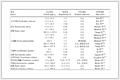
The tests were conducted after the expected consolidation time was achieved. The propulsion rod was rotated at a uniform speed to make the upper soil chamber move forward slowly for 200 mm. At the same time, the displacement of the upper soil chamber was measured by the laser displacement meter. The soil samples were collected from the gap between the upper and lower champers after tests, and the moisture content, density, void ratio and other parameters of the samples were measured by geotechnical tests. Four rounds of tests were repeated in the way described above, and the detailed soil physical parameters for each group test were summarized in Table 1.
|
Table 1 Parameters for test soils |
When the lateral deformation of soils in the upper chamber occurred, the accelerometer-array inside the soil would deform therewith. Unlike the monitoring in steel, concrete or composite structures, the accelerometer-array in the earth structures cannot be adhered directly to soils; hence, the intimate contact between the accelerometer-array and the surrounding soil mass can hardly be ensured (Zhang et al., 2016a). Whether the accelerometer-array coupled with soils perfectly during deformation is one of the questions that the tests intend to solve. The collected lateral displacement data of Joint A were compared with the data of the laser displacement meter, and the time series of deformation data are shown in Fig.4. The results show that the deformation trend of the accelerometer-array and soil are in good agreement during the test process.

|
Fig. 4 Comparison of the soil deformation with the measured results of the accelerometer-array under different consolidation conditions. |
The difference between soil deformation and the deformation measured by the accelerometer-array was taken as the cumulative deviation. The curve of accumulative deviation with soil lateral deformation (Fig.5a) showed that the coupling between the accelerometer-array and consolidated soils was better than that with unconsolidated soil. Furthermore, the coupling effect has a positive correlation with the consolidation time of soils at further deformation stages.

|
Fig. 5 Variations of the cumulative deviation and deviation ratio with the soil deformation. |
The ratio of accumulative deviation to soil lateral deformation was taken as the deviation ratio (Fig.5b). The test results revealed that the deviation ratios were large in the initial stage of the soil deformation. For the deformation in the range of 0 – 50 mm, the deviation ratios were as high as 19.2% – 24.4%, even in Test 4 when the soil was consolidated for 7 days. While the coupling deviation tended to be decreasing and kept stable when the deformation was larger than 100 mm, with the deviation ratios between 0.7% – 13.7%.
In conclusion, the deformation of the accelerometerarray basically kept same as the soil deformation, and the coupling effect between the accelerometer-array and soils was positively related to the soil consolidation time. The deviation ratio was relatively large at the initial stage of deformation, while decreased and remained stable at the later stages. Taking the unconsolidated soil in Test 1 as an example, which corresponds to the situation that the soil failure and liquefication occur, the deviation ratio is about 22.2% at the initial stage of deformation (0 – 50 mm) and reduced to 9.2% – 13.7% when the deformation continues to increase (> 100 mm).
4.2 Linkage Effect of Accelerometer-Array in the Deformation MeasurementThe second problem to be solved in these tests is whether the deformation of the upper box would lead to the deformation of the accelerometer at Joint B in the lower box, producing a significant linkage effect (Fig.6). The result of Test 1 shows that the linkage effect can be ignored with the soil in flow state. The deformation of Joint B induced by Joint A are 0.1 – 1.3 mm, and the ratios to the deformation of Joint A are 0.3% – 0.9%. Therefore, it can be seen that the joints in different depths do not interfere with each other during the soil deformation measurement (under the liquefaction condition), which ensures the accuracy of measurement results.

|
Fig. 6 Results of linkage effect of accelerometer-array under different consolidation conditions. |
It is worth noting that the linkage effect of accelerometer-array is positively correlated with the consolidation degree of soils. The linkage effect can be ignored in the process of liquefied soil deformation, while with the increase of soil consolidation time, the linkage effect of accelerometer-array becomes more significant. Taking the Test 4 as an example (Tc = 7 d), the deformation scales of Joint B induced by of Joint A range from 0.4 – 11.9 mm, and the ratios to those of Joint A range from 1.6% – 6.1%.
The measured data showed that the deformation direction of Joint A is the same as that of Joint B in the Test 1, while the deformation direction is opposite in the consolidated soils (i.e., in the Tests 2, 3, 4). Based on the above results, the mechanism of linkage effects was summarized in Fig.7. When the soil is in liquefied state, the deformation of Joint A will not induce the linkage deformation of Joint B, which was proved in Test 1. While the deformation was measured in consolidated state soils, the shear force generated by the relative movement between the two parts of soil (the soil above the shear failure interface slides forward and the deep soil remains in a static state) makes the rod of accelerometer-array rotate. Therefore the deformation of joints below the interface occurs in the opposite direction (Fig.7).

|
Fig. 7 Schematic diagram of the mechanism of linkage effect between accelerometers. |
Seafloor failure deformation includes various modes such as liquefaction, shear failure, and so on (Wang and Liu, 2016), which may be triggered by storm waves, earthquakes, volcanic eruptions and other causes. Taking wave-induced seabed failure as an example, when pore water pressure exceeds the self-weight stress of the overlying soils, soils will lose all of their structural strength and behave as a heavy liquid with no rigidity (Groot et al., 2006; Summer et al., 2006). The liquefied soil particles periodically deform elliptically under the action of waves (Wang et al., 2020). Similar to the movement of water, the trajectories of the soil particles in the liquefied soil are elliptic, and the longitudinal displacement gradually decreases with depth until it reaches 0 at the maximum liquefaction depth (Ren et al., 2020). Under the action of the wave loading, horizontal shear stress produced by the rotation of water may be large enough to overcome the soil shearing resistance, the shear failure may occur without liquefaction (Wang et al., 2018b).
In the process of in situ monitoring of marine engineering geological hazards, seabed failure deformation mode can be comprehensively distinguished according to the pore water pressure and seabed deformation data. When pore water pressure exceeds or approaches the self-weight stress of the overlying soil, it can be identified as liquefaction failure, which is usually accompanied by the reciprocating vibration deformation of the seabed. Under such conditions, the seafloor deformation measured by the accelerometer-array needs to be corrected based on the coupling deviation ratio, while the linkage effect within the depth of liquefaction can be ignored (Table 2).
|
|
Table 2 Correction or not to the coupling effect and linkage effect in different seafloor failure deformation modes |
When the seabed deformation occurs, while the accumulated excess pore pressure is far below the overburden effective stress, or the significant accumulation of excess pore pressure only occurs at a certain depth (i.e., the shear failure interface), the failure can be identified as the shear failure mode. In the initial stage of this situation, the coupling effect between the accelerometer-array and the soil is ideal due to the certain consolidation state of seabed soils. However, the data of the joints below the shear plane need to be corrected based on the linkage effect analysis (Table 2).
In general, the seafloor failure deformation process is complex and may include liquefaction and shear failure at the same time. Therefore, it is necessary to meticulously analyze the deformation data based on the pore water pressure and deformation characteristics to improve the accuracy of accelerometer-array in deformation monitoring.
5 ConclusionsA simulation test chamber was designed and processed, and four groups of simulation tests were carried out to explore the coupling effect and linkage effect of accelerometer-array in the process of soil deformation with different degree of consolidation. A concept to improve the measurement accuracy of accelerometer-array in different seafloor failure deformation modes is proposed. The key conclusions are as follows, and are applicable only to the silty soil seabed.
1) The accelerometer-array and the soil coupled well, and the coupling effect is positively correlated with the degree of consolidation of the soil. The ratios of accumulative deviation to soil lateral deformation are high (19.2% – 24.4%) at the initial stage of deformation (0 – 50 mm) and reduce to 0.7% – 13.7% with the continuous increase (> 100 mm) of deformation.
2) In the process of liquefied soil deformation, the linkage effect of accelerometer-array can be ignored, and is negatively correlated with the degree of soil consolidation.
3) The seafloor failure deformation process is complex, the data of accelerometer-array in deformation monitoring should be meticulously corrected according to the failure mode identified by the pore water pressure and deformation characteristics.
AcknowledgementsThis work was funded by the National Natural Science Foundation of China (Nos. 42022052, 42107207), the Shandong Provincial Natural Science Foundation (Nos. ZR20 20QD067, ZR2020YQ29), and the Postdoctoral Science Foundation of China (No. 2019M662474).
Blum, J. A., Chadwell, C. D., Driscoll, N., and Zumberge, M. A., 2010. Assessing slope stability in the Santa Barbara Basin, California, using seafloor geodesy and chirp seismic data. Geophysical Research Letters, 37(13): 438-454. (  0) 0) |
Blum, J. A., Nooner, S. L., and Zumberge, M. A., 2008. Recording Earth strain with optical fibers. IEEE Sensor Journal, 8(7): 1152-1160. DOI:10.1109/JSEN.2008.926882 ( 0) |
Coleman, J. M., Prior, D. B., and Garrison, L. E., 1980. Subaqueous sediment instabilities in the offshore Mississippi River Delta. U. S. Department of the Interior, Bureau of Land Management Open-File Report.
( 0) |
Danisch, L. A., Englehart, K., and Trivett, A., 1999. Spatially continuous six degree of freedom position and orientation sensor. Sensor Review, 3541: 48-56. ( 0) |
Danisch, L. A., Lowery-Simpson, M. S., and Abdoun, T. H., 2007. Shape-acceleration measurement device and method. U. S. Patent.
( 0) |
Fabian, M., and Villinger, H., 2008. Long-term tilt and acceleration data from the Logatchev Hydrothermal Vent Field, MidAtlantic Ridge, measured by the Bremen Ocean Bottom Tiltmeter. Geochemistry Geophysics Geosystems, 9(7): 1-12. ( 0) |
Fan, N., Jiang, J. X., Dong, Y. K., Guo, L., and Song, L. F., 2022. Approach for evaluating instantaneous impact forces during submarine slide-pipeline interaction considering the inertial action. Ocean Engineering, 245: 110466. DOI:10.1016/j.oceaneng.2021.110466 ( 0) |
Groot, M. B. D., Kudella, M., Meijers, P., and Oumeraci, H., 2006. Liquefaction phenomena underneath marine gravity structures subjected to wave loads. Journal of Waterway Port Coastal & Ocean Engineering, 132(4): 325-335. ( 0) |
Hooper, J. R., and Suhayda, J. N., 2005. Hurricane Ivan as a geologic force: Mississippi Delta front seafloor failures. Offshore Technology Conference. Houston, Texas.
( 0) |
Phillips, K. A., Chadwell, C. D., and Hildebrand, J. A., 2008. Vertical deformation measurements on the submerged south flank of Kīlauea volcano, Hawai'i reveal seafloor motion associated with volcanic collapse. Journal of Geophysical Research: Solid Earth, 113: B05106. ( 0) |
Prior, D. B., Suhayda, J. N., Lu, N. Z., Bornhold, B. D., Keller, G. H., Wiseman, W. J., et al., 1989. Storm wave reactivation of a submarine landslide. Nature, 341: 47-50. DOI:10.1038/341047a0 ( 0) |
Ren, Y. P., Xu, X. B., Xu, G. H., and Liu, Z. Q., 2020. Measurement and calculation of particle trajectory of liquefied soil under wave action. Applied Ocean Research, 101: 102202. DOI:10.1016/j.apor.2020.102202 ( 0) |
Stegmann, S., Sultan, N., Garziglia, S., Pelleau, P., Apprioual, R., Kopf, A., et al., 2012. A long-term monitoring array for landslide precursors: A case study at the Ligurian slope (western Mediterranean Sea). Offshore Technology Conference. Houston, OTC-23271-MS.
( 0) |
Sumer, B. M., Hatipoglu, F., Fredsøe, J., and Sumer, S. K., 2006. The sequence of sediment behaviour during wave-induced liquefaction. Sedimentology, 53(3): 611-629. DOI:10.1111/j.1365-3091.2006.00763.x ( 0) |
Urlaub, M., and Villinger, H., 2018. Combining in situ monitoring using seabed instruments and numerical modelling to assess the transient stability of underwater slopes. Geological Society, London, Special Publications, 477(1): 511-521. ( 0) |
Vanneste, M., Sultan, N., Garziglia, S., Forsberg, C. F., and L' Heureux, J. S., 2014. Seafloor instabilities and sediment deformation processes: The need for integrated, multi-disciplinary investigations. Marine Geology, 352(3): 183-214. ( 0) |
Wang, H., and Liu, H. J., 2016. Evaluation of storm wave-induced silty seabed instability and geo-hazards: A case study in the Yellow River Delta. Applied Ocean Research, 58: 135-145. ( 0) |
Wang, W. W., Wang, D. W., Wu, S. G., Völker, D., Zeng, H. L., Cai, G. Q., et al., 2018a. Submarine landslides on the north continental slope of the South China Sea. Journal of Ocean University of China, 17(1): 83-100. ( 0) |
Wang, Z. H., Jia, Y. G., Liu, X. L., Wang, D., Shan, H. X., Guo, L., et al., 2018b. In situ observation of storm-wave-induced seabed deformation with a submarine landslide monitoring system. Bulletin of Engineering Geology & the Environment, 77(3): 1091-1102. ( 0) |
Wang, Z. H., Sun, Y. F., Jia, Y. G., Shan, Z. G., Shan, H. X., Zhang, S. T., et al., 2020. Wave-induced seafloor instabilities in the subaqueous Yellow River Delta – Initiation and process of sediment failure. Landslides, 17: 1849-1862. ( 0) |
Wu, S. G., Wang, D. G., and Völker, D., 2018. Deep-sea geohazards in the South China Sea. Journal of Ocean University of China, 17(1): 1-7. ( 0) |
Yang, S. L., Sandven, R., and Grande, L., 2002. Undrained behaviour of silt under static and cyclic loading. Journal of Ocean University of China, 1(2): 176-182. ( 0) |
Zhang, C. C., Zhu, H. H., and Shi, B., 2016a. Role of the interface between distributed fibre optic strain sensor and soil in ground deformation measurement. Scientific Reports, 6: 36469. ( 0) |
Zhang, M., Huang, Y., and Bao, Y. J., 2016b. The mechanism of shallow submarine landslides triggered by storm surge. Natural Hazards, 81(2): 1373-1383. ( 0) |